
Oracle Critical Patch Update January 2024
Released January 2024 · Oracle's advisory ↗ · ← Critical Patch Update, October 2023 · Critical Patch Update, April 2024 →
236 CVEs in this release, one square each
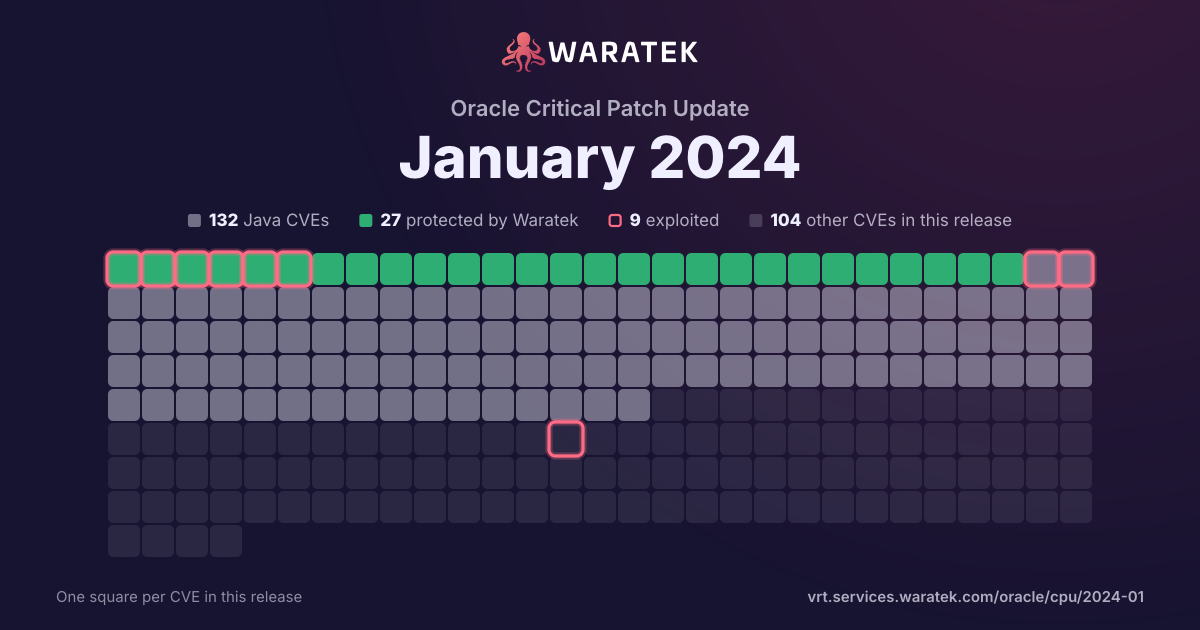
By status
27Protected by Waratek4Mitigation candidate101No exploit published26Outside Waratek scope78Not applicable
9Exploited, marked by the ring
No exploit published. For 47 of them, Oracle's security advisory is the source of public detail.
Protected by Waratek. Waratek RASP can block exploitation of these on systems that have not applied the patch yet.
Overview 9 matches · 0 in Waratek scope · 0 protected · 0 exploited · 0 CISA KEV · 0 public PoC · 0 EPSS ≥ 0.5
9matches
0in Waratek scope0.0%
0protected0.0%
0exploited0.0%
0CISA KEV0.0%
0public PoC0.0%
0EPSS ≥ 0.50.0%
Protected by Waratek
0
0.0%
Rule in development
0
0.0%
Mitigation candidate
0
0.0%
No exploit published
0
0.0%
Outside Waratek scope
0
0.0%
Not applicable
9
100.0%
Withdrawn CVE
0
0.0%
blocked by ARMR today
0
0.0%
partly blocked
0
0.0%
not blocked
9
100.0%
not established
0
0.0%
unrecorded
0
0.0%
Exploited
0
0.0%
Working exploit published
0
0.0%
Proof of concept only
0
0.0%
Forecast only
0
0.0%
No public exploit
9
100.0%
split by
peak 4 / month
Sep 23Oct 23Nov 23Dec 23Jan 24Feb 24
| CVE | Severity | Published▾ | Status | Exploitation | Description |
|---|---|---|---|---|---|
| CVE-2024-20911 | Low | 2024-02-17 | Not applicable | No public exploit | Vulnerability in Oracle Audit Vault and Database Firewall (component: Firewall). Supported versions that are affected are 20.1-20.9. Difficult to exploit vulnerability allows high privileged attacker with network access via Oracle Net to compromise Oracle Audit Vault and Database Firewall. Successful attacks require human interaction from a person other than the attacker and while the vulnerability is in Oracle Audit Vault and Database Firewall, attacks may significantly impact additional products (scope change). Successful attacks of this vulnerability can result in unauthorized read access to a subset of Oracle Audit Vault and Database Firewall accessible data. CVSS 3.1 Base Score 2.6 (Confidentiality impacts). CVSS Vector: (CVSS:3.1/AV:N/AC:H/PR:H/UI:R/S:C/C:L/I:N/A:N). |
| CVE-2024-20920 | Low | 2024-01-16 | Not applicable | No public exploit | Vulnerability in the Oracle Solaris product of Oracle Systems (component: Filesystem). The supported version that is affected is 11. Easily exploitable vulnerability allows low privileged attacker with logon to the infrastructure where Oracle Solaris executes to compromise Oracle Solaris. While the vulnerability is in Oracle Solaris, attacks may significantly impact additional products (scope change). Successful attacks of this vulnerability can result in unauthorized read access to a subset of Oracle Solaris accessible data. CVSS 3.1 Base Score 3.8 (Confidentiality impacts). CVSS Vector: (CVSS:3.1/AV:L/AC:L/PR:L/UI:N/S:C/C:L/I:N/A:N). |
| CVE-2024-20914 | Low | 2024-01-16 | Not applicable | No public exploit | Vulnerability in the Oracle ZFS Storage Appliance Kit product of Oracle Systems (component: Core). The supported version that is affected is 8.8. Easily exploitable vulnerability allows high privileged attacker with logon to the infrastructure where Oracle ZFS Storage Appliance Kit executes to compromise Oracle ZFS Storage Appliance Kit. Successful attacks of this vulnerability can result in unauthorized read access to a subset of Oracle ZFS Storage Appliance Kit accessible data. CVSS 3.1 Base Score 2.3 (Confidentiality impacts). CVSS Vector: (CVSS:3.1/AV:L/AC:L/PR:H/UI:N/S:U/C:L/I:N/A:N). |
| CVE-2024-20912 | Low | 2024-01-16 | Not applicable | No public exploit | Vulnerability in Oracle Audit Vault and Database Firewall (component: Firewall). Supported versions that are affected are 20.1-20.9. Easily exploitable vulnerability allows high privileged attacker with network access via Oracle Net to compromise Oracle Audit Vault and Database Firewall. Successful attacks of this vulnerability can result in unauthorized update, insert or delete access to some of Oracle Audit Vault and Database Firewall accessible data. CVSS 3.1 Base Score 2.7 (Integrity impacts). CVSS Vector: (CVSS:3.1/AV:N/AC:L/PR:H/UI:N/S:U/C:N/I:L/A:N). |
| CVE-2024-20910 | Low | 2024-01-16 | Not applicable | No public exploit | Vulnerability in Oracle Audit Vault and Database Firewall (component: Firewall). Supported versions that are affected are 20.1-20.9. Difficult to exploit vulnerability allows high privileged attacker with network access via Oracle Net to compromise Oracle Audit Vault and Database Firewall. While the vulnerability is in Oracle Audit Vault and Database Firewall, attacks may significantly impact additional products (scope change). Successful attacks of this vulnerability can result in unauthorized read access to a subset of Oracle Audit Vault and Database Firewall accessible data. CVSS 3.1 Base Score 3.0 (Confidentiality impacts). CVSS Vector: (CVSS:3.1/AV:N/AC:H/PR:H/UI:N/S:C/C:L/I:N/A:N). |
| CVE-2023-45145 | Low | 2023-10-18 | Not applicable | No public exploit | Redis is an in-memory database that persists on disk. On startup, Redis begins listening on a Unix socket before adjusting its permissions to the user-provided configuration. If a permissive umask(2) is used, this creates a race condition that enables, during a short period of time, another process to establish an otherwise unauthorized connection. This problem has existed since Redis 2.6.0-RC1. This issue has been addressed in Redis versions 7.2.2, 7.0.14 and 6.2.14. Users are advised to upgrade. For users unable to upgrade, it is possible to work around the problem by disabling Unix sockets, starting Redis with a restrictive umask, or storing the Unix socket file in a protected directory. |
| CVE-2023-38546 | Low | 2023-10-18 | Not applicable | No public exploit | This flaw allows an attacker to insert cookies at will into a running program using libcurl, if the specific series of conditions are met. libcurl performs transfers. In its API, an application creates "easy handles" that are the individual handles for single transfers. libcurl provides a function call that duplicates en easy handle called [curl_easy_duphandle](https://curl.se/libcurl/c/curl_easy_duphandle.html). If a transfer has cookies enabled when the handle is duplicated, the cookie-enable state is also cloned - but without cloning the actual cookies. If the source handle did not read any cookies from a specific file on disk, the cloned version of the handle would instead store the file name as `none` (using the four ASCII letters, no quotes). Subsequent use of the cloned handle that does not explicitly set a source to load cookies from would then inadvertently load cookies from a file named `none` - if such a file exists and is readable in the current directory of the program using libcurl. And if using the correct file format of course. |
| CVE-2023-45143 | Low | 2023-10-12 | Not applicable | No public exploit | Undici is an HTTP/1.1 client written from scratch for Node.js. Prior to version 5.26.2, Undici already cleared Authorization headers on cross-origin redirects, but did not clear `Cookie` headers. By design, `cookie` headers are forbidden request headers, disallowing them to be set in RequestInit.headers in browser environments. Since undici handles headers more liberally than the spec, there was a disconnect from the assumptions the spec made, and undici's implementation of fetch. As such this may lead to accidental leakage of cookie to a third-party site or a malicious attacker who can control the redirection target (ie. an open redirector) to leak the cookie to the third party site. This was patched in version 5.26.2. There are no known workarounds. |
| CVE-2023-41053 | Low | 2023-09-06 | Not applicable | No public exploit | Redis is an in-memory database that persists on disk. Redis does not correctly identify keys accessed by `SORT_RO` and as a result may grant users executing this command access to keys that are not explicitly authorized by the ACL configuration. The problem exists in Redis 7.0 or newer and has been fixed in Redis 7.0.13 and 7.2.1. Users are advised to upgrade. There are no known workarounds for this vulnerability. |