
Oracle Critical Patch Update January 2024
Released January 2024 · Oracle's advisory ↗ · ← Critical Patch Update, October 2023 · Critical Patch Update, April 2024 →
236 CVEs in this release, one square each
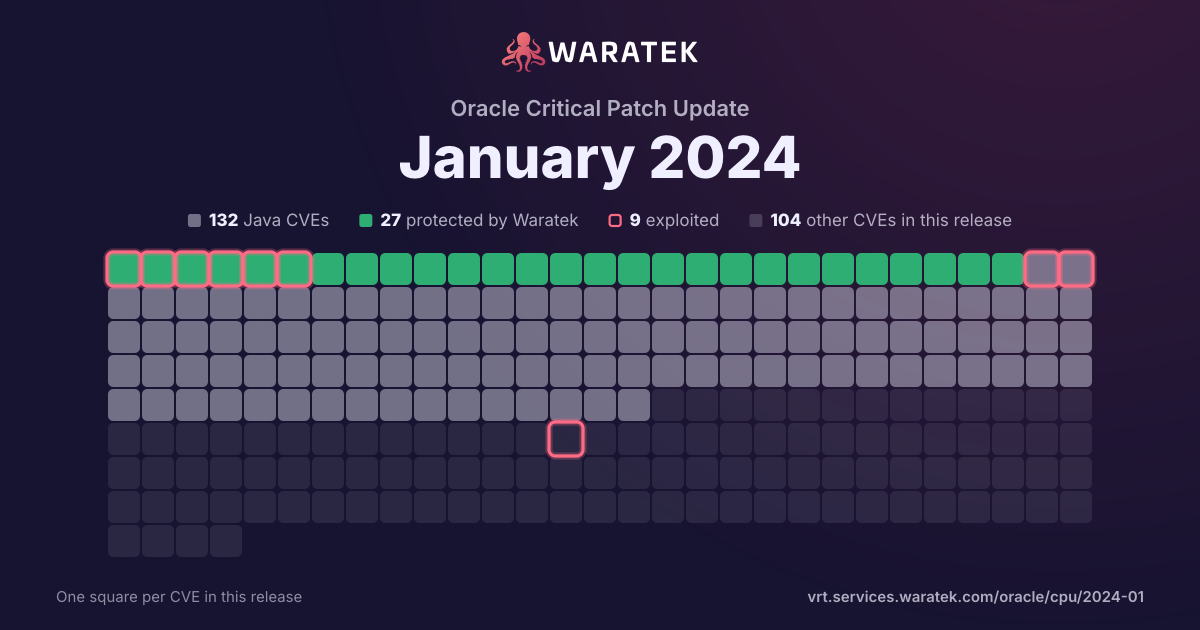
By status
27Protected by Waratek4Mitigation candidate101No exploit published26Outside Waratek scope78Not applicable
9Exploited, marked by the ring
No exploit published. For 47 of them, Oracle's security advisory is the source of public detail.
Protected by Waratek. Waratek RASP can block exploitation of these on systems that have not applied the patch yet.
Overview 28 matches · 0 in Waratek scope · 0 protected · 1 exploited · 1 CISA KEV · 3 public PoC · 5 EPSS ≥ 0.5
28matches
0in Waratek scope0.0%
0protected0.0%
1exploited3.6%
1CISA KEV3.6%
3public PoC10.7%
5EPSS ≥ 0.517.9%
Protected by Waratek
0
0.0%
Rule in development
0
0.0%
Mitigation candidate
0
0.0%
No exploit published
0
0.0%
Outside Waratek scope
0
0.0%
Not applicable
28
100.0%
Withdrawn CVE
0
0.0%
blocked by ARMR today
0
0.0%
partly blocked
0
0.0%
not blocked
28
100.0%
not established
0
0.0%
unrecorded
0
0.0%
Exploited
1
3.6%
Working exploit published
0
0.0%
Proof of concept only
8
28.6%
Forecast only
0
0.0%
No public exploit
19
67.9%
split by
peak 7 / quarter
Q2 221
Not applicable1
High1
not blocked1
No public exploit1
Q3 221
Not applicable1
High1
not blocked1
No public exploit1
Q4 224
Not applicable4
High4
not blocked4
Proof of concept only3
No public exploit1
Q1 232
Not applicable2
High2
not blocked2
No public exploit2
Q2 236
Not applicable6
High6
not blocked6
Proof of concept only2
No public exploit4
Q3 237
Not applicable7
High7
not blocked7
Proof of concept only2
No public exploit5
Q4 235
Not applicable5
High5
not blocked5
Exploited1
Proof of concept only1
No public exploit3
Q1 242
Not applicable2
High2
not blocked2
No public exploit2
Q2 22Q3 22Q4 22Q1 23Q2 23Q3 23Q4 23Q1 24
| CVE | Severity | Published▾ | Status | Exploitation | Description |
|---|---|---|---|---|---|
| CVE-2024-20909 | High | 2024-02-17 | Not applicable | No public exploit | Vulnerability in Oracle Audit Vault and Database Firewall (component: Firewall). Supported versions that are affected are 20.1-20.9. Easily exploitable vulnerability allows unauthenticated attacker with network access via Oracle Net to compromise Oracle Audit Vault and Database Firewall. Successful attacks of this vulnerability can result in unauthorized creation, deletion or modification access to critical data or all Oracle Audit Vault and Database Firewall accessible data. CVSS 3.1 Base Score 7.5 (Integrity impacts). CVSS Vector: (CVSS:3.1/AV:N/AC:L/PR:N/UI:N/S:U/C:N/I:H/A:N). |
| CVE-2024-20924 | High | 2024-01-16 | Not applicable | No public exploit | Vulnerability in Oracle Audit Vault and Database Firewall (component: Firewall). Supported versions that are affected are 20.1-20.9. Difficult to exploit vulnerability allows high privileged attacker with network access via Oracle Net to compromise Oracle Audit Vault and Database Firewall. Successful attacks require human interaction from a person other than the attacker and while the vulnerability is in Oracle Audit Vault and Database Firewall, attacks may significantly impact additional products (scope change). Successful attacks of this vulnerability can result in takeover of Oracle Audit Vault and Database Firewall. CVSS 3.1 Base Score 7.6 (Confidentiality, Integrity and Availability impacts). CVSS Vector: (CVSS:3.1/AV:N/AC:H/PR:H/UI:R/S:C/C:H/I:H/A:H). |
| CVE-2023-5363 | High | 2023-10-25 | Not applicable | No public exploit | Issue summary: A bug has been identified in the processing of key and initialisation vector (IV) lengths. This can lead to potential truncation or overruns during the initialisation of some symmetric ciphers. Impact summary: A truncation in the IV can result in non-uniqueness, which could result in loss of confidentiality for some cipher modes. When calling EVP_EncryptInit_ex2(), EVP_DecryptInit_ex2() or EVP_CipherInit_ex2() the provided OSSL_PARAM array is processed after the key and IV have been established. Any alterations to the key length, via the "keylen" parameter or the IV length, via the "ivlen" parameter, within the OSSL_PARAM array will not take effect as intended, potentially causing truncation or overreading of these values. The following ciphers and cipher modes are impacted: RC2, RC4, RC5, CCM, GCM and OCB. For the CCM, GCM and OCB cipher modes, truncation of the IV can result in loss of confidentiality. For example, when following NIST's SP 800-38D section 8.2.1 guidance for constructing a deterministic IV for AES in GCM mode, truncation of the counter portion could lead to IV reuse. Both truncations and overruns of the key and overruns of the IV will produce incorrect results and could, in some cases, trigger a memory exception. However, these issues are not currently assessed as security critical. Changing the key and/or IV lengths is not considered to be a common operation and the vulnerable API was recently introduced. Furthermore it is likely that application developers will have spotted this problem during testing since decryption would fail unless both peers in the communication were similarly vulnerable. For these reasons we expect the probability of an application being vulnerable to this to be quite low. However if an application is vulnerable then this issue is considered very serious. For these reasons we have assessed this issue as Moderate severity overall. The OpenSSL SSL/TLS implementation is not affected by this issue. The OpenSSL 3.0 and 3.1 FIPS providers are not affected by this because the issue lies outside of the FIPS provider boundary. OpenSSL 3.1 and 3.0 are vulnerable to this issue. |
| CVE-2023-43622 | High | 2023-10-23 | Not applicable | Proof of concept only | An attacker, opening a HTTP/2 connection with an initial window size of 0, was able to block handling of that connection indefinitely in Apache HTTP Server. This could be used to exhaust worker resources in the server, similar to the well known "slow loris" attack pattern. This has been fixed in version 2.4.58, so that such connection are terminated properly after the configured connection timeout. This issue affects Apache HTTP Server: from 2.4.55 through 2.4.57. Users are recommended to upgrade to version 2.4.58, which fixes the issue. |
| CVE-2023-31122 | High | 2023-10-23 | Not applicable | No public exploit | Out-of-bounds Read vulnerability in mod_macro of Apache HTTP Server.This issue affects Apache HTTP Server: through 2.4.57. |
| CVE-2023-37536 | High | 2023-10-11 | Not applicable | No public exploit | An integer overflow in xerces-c++ 3.2.3 in BigFix Platform allows remote attackers to cause out-of-bound access via HTTP request. |
| CVE-2023-4911 | High | 2023-10-03 | Not applicable | Exploited | A buffer overflow was discovered in the GNU C Library's dynamic loader ld.so while processing the GLIBC_TUNABLES environment variable. This issue could allow a local attacker to use maliciously crafted GLIBC_TUNABLES environment variables when launching binaries with SUID permission to execute code with elevated privileges. |
| CVE-2023-38039 | High | 2023-09-15 | Not applicable | Proof of concept only | When curl retrieves an HTTP response, it stores the incoming headers so that they can be accessed later via the libcurl headers API. However, curl did not have a limit in how many or how large headers it would accept in a response, allowing a malicious server to stream an endless series of headers and eventually cause curl to run out of heap memory. |
| CVE-2023-32559 | High | 2023-08-24 | Not applicable | No public exploit | A privilege escalation vulnerability exists in the experimental policy mechanism in all active release lines: 16.x, 18.x and, 20.x. The use of the deprecated API `process.binding()` can bypass the policy mechanism by requiring internal modules and eventually take advantage of `process.binding('spawn_sync')` run arbitrary code, outside of the limits defined in a `policy.json` file. Please note that at the time this CVE was issued, the policy is an experimental feature of Node.js. |
| CVE-2023-41105 | High | 2023-08-23 | Not applicable | No public exploit | An issue was discovered in Python 3.11 through 3.11.4. If a path containing '\0' bytes is passed to os.path.normpath(), the path will be truncated unexpectedly at the first '\0' byte. There are plausible cases in which an application would have rejected a filename for security reasons in Python 3.10.x or earlier, but that filename is no longer rejected in Python 3.11.x. |
| CVE-2023-39975 | High | 2023-08-16 | Not applicable | No public exploit | kdc/do_tgs_req.c in MIT Kerberos 5 (aka krb5) 1.21 before 1.21.2 has a double free that is reachable if an authenticated user can trigger an authorization-data handling failure. Incorrect data is copied from one ticket to another. |
| CVE-2023-32006 | High | 2023-08-15 | Not applicable | No public exploit | The use of `module.constructor.createRequire()` can bypass the policy mechanism and require modules outside of the policy.json definition for a given module. This vulnerability affects all users using the experimental policy mechanism in all active release lines: 16.x, 18.x, and, 20.x. Please note that at the time this CVE was issued, the policy is an experimental feature of Node.js. |
| CVE-2023-28823 | High | 2023-08-11 | Not applicable | No public exploit | Uncontrolled search path in some Intel(R) oneAPI Toolkit and component software installers before version 4.3.1.493 may allow an authenticated user to potentially enable escalation of privilege via local access. |
| CVE-2023-38325 | High | 2023-07-14 | Not applicable | Proof of concept only | The cryptography package before 41.0.2 for Python mishandles SSH certificates that have critical options. |
| CVE-2023-36632 | High | 2023-06-25 | Not applicable | Proof of concept only | The legacy email.utils.parseaddr function in Python through 3.11.4 allows attackers to trigger "RecursionError: maximum recursion depth exceeded while calling a Python object" via a crafted argument. This argument is plausibly an untrusted value from an application's input data that was supposed to contain a name and an e-mail address. NOTE: email.utils.parseaddr is categorized as a Legacy API in the documentation of the Python email package. Applications should instead use the email.parser.BytesParser or email.parser.Parser class. NOTE: the vendor's perspective is that this is neither a vulnerability nor a bug. The email package is intended to have size limits and to throw an exception when limits are exceeded; they were exceeded by the example demonstration code. |
| CVE-2023-2618 | High | 2023-05-10 | Not applicable | No public exploit | A vulnerability, which was classified as problematic, has been found in OpenCV wechat_qrcode Module up to 4.7.0. Affected by this issue is the function DecodedBitStreamParser::decodeHanziSegment of the file qrcode/decoder/decoded_bit_stream_parser.cpp. The manipulation leads to memory leak. The attack may be launched remotely. The name of the patch is 2b62ff6181163eea029ed1cab11363b4996e9cd6. It is recommended to apply a patch to fix this issue. The identifier of this vulnerability is VDB-228548. |
| CVE-2023-2617 | High | 2023-05-10 | Not applicable | Proof of concept only | A vulnerability classified as problematic was found in OpenCV wechat_qrcode Module up to 4.7.0. Affected by this vulnerability is the function DecodedBitStreamParser::decodeByteSegment of the file qrcode/decoder/decoded_bit_stream_parser.cpp. The manipulation leads to null pointer dereference. The attack can be launched remotely. The exploit has been disclosed to the public and may be used. It is recommended to apply a patch to fix this issue. The associated identifier of this vulnerability is VDB-228547. |
| CVE-2023-30861 | High | 2023-05-02 | Not applicable | No public exploit | Flask is a lightweight WSGI web application framework. When all of the following conditions are met, a response containing data intended for one client may be cached and subsequently sent by the proxy to other clients. If the proxy also caches `Set-Cookie` headers, it may send one client's `session` cookie to other clients. The severity depends on the application's use of the session and the proxy's behavior regarding cookies. The risk depends on all these conditions being met. 1. The application must be hosted behind a caching proxy that does not strip cookies or ignore responses with cookies. 2. The application sets `session.permanent = True` 3. The application does not access or modify the session at any point during a request. 4. `SESSION_REFRESH_EACH_REQUEST` enabled (the default). 5. The application does not set a `Cache-Control` header to indicate that a page is private or should not be cached. This happens because vulnerable versions of Flask only set the `Vary: Cookie` header when the session is accessed or modified, not when it is refreshed (re-sent to update the expiration) without being accessed or modified. This issue has been fixed in versions 2.3.2 and 2.2.5. |
| CVE-2023-31486 | High | 2023-04-29 | Not applicable | No public exploit | HTTP::Tiny before 0.083, a Perl core module since 5.13.9 and available standalone on CPAN, has an insecure default TLS configuration where users must opt in to verify certificates. |
| CVE-2023-31484 | High | 2023-04-29 | Not applicable | No public exploit | CPAN.pm before 2.35 does not verify TLS certificates when downloading distributions over HTTPS. |
| CVE-2023-0464 | High | 2023-03-22 | Not applicable | No public exploit | A security vulnerability has been identified in all supported versions of OpenSSL related to the verification of X.509 certificate chains that include policy constraints. Attackers may be able to exploit this vulnerability by creating a malicious certificate chain that triggers exponential use of computational resources, leading to a denial-of-service (DoS) attack on affected systems. Policy processing is disabled by default but can be enabled by passing the `-policy' argument to the command line utilities or by calling the `X509_VERIFY_PARAM_set1_policies()' function. |
| CVE-2022-4450 | High | 2023-02-08 | Not applicable | No public exploit | The function PEM_read_bio_ex() reads a PEM file from a BIO and parses and decodes the "name" (e.g. "CERTIFICATE"), any header data and the payload data. If the function succeeds then the "name_out", "header" and "data" arguments are populated with pointers to buffers containing the relevant decoded data. The caller is responsible for freeing those buffers. It is possible to construct a PEM file that results in 0 bytes of payload data. In this case PEM_read_bio_ex() will return a failure code but will populate the header argument with a pointer to a buffer that has already been freed. If the caller also frees this buffer then a double free will occur. This will most likely lead to a crash. This could be exploited by an attacker who has the ability to supply malicious PEM files for parsing to achieve a denial of service attack. The functions PEM_read_bio() and PEM_read() are simple wrappers around PEM_read_bio_ex() and therefore these functions are also directly affected. These functions are also called indirectly by a number of other OpenSSL functions including PEM_X509_INFO_read_bio_ex() and SSL_CTX_use_serverinfo_file() which are also vulnerable. Some OpenSSL internal uses of these functions are not vulnerable because the caller does not free the header argument if PEM_read_bio_ex() returns a failure code. These locations include the PEM_read_bio_TYPE() functions as well as the decoders introduced in OpenSSL 3.0. The OpenSSL asn1parse command line application is also impacted by this issue. |
| CVE-2022-46908 | High | 2022-12-12 | Not applicable | Proof of concept only | SQLite through 3.40.0, when relying on --safe for execution of an untrusted CLI script, does not properly implement the azProhibitedFunctions protection mechanism, and instead allows UDF functions such as WRITEFILE. |
| CVE-2022-3786 | High | 2022-11-01 | Not applicable | Proof of concept only | A buffer overrun can be triggered in X.509 certificate verification, specifically in name constraint checking. Note that this occurs after certificate chain signature verification and requires either a CA to have signed a malicious certificate or for an application to continue certificate verification despite failure to construct a path to a trusted issuer. An attacker can craft a malicious email address in a certificate to overflow an arbitrary number of bytes containing the `.' character (decimal 46) on the stack. This buffer overflow could result in a crash (causing a denial of service). In a TLS client, this can be triggered by connecting to a malicious server. In a TLS server, this can be triggered if the server requests client authentication and a malicious client connects. |
| CVE-2022-3602 | High | 2022-11-01 | Not applicable | Proof of concept only | A buffer overrun can be triggered in X.509 certificate verification, specifically in name constraint checking. Note that this occurs after certificate chain signature verification and requires either a CA to have signed the malicious certificate or for the application to continue certificate verification despite failure to construct a path to a trusted issuer. An attacker can craft a malicious email address to overflow four attacker-controlled bytes on the stack. This buffer overflow could result in a crash (causing a denial of service) or potentially remote code execution. Many platforms implement stack overflow protections which would mitigate against the risk of remote code execution. The risk may be further mitigated based on stack layout for any given platform/compiler. Pre-announcements of CVE-2022-3602 described this issue as CRITICAL. Further analysis based on some of the mitigating factors described above have led this to be downgraded to HIGH. Users are still encouraged to upgrade to a new version as soon as possible. In a TLS client, this can be triggered by connecting to a malicious server. In a TLS server, this can be triggered if the server requests client authentication and a malicious client connects. Fixed in OpenSSL 3.0.7 (Affected 3.0.0,3.0.1,3.0.2,3.0.3,3.0.4,3.0.5,3.0.6). |
| CVE-2022-3479 | High | 2022-10-14 | Not applicable | No public exploit | A vulnerability found in nss. By this security vulnerability, nss client auth crash without a user certificate in the database and this can lead us to a segmentation fault or crash. |
| CVE-2022-31147 | High | 2022-07-14 | Not applicable | No public exploit | The jQuery Validation Plugin (jquery-validation) provides drop-in validation for forms. Versions of jquery-validation prior to 1.19.5 are vulnerable to regular expression denial of service (ReDoS) when an attacker is able to supply arbitrary input to the url2 method. This is due to an incomplete fix for CVE-2021-43306. Users should upgrade to version 1.19.5 to receive a patch. |
| CVE-2021-43306 | High | 2022-06-02 | Not applicable | No public exploit | An exponential ReDoS (Regular Expression Denial of Service) can be triggered in the jquery-validation npm package, when an attacker is able to supply arbitrary input to the url2 method |