
WaratekVRT Sign in

Oracle Critical Patch Update January 2024

Released January 2024 · Oracle's advisory ↗ · ← Critical Patch Update, October 2023 · Critical Patch Update, April 2024 →

236 CVEs in this release, one square each
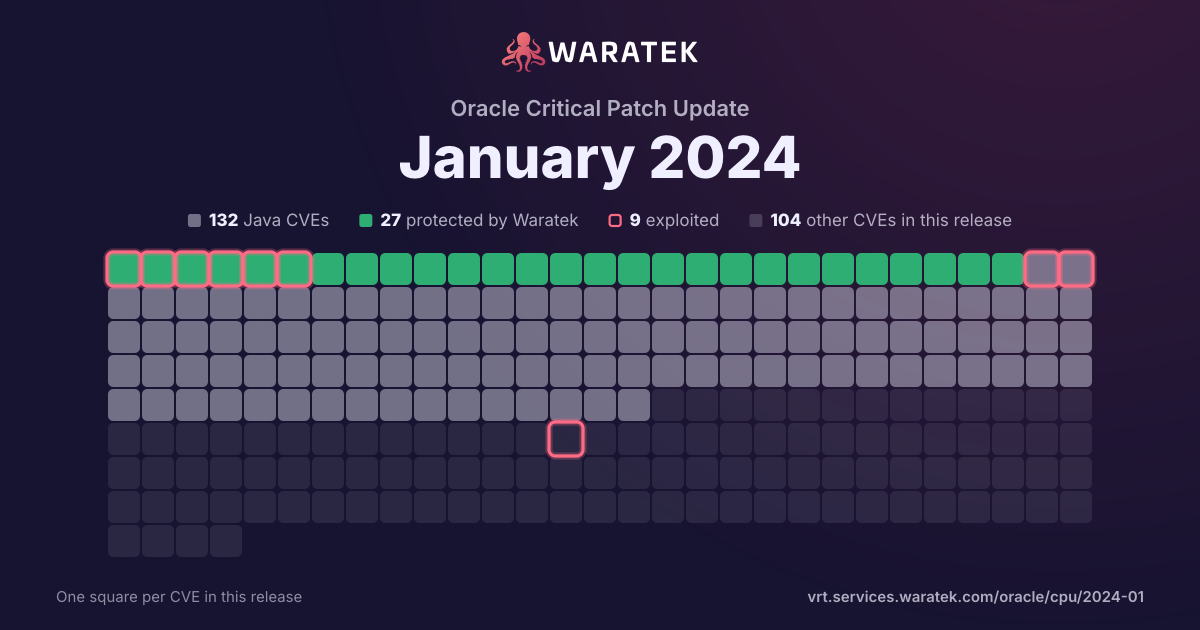
Protected by Waratek, exploitedProtected by Waratek, exploitedProtected by Waratek, exploitedProtected by Waratek, exploitedProtected by Waratek, exploitedProtected by Waratek, exploitedProtected by WaratekProtected by WaratekProtected by WaratekProtected by WaratekProtected by WaratekProtected by WaratekProtected by WaratekProtected by WaratekProtected by WaratekProtected by WaratekProtected by WaratekProtected by WaratekProtected by WaratekProtected by WaratekProtected by WaratekProtected by WaratekProtected by WaratekProtected by WaratekProtected by WaratekProtected by WaratekProtected by WaratekMitigation candidate, exploitedMitigation candidate, exploitedMitigation candidateMitigation candidateNo exploit publishedNo exploit publishedNo exploit publishedNo exploit publishedNo exploit publishedNo exploit publishedNo exploit publishedNo exploit publishedNo exploit publishedNo exploit publishedNo exploit publishedNo exploit publishedNo exploit publishedNo exploit publishedNo exploit publishedNo exploit publishedNo exploit publishedNo exploit publishedNo exploit publishedNo exploit publishedNo exploit publishedNo exploit publishedNo exploit publishedNo exploit publishedNo exploit publishedNo exploit publishedNo exploit publishedNo exploit publishedNo exploit publishedNo exploit publishedNo exploit publishedNo exploit publishedNo exploit publishedNo exploit publishedNo exploit publishedNo exploit publishedNo exploit publishedNo exploit publishedNo exploit publishedNo exploit publishedNo exploit publishedNo exploit publishedNo exploit publishedNo exploit publishedNo exploit publishedNo exploit publishedNo exploit publishedNo exploit publishedNo exploit publishedNo exploit publishedNo exploit publishedNo exploit publishedNo exploit publishedNo exploit publishedNo exploit publishedNo exploit publishedNo exploit publishedNo exploit publishedNo exploit publishedNo exploit publishedNo exploit publishedNo exploit publishedNo exploit publishedNo exploit publishedNo exploit publishedNo exploit publishedNo exploit publishedNo exploit publishedNo exploit publishedNo exploit publishedNo exploit publishedNo exploit publishedNo exploit publishedNo exploit publishedNo exploit publishedNo exploit publishedNo exploit publishedNo exploit publishedNo exploit publishedNo exploit publishedNo exploit publishedNo exploit publishedNo exploit publishedNo exploit publishedNo exploit publishedNo exploit publishedNo exploit publishedNo exploit publishedNo exploit publishedNo exploit publishedNo exploit publishedNo exploit publishedNo exploit publishedNo exploit publishedNo exploit publishedNo exploit publishedNo exploit publishedNo exploit publishedNo exploit publishedNo exploit publishedNo exploit publishedOutside Waratek scopeOutside Waratek scopeOutside Waratek scopeOutside Waratek scopeOutside Waratek scopeOutside Waratek scopeOutside Waratek scopeOutside Waratek scopeOutside Waratek scopeOutside Waratek scopeOutside Waratek scopeOutside Waratek scopeOutside Waratek scopeOutside Waratek scopeOutside Waratek scopeOutside Waratek scopeOutside Waratek scopeOutside Waratek scopeOutside Waratek scopeOutside Waratek scopeOutside Waratek scopeOutside Waratek scopeOutside Waratek scopeOutside Waratek scopeOutside Waratek scopeOutside Waratek scopeNot applicable, exploitedNot applicableNot applicableNot applicableNot applicableNot applicableNot applicableNot applicableNot applicableNot applicableNot applicableNot applicableNot applicableNot applicableNot applicableNot applicableNot applicableNot applicableNot applicableNot applicableNot applicableNot applicableNot applicableNot applicableNot applicableNot applicableNot applicableNot applicableNot applicableNot applicableNot applicableNot applicableNot applicableNot applicableNot applicableNot applicableNot applicableNot applicableNot applicableNot applicableNot applicableNot applicableNot applicableNot applicableNot applicableNot applicableNot applicableNot applicableNot applicableNot applicableNot applicableNot applicableNot applicableNot applicableNot applicableNot applicableNot applicableNot applicableNot applicableNot applicableNot applicableNot applicableNot applicableNot applicableNot applicableNot applicableNot applicableNot applicableNot applicableNot applicableNot applicableNot applicableNot applicableNot applicableNot applicableNot applicableNot applicableNot applicable
Share this chart Oracle Critical Patch Update January 2024, one square per CVE: 132 Java CVEs, 27 protected by Waratek, 9 exploited, 104 other CVEs in this release.

Download the image

By status

No exploit published. For 47 of them, Oracle's security advisory is the source of public detail.

Protected by Waratek. Waratek RASP can block exploitation of these on systems that have not applied the patch yet.

Reset
More filters (1)
Columns
Including CVEs outside Waratek scope✕Has a public PoC✕
Overview 3 matches · 0 in Waratek scope · 0 protected · 1 exploited · 1 CISA KEV
3matches 0in Waratek scope0.0% 0protected0.0% 1exploited33.3% 1CISA KEV33.3%
Protected by Waratek 0 0.0% Rule in development 0 0.0% Mitigation candidate 0 0.0% No exploit published 0 0.0% Outside Waratek scope 0 0.0% Not applicable 3 100.0% Withdrawn CVE 0 0.0%
Critical 0 0.0% High 3 100.0% Medium 0 0.0% Low 0 0.0% None 0 0.0% Unknown 0 0.0%
blocked by ARMR today 0 0.0% partly blocked 0 0.0% not blocked 3 100.0% not established 0 0.0% unrecorded 0 0.0%
Exploited 1 33.3% Working exploit published 0 0.0% Proof of concept only 2 66.7% Forecast only 0 0.0% No public exploit 0 0.0%
split by peak 2 / month
Nov 22Dec 22Jan 23Feb 23Mar 23Apr 23May 23Jun 23Jul 23Aug 23Sep 23Oct 23
3 matches Sign in to download these CVEs as CSV or JSON, or to follow them in a feed.
CVE Severity Published▾ Status Exploitation Description
CVE-2023-4911 High 2023-10-03 Not applicable Exploited A buffer overflow was discovered in the GNU C Library's dynamic loader ld.so while processing the GLIBC_TUNABLES environment variable. This issue could allow a local attacker to use maliciously crafted GLIBC_TUNABLES environment variables when launching binaries with SUID permission to execute code with elevated privileges.
CVE-2022-3786 High 2022-11-01 Not applicable Proof of concept only A buffer overrun can be triggered in X.509 certificate verification, specifically in name constraint checking. Note that this occurs after certificate chain signature verification and requires either a CA to have signed a malicious certificate or for an application to continue certificate verification despite failure to construct a path to a trusted issuer. An attacker can craft a malicious email address in a certificate to overflow an arbitrary number of bytes containing the `.' character (decimal 46) on the stack. This buffer overflow could result in a crash (causing a denial of service). In a TLS client, this can be triggered by connecting to a malicious server. In a TLS server, this can be triggered if the server requests client authentication and a malicious client connects.
CVE-2022-3602 High 2022-11-01 Not applicable Proof of concept only A buffer overrun can be triggered in X.509 certificate verification, specifically in name constraint checking. Note that this occurs after certificate chain signature verification and requires either a CA to have signed the malicious certificate or for the application to continue certificate verification despite failure to construct a path to a trusted issuer. An attacker can craft a malicious email address to overflow four attacker-controlled bytes on the stack. This buffer overflow could result in a crash (causing a denial of service) or potentially remote code execution. Many platforms implement stack overflow protections which would mitigate against the risk of remote code execution. The risk may be further mitigated based on stack layout for any given platform/compiler. Pre-announcements of CVE-2022-3602 described this issue as CRITICAL. Further analysis based on some of the mitigating factors described above have led this to be downgraded to HIGH. Users are still encouraged to upgrade to a new version as soon as possible. In a TLS client, this can be triggered by connecting to a malicious server. In a TLS server, this can be triggered if the server requests client authentication and a malicious client connects. Fixed in OpenSSL 3.0.7 (Affected 3.0.0,3.0.1,3.0.2,3.0.3,3.0.4,3.0.5,3.0.6).