
Oracle Critical Patch Update January 2024
Released January 2024 · Oracle's advisory ↗ · ← Critical Patch Update, October 2023 · Critical Patch Update, April 2024 →
236 CVEs in this release, one square each
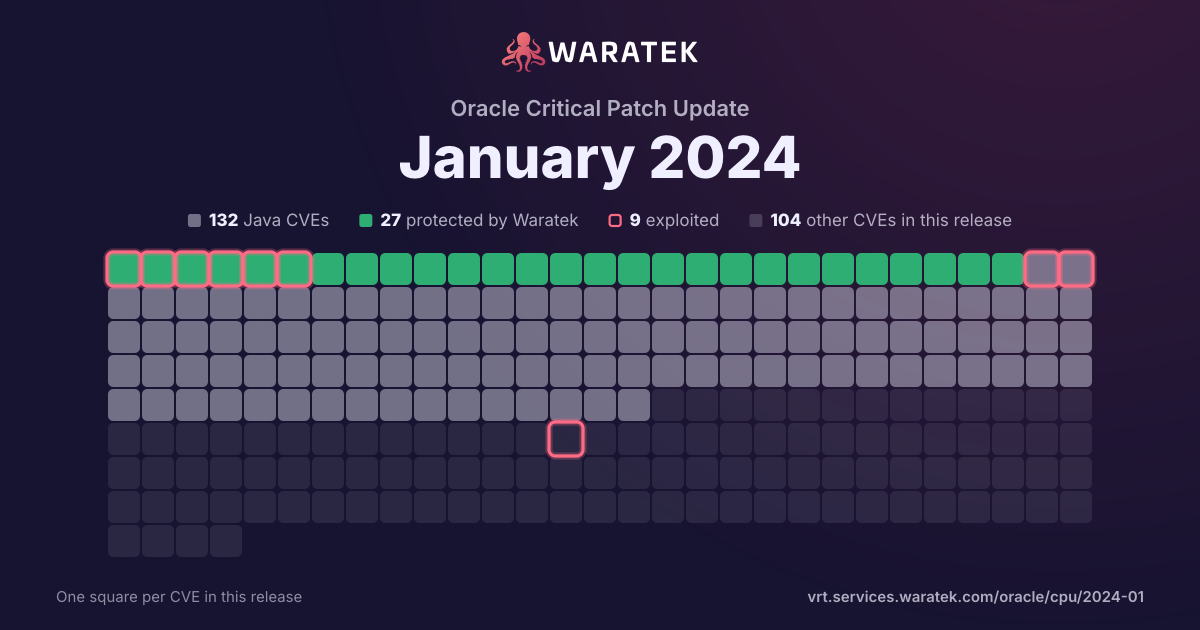
By status
27Protected by Waratek5Mitigation candidate104No exploit published9Outside Waratek scope91Not applicable
9Exploited, marked by the ring
No exploit published. For 47 of them, Oracle's security advisory is the source of public detail.
Protected by Waratek. Waratek RASP can block exploitation of these on systems that have not applied the patch yet.
Overview 4 matches · 2 in Waratek scope · 2 protected · 0 exploited · 0 CISA KEV · 2 public PoC · 3 EPSS ≥ 0.5
4matches
2in Waratek scope50.0%
2protected50.0%
0exploited0.0%
0CISA KEV0.0%
2public PoC50.0%
3EPSS ≥ 0.575.0%
Protected by Waratek
2
50.0%
Rule in development
0
0.0%
Mitigation candidate
0
0.0%
No exploit published
0
0.0%
Outside Waratek scope
0
0.0%
Not applicable
2
50.0%
Withdrawn CVE
0
0.0%
blocked by ARMR today
2
50.0%
partly blocked
0
0.0%
not blocked
2
50.0%
not established
0
0.0%
unrecorded
0
0.0%
Exploited
0
0.0%
Working exploit published
0
0.0%
Proof of concept only
4
100.0%
Forecast only
0
0.0%
No public exploit
0
0.0%
split by
peak 2 / month
Oct 23Nov 23Dec 23Jan 24Feb 24
| CVE | Severity | Published▾ | Status | Exploitation | Description |
|---|---|---|---|---|---|
| CVE-2024-20931 | High | 2024-02-17 | Protected by Waratek | Proof of concept only | Vulnerability in the Oracle WebLogic Server product of Oracle Fusion Middleware (component: Core). Supported versions that are affected are 12.2.1.4.0 and 14.1.1.0.0. Easily exploitable vulnerability allows unauthenticated attacker with network access via T3, IIOP to compromise Oracle WebLogic Server. Successful attacks of this vulnerability can result in unauthorized access to critical data or complete access to all Oracle WebLogic Server accessible data. CVSS 3.1 Base Score 7.5 (Confidentiality impacts). CVSS Vector: (CVSS:3.1/AV:N/AC:L/PR:N/UI:N/S:U/C:H/I:N/A:N). |
| CVE-2023-49093 | Critical | 2023-12-04 | Protected by Waratek | Proof of concept only | HtmlUnit is a GUI-less browser for Java programs. HtmlUnit is vulnerable to Remote Code Execution (RCE) via XSTL, when browsing the attacker’s webpage. This vulnerability has been patched in version 3.9.0 |
| CVE-2023-43622 | High | 2023-10-23 | Not applicable | Proof of concept only | An attacker, opening a HTTP/2 connection with an initial window size of 0, was able to block handling of that connection indefinitely in Apache HTTP Server. This could be used to exhaust worker resources in the server, similar to the well known "slow loris" attack pattern. This has been fixed in version 2.4.58, so that such connection are terminated properly after the configured connection timeout. This issue affects Apache HTTP Server: from 2.4.55 through 2.4.57. Users are recommended to upgrade to version 2.4.58, which fixes the issue. |
| CVE-2023-38545 | Critical | 2023-10-18 | Not applicable | Proof of concept only | This flaw makes curl overflow a heap based buffer in the SOCKS5 proxy handshake. When curl is asked to pass along the host name to the SOCKS5 proxy to allow that to resolve the address instead of it getting done by curl itself, the maximum length that host name can be is 255 bytes. If the host name is detected to be longer, curl switches to local name resolving and instead passes on the resolved address only. Due to this bug, the local variable that means "let the host resolve the name" could get the wrong value during a slow SOCKS5 handshake, and contrary to the intention, copy the too long host name to the target buffer instead of copying just the resolved address there. The target buffer being a heap based buffer, and the host name coming from the URL that curl has been told to operate with. |