
Oracle Critical Patch Update January 2024
Released January 2024 · Oracle's advisory ↗ · ← Critical Patch Update, October 2023 · Critical Patch Update, April 2024 →
236 CVEs in this release, one square each
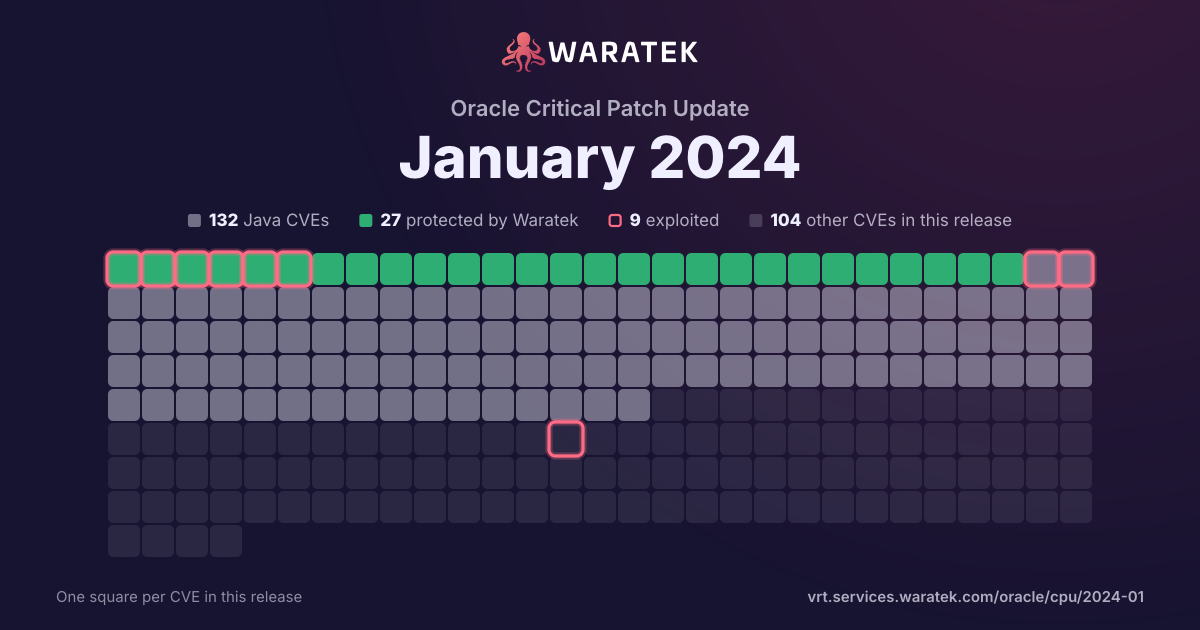
By status
27Protected by Waratek5Mitigation candidate104No exploit published9Outside Waratek scope91Not applicable
9Exploited, marked by the ring
No exploit published. For 47 of them, Oracle's security advisory is the source of public detail.
Protected by Waratek. Waratek RASP can block exploitation of these on systems that have not applied the patch yet.
Overview 7 matches · 3 in Waratek scope · 2 protected · 0 exploited · 0 CISA KEV · 2 public PoC · 4 EPSS ≥ 0.5
7matches
3in Waratek scope42.9%
2protected28.6%
0exploited0.0%
0CISA KEV0.0%
2public PoC28.6%
4EPSS ≥ 0.557.1%
Protected by Waratek
2
28.6%
Rule in development
0
0.0%
Mitigation candidate
0
0.0%
No exploit published
1
14.3%
Outside Waratek scope
0
0.0%
Not applicable
4
57.1%
Withdrawn CVE
0
0.0%
blocked by ARMR today
2
28.6%
partly blocked
0
0.0%
not blocked
5
71.4%
not established
0
0.0%
unrecorded
0
0.0%
Exploited
0
0.0%
Working exploit published
0
0.0%
Proof of concept only
7
100.0%
Forecast only
0
0.0%
No public exploit
0
0.0%
split by
peak 2 / month
Jul 231
Not applicable1
High1
not blocked1
Proof of concept only1
Aug 230
Sep 232
No exploit published1
Not applicable1
High2
not blocked2
Proof of concept only2
Oct 232
Not applicable2
Critical1
High1
not blocked2
Proof of concept only2
Nov 230
Dec 231
Protected by Waratek1
Critical1
blocked by ARMR today1
Proof of concept only1
Jan 240
Feb 241
Protected by Waratek1
High1
blocked by ARMR today1
Proof of concept only1
Jul 23Aug 23Sep 23Oct 23Nov 23Dec 23Jan 24Feb 24
| CVE | Severity | Published▾ | Status | Exploitation | Description |
|---|---|---|---|---|---|
| CVE-2024-20931 | High | 2024-02-17 | Protected by Waratek | Proof of concept only | Vulnerability in the Oracle WebLogic Server product of Oracle Fusion Middleware (component: Core). Supported versions that are affected are 12.2.1.4.0 and 14.1.1.0.0. Easily exploitable vulnerability allows unauthenticated attacker with network access via T3, IIOP to compromise Oracle WebLogic Server. Successful attacks of this vulnerability can result in unauthorized access to critical data or complete access to all Oracle WebLogic Server accessible data. CVSS 3.1 Base Score 7.5 (Confidentiality impacts). CVSS Vector: (CVSS:3.1/AV:N/AC:L/PR:N/UI:N/S:U/C:H/I:N/A:N). |
| CVE-2023-49093 | Critical | 2023-12-04 | Protected by Waratek | Proof of concept only | HtmlUnit is a GUI-less browser for Java programs. HtmlUnit is vulnerable to Remote Code Execution (RCE) via XSTL, when browsing the attacker’s webpage. This vulnerability has been patched in version 3.9.0 |
| CVE-2023-43622 | High | 2023-10-23 | Not applicable | Proof of concept only | An attacker, opening a HTTP/2 connection with an initial window size of 0, was able to block handling of that connection indefinitely in Apache HTTP Server. This could be used to exhaust worker resources in the server, similar to the well known "slow loris" attack pattern. This has been fixed in version 2.4.58, so that such connection are terminated properly after the configured connection timeout. This issue affects Apache HTTP Server: from 2.4.55 through 2.4.57. Users are recommended to upgrade to version 2.4.58, which fixes the issue. |
| CVE-2023-38545 | Critical | 2023-10-18 | Not applicable | Proof of concept only | This flaw makes curl overflow a heap based buffer in the SOCKS5 proxy handshake. When curl is asked to pass along the host name to the SOCKS5 proxy to allow that to resolve the address instead of it getting done by curl itself, the maximum length that host name can be is 255 bytes. If the host name is detected to be longer, curl switches to local name resolving and instead passes on the resolved address only. Due to this bug, the local variable that means "let the host resolve the name" could get the wrong value during a slow SOCKS5 handshake, and contrary to the intention, copy the too long host name to the target buffer instead of copying just the resolved address there. The target buffer being a heap based buffer, and the host name coming from the URL that curl has been told to operate with. |
| CVE-2023-43642 | High | 2023-09-25 | No exploit published | Proof of concept only | snappy-java is a Java port of the snappy, a fast C++ compresser/decompresser developed by Google. The SnappyInputStream was found to be vulnerable to Denial of Service (DoS) attacks when decompressing data with a too large chunk size. Due to missing upper bound check on chunk length, an unrecoverable fatal error can occur. All versions of snappy-java including the latest released version 1.1.10.3 are vulnerable to this issue. A fix has been introduced in commit `9f8c3cf74` which will be included in the 1.1.10.4 release. Users are advised to upgrade. Users unable to upgrade should only accept compressed data from trusted sources. |
| CVE-2023-38039 | High | 2023-09-15 | Not applicable | Proof of concept only | When curl retrieves an HTTP response, it stores the incoming headers so that they can be accessed later via the libcurl headers API. However, curl did not have a limit in how many or how large headers it would accept in a response, allowing a malicious server to stream an endless series of headers and eventually cause curl to run out of heap memory. |
| CVE-2023-38325 | High | 2023-07-14 | Not applicable | Proof of concept only | The cryptography package before 41.0.2 for Python mishandles SSH certificates that have critical options. |