
Oracle Critical Patch Update January 2024
Released January 2024 · Oracle's advisory ↗ · ← Critical Patch Update, October 2023 · Critical Patch Update, April 2024 →
236 CVEs in this release, one square each
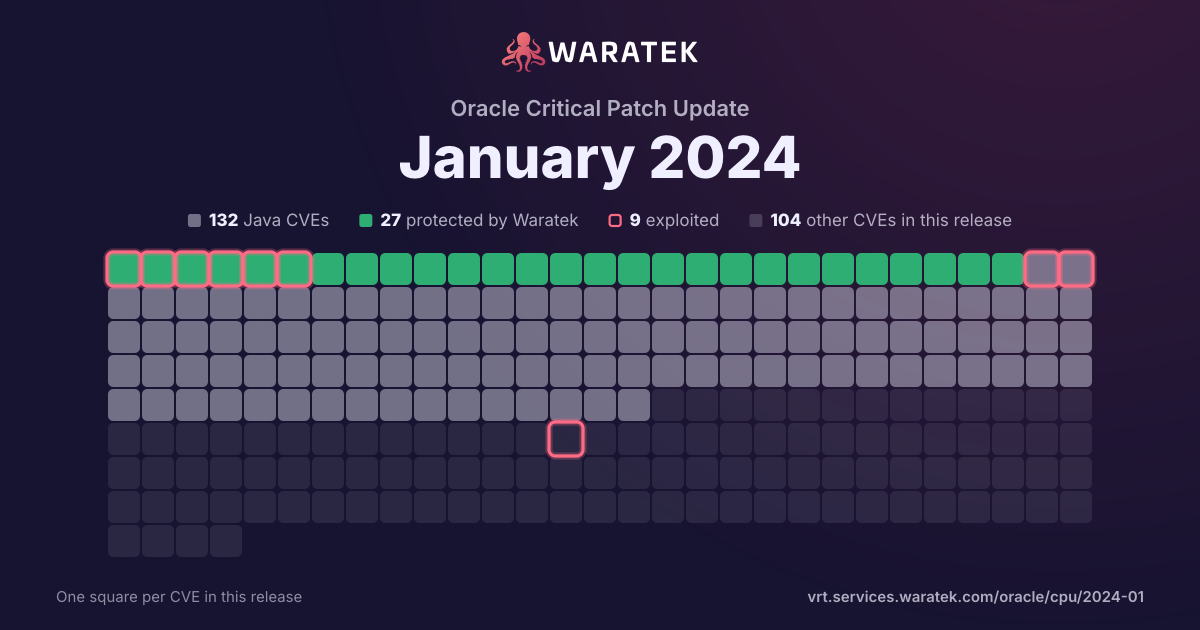
By status
21Protected by Waratek2Rule in development6Mitigation candidate103No exploit published9Outside Waratek scope95Not applicable
9Exploited, marked by the ring
No exploit published. For 38 of them, Oracle's security advisory is the source of public detail.
Protected by Waratek. Waratek RASP can block exploitation of these on systems that have not applied the patch yet.
Overview 7 matches · 2 protected · 1 exploited · 0 CISA KEV · 1 public PoC · 1 EPSS ≥ 0.5
Protected by Waratek
2
28.6%
Rule in development
0
0.0%
Mitigation candidate
0
0.0%
No exploit published
5
71.4%
blocked by ARMR today
2
28.6%
partly blocked
0
0.0%
not blocked
5
71.4%
not established
0
0.0%
unrecorded
0
0.0%
Exploited
1
14.3%
Working exploit published
0
0.0%
Proof of concept only
0
0.0%
Forecast only
0
0.0%
No public exploit
6
85.7%
split by
peak 4 / month
Oct 22Nov 22Dec 22
| CVE | Severity | Published▾ | Status | Exploitation | Description |
|---|---|---|---|---|---|
| CVE-2021-37533 | Medium | 2022-12-03 | No exploit published | No public exploit | Prior to Apache Commons Net 3.9.0, Net's FTP client trusts the host from PASV response by default. A malicious server can redirect the Commons Net code to use a different host, but the user has to connect to the malicious server in the first place. This may lead to leakage of information about services running on the private network of the client. The default in version 3.9.0 is now false to ignore such hosts, as cURL does. See https://issues.apache.org/jira/browse/NET-711. |
| CVE-2022-1471 | Critical | 2022-12-01 | Protected by Waratek | Exploited | SnakeYaml's Constructor() class does not restrict types which can be instantiated during deserialization. Deserializing yaml content provided by an attacker can lead to remote code execution. We recommend using SnakeYaml's SafeConsturctor when parsing untrusted content to restrict deserialization. We recommend upgrading to version 2.0 and beyond. |
| CVE-2022-42920 | Critical | 2022-11-07 | Protected by Waratek | No public exploit | Apache Commons BCEL has a number of APIs that would normally only allow changing specific class characteristics. However, due to an out-of-bounds writing issue, these APIs can be used to produce arbitrary bytecode. This could be abused in applications that pass attacker-controllable data to those APIs, giving the attacker more control over the resulting bytecode than otherwise expected. Update to Apache Commons BCEL 6.6.0. |
| CVE-2022-42890 | High | 2022-10-25 | No exploit published | No public exploit | A vulnerability in Batik of Apache XML Graphics allows an attacker to run Java code from untrusted SVG via JavaScript. This issue affects Apache XML Graphics prior to 1.16. Users are recommended to upgrade to version 1.16. |
| CVE-2022-41704 | High | 2022-10-25 | No exploit published | No public exploit | A vulnerability in Batik of Apache XML Graphics allows an attacker to run untrusted Java code from an SVG. This issue affects Apache XML Graphics prior to 1.16. It is recommended to update to version 1.16. |
| CVE-2022-42004 | High | 2022-10-02 | No exploit published | No public exploit | In FasterXML jackson-databind before 2.13.4, resource exhaustion can occur because of a lack of a check in BeanDeserializer._deserializeFromArray to prevent use of deeply nested arrays. An application is vulnerable only with certain customized choices for deserialization. |
| CVE-2022-42003 | High | 2022-10-02 | No exploit published | No public exploit | In FasterXML jackson-databind before versions 2.13.4.1 and 2.12.17.1, resource exhaustion can occur because of a lack of a check in primitive value deserializers to avoid deep wrapper array nesting, when the UNWRAP_SINGLE_VALUE_ARRAYS feature is enabled. |