
Oracle Critical Patch Update January 2024
Released January 2024 · Oracle's advisory ↗ · ← Critical Patch Update, October 2023 · Critical Patch Update, April 2024 →
236 CVEs in this release, one square each
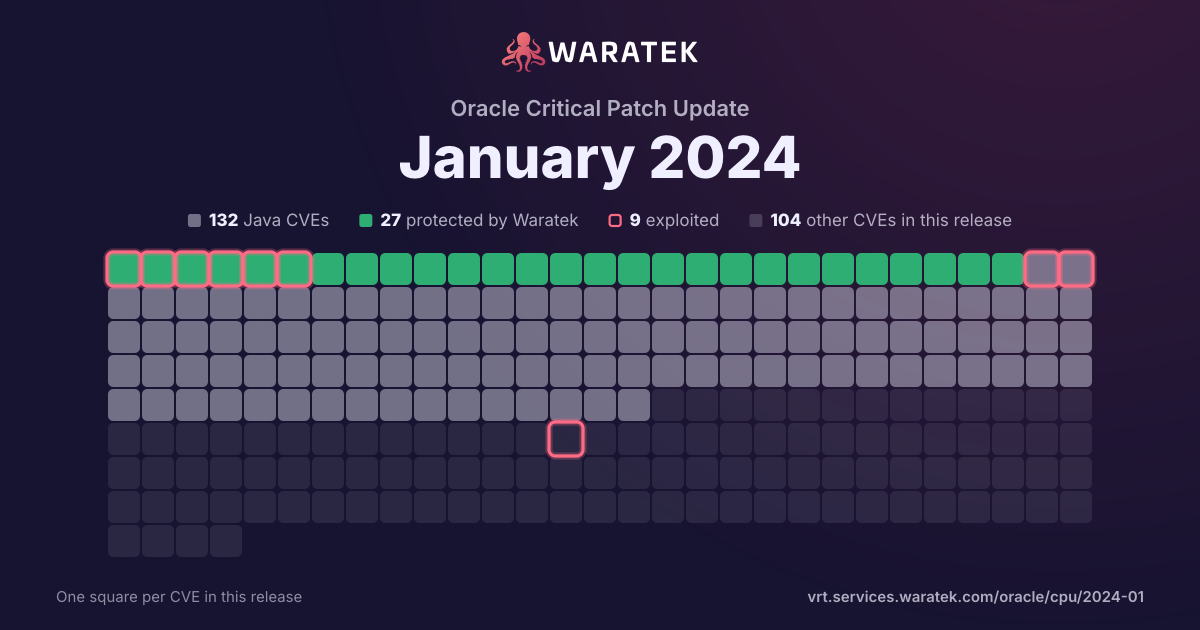
By status
21Protected by Waratek2Rule in development6Mitigation candidate103No exploit published9Outside Waratek scope95Not applicable
9Exploited, marked by the ring
No exploit published. For 38 of them, Oracle's security advisory is the source of public detail.
Protected by Waratek. Waratek RASP can block exploitation of these on systems that have not applied the patch yet.
Overview 3 matches · 0 protected · 0 exploited · 0 CISA KEV · 0 public PoC · 0 EPSS ≥ 0.5
3matches
0protected0.0%
0exploited0.0%
0CISA KEV0.0%
0public PoC0.0%
0EPSS ≥ 0.50.0%
Protected by Waratek
0
0.0%
Rule in development
0
0.0%
Mitigation candidate
0
0.0%
No exploit published
3
100.0%
blocked by ARMR today
0
0.0%
partly blocked
0
0.0%
not blocked
3
100.0%
not established
0
0.0%
unrecorded
0
0.0%
Exploited
0
0.0%
Working exploit published
0
0.0%
Proof of concept only
0
0.0%
Forecast only
0
0.0%
No public exploit
3
100.0%
| CVE | Severity | Published▾ | Status | Exploitation | Description |
|---|---|---|---|---|---|
| CVE-2023-34055 | Medium | 2023-11-28 | No exploit published | No public exploit | In Spring Boot versions 2.7.0 - 2.7.17, 3.0.0-3.0.12 and 3.1.0-3.1.5, it is possible for a user to provide specially crafted HTTP requests that may cause a denial-of-service (DoS) condition. Specifically, an application is vulnerable when all of the following are true: * the application uses Spring MVC or Spring WebFlux * org.springframework.boot:spring-boot-actuator is on the classpath |
| CVE-2023-44483 | Medium | 2023-10-20 | No exploit published | No public exploit | All versions of Apache Santuario - XML Security for Java prior to 2.2.6, 2.3.4, and 3.0.3, when using the JSR 105 API, are vulnerable to an issue where a private key may be disclosed in log files when generating an XML Signature and logging with debug level is enabled. Users are recommended to upgrade to version 2.2.6, 2.3.4, or 3.0.3, which fixes this issue. |
| CVE-2023-42503 | Medium | 2023-09-14 | No exploit published | No public exploit | Improper Input Validation, Uncontrolled Resource Consumption vulnerability in Apache Commons Compress in TAR parsing.This issue affects Apache Commons Compress: from 1.22 before 1.24.0. Users are recommended to upgrade to version 1.24.0, which fixes the issue. A third party can create a malformed TAR file by manipulating file modification times headers, which when parsed with Apache Commons Compress, will cause a denial of service issue via CPU consumption. In version 1.22 of Apache Commons Compress, support was added for file modification times with higher precision (issue # COMPRESS-612 [1]). The format for the PAX extended headers carrying this data consists of two numbers separated by a period [2], indicating seconds and subsecond precision (for example “1647221103.5998539”). The impacted fields are “atime”, “ctime”, “mtime” and “LIBARCHIVE.creationtime”. No input validation is performed prior to the parsing of header values. Parsing of these numbers uses the BigDecimal [3] class from the JDK which has a publicly known algorithmic complexity issue when doing operations on large numbers, causing denial of service (see issue # JDK-6560193 [4]). A third party can manipulate file time headers in a TAR file by placing a number with a very long fraction (300,000 digits) or a number with exponent notation (such as “9e9999999”) within a file modification time header, and the parsing of files with these headers will take hours instead of seconds, leading to a denial of service via exhaustion of CPU resources. This issue is similar to CVE-2012-2098 [5]. [1]: https://issues.apache.org/jira/browse/COMPRESS-612 [2]: https://pubs.opengroup.org/onlinepubs/9699919799/utilities/pax.html#tag_20_92_13_05 [3]: https://docs.oracle.com/javase/8/docs/api/java/math/BigDecimal.html [4]: https://bugs.openjdk.org/browse/JDK-6560193 [5]: https://cve.mitre.org/cgi-bin/cvename.cgi?name=CVE-2012-2098 Only applications using CompressorStreamFactory class (with auto-detection of file types), TarArchiveInputStream and TarFile classes to parse TAR files are impacted. Since this code was introduced in v1.22, only that version and later versions are impacted. |