
Oracle Critical Patch Update January 2024
Released January 2024 · Oracle's advisory ↗ · ← Critical Patch Update, October 2023 · Critical Patch Update, April 2024 →
236 CVEs in this release, one square each
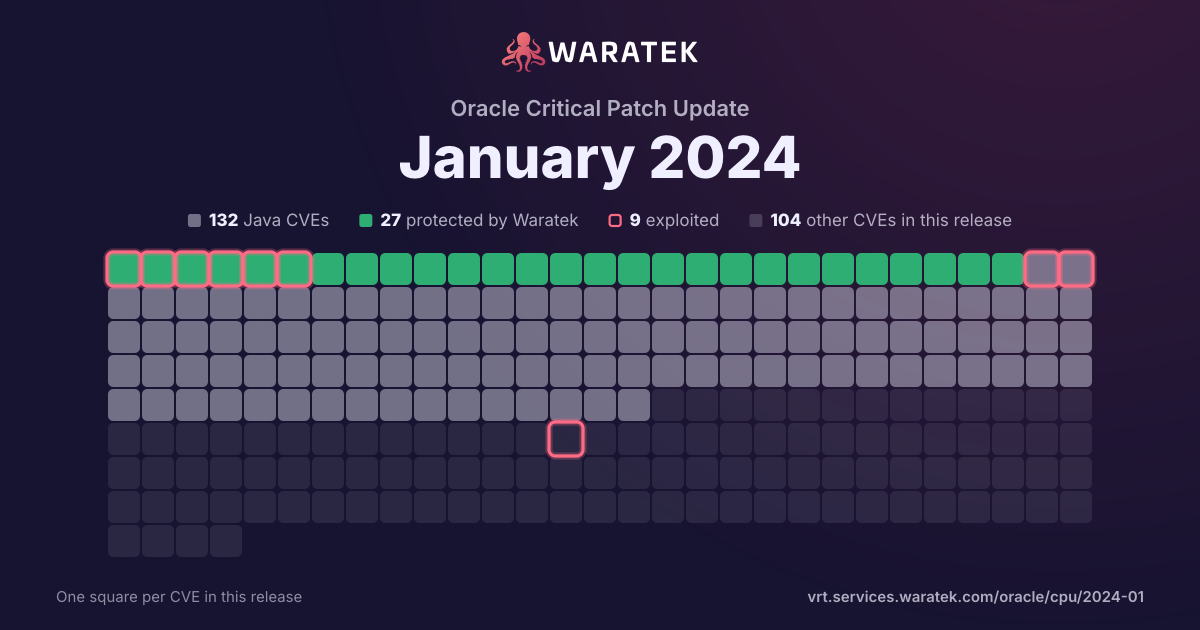
By status
27Protected by Waratek4Mitigation candidate101No exploit published26Outside Waratek scope78Not applicable
9Exploited, marked by the ring
No exploit published. For 47 of them, Oracle's security advisory is the source of public detail.
Protected by Waratek. Waratek RASP can block exploitation of these on systems that have not applied the patch yet.
Overview 7 matches · 0 in Waratek scope · 0 protected · 1 exploited · 1 CISA KEV · 3 public PoC
Protected by Waratek
0
0.0%
Rule in development
0
0.0%
Mitigation candidate
0
0.0%
No exploit published
0
0.0%
Outside Waratek scope
0
0.0%
Not applicable
7
100.0%
Withdrawn CVE
0
0.0%
blocked by ARMR today
0
0.0%
partly blocked
0
0.0%
not blocked
7
100.0%
not established
0
0.0%
unrecorded
0
0.0%
Exploited
1
14.3%
Working exploit published
0
0.0%
Proof of concept only
4
57.1%
Forecast only
2
28.6%
No public exploit
0
0.0%
split by
peak 2 / month
May 221
Not applicable1
Critical1
not blocked1
Forecast only1
Jun 220
Jul 220
Aug 220
Sep 220
Oct 220
Nov 222
Not applicable2
High2
not blocked2
Proof of concept only2
Dec 220
Jan 230
Feb 230
Mar 230
Apr 230
May 231
Not applicable1
Medium1
not blocked1
Forecast only1
Jun 230
Jul 230
Aug 230
Sep 231
Not applicable1
High1
not blocked1
Proof of concept only1
Oct 232
Not applicable2
High2
not blocked2
Exploited1
Proof of concept only1
Jun 22Aug 22Oct 22Dec 22Feb 23Apr 23Jun 23Aug 23Oct 23
| CVE | Severity | Published▾ | Status | Exploitation | Description |
|---|---|---|---|---|---|
| CVE-2023-43622 | High | 2023-10-23 | Not applicable | Proof of concept only | An attacker, opening a HTTP/2 connection with an initial window size of 0, was able to block handling of that connection indefinitely in Apache HTTP Server. This could be used to exhaust worker resources in the server, similar to the well known "slow loris" attack pattern. This has been fixed in version 2.4.58, so that such connection are terminated properly after the configured connection timeout. This issue affects Apache HTTP Server: from 2.4.55 through 2.4.57. Users are recommended to upgrade to version 2.4.58, which fixes the issue. |
| CVE-2023-4911 | High | 2023-10-03 | Not applicable | Exploited | A buffer overflow was discovered in the GNU C Library's dynamic loader ld.so while processing the GLIBC_TUNABLES environment variable. This issue could allow a local attacker to use maliciously crafted GLIBC_TUNABLES environment variables when launching binaries with SUID permission to execute code with elevated privileges. |
| CVE-2023-38039 | High | 2023-09-15 | Not applicable | Proof of concept only | When curl retrieves an HTTP response, it stores the incoming headers so that they can be accessed later via the libcurl headers API. However, curl did not have a limit in how many or how large headers it would accept in a response, allowing a malicious server to stream an endless series of headers and eventually cause curl to run out of heap memory. |
| CVE-2023-2650 | Medium | 2023-05-30 | Not applicable | Forecast only | Issue summary: Processing some specially crafted ASN.1 object identifiers or data containing them may be very slow. Impact summary: Applications that use OBJ_obj2txt() directly, or use any of the OpenSSL subsystems OCSP, PKCS7/SMIME, CMS, CMP/CRMF or TS with no message size limit may experience notable to very long delays when processing those messages, which may lead to a Denial of Service. An OBJECT IDENTIFIER is composed of a series of numbers - sub-identifiers - most of which have no size limit. OBJ_obj2txt() may be used to translate an ASN.1 OBJECT IDENTIFIER given in DER encoding form (using the OpenSSL type ASN1_OBJECT) to its canonical numeric text form, which are the sub-identifiers of the OBJECT IDENTIFIER in decimal form, separated by periods. When one of the sub-identifiers in the OBJECT IDENTIFIER is very large (these are sizes that are seen as absurdly large, taking up tens or hundreds of KiBs), the translation to a decimal number in text may take a very long time. The time complexity is O(n^2) with 'n' being the size of the sub-identifiers in bytes (*). With OpenSSL 3.0, support to fetch cryptographic algorithms using names / identifiers in string form was introduced. This includes using OBJECT IDENTIFIERs in canonical numeric text form as identifiers for fetching algorithms. Such OBJECT IDENTIFIERs may be received through the ASN.1 structure AlgorithmIdentifier, which is commonly used in multiple protocols to specify what cryptographic algorithm should be used to sign or verify, encrypt or decrypt, or digest passed data. Applications that call OBJ_obj2txt() directly with untrusted data are affected, with any version of OpenSSL. If the use is for the mere purpose of display, the severity is considered low. In OpenSSL 3.0 and newer, this affects the subsystems OCSP, PKCS7/SMIME, CMS, CMP/CRMF or TS. It also impacts anything that processes X.509 certificates, including simple things like verifying its signature. The impact on TLS is relatively low, because all versions of OpenSSL have a 100KiB limit on the peer's certificate chain. Additionally, this only impacts clients, or servers that have explicitly enabled client authentication. In OpenSSL 1.1.1 and 1.0.2, this only affects displaying diverse objects, such as X.509 certificates. This is assumed to not happen in such a way that it would cause a Denial of Service, so these versions are considered not affected by this issue in such a way that it would be cause for concern, and the severity is therefore considered low. |
| CVE-2022-3786 | High | 2022-11-01 | Not applicable | Proof of concept only | A buffer overrun can be triggered in X.509 certificate verification, specifically in name constraint checking. Note that this occurs after certificate chain signature verification and requires either a CA to have signed a malicious certificate or for an application to continue certificate verification despite failure to construct a path to a trusted issuer. An attacker can craft a malicious email address in a certificate to overflow an arbitrary number of bytes containing the `.' character (decimal 46) on the stack. This buffer overflow could result in a crash (causing a denial of service). In a TLS client, this can be triggered by connecting to a malicious server. In a TLS server, this can be triggered if the server requests client authentication and a malicious client connects. |
| CVE-2022-3602 | High | 2022-11-01 | Not applicable | Proof of concept only | A buffer overrun can be triggered in X.509 certificate verification, specifically in name constraint checking. Note that this occurs after certificate chain signature verification and requires either a CA to have signed the malicious certificate or for the application to continue certificate verification despite failure to construct a path to a trusted issuer. An attacker can craft a malicious email address to overflow four attacker-controlled bytes on the stack. This buffer overflow could result in a crash (causing a denial of service) or potentially remote code execution. Many platforms implement stack overflow protections which would mitigate against the risk of remote code execution. The risk may be further mitigated based on stack layout for any given platform/compiler. Pre-announcements of CVE-2022-3602 described this issue as CRITICAL. Further analysis based on some of the mitigating factors described above have led this to be downgraded to HIGH. Users are still encouraged to upgrade to a new version as soon as possible. In a TLS client, this can be triggered by connecting to a malicious server. In a TLS server, this can be triggered if the server requests client authentication and a malicious client connects. Fixed in OpenSSL 3.0.7 (Affected 3.0.0,3.0.1,3.0.2,3.0.3,3.0.4,3.0.5,3.0.6). |
| CVE-2022-29155 | Critical | 2022-05-04 | Not applicable | Forecast only | In OpenLDAP 2.x before 2.5.12 and 2.6.x before 2.6.2, a SQL injection vulnerability exists in the experimental back-sql backend to slapd, via a SQL statement within an LDAP query. This can occur during an LDAP search operation when the search filter is processed, due to a lack of proper escaping. |