
Oracle Critical Patch Update January 2024
Released January 2024 · Oracle's advisory ↗ · ← Critical Patch Update, October 2023 · Critical Patch Update, April 2024 →
236 CVEs in this release, one square each
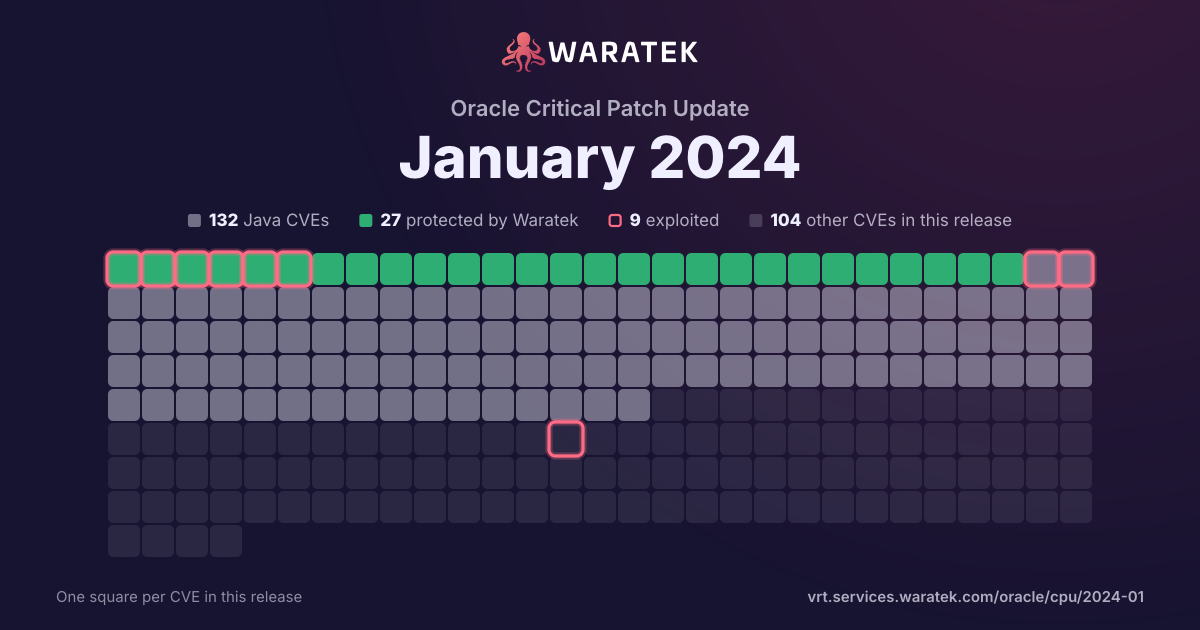
By status
22Protected by Waratek8Mitigation candidate105No exploit published10Outside Waratek scope91Not applicable
9Exploited, marked by the ring
No exploit published. For 38 of them, Oracle's security advisory is the source of public detail.
Protected by Waratek. Waratek RASP can block exploitation of these on systems that have not applied the patch yet.
Overview 19 matches · 4 exploited · 2 CISA KEV · 6 public PoC · 5 EPSS ≥ 0.5
Protected by Waratek
19
100.0%
Rule in development
0
0.0%
Mitigation candidate
0
0.0%
No exploit published
0
0.0%
blocked by ARMR today
19
100.0%
partly blocked
0
0.0%
not blocked
0
0.0%
not established
0
0.0%
unrecorded
0
0.0%
Exploited
4
21.1%
Working exploit published
0
0.0%
Proof of concept only
5
26.3%
Forecast only
0
0.0%
No public exploit
10
52.6%
split by
peak 4 / quarter
Q2 212
Protected by Waratek2
High1
Medium1
blocked by ARMR today2
No public exploit2
Q3 210
Q4 211
Protected by Waratek1
High1
blocked by ARMR today1
Exploited1
Q1 220
Q2 221
Protected by Waratek1
High1
blocked by ARMR today1
No public exploit1
Q3 223
Protected by Waratek3
Critical1
High1
Medium1
blocked by ARMR today3
Proof of concept only3
Q4 222
Protected by Waratek2
Critical2
blocked by ARMR today2
Exploited1
No public exploit1
Q1 230
Q2 230
Q3 233
Protected by Waratek3
High2
Medium1
blocked by ARMR today3
No public exploit3
Q4 233
Protected by Waratek3
Critical2
Medium1
blocked by ARMR today3
Exploited1
Proof of concept only1
No public exploit1
Q1 244
Protected by Waratek4
High2
Medium2
blocked by ARMR today4
Exploited1
Proof of concept only1
No public exploit2
Q2 21Q3 21Q4 21Q1 22Q2 22Q3 22Q4 22Q1 23Q2 23Q3 23Q4 23Q1 24
| CVE | Severity | Published▾ | Status | Exploitation | Description |
|---|---|---|---|---|---|
| CVE-2024-20953 | High | 2024-02-17 | Protected by Waratek | Exploited | Vulnerability in the Oracle Agile PLM product of Oracle Supply Chain (component: Export). The supported version that is affected is 9.3.6. Easily exploitable vulnerability allows low privileged attacker with network access via HTTP to compromise Oracle Agile PLM. Successful attacks of this vulnerability can result in takeover of Oracle Agile PLM. CVSS 3.1 Base Score 8.8 (Confidentiality, Integrity and Availability impacts). CVSS Vector: (CVSS:3.1/AV:N/AC:L/PR:L/UI:N/S:U/C:H/I:H/A:H). |
| CVE-2024-20945 | Medium | 2024-02-17 | Protected by Waratek | No public exploit | Vulnerability in the Oracle Java SE, Oracle GraalVM for JDK, Oracle GraalVM Enterprise Edition product of Oracle Java SE (component: Security). Supported versions that are affected are Oracle Java SE: 8u391, 8u391-perf, 11.0.21, 17.0.9, 21.0.1; Oracle GraalVM for JDK: 17.0.9, 21.0.1; Oracle GraalVM Enterprise Edition: 20.3.12, 21.3.8 and 22.3.4. Difficult to exploit vulnerability allows low privileged attacker with logon to the infrastructure where Oracle Java SE, Oracle GraalVM for JDK, Oracle GraalVM Enterprise Edition executes to compromise Oracle Java SE, Oracle GraalVM for JDK, Oracle GraalVM Enterprise Edition. Successful attacks of this vulnerability can result in unauthorized access to critical data or complete access to all Oracle Java SE, Oracle GraalVM for JDK, Oracle GraalVM Enterprise Edition accessible data. Note: This vulnerability can be exploited by using APIs in the specified Component, e.g., through a web service which supplies data to the APIs. This vulnerability also applies to Java deployments, typically in clients running sandboxed Java Web Start applications or sandboxed Java applets, that load and run untrusted code (e.g., code that comes from the internet) and rely on the Java sandbox for security. CVSS 3.1 Base Score 4.7 (Confidentiality impacts). CVSS Vector: (CVSS:3.1/AV:L/AC:H/PR:L/UI:N/S:U/C:H/I:N/A:N). |
| CVE-2024-20931 | High | 2024-02-17 | Protected by Waratek | Proof of concept only | Vulnerability in the Oracle WebLogic Server product of Oracle Fusion Middleware (component: Core). Supported versions that are affected are 12.2.1.4.0 and 14.1.1.0.0. Easily exploitable vulnerability allows unauthenticated attacker with network access via T3, IIOP to compromise Oracle WebLogic Server. Successful attacks of this vulnerability can result in unauthorized access to critical data or complete access to all Oracle WebLogic Server accessible data. CVSS 3.1 Base Score 7.5 (Confidentiality impacts). CVSS Vector: (CVSS:3.1/AV:N/AC:L/PR:N/UI:N/S:U/C:H/I:N/A:N). |
| CVE-2024-20926 | Medium | 2024-01-16 | Protected by Waratek | No public exploit | Vulnerability in the Oracle Java SE, Oracle GraalVM for JDK, Oracle GraalVM Enterprise Edition product of Oracle Java SE (component: Scripting). Supported versions that are affected are Oracle Java SE: 8u391, 8u391-perf, 11.0.21; Oracle GraalVM for JDK: 17.0.9; Oracle GraalVM Enterprise Edition: 20.3.12, 21.3.8 and 22.3.4. Difficult to exploit vulnerability allows unauthenticated attacker with network access via multiple protocols to compromise Oracle Java SE, Oracle GraalVM for JDK, Oracle GraalVM Enterprise Edition. Successful attacks of this vulnerability can result in unauthorized access to critical data or complete access to all Oracle Java SE, Oracle GraalVM for JDK, Oracle GraalVM Enterprise Edition accessible data. Note: This vulnerability can be exploited by using APIs in the specified Component, e.g., through a web service which supplies data to the APIs. This vulnerability also applies to Java deployments, typically in clients running sandboxed Java Web Start applications or sandboxed Java applets, that load and run untrusted code (e.g., code that comes from the internet) and rely on the Java sandbox for security. CVSS 3.1 Base Score 5.9 (Confidentiality impacts). CVSS Vector: (CVSS:3.1/AV:N/AC:H/PR:N/UI:N/S:U/C:H/I:N/A:N). |
| CVE-2023-49093 | Critical | 2023-12-04 | Protected by Waratek | Proof of concept only | HtmlUnit is a GUI-less browser for Java programs. HtmlUnit is vulnerable to Remote Code Execution (RCE) via XSTL, when browsing the attacker’s webpage. This vulnerability has been patched in version 3.9.0 |
| CVE-2023-46604 | Critical | 2023-10-27 | Protected by Waratek | Exploited | The Java OpenWire protocol marshaller is vulnerable to Remote Code Execution. This vulnerability may allow a remote attacker with network access to either a Java-based OpenWire broker or client to run arbitrary shell commands by manipulating serialized class types in the OpenWire protocol to cause either the client or the broker (respectively) to instantiate any class on the classpath. Users are recommended to upgrade both brokers and clients to version 5.15.16, 5.16.7, 5.17.6, or 5.18.3 which fixes this issue. |
| CVE-2023-43643 | Medium | 2023-10-09 | Protected by Waratek | No public exploit | AntiSamy is a library for performing fast, configurable cleansing of HTML coming from untrusted sources. Prior to version 1.7.4, there is a potential for a mutation XSS (mXSS) vulnerability in AntiSamy caused by flawed parsing of the HTML being sanitized. To be subject to this vulnerability the `preserveComments` directive must be enabled in your policy file and also allow for certain tags at the same time. As a result, certain crafty inputs can result in elements in comment tags being interpreted as executable when using AntiSamy's sanitized output. This issue has been patched in AntiSamy 1.7.4 and later. |
| CVE-2023-39410 | High | 2023-09-29 | Protected by Waratek | No public exploit | When deserializing untrusted or corrupted data, it is possible for a reader to consume memory beyond the allowed constraints and thus lead to out of memory on the system. This issue affects Java applications using Apache Avro Java SDK up to and including 1.11.2. Users should update to apache-avro version 1.11.3 which addresses this issue. |
| CVE-2022-46751 | High | 2023-08-21 | Protected by Waratek | No public exploit | Improper Restriction of XML External Entity Reference, XML Injection (aka Blind XPath Injection) vulnerability in Apache Software Foundation Apache Ivy.This issue affects any version of Apache Ivy prior to 2.5.2. When Apache Ivy prior to 2.5.2 parses XML files - either its own configuration, Ivy files or Apache Maven POMs - it will allow downloading external document type definitions and expand any entity references contained therein when used. This can be used to exfiltrate data, access resources only the machine running Ivy has access to or disturb the execution of Ivy in different ways. Starting with Ivy 2.5.2 DTD processing is disabled by default except when parsing Maven POMs where the default is to allow DTD processing but only to include a DTD snippet shipping with Ivy that is needed to deal with existing Maven POMs that are not valid XML files but are nevertheless accepted by Maven. Access can be be made more lenient via newly introduced system properties where needed. Users of Ivy prior to version 2.5.2 can use Java system properties to restrict processing of external DTDs, see the section about "JAXP Properties for External Access restrictions" inside Oracle's "Java API for XML Processing (JAXP) Security Guide". |
| CVE-2023-35887 | Medium | 2023-07-10 | Protected by Waratek | No public exploit | Exposure of Sensitive Information to an Unauthorized Actor vulnerability in Apache Software Foundation Apache MINA. In SFTP servers implemented using Apache MINA SSHD that use a RootedFileSystem, logged users may be able to discover "exists/does not exist" information about items outside the rooted tree via paths including parent navigation ("..") beyond the root, or involving symlinks. This issue affects Apache MINA: from 1.0 before 2.10. Users are recommended to upgrade to 2.10 |
| CVE-2022-1471 | Critical | 2022-12-01 | Protected by Waratek | Exploited | SnakeYaml's Constructor() class does not restrict types which can be instantiated during deserialization. Deserializing yaml content provided by an attacker can lead to remote code execution. We recommend using SnakeYaml's SafeConsturctor when parsing untrusted content to restrict deserialization. We recommend upgrading to version 2.0 and beyond. |
| CVE-2022-42920 | Critical | 2022-11-07 | Protected by Waratek | No public exploit | Apache Commons BCEL has a number of APIs that would normally only allow changing specific class characteristics. However, due to an out-of-bounds writing issue, these APIs can be used to produce arbitrary bytecode. This could be abused in applications that pass attacker-controllable data to those APIs, giving the attacker more control over the resulting bytecode than otherwise expected. Update to Apache Commons BCEL 6.6.0. |
| CVE-2022-36944 | Critical | 2022-09-23 | Protected by Waratek | Proof of concept only | Scala 2.13.x before 2.13.9 has a Java deserialization chain in its JAR file. On its own, it cannot be exploited. There is only a risk in conjunction with Java object deserialization within an application. In such situations, it allows attackers to erase contents of arbitrary files, make network connections, or possibly run arbitrary code (specifically, Function0 functions) via a gadget chain. |
| CVE-2022-36033 | Medium | 2022-08-29 | Protected by Waratek | Proof of concept only | jsoup is a Java HTML parser, built for HTML editing, cleaning, scraping, and cross-site scripting (XSS) safety. jsoup may incorrectly sanitize HTML including `javascript:` URL expressions, which could allow XSS attacks when a reader subsequently clicks that link. If the non-default `SafeList.preserveRelativeLinks` option is enabled, HTML including `javascript:` URLs that have been crafted with control characters will not be sanitized. If the site that this HTML is published on does not set a Content Security Policy, an XSS attack is then possible. This issue is patched in jsoup 1.15.3. Users should upgrade to this version. Additionally, as the unsanitized input may have been persisted, old content should be cleaned again using the updated version. To remediate this issue without immediately upgrading: - disable `SafeList.preserveRelativeLinks`, which will rewrite input URLs as absolute URLs - ensure an appropriate [Content Security Policy](https://developer.mozilla.org/en-US/docs/Web/HTTP/CSP) is defined. (This should be used regardless of upgrading, as a defence-in-depth best practice.) |
| CVE-2022-34169 | High | 2022-07-19 | Protected by Waratek | Proof of concept only | The Apache Xalan Java XSLT library is vulnerable to an integer truncation issue when processing malicious XSLT stylesheets. This can be used to corrupt Java class files generated by the internal XSLTC compiler and execute arbitrary Java bytecode. Users are recommended to update to version 2.7.3 or later. Note: Java runtimes (such as OpenJDK) include repackaged copies of Xalan. |
| CVE-2022-25647 | High | 2022-05-01 | Protected by Waratek | No public exploit | The package com.google.code.gson:gson before 2.8.9 are vulnerable to Deserialization of Untrusted Data via the writeReplace() method in internal classes, which may lead to DoS attacks. |
| CVE-2021-4104 | High | 2021-12-14 | Protected by Waratek | Exploited | JMSAppender in Log4j 1.2 is vulnerable to deserialization of untrusted data when the attacker has write access to the Log4j configuration. The attacker can provide TopicBindingName and TopicConnectionFactoryBindingName configurations causing JMSAppender to perform JNDI requests that result in remote code execution in a similar fashion to CVE-2021-44228. Note this issue only affects Log4j 1.2 when specifically configured to use JMSAppender, which is not the default. Apache Log4j 1.2 reached end of life in August 2015. Users should upgrade to Log4j 2 as it addresses numerous other issues from the previous versions. |
| CVE-2021-33813 | High | 2021-06-16 | Protected by Waratek | No public exploit | An XXE issue in SAXBuilder in JDOM through 2.0.6 allows attackers to cause a denial of service via a crafted HTTP request. |
| CVE-2021-29425 | Medium | 2021-04-13 | Protected by Waratek | No public exploit | In Apache Commons IO before 2.7, When invoking the method FileNameUtils.normalize with an improper input string, like "//../foo", or "\\..\foo", the result would be the same value, thus possibly providing access to files in the parent directory, but not further above (thus "limited" path traversal), if the calling code would use the result to construct a path value. |