
Oracle Critical Patch Update October 2023
Released October 2023 · Oracle's advisory ↗ · ← Critical Patch Update, July 2023 · Critical Patch Update, January 2024 →
245 CVEs in this release, one square each
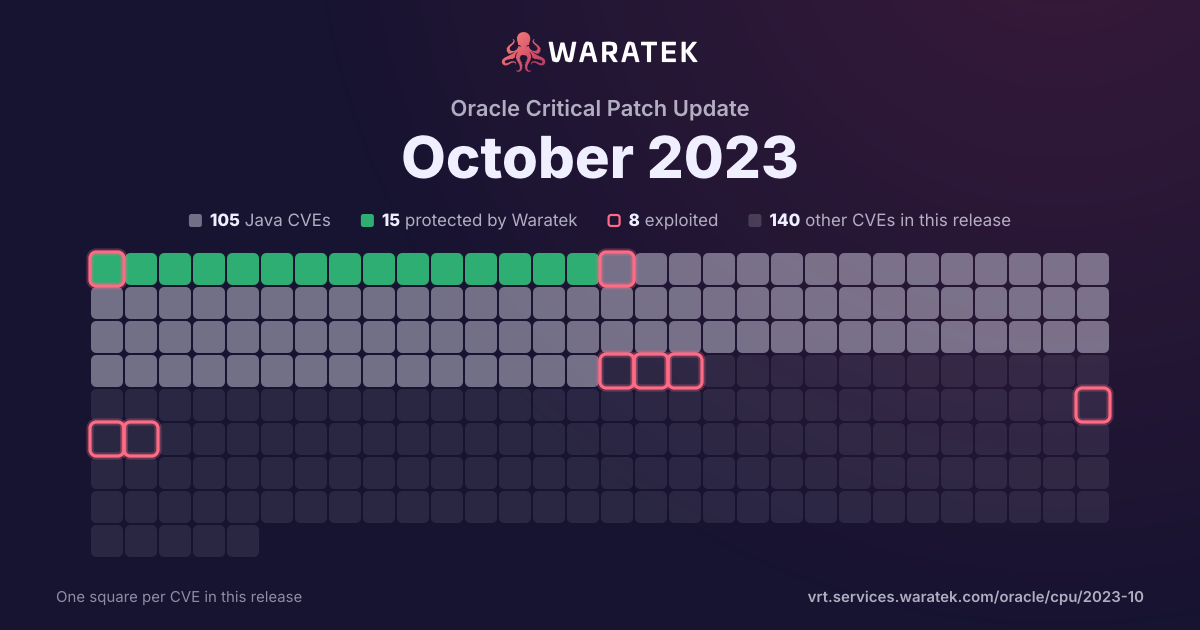
By status
15Protected by Waratek3Mitigation candidate87No exploit published44Outside Waratek scope96Not applicable
8Exploited, marked by the ring
No exploit published. For 35 of them, Oracle's security advisory is the source of public detail.
Protected by Waratek. Waratek RASP can block exploitation of these on systems that have not applied the patch yet.
Overview 8 matches · 2 in Waratek scope · 0 protected · 0 exploited · 0 CISA KEV · 0 public PoC · 0 EPSS ≥ 0.5
8matches
2in Waratek scope25.0%
0protected0.0%
0exploited0.0%
0CISA KEV0.0%
0public PoC0.0%
0EPSS ≥ 0.50.0%
Protected by Waratek
0
0.0%
Rule in development
0
0.0%
Mitigation candidate
0
0.0%
No exploit published
2
25.0%
Outside Waratek scope
2
25.0%
Not applicable
4
50.0%
Withdrawn CVE
0
0.0%
blocked by ARMR today
0
0.0%
partly blocked
0
0.0%
not blocked
8
100.0%
not established
0
0.0%
unrecorded
0
0.0%
Exploited
0
0.0%
Working exploit published
0
0.0%
Proof of concept only
0
0.0%
Forecast only
0
0.0%
No public exploit
8
100.0%
split by
peak 6 / month
Nov 22Dec 22Jan 23Feb 23Mar 23Apr 23May 23Jun 23Jul 23Aug 23Sep 23Oct 23
| CVE | Severity | Published▾ | Status | Exploitation | Description |
|---|---|---|---|---|---|
| CVE-2023-38546 | Low | 2023-10-18 | Not applicable | No public exploit | This flaw allows an attacker to insert cookies at will into a running program using libcurl, if the specific series of conditions are met. libcurl performs transfers. In its API, an application creates "easy handles" that are the individual handles for single transfers. libcurl provides a function call that duplicates en easy handle called [curl_easy_duphandle](https://curl.se/libcurl/c/curl_easy_duphandle.html). If a transfer has cookies enabled when the handle is duplicated, the cookie-enable state is also cloned - but without cloning the actual cookies. If the source handle did not read any cookies from a specific file on disk, the cloned version of the handle would instead store the file name as `none` (using the four ASCII letters, no quotes). Subsequent use of the cloned handle that does not explicitly set a source to load cookies from would then inadvertently load cookies from a file named `none` - if such a file exists and is readable in the current directory of the program using libcurl. And if using the correct file format of course. |
| CVE-2023-22128 | Low | 2023-10-17 | Not applicable | No public exploit | Vulnerability in the Oracle Solaris product of Oracle Systems (component: Filesystem). Supported versions that are affected are 10 and 11. Difficult to exploit vulnerability allows unauthenticated attacker with network access via rquota to compromise Oracle Solaris. Successful attacks require human interaction from a person other than the attacker. Successful attacks of this vulnerability can result in unauthorized read access to a subset of Oracle Solaris accessible data. CVSS 3.1 Base Score 3.1 (Confidentiality impacts). CVSS Vector: (CVSS:3.1/AV:N/AC:H/PR:N/UI:R/S:U/C:L/I:N/A:N). |
| CVE-2023-22113 | Low | 2023-10-17 | Outside Waratek scope | No public exploit | Vulnerability in the MySQL Server product of Oracle MySQL (component: Server: Security: Encryption). Supported versions that are affected are 8.0.33 and prior. Easily exploitable vulnerability allows high privileged attacker with network access via multiple protocols to compromise MySQL Server. Successful attacks of this vulnerability can result in unauthorized read access to a subset of MySQL Server accessible data. CVSS 3.1 Base Score 2.7 (Confidentiality impacts). CVSS Vector: (CVSS:3.1/AV:N/AC:L/PR:H/UI:N/S:U/C:L/I:N/A:N). |
| CVE-2023-22075 | Low | 2023-10-17 | Not applicable | No public exploit | Vulnerability in the Oracle Database Sharding component of Oracle Database Server. Supported versions that are affected are 19.3-19.20 and 21.3-21.11. Easily exploitable vulnerability allows high privileged attacker having Create Session, Create Any View, Select Any Table privilege with network access via Oracle Net to compromise Oracle Database Sharding. Successful attacks require human interaction from a person other than the attacker. Successful attacks of this vulnerability can result in unauthorized ability to cause a partial denial of service (partial DOS) of Oracle Database Sharding. CVSS 3.1 Base Score 2.4 (Availability impacts). CVSS Vector: (CVSS:3.1/AV:N/AC:L/PR:H/UI:R/S:U/C:N/I:N/A:L). |
| CVE-2023-22074 | Low | 2023-10-17 | Not applicable | No public exploit | Vulnerability in the Oracle Database Sharding component of Oracle Database Server. Supported versions that are affected are 19.3-19.20 and 21.3-21.11. Easily exploitable vulnerability allows high privileged attacker having Create Session, Select Any Dictionary privilege with network access via Oracle Net to compromise Oracle Database Sharding. Successful attacks require human interaction from a person other than the attacker. Successful attacks of this vulnerability can result in unauthorized ability to cause a partial denial of service (partial DOS) of Oracle Database Sharding. CVSS 3.1 Base Score 2.4 (Availability impacts). CVSS Vector: (CVSS:3.1/AV:N/AC:L/PR:H/UI:R/S:U/C:N/I:N/A:L). |
| CVE-2023-22025 | Low | 2023-10-17 | Outside Waratek scope | No public exploit | Vulnerability in the Oracle Java SE, Oracle GraalVM for JDK, Oracle GraalVM Enterprise Edition, product of Oracle Java SE (component: Hotspot). Supported versions that are affected are Oracle Java SE: 8u381-perf, 17.0.8, 21; Oracle GraalVM for JDK: 17.0.8, 21; Oracle GraalVM Enterprise Edition: 21.3.7 and 22.3.3. Difficult to exploit vulnerability allows unauthenticated attacker with network access via multiple protocols to compromise Oracle Java SE, Oracle GraalVM for JDK, Oracle GraalVM Enterprise Edition,. Successful attacks of this vulnerability can result in unauthorized update, insert or delete access to some of Oracle Java SE, Oracle GraalVM for JDK, Oracle GraalVM Enterprise Edition, accessible data. Note: This vulnerability can be exploited by using APIs in the specified Component, e.g., through a web service which supplies data to the APIs. This vulnerability also applies to Java deployments, typically in clients running sandboxed Java Web Start applications or sandboxed Java applets, that load and run untrusted code (e.g., code that comes from the internet) and rely on the Java sandbox for security. CVSS 3.1 Base Score 3.7 (Integrity impacts). CVSS Vector: (CVSS:3.1/AV:N/AC:H/PR:N/UI:N/S:U/C:N/I:L/A:N). |
| CVE-2023-36479 | Low | 2023-09-15 | No exploit published | No public exploit | Eclipse Jetty Canonical Repository is the canonical repository for the Jetty project. Users of the CgiServlet with a very specific command structure may have the wrong command executed. If a user sends a request to a org.eclipse.jetty.servlets.CGI Servlet for a binary with a space in its name, the servlet will escape the command by wrapping it in quotation marks. This wrapped command, plus an optional command prefix, will then be executed through a call to Runtime.exec. If the original binary name provided by the user contains a quotation mark followed by a space, the resulting command line will contain multiple tokens instead of one. This issue was patched in version 9.4.52, 10.0.16, 11.0.16 and 12.0.0-beta2. |
| CVE-2022-41954 | Low | 2022-11-25 | No exploit published | No public exploit | MPXJ is an open source library to read and write project plans from a variety of file formats and databases. On Unix-like operating systems (not Windows or macos), MPXJ's use of `File.createTempFile(..)` results in temporary files being created with the permissions `-rw-r--r--`. This means that any other user on the system can read the contents of this file. When MPXJ is reading a schedule file which requires the creation of a temporary file or directory, a knowledgeable local user could locate these transient files while they are in use and would then be able to read the schedule being processed by MPXJ. The problem has been patched, MPXJ version 10.14.1 and later includes the necessary changes. Users unable to upgrade may set `java.io.tmpdir` to a directory to which only the user running the application has access will prevent other users from accessing these temporary files. |