
Oracle Critical Patch Update October 2023
Released October 2023 · Oracle's advisory ↗ · ← Critical Patch Update, July 2023 · Critical Patch Update, January 2024 →
245 CVEs in this release, one square each
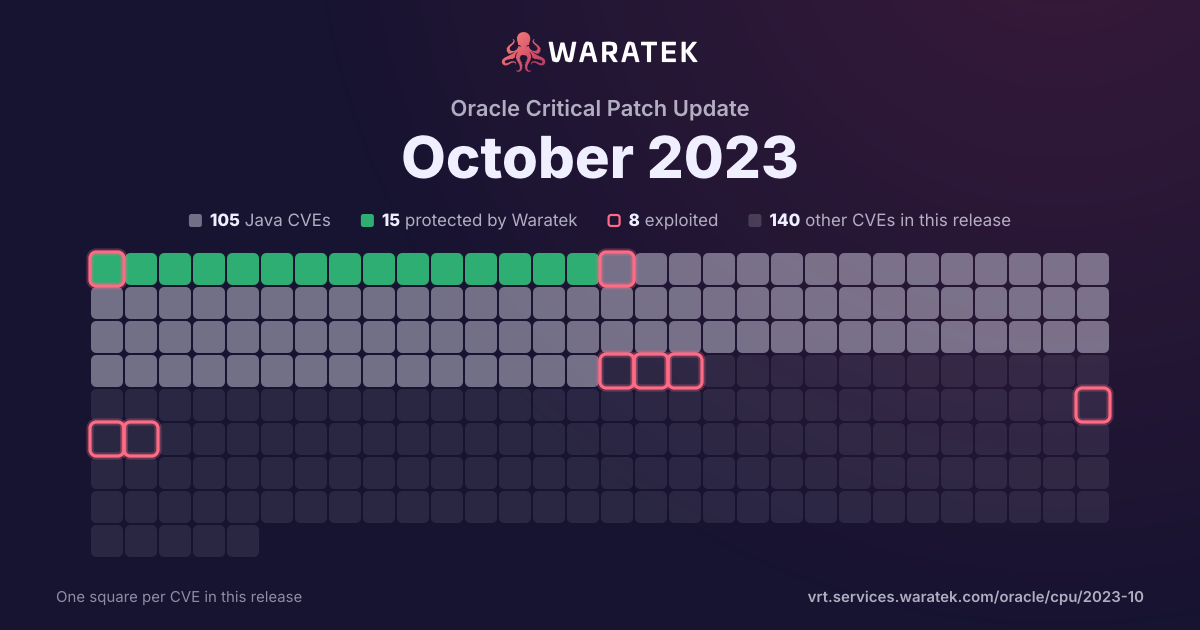
By status
13Protected by Waratek3Mitigation candidate92No exploit published5Outside Waratek scope132Not applicable
8Exploited, marked by the ring
No exploit published. For 30 of them, Oracle's security advisory is the source of public detail.
Protected by Waratek. Waratek RASP can block exploitation of these on systems that have not applied the patch yet.
Overview 23 matches · 10 in Waratek scope · 2 protected · 0 exploited · 0 CISA KEV · 3 public PoC · 0 EPSS ≥ 0.5
23matches
10in Waratek scope43.5%
2protected8.7%
0exploited0.0%
0CISA KEV0.0%
3public PoC13.0%
0EPSS ≥ 0.50.0%
Protected by Waratek
2
8.7%
Rule in development
0
0.0%
Mitigation candidate
1
4.3%
No exploit published
7
30.4%
Outside Waratek scope
0
0.0%
Not applicable
13
56.5%
Withdrawn CVE
0
0.0%
blocked by ARMR today
2
8.7%
partly blocked
0
0.0%
not blocked
21
91.3%
not established
0
0.0%
unrecorded
0
0.0%
Exploited
0
0.0%
Working exploit published
0
0.0%
Proof of concept only
23
100.0%
Forecast only
0
0.0%
No public exploit
0
0.0%
split by
peak 6 / month
Oct 211
Not applicable1
Medium1
not blocked1
Proof of concept only1
Nov 210
Dec 210
Jan 220
Feb 220
Mar 220
Apr 220
May 220
Jun 223
Not applicable3
High3
not blocked3
Proof of concept only3
Jul 223
Mitigation candidate1
Not applicable2
Critical1
High1
Medium1
not blocked3
Proof of concept only3
Aug 221
Protected by Waratek1
Medium1
blocked by ARMR today1
Proof of concept only1
Sep 223
Protected by Waratek1
No exploit published2
Critical1
High2
blocked by ARMR today1
not blocked2
Proof of concept only3
Oct 221
Not applicable1
Critical1
not blocked1
Proof of concept only1
Nov 221
Not applicable1
High1
not blocked1
Proof of concept only1
Dec 226
No exploit published5
Not applicable1
High5
Medium1
not blocked6
Proof of concept only6
Jan 230
Feb 234
Not applicable4
Critical1
High1
Medium2
not blocked4
Proof of concept only4
Oct 21Dec 21Feb 22Apr 22Jun 22Aug 22Oct 22Dec 22Feb 23
| CVE | Severity | Published▾ | Status | Exploitation | Description |
|---|---|---|---|---|---|
| CVE-2023-23916 | Medium | 2023-02-23 | Not applicable | Proof of concept only | An allocation of resources without limits or throttling vulnerability exists in curl <v7.88.0 based on the "chained" HTTP compression algorithms, meaning that a server response can be compressed multiple times and potentially with differentalgorithms. The number of acceptable "links" in this "decompression chain" wascapped, but the cap was implemented on a per-header basis allowing a maliciousserver to insert a virtually unlimited number of compression steps simply byusing many headers. The use of such a decompression chain could result in a "malloc bomb", making curl end up spending enormous amounts of allocated heap memory, or trying to and returning out of memory errors. |
| CVE-2023-23914 | Critical | 2023-02-23 | Not applicable | Proof of concept only | A cleartext transmission of sensitive information vulnerability exists in curl <v7.88.0 that could cause HSTS functionality fail when multiple URLs are requested serially. Using its HSTS support, curl can be instructed to use HTTPS instead of usingan insecure clear-text HTTP step even when HTTP is provided in the URL. ThisHSTS mechanism would however surprisingly be ignored by subsequent transferswhen done on the same command line because the state would not be properlycarried on. |
| CVE-2023-0361 | High | 2023-02-15 | Not applicable | Proof of concept only | A timing side-channel in the handling of RSA ClientKeyExchange messages was discovered in GnuTLS. This side-channel can be sufficient to recover the key encrypted in the RSA ciphertext across a network in a Bleichenbacher style attack. To achieve a successful decryption the attacker would need to send a large amount of specially crafted messages to the vulnerable server. By recovering the secret from the ClientKeyExchange message, the attacker would be able to decrypt the application data exchanged over that connection. |
| CVE-2023-23931 | Medium | 2023-02-07 | Not applicable | Proof of concept only | cryptography is a package designed to expose cryptographic primitives and recipes to Python developers. In affected versions `Cipher.update_into` would accept Python objects which implement the buffer protocol, but provide only immutable buffers. This would allow immutable objects (such as `bytes`) to be mutated, thus violating fundamental rules of Python and resulting in corrupted output. This now correctly raises an exception. This issue has been present since `update_into` was originally introduced in cryptography 1.8. |
| CVE-2022-41966 | High | 2022-12-28 | No exploit published | Proof of concept only | XStream serializes Java objects to XML and back again. Versions prior to 1.4.20 may allow a remote attacker to terminate the application with a stack overflow error, resulting in a denial of service only via manipulation the processed input stream. The attack uses the hash code implementation for collections and maps to force recursive hash calculation causing a stack overflow. This issue is patched in version 1.4.20 which handles the stack overflow and raises an InputManipulationException instead. A potential workaround for users who only use HashMap or HashSet and whose XML refers these only as default map or set, is to change the default implementation of java.util.Map and java.util per the code example in the referenced advisory. However, this implies that your application does not care about the implementation of the map and all elements are comparable. |
| CVE-2022-43551 | High | 2022-12-23 | Not applicable | Proof of concept only | A vulnerability exists in curl <7.87.0 HSTS check that could be bypassed to trick it to keep using HTTP. Using its HSTS support, curl can be instructed to use HTTPS instead of using an insecure clear-text HTTP step even when HTTP is provided in the URL. However, the HSTS mechanism could be bypassed if the host name in the given URL first uses IDN characters that get replaced to ASCII counterparts as part of the IDN conversion. Like using the character UTF-8 U+3002 (IDEOGRAPHIC FULL STOP) instead of the common ASCII full stop (U+002E) `.`. Then in a subsequent request, it does not detect the HSTS state and makes a clear text transfer. Because it would store the info IDN encoded but look for it IDN decoded. |
| CVE-2022-45690 | High | 2022-12-13 | No exploit published | Proof of concept only | A stack overflow in the org.json.JSONTokener.nextValue::JSONTokener.java component of hutool-json v5.8.10 allows attackers to cause a Denial of Service (DoS) via crafted JSON or XML data. |
| CVE-2022-45688 | High | 2022-12-13 | No exploit published | Proof of concept only | A stack overflow in the XML.toJSONObject component of hutool-json v5.8.10 allows attackers to cause a Denial of Service (DoS) via crafted JSON or XML data. |
| CVE-2022-41915 | Medium | 2022-12-13 | No exploit published | Proof of concept only | Netty project is an event-driven asynchronous network application framework. Starting in version 4.1.83.Final and prior to 4.1.86.Final, when calling `DefaultHttpHeadesr.set` with an _iterator_ of values, header value validation was not performed, allowing malicious header values in the iterator to perform HTTP Response Splitting. This issue has been patched in version 4.1.86.Final. Integrators can work around the issue by changing the `DefaultHttpHeaders.set(CharSequence, Iterator<?>)` call, into a `remove()` call, and call `add()` in a loop over the iterator of values. |
| CVE-2022-41881 | High | 2022-12-12 | No exploit published | Proof of concept only | Netty project is an event-driven asynchronous network application framework. In versions prior to 4.1.86.Final, a StackOverflowError can be raised when parsing a malformed crafted message due to an infinite recursion. This issue is patched in version 4.1.86.Final. There is no workaround, except using a custom HaProxyMessageDecoder. |
| CVE-2022-45061 | High | 2022-11-09 | Not applicable | Proof of concept only | An issue was discovered in Python before 3.11.1. An unnecessary quadratic algorithm exists in one path when processing some inputs to the IDNA (RFC 3490) decoder, such that a crafted, unreasonably long name being presented to the decoder could lead to a CPU denial of service. Hostnames are often supplied by remote servers that could be controlled by a malicious actor; in such a scenario, they could trigger excessive CPU consumption on the client attempting to make use of an attacker-supplied supposed hostname. For example, the attack payload could be placed in the Location header of an HTTP response with status code 302. A fix is planned in 3.11.1, 3.10.9, 3.9.16, 3.8.16, and 3.7.16. |
| CVE-2022-37454 | Critical | 2022-10-21 | Not applicable | Proof of concept only | The Keccak XKCP SHA-3 reference implementation before fdc6fef has an integer overflow and resultant buffer overflow that allows attackers to execute arbitrary code or eliminate expected cryptographic properties. This occurs in the sponge function interface. |
| CVE-2022-36944 | Critical | 2022-09-23 | Protected by Waratek | Proof of concept only | Scala 2.13.x before 2.13.9 has a Java deserialization chain in its JAR file. On its own, it cannot be exploited. There is only a risk in conjunction with Java object deserialization within an application. In such situations, it allows attackers to erase contents of arbitrary files, make network connections, or possibly run arbitrary code (specifically, Function0 functions) via a gadget chain. |
| CVE-2022-40152 | High | 2022-09-16 | No exploit published | Proof of concept only | Those using Woodstox to parse XML data may be vulnerable to Denial of Service attacks (DOS) if DTD support is enabled. If the parser is running on user supplied input, an attacker may supply content that causes the parser to crash by stackoverflow. This effect may support a denial of service attack. |
| CVE-2022-40151 | High | 2022-09-16 | No exploit published | Proof of concept only | Those using Xstream to seralize XML data may be vulnerable to Denial of Service attacks (DOS). If the parser is running on user supplied input, an attacker may supply content that causes the parser to crash by stackoverflow. This effect may support a denial of service attack. |
| CVE-2022-36033 | Medium | 2022-08-29 | Protected by Waratek | Proof of concept only | jsoup is a Java HTML parser, built for HTML editing, cleaning, scraping, and cross-site scripting (XSS) safety. jsoup may incorrectly sanitize HTML including `javascript:` URL expressions, which could allow XSS attacks when a reader subsequently clicks that link. If the non-default `SafeList.preserveRelativeLinks` option is enabled, HTML including `javascript:` URLs that have been crafted with control characters will not be sanitized. If the site that this HTML is published on does not set a Content Security Policy, an XSS attack is then possible. This issue is patched in jsoup 1.15.3. Users should upgrade to this version. Additionally, as the unsanitized input may have been persisted, old content should be cleaned again using the updated version. To remediate this issue without immediately upgrading: - disable `SafeList.preserveRelativeLinks`, which will rewrite input URLs as absolute URLs - ensure an appropriate [Content Security Policy](https://developer.mozilla.org/en-US/docs/Web/HTTP/CSP) is defined. (This should be used regardless of upgrading, as a defence-in-depth best practice.) |
| CVE-2022-31160 | Medium | 2022-07-20 | Not applicable | Proof of concept only | jQuery UI is a curated set of user interface interactions, effects, widgets, and themes built on top of jQuery. Versions prior to 1.13.2 are potentially vulnerable to cross-site scripting. Initializing a checkboxradio widget on an input enclosed within a label makes that parent label contents considered as the input label. Calling `.checkboxradio( "refresh" )` on such a widget and the initial HTML contained encoded HTML entities will make them erroneously get decoded. This can lead to potentially executing JavaScript code. The bug has been patched in jQuery UI 1.13.2. To remediate the issue, someone who can change the initial HTML can wrap all the non-input contents of the `label` in a `span`. |
| CVE-2022-33980 | Critical | 2022-07-06 | Mitigation candidate | Proof of concept only | Apache Commons Configuration performs variable interpolation, allowing properties to be dynamically evaluated and expanded. The standard format for interpolation is "${prefix:name}", where "prefix" is used to locate an instance of org.apache.commons.configuration2.interpol.Lookup that performs the interpolation. Starting with version 2.4 and continuing through 2.7, the set of default Lookup instances included interpolators that could result in arbitrary code execution or contact with remote servers. These lookups are: - "script" - execute expressions using the JVM script execution engine (javax.script) - "dns" - resolve dns records - "url" - load values from urls, including from remote servers Applications using the interpolation defaults in the affected versions may be vulnerable to remote code execution or unintentional contact with remote servers if untrusted configuration values are used. Users are recommended to upgrade to Apache Commons Configuration 2.8.0, which disables the problematic interpolators by default. |
| CVE-2022-31129 | High | 2022-07-06 | Not applicable | Proof of concept only | moment is a JavaScript date library for parsing, validating, manipulating, and formatting dates. Affected versions of moment were found to use an inefficient parsing algorithm. Specifically using string-to-date parsing in moment (more specifically rfc2822 parsing, which is tried by default) has quadratic (N^2) complexity on specific inputs. Users may notice a noticeable slowdown is observed with inputs above 10k characters. Users who pass user-provided strings without sanity length checks to moment constructor are vulnerable to (Re)DoS attacks. The problem is patched in 2.29.4, the patch can be applied to all affected versions with minimal tweaking. Users are advised to upgrade. Users unable to upgrade should consider limiting date lengths accepted from user input. |
| CVE-2022-27782 | High | 2022-06-02 | Not applicable | Proof of concept only | libcurl would reuse a previously created connection even when a TLS or SSHrelated option had been changed that should have prohibited reuse.libcurl keeps previously used connections in a connection pool for subsequenttransfers to reuse if one of them matches the setup. However, several TLS andSSH settings were left out from the configuration match checks, making themmatch too easily. |
| CVE-2022-27781 | High | 2022-06-02 | Not applicable | Proof of concept only | libcurl provides the `CURLOPT_CERTINFO` option to allow applications torequest details to be returned about a server's certificate chain.Due to an erroneous function, a malicious server could make libcurl built withNSS get stuck in a never-ending busy-loop when trying to retrieve thatinformation. |
| CVE-2022-27780 | High | 2022-06-02 | Not applicable | Proof of concept only | The curl URL parser wrongly accepts percent-encoded URL separators like '/'when decoding the host name part of a URL, making it a *different* URL usingthe wrong host name when it is later retrieved.For example, a URL like `http://example.com%2F127.0.0.1/`, would be allowed bythe parser and get transposed into `http://example.com/127.0.0.1/`. This flawcan be used to circumvent filters, checks and more. |
| CVE-2021-41184 | Medium | 2021-10-26 | Not applicable | Proof of concept only | jQuery-UI is the official jQuery user interface library. Prior to version 1.13.0, accepting the value of the `of` option of the `.position()` util from untrusted sources may execute untrusted code. The issue is fixed in jQuery UI 1.13.0. Any string value passed to the `of` option is now treated as a CSS selector. A workaround is to not accept the value of the `of` option from untrusted sources. |