
Oracle Critical Patch Update October 2023
Released October 2023 · Oracle's advisory ↗ · ← Critical Patch Update, July 2023 · Critical Patch Update, January 2024 →
245 CVEs in this release, one square each
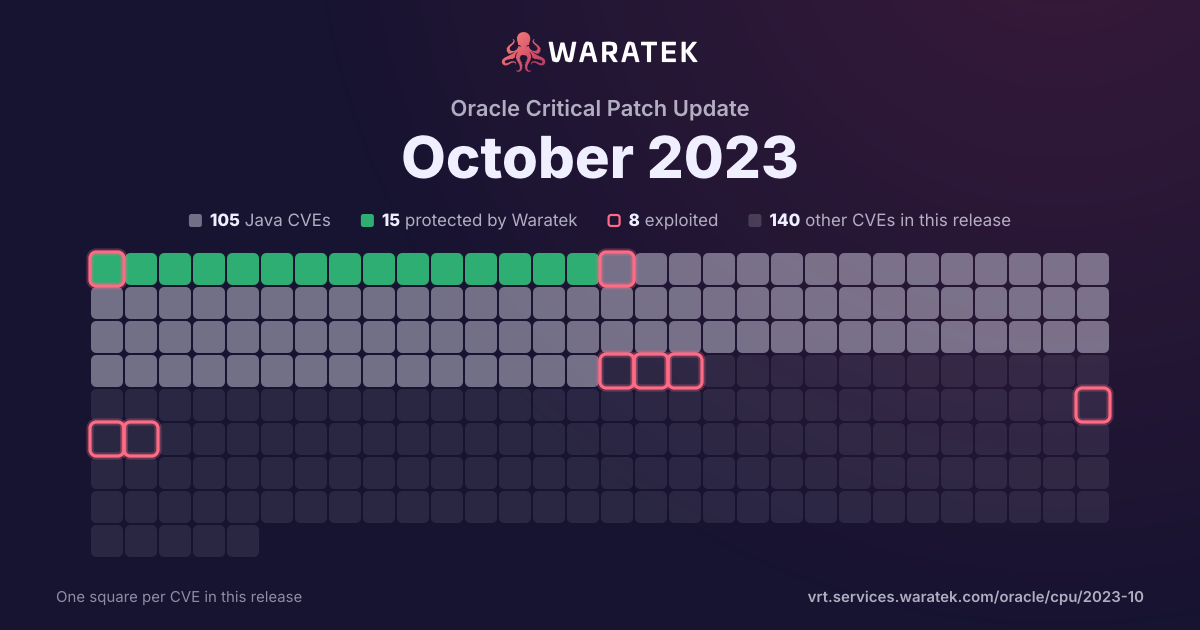
By status
14Protected by Waratek7Mitigation candidate93No exploit published6Outside Waratek scope125Not applicable
8Exploited, marked by the ring
No exploit published. For 30 of them, Oracle's security advisory is the source of public detail.
Protected by Waratek. Waratek RASP can block exploitation of these on systems that have not applied the patch yet.
Overview 5 matches · 1 in Waratek scope · 0 protected · 0 exploited · 0 CISA KEV · 3 public PoC · 2 EPSS ≥ 0.5
5matches
1in Waratek scope20.0%
0protected0.0%
0exploited0.0%
0CISA KEV0.0%
3public PoC60.0%
2EPSS ≥ 0.540.0%
Protected by Waratek
0
0.0%
Rule in development
0
0.0%
Mitigation candidate
1
20.0%
No exploit published
0
0.0%
Outside Waratek scope
0
0.0%
Not applicable
4
80.0%
Withdrawn CVE
0
0.0%
blocked by ARMR today
0
0.0%
partly blocked
0
0.0%
not blocked
5
100.0%
not established
0
0.0%
unrecorded
0
0.0%
Exploited
0
0.0%
Working exploit published
0
0.0%
Proof of concept only
5
100.0%
Forecast only
0
0.0%
No public exploit
0
0.0%
| CVE | Severity | Published▾ | Status | Exploitation | Description |
|---|---|---|---|---|---|
| CVE-2023-38545 | Critical | 2023-10-18 | Not applicable | Proof of concept only | This flaw makes curl overflow a heap based buffer in the SOCKS5 proxy handshake. When curl is asked to pass along the host name to the SOCKS5 proxy to allow that to resolve the address instead of it getting done by curl itself, the maximum length that host name can be is 255 bytes. If the host name is detected to be longer, curl switches to local name resolving and instead passes on the resolved address only. Due to this bug, the local variable that means "let the host resolve the name" could get the wrong value during a slow SOCKS5 handshake, and contrary to the intention, copy the too long host name to the target buffer instead of copying just the resolved address there. The target buffer being a heap based buffer, and the host name coming from the URL that curl has been told to operate with. |
| CVE-2023-22098 | High | 2023-10-17 | Not applicable | Proof of concept only | Vulnerability in the Oracle VM VirtualBox product of Oracle Virtualization (component: Core). Supported versions that are affected are Prior to 7.0.12. Easily exploitable vulnerability allows high privileged attacker with logon to the infrastructure where Oracle VM VirtualBox executes to compromise Oracle VM VirtualBox. While the vulnerability is in Oracle VM VirtualBox, attacks may significantly impact additional products (scope change). Successful attacks of this vulnerability can result in takeover of Oracle VM VirtualBox. Note: Only applicable to 7.0.x platform. CVSS 3.1 Base Score 8.2 (Confidentiality, Integrity and Availability impacts). CVSS Vector: (CVSS:3.1/AV:L/AC:L/PR:H/UI:N/S:C/C:H/I:H/A:H). |
| CVE-2023-38039 | High | 2023-09-15 | Not applicable | Proof of concept only | When curl retrieves an HTTP response, it stores the incoming headers so that they can be accessed later via the libcurl headers API. However, curl did not have a limit in how many or how large headers it would accept in a response, allowing a malicious server to stream an endless series of headers and eventually cause curl to run out of heap memory. |
| CVE-2023-4039 | Medium | 2023-09-13 | Not applicable | Proof of concept only | **DISPUTED**A failure in the -fstack-protector feature in GCC-based toolchains that target AArch64 allows an attacker to exploit an existing buffer overflow in dynamically-sized local variables in your application without this being detected. This stack-protector failure only applies to C99-style dynamically-sized local variables or those created using alloca(). The stack-protector operates as intended for statically-sized local variables. The default behavior when the stack-protector detects an overflow is to terminate your application, resulting in controlled loss of availability. An attacker who can exploit a buffer overflow without triggering the stack-protector might be able to change program flow control to cause an uncontrolled loss of availability or to go further and affect confidentiality or integrity. NOTE: The GCC project argues that this is a missed hardening bug and not a vulnerability by itself. |
| CVE-2023-41080 | Medium | 2023-08-25 | Mitigation candidate | Proof of concept only | URL Redirection to Untrusted Site ('Open Redirect') vulnerability in FORM authentication feature Apache Tomcat.This issue affects Apache Tomcat: from 11.0.0-M1 through 11.0.0-M10, from 10.1.0-M1 through 10.0.12, from 9.0.0-M1 through 9.0.79 and from 8.5.0 through 8.5.92. Older, EOL versions may also be affected. The vulnerability is limited to the ROOT (default) web application. |