
Oracle Critical Patch Update October 2023
Released October 2023 · Oracle's advisory ↗ · ← Critical Patch Update, July 2023 · Critical Patch Update, January 2024 →
245 CVEs in this release, one square each
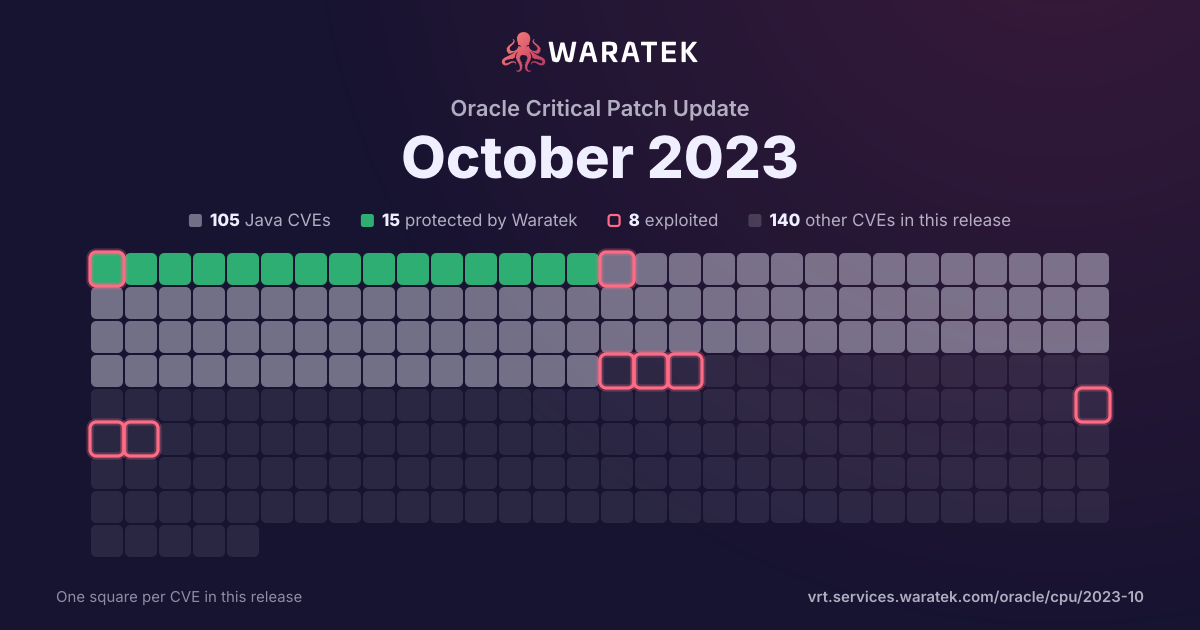
By status
15Protected by Waratek3Mitigation candidate87No exploit published44Outside Waratek scope96Not applicable
8Exploited, marked by the ring
No exploit published. For 35 of them, Oracle's security advisory is the source of public detail.
Protected by Waratek. Waratek RASP can block exploitation of these on systems that have not applied the patch yet.
Overview 3 matches · 0 in Waratek scope · 0 protected · 0 CISA KEV · 2 public PoC · 2 EPSS ≥ 0.5
Protected by Waratek
0
0.0%
Rule in development
0
0.0%
Mitigation candidate
0
0.0%
No exploit published
0
0.0%
Outside Waratek scope
0
0.0%
Not applicable
3
100.0%
Withdrawn CVE
0
0.0%
blocked by ARMR today
0
0.0%
partly blocked
0
0.0%
not blocked
3
100.0%
not established
0
0.0%
unrecorded
0
0.0%
Exploited
3
100.0%
Working exploit published
0
0.0%
Proof of concept only
0
0.0%
Forecast only
0
0.0%
No public exploit
0
0.0%
split by
peak 1 / month
Mar 23Apr 23May 23Jun 23Jul 23Aug 23
| CVE | Severity | Published▾ | Status | Exploitation | Description |
|---|---|---|---|---|---|
| CVE-2023-3824 | Critical | 2023-08-11 | Not applicable | Exploited | In PHP version 8.0.* before 8.0.30, 8.1.* before 8.1.22, and 8.2.* before 8.2.8, when loading phar file, while reading PHAR directory entries, insufficient length checking may lead to a stack buffer overflow, leading potentially to memory corruption or RCE. |
| CVE-2023-38408 | Critical | 2023-07-20 | Not applicable | Exploited | The PKCS#11 feature in ssh-agent in OpenSSH before 9.3p2 has an insufficiently trustworthy search path, leading to remote code execution if an agent is forwarded to an attacker-controlled system. (Code in /usr/lib is not necessarily safe for loading into ssh-agent.) NOTE: this issue exists because of an incomplete fix for CVE-2016-10009. |
| CVE-2023-25690 | Critical | 2023-03-07 | Not applicable | Exploited | Some mod_proxy configurations on Apache HTTP Server versions 2.4.0 through 2.4.55 allow a HTTP Request Smuggling attack. Configurations are affected when mod_proxy is enabled along with some form of RewriteRule or ProxyPassMatch in which a non-specific pattern matches some portion of the user-supplied request-target (URL) data and is then re-inserted into the proxied request-target using variable substitution. For example, something like: RewriteEngine on RewriteRule "^/here/(.*)" "http://example.com:8080/elsewhere?$1"; [P] ProxyPassReverse /here/ http://example.com:8080/ Request splitting/smuggling could result in bypass of access controls in the proxy server, proxying unintended URLs to existing origin servers, and cache poisoning. Users are recommended to update to at least version 2.4.56 of Apache HTTP Server. |