
Oracle Critical Patch Update October 2023
Released October 2023 · Oracle's advisory ↗ · ← Critical Patch Update, July 2023 · Critical Patch Update, January 2024 →
245 CVEs in this release, one square each
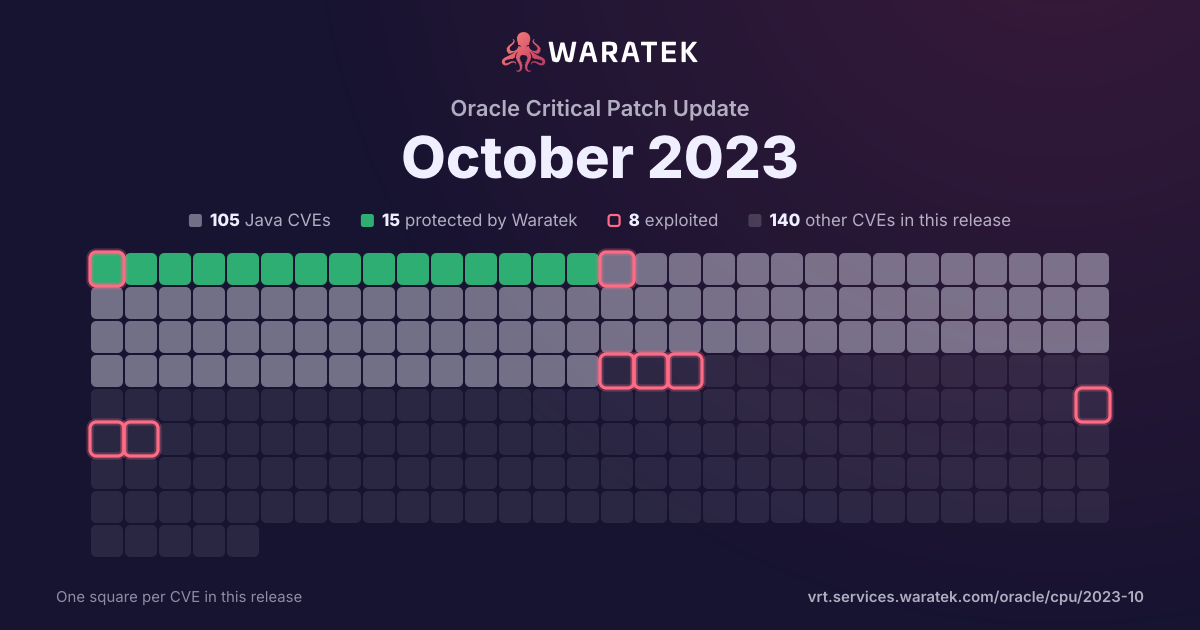
By status
13Protected by Waratek3Mitigation candidate92No exploit published5Outside Waratek scope132Not applicable
8Exploited, marked by the ring
No exploit published. For 30 of them, Oracle's security advisory is the source of public detail.
Protected by Waratek. Waratek RASP can block exploitation of these on systems that have not applied the patch yet.
Overview 7 matches · 1 protected · 0 exploited · 0 CISA KEV · 0 public PoC · 0 EPSS ≥ 0.5
Protected by Waratek
1
14.3%
Rule in development
0
0.0%
Mitigation candidate
0
0.0%
No exploit published
6
85.7%
blocked by ARMR today
1
14.3%
partly blocked
0
0.0%
not blocked
6
85.7%
not established
0
0.0%
unrecorded
0
0.0%
Exploited
0
0.0%
Working exploit published
0
0.0%
Proof of concept only
0
0.0%
Forecast only
0
0.0%
No public exploit
7
100.0%
split by
peak 2 / month
Jun 232
No exploit published2
Medium2
not blocked2
No public exploit2
Jul 232
Protected by Waratek1
No exploit published1
Medium2
blocked by ARMR today1
not blocked1
No public exploit2
Aug 231
No exploit published1
Medium1
not blocked1
No public exploit1
Sep 231
No exploit published1
Medium1
not blocked1
No public exploit1
Oct 231
No exploit published1
Medium1
not blocked1
No public exploit1
Jun 23Jul 23Aug 23Sep 23Oct 23
| CVE | Severity | Published▾ | Status | Exploitation | Description |
|---|---|---|---|---|---|
| CVE-2023-22126 | Medium | 2023-10-17 | No exploit published | No public exploit | Vulnerability in the Oracle WebCenter Content product of Oracle Fusion Middleware (component: Content Server). The supported version that is affected is 12.2.1.4.0. Easily exploitable vulnerability allows unauthenticated attacker with network access via HTTP to compromise Oracle WebCenter Content. Successful attacks of this vulnerability can result in unauthorized read access to a subset of Oracle WebCenter Content accessible data. CVSS 3.1 Base Score 5.3 (Confidentiality impacts). CVSS Vector: (CVSS:3.1/AV:N/AC:L/PR:N/UI:N/S:U/C:L/I:N/A:N). |
| CVE-2023-41900 | Medium | 2023-09-15 | No exploit published | No public exploit | Jetty is a Java based web server and servlet engine. Versions 9.4.21 through 9.4.51, 10.0.15, and 11.0.15 are vulnerable to weak authentication. If a Jetty `OpenIdAuthenticator` uses the optional nested `LoginService`, and that `LoginService` decides to revoke an already authenticated user, then the current request will still treat the user as authenticated. The authentication is then cleared from the session and subsequent requests will not be treated as authenticated. So a request on a previously authenticated session could be allowed to bypass authentication after it had been rejected by the `LoginService`. This impacts usages of the jetty-openid which have configured a nested `LoginService` and where that `LoginService` will is capable of rejecting previously authenticated users. Versions 9.4.52, 10.0.16, and 11.0.16 have a patch for this issue. |
| CVE-2022-44730 | Medium | 2023-08-22 | No exploit published | No public exploit | Server-Side Request Forgery (SSRF) vulnerability in Apache Software Foundation Apache XML Graphics Batik.This issue affects Apache XML Graphics Batik: 1.16. A malicious SVG can probe user profile / data and send it directly as parameter to a URL. |
| CVE-2023-35887 | Medium | 2023-07-10 | Protected by Waratek | No public exploit | Exposure of Sensitive Information to an Unauthorized Actor vulnerability in Apache Software Foundation Apache MINA. In SFTP servers implemented using Apache MINA SSHD that use a RootedFileSystem, logged users may be able to discover "exists/does not exist" information about items outside the rooted tree via paths including parent navigation ("..") beyond the root, or involving symlinks. This issue affects Apache MINA: from 1.0 before 2.10. Users are recommended to upgrade to 2.10 |
| CVE-2023-33201 | Medium | 2023-07-05 | No exploit published | No public exploit | Bouncy Castle For Java before 1.74 is affected by an LDAP injection vulnerability. The vulnerability only affects applications that use an LDAP CertStore from Bouncy Castle to validate X.509 certificates. During the certificate validation process, Bouncy Castle inserts the certificate's Subject Name into an LDAP search filter without any escaping, which leads to an LDAP injection vulnerability. |
| CVE-2023-34462 | Medium | 2023-06-22 | No exploit published | No public exploit | Netty is an asynchronous event-driven network application framework for rapid development of maintainable high performance protocol servers & clients. The `SniHandler` can allocate up to 16MB of heap for each channel during the TLS handshake. When the handler or the channel does not have an idle timeout, it can be used to make a TCP server using the `SniHandler` to allocate 16MB of heap. The `SniHandler` class is a handler that waits for the TLS handshake to configure a `SslHandler` according to the indicated server name by the `ClientHello` record. For this matter it allocates a `ByteBuf` using the value defined in the `ClientHello` record. Normally the value of the packet should be smaller than the handshake packet but there are not checks done here and the way the code is written, it is possible to craft a packet that makes the `SslClientHelloHandler`. This vulnerability has been fixed in version 4.1.94.Final. |
| CVE-2023-35116 | Medium | 2023-06-14 | No exploit published | No public exploit | jackson-databind through 2.15.2 allows attackers to cause a denial of service or other unspecified impact via a crafted object that uses cyclic dependencies. NOTE: the vendor's perspective is that this is not a valid vulnerability report, because the steps of constructing a cyclic data structure and trying to serialize it cannot be achieved by an external attacker. |