
Oracle Critical Patch Update October 2023
Released October 2023 · Oracle's advisory ↗ · ← Critical Patch Update, July 2023 · Critical Patch Update, January 2024 →
245 CVEs in this release, one square each
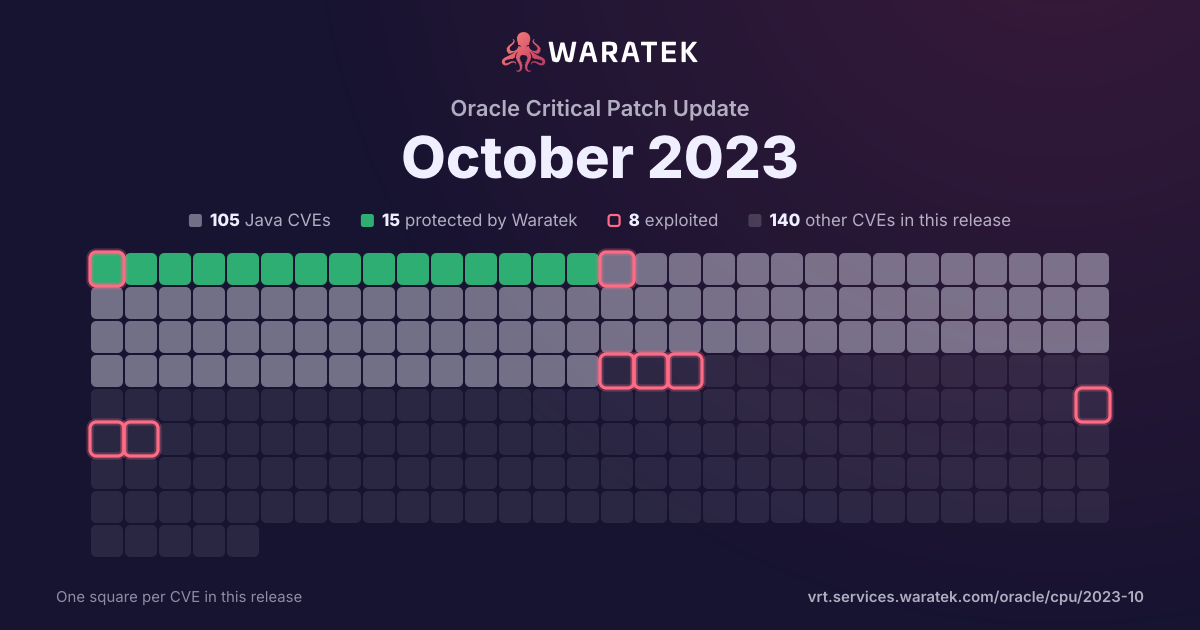
By status
13Protected by Waratek3Mitigation candidate92No exploit published5Outside Waratek scope132Not applicable
8Exploited, marked by the ring
No exploit published. For 30 of them, Oracle's security advisory is the source of public detail.
Protected by Waratek. Waratek RASP can block exploitation of these on systems that have not applied the patch yet.
Overview 10 matches · 0 protected · 0 exploited · 0 CISA KEV · 0 public PoC · 0 EPSS ≥ 0.5
10matches
0protected0.0%
0exploited0.0%
0CISA KEV0.0%
0public PoC0.0%
0EPSS ≥ 0.50.0%
Protected by Waratek
0
0.0%
Rule in development
0
0.0%
Mitigation candidate
0
0.0%
No exploit published
10
100.0%
blocked by ARMR today
0
0.0%
partly blocked
0
0.0%
not blocked
10
100.0%
not established
0
0.0%
unrecorded
0
0.0%
Exploited
0
0.0%
Working exploit published
0
0.0%
Proof of concept only
0
0.0%
Forecast only
0
0.0%
No public exploit
10
100.0%
split by
peak 8 / month
Jun 23Jul 23Aug 23Sep 23Oct 23
| CVE | Severity | Published▾ | Status | Exploitation | Description |
|---|---|---|---|---|---|
| CVE-2023-22125 | Medium | 2023-10-17 | No exploit published | No public exploit | Vulnerability in the Oracle Banking Trade Finance product of Oracle Financial Services Applications (component: Infrastructure). Supported versions that are affected are 14.5-14.7. Easily exploitable vulnerability allows low privileged attacker with network access via HTTP to compromise Oracle Banking Trade Finance. Successful attacks require human interaction from a person other than the attacker and while the vulnerability is in Oracle Banking Trade Finance, attacks may significantly impact additional products (scope change). Successful attacks of this vulnerability can result in unauthorized update, insert or delete access to some of Oracle Banking Trade Finance accessible data as well as unauthorized read access to a subset of Oracle Banking Trade Finance accessible data. CVSS 3.1 Base Score 5.4 (Confidentiality and Integrity impacts). CVSS Vector: (CVSS:3.1/AV:N/AC:L/PR:L/UI:R/S:C/C:L/I:L/A:N). |
| CVE-2023-22124 | Medium | 2023-10-17 | No exploit published | No public exploit | Vulnerability in the Oracle Banking Trade Finance product of Oracle Financial Services Applications (component: Infrastructure). Supported versions that are affected are 14.5-14.7. Easily exploitable vulnerability allows low privileged attacker with network access via HTTP to compromise Oracle Banking Trade Finance. Successful attacks require human interaction from a person other than the attacker and while the vulnerability is in Oracle Banking Trade Finance, attacks may significantly impact additional products (scope change). Successful attacks of this vulnerability can result in unauthorized update, insert or delete access to some of Oracle Banking Trade Finance accessible data as well as unauthorized read access to a subset of Oracle Banking Trade Finance accessible data. CVSS 3.1 Base Score 5.4 (Confidentiality and Integrity impacts). CVSS Vector: (CVSS:3.1/AV:N/AC:L/PR:L/UI:R/S:C/C:L/I:L/A:N). |
| CVE-2023-22123 | Medium | 2023-10-17 | No exploit published | No public exploit | Vulnerability in the Oracle Banking Trade Finance product of Oracle Financial Services Applications (component: Infrastructure). Supported versions that are affected are 14.5-14.7. Easily exploitable vulnerability allows low privileged attacker with network access via HTTP to compromise Oracle Banking Trade Finance. Successful attacks require human interaction from a person other than the attacker and while the vulnerability is in Oracle Banking Trade Finance, attacks may significantly impact additional products (scope change). Successful attacks of this vulnerability can result in unauthorized update, insert or delete access to some of Oracle Banking Trade Finance accessible data as well as unauthorized read access to a subset of Oracle Banking Trade Finance accessible data. CVSS 3.1 Base Score 5.4 (Confidentiality and Integrity impacts). CVSS Vector: (CVSS:3.1/AV:N/AC:L/PR:L/UI:R/S:C/C:L/I:L/A:N). |
| CVE-2023-22122 | Medium | 2023-10-17 | No exploit published | No public exploit | Vulnerability in the Oracle Banking Trade Finance product of Oracle Financial Services Applications (component: Infrastructure). Supported versions that are affected are 14.5-14.7. Difficult to exploit vulnerability allows low privileged attacker with network access via HTTP to compromise Oracle Banking Trade Finance. Successful attacks require human interaction from a person other than the attacker. Successful attacks of this vulnerability can result in unauthorized access to critical data or complete access to all Oracle Banking Trade Finance accessible data as well as unauthorized update, insert or delete access to some of Oracle Banking Trade Finance accessible data and unauthorized ability to cause a partial denial of service (partial DOS) of Oracle Banking Trade Finance. CVSS 3.1 Base Score 5.9 (Confidentiality, Integrity and Availability impacts). CVSS Vector: (CVSS:3.1/AV:N/AC:H/PR:L/UI:R/S:U/C:H/I:L/A:L). |
| CVE-2023-22121 | Medium | 2023-10-17 | No exploit published | No public exploit | Vulnerability in the Oracle Banking Trade Finance product of Oracle Financial Services Applications (component: Infrastructure). Supported versions that are affected are 14.5-14.7. Easily exploitable vulnerability allows unauthenticated attacker with network access via HTTP to compromise Oracle Banking Trade Finance. Successful attacks require human interaction from a person other than the attacker. Successful attacks of this vulnerability can result in unauthorized update, insert or delete access to some of Oracle Banking Trade Finance accessible data as well as unauthorized read access to a subset of Oracle Banking Trade Finance accessible data. CVSS 3.1 Base Score 5.4 (Confidentiality and Integrity impacts). CVSS Vector: (CVSS:3.1/AV:N/AC:L/PR:N/UI:R/S:U/C:L/I:L/A:N). |
| CVE-2023-22119 | Medium | 2023-10-17 | No exploit published | No public exploit | Vulnerability in the Oracle FLEXCUBE Universal Banking product of Oracle Financial Services Applications (component: Infrastructure). Supported versions that are affected are 12.3, 12.4, 14.0-14.3 and 14.5-14.7. Difficult to exploit vulnerability allows low privileged attacker with network access via HTTP to compromise Oracle FLEXCUBE Universal Banking. Successful attacks require human interaction from a person other than the attacker. Successful attacks of this vulnerability can result in unauthorized access to critical data or complete access to all Oracle FLEXCUBE Universal Banking accessible data as well as unauthorized update, insert or delete access to some of Oracle FLEXCUBE Universal Banking accessible data and unauthorized ability to cause a partial denial of service (partial DOS) of Oracle FLEXCUBE Universal Banking. CVSS 3.1 Base Score 5.9 (Confidentiality, Integrity and Availability impacts). CVSS Vector: (CVSS:3.1/AV:N/AC:H/PR:L/UI:R/S:U/C:H/I:L/A:L). |
| CVE-2023-22118 | Medium | 2023-10-17 | No exploit published | No public exploit | Vulnerability in the Oracle FLEXCUBE Universal Banking product of Oracle Financial Services Applications (component: Infrastructure). Supported versions that are affected are 12.3, 12.4, 14.0-14.3 and 14.5-14.7. Easily exploitable vulnerability allows low privileged attacker with network access via HTTP to compromise Oracle FLEXCUBE Universal Banking. Successful attacks require human interaction from a person other than the attacker and while the vulnerability is in Oracle FLEXCUBE Universal Banking, attacks may significantly impact additional products (scope change). Successful attacks of this vulnerability can result in unauthorized update, insert or delete access to some of Oracle FLEXCUBE Universal Banking accessible data as well as unauthorized read access to a subset of Oracle FLEXCUBE Universal Banking accessible data and unauthorized ability to cause a partial denial of service (partial DOS) of Oracle FLEXCUBE Universal Banking. CVSS 3.1 Base Score 6.5 (Confidentiality, Integrity and Availability impacts). CVSS Vector: (CVSS:3.1/AV:N/AC:L/PR:L/UI:R/S:C/C:L/I:L/A:L). |
| CVE-2023-22117 | Medium | 2023-10-17 | No exploit published | No public exploit | Vulnerability in the Oracle FLEXCUBE Universal Banking product of Oracle Financial Services Applications (component: Infrastructure). Supported versions that are affected are 12.3, 12.4, 14.0-14.3 and 14.5-14.7. Easily exploitable vulnerability allows low privileged attacker with network access via HTTP to compromise Oracle FLEXCUBE Universal Banking. Successful attacks require human interaction from a person other than the attacker and while the vulnerability is in Oracle FLEXCUBE Universal Banking, attacks may significantly impact additional products (scope change). Successful attacks of this vulnerability can result in unauthorized update, insert or delete access to some of Oracle FLEXCUBE Universal Banking accessible data as well as unauthorized read access to a subset of Oracle FLEXCUBE Universal Banking accessible data. CVSS 3.1 Base Score 5.4 (Confidentiality and Integrity impacts). CVSS Vector: (CVSS:3.1/AV:N/AC:L/PR:L/UI:R/S:C/C:L/I:L/A:N). |
| CVE-2023-33201 | Medium | 2023-07-05 | No exploit published | No public exploit | Bouncy Castle For Java before 1.74 is affected by an LDAP injection vulnerability. The vulnerability only affects applications that use an LDAP CertStore from Bouncy Castle to validate X.509 certificates. During the certificate validation process, Bouncy Castle inserts the certificate's Subject Name into an LDAP search filter without any escaping, which leads to an LDAP injection vulnerability. |
| CVE-2023-34462 | Medium | 2023-06-22 | No exploit published | No public exploit | Netty is an asynchronous event-driven network application framework for rapid development of maintainable high performance protocol servers & clients. The `SniHandler` can allocate up to 16MB of heap for each channel during the TLS handshake. When the handler or the channel does not have an idle timeout, it can be used to make a TCP server using the `SniHandler` to allocate 16MB of heap. The `SniHandler` class is a handler that waits for the TLS handshake to configure a `SslHandler` according to the indicated server name by the `ClientHello` record. For this matter it allocates a `ByteBuf` using the value defined in the `ClientHello` record. Normally the value of the packet should be smaller than the handshake packet but there are not checks done here and the way the code is written, it is possible to craft a packet that makes the `SslClientHelloHandler`. This vulnerability has been fixed in version 4.1.94.Final. |