
Oracle Critical Patch Update October 2023
Released October 2023 · Oracle's advisory ↗ · ← Critical Patch Update, July 2023 · Critical Patch Update, January 2024 →
245 CVEs in this release, one square each
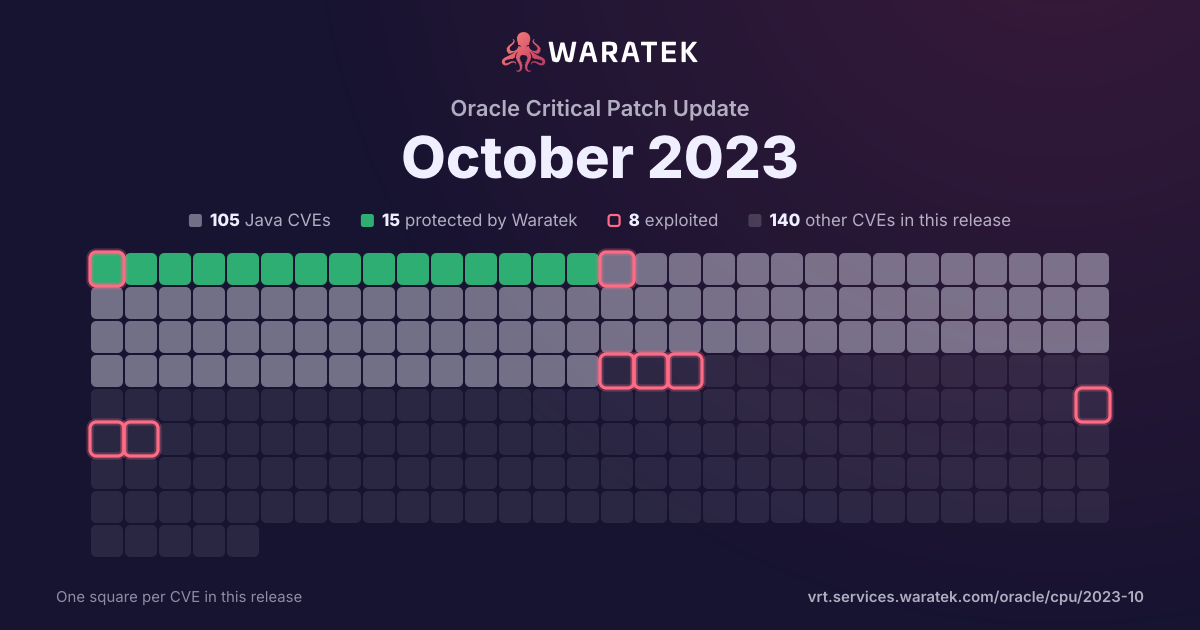
By status
15Protected by Waratek3Mitigation candidate87No exploit published44Outside Waratek scope96Not applicable
8Exploited, marked by the ring
No exploit published. For 35 of them, Oracle's security advisory is the source of public detail.
Protected by Waratek. Waratek RASP can block exploitation of these on systems that have not applied the patch yet.
Overview 96 matches · 0 in Waratek scope · 0 protected · 3 exploited · 0 CISA KEV · 7 public PoC · 6 EPSS ≥ 0.5
96matches
0in Waratek scope0.0%
0protected0.0%
3exploited3.1%
0CISA KEV0.0%
7public PoC7.3%
6EPSS ≥ 0.56.2%
Protected by Waratek
0
0.0%
Rule in development
0
0.0%
Mitigation candidate
0
0.0%
No exploit published
0
0.0%
Outside Waratek scope
0
0.0%
Not applicable
96
100.0%
Withdrawn CVE
0
0.0%
blocked by ARMR today
0
0.0%
partly blocked
0
0.0%
not blocked
96
100.0%
not established
0
0.0%
unrecorded
0
0.0%
Exploited
3
3.1%
Working exploit published
0
0.0%
Proof of concept only
29
30.2%
Forecast only
3
3.1%
No public exploit
61
63.5%
split by
peak 22 / quarter
Q1 211
Not applicable1
Medium1
not blocked1
No public exploit1
Q2 210
Q3 210
Q4 212
Not applicable2
High2
not blocked2
No public exploit2
Q1 221
Not applicable1
High1
not blocked1
No public exploit1
Q2 226
Not applicable6
Critical1
High3
Medium2
not blocked6
Proof of concept only3
No public exploit3
Q3 222
Not applicable2
Critical1
High1
not blocked2
Proof of concept only1
No public exploit1
Q4 227
Not applicable7
Critical1
High5
Medium1
not blocked7
Proof of concept only2
No public exploit5
Q1 2322
Not applicable22
Critical3
High10
Medium9
not blocked22
Exploited1
Proof of concept only7
Forecast only1
No public exploit13
Q2 2316
Not applicable16
High7
Medium9
not blocked16
Proof of concept only7
Forecast only1
No public exploit8
Q3 2321
Not applicable21
Critical3
High10
Medium8
not blocked21
Exploited2
Proof of concept only8
Forecast only1
No public exploit10
Q4 2318
Not applicable18
High7
Medium7
Low4
not blocked18
Proof of concept only1
No public exploit17
Q1 21Q2 21Q3 21Q4 21Q1 22Q2 22Q3 22Q4 22Q1 23Q2 23Q3 23Q4 23
| CVE | Severity | Published▾ | Status | Exploitation | Description |
|---|---|---|---|---|---|
| CVE-2023-30590 | High | 2023-11-28 | Not applicable | No public exploit | The generateKeys() API function returned from crypto.createDiffieHellman() only generates missing (or outdated) keys, that is, it only generates a private key if none has been set yet, but the function is also needed to compute the corresponding public key after calling setPrivateKey(). However, the documentation says this API call: "Generates private and public Diffie-Hellman key values". The documented behavior is very different from the actual behavior, and this difference could easily lead to security issues in applications that use these APIs as the DiffieHellman may be used as the basis for application-level security, implications are consequently broad. |
| CVE-2023-30588 | Medium | 2023-11-28 | Not applicable | No public exploit | When an invalid public key is used to create an x509 certificate using the crypto.X509Certificate() API a non-expect termination occurs making it susceptible to DoS attacks when the attacker could force interruptions of application processing, as the process terminates when accessing public key info of provided certificates from user code. The current context of the users will be gone, and that will cause a DoS scenario. This vulnerability affects all active Node.js versions v16, v18, and, v20. |
| CVE-2023-30585 | High | 2023-11-28 | Not applicable | No public exploit | A vulnerability has been identified in the Node.js (.msi version) installation process, specifically affecting Windows users who install Node.js using the .msi installer. This vulnerability emerges during the repair operation, where the "msiexec.exe" process, running under the NT AUTHORITY\SYSTEM context, attempts to read the %USERPROFILE% environment variable from the current user's registry. The issue arises when the path referenced by the %USERPROFILE% environment variable does not exist. In such cases, the "msiexec.exe" process attempts to create the specified path in an unsafe manner, potentially leading to the creation of arbitrary folders in arbitrary locations. The severity of this vulnerability is heightened by the fact that the %USERPROFILE% environment variable in the Windows registry can be modified by standard (or "non-privileged") users. Consequently, unprivileged actors, including malicious entities or trojans, can manipulate the environment variable key to deceive the privileged "msiexec.exe" process. This manipulation can result in the creation of folders in unintended and potentially malicious locations. It is important to note that this vulnerability is specific to Windows users who install Node.js using the .msi installer. Users who opt for other installation methods are not affected by this particular issue. |
| CVE-2023-38546 | Low | 2023-10-18 | Not applicable | No public exploit | This flaw allows an attacker to insert cookies at will into a running program using libcurl, if the specific series of conditions are met. libcurl performs transfers. In its API, an application creates "easy handles" that are the individual handles for single transfers. libcurl provides a function call that duplicates en easy handle called [curl_easy_duphandle](https://curl.se/libcurl/c/curl_easy_duphandle.html). If a transfer has cookies enabled when the handle is duplicated, the cookie-enable state is also cloned - but without cloning the actual cookies. If the source handle did not read any cookies from a specific file on disk, the cloned version of the handle would instead store the file name as `none` (using the four ASCII letters, no quotes). Subsequent use of the cloned handle that does not explicitly set a source to load cookies from would then inadvertently load cookies from a file named `none` - if such a file exists and is readable in the current directory of the program using libcurl. And if using the correct file format of course. |
| CVE-2023-22130 | Medium | 2023-10-17 | Not applicable | No public exploit | Vulnerability in the Sun ZFS Storage Appliance product of Oracle Systems (component: Core). The supported version that is affected is 8.8.60. Difficult to exploit vulnerability allows unauthenticated attacker with network access via HTTP to compromise Sun ZFS Storage Appliance. Successful attacks of this vulnerability can result in unauthorized ability to cause a hang or frequently repeatable crash (complete DOS) of Sun ZFS Storage Appliance. CVSS 3.1 Base Score 5.9 (Availability impacts). CVSS Vector: (CVSS:3.1/AV:N/AC:H/PR:N/UI:N/S:U/C:N/I:N/A:H). |
| CVE-2023-22129 | Medium | 2023-10-17 | Not applicable | No public exploit | Vulnerability in the Oracle Solaris product of Oracle Systems (component: Kernel). The supported version that is affected is 11. Easily exploitable vulnerability allows low privileged attacker with logon to the infrastructure where Oracle Solaris executes to compromise Oracle Solaris. Successful attacks of this vulnerability can result in unauthorized ability to cause a hang or frequently repeatable crash (complete DOS) of Oracle Solaris. Note: This vunlerability only affects SPARC Systems. CVSS 3.1 Base Score 5.5 (Availability impacts). CVSS Vector: (CVSS:3.1/AV:L/AC:L/PR:L/UI:N/S:U/C:N/I:N/A:H). |
| CVE-2023-22128 | Low | 2023-10-17 | Not applicable | No public exploit | Vulnerability in the Oracle Solaris product of Oracle Systems (component: Filesystem). Supported versions that are affected are 10 and 11. Difficult to exploit vulnerability allows unauthenticated attacker with network access via rquota to compromise Oracle Solaris. Successful attacks require human interaction from a person other than the attacker. Successful attacks of this vulnerability can result in unauthorized read access to a subset of Oracle Solaris accessible data. CVSS 3.1 Base Score 3.1 (Confidentiality impacts). CVSS Vector: (CVSS:3.1/AV:N/AC:H/PR:N/UI:R/S:U/C:L/I:N/A:N). |
| CVE-2023-22127 | Medium | 2023-10-17 | Not applicable | No public exploit | Vulnerability in the Oracle Outside In Technology product of Oracle Fusion Middleware (component: Content Access SDK, Image Export SDK, PDF Export SDK, HTML Export SDK). The supported version that is affected is 8.5.6. Easily exploitable vulnerability allows low privileged attacker with network access via HTTP to compromise Oracle Outside In Technology. Successful attacks of this vulnerability can result in unauthorized update, insert or delete access to some of Oracle Outside In Technology accessible data as well as unauthorized read access to a subset of Oracle Outside In Technology accessible data and unauthorized ability to cause a partial denial of service (partial DOS) of Oracle Outside In Technology. CVSS 3.1 Base Score 6.3 (Confidentiality, Integrity and Availability impacts). CVSS Vector: (CVSS:3.1/AV:N/AC:L/PR:L/UI:N/S:U/C:L/I:L/A:L). |
| CVE-2023-22100 | High | 2023-10-17 | Not applicable | No public exploit | Vulnerability in the Oracle VM VirtualBox product of Oracle Virtualization (component: Core). Supported versions that are affected are Prior to 7.0.12. Easily exploitable vulnerability allows high privileged attacker with logon to the infrastructure where Oracle VM VirtualBox executes to compromise Oracle VM VirtualBox. While the vulnerability is in Oracle VM VirtualBox, attacks may significantly impact additional products (scope change). Successful attacks of this vulnerability can result in unauthorized access to critical data or complete access to all Oracle VM VirtualBox accessible data and unauthorized ability to cause a hang or frequently repeatable crash (complete DOS) of Oracle VM VirtualBox. Note: Only applicable to 7.0.x platform. CVSS 3.1 Base Score 7.9 (Confidentiality and Availability impacts). CVSS Vector: (CVSS:3.1/AV:L/AC:L/PR:H/UI:N/S:C/C:H/I:N/A:H). |
| CVE-2023-22099 | High | 2023-10-17 | Not applicable | No public exploit | Vulnerability in the Oracle VM VirtualBox product of Oracle Virtualization (component: Core). Supported versions that are affected are Prior to 7.0.12. Easily exploitable vulnerability allows high privileged attacker with logon to the infrastructure where Oracle VM VirtualBox executes to compromise Oracle VM VirtualBox. While the vulnerability is in Oracle VM VirtualBox, attacks may significantly impact additional products (scope change). Successful attacks of this vulnerability can result in takeover of Oracle VM VirtualBox. Note: Only applicable to 7.0.x platform. CVSS 3.1 Base Score 8.2 (Confidentiality, Integrity and Availability impacts). CVSS Vector: (CVSS:3.1/AV:L/AC:L/PR:H/UI:N/S:C/C:H/I:H/A:H). |
| CVE-2023-22098 | High | 2023-10-17 | Not applicable | Proof of concept only | Vulnerability in the Oracle VM VirtualBox product of Oracle Virtualization (component: Core). Supported versions that are affected are Prior to 7.0.12. Easily exploitable vulnerability allows high privileged attacker with logon to the infrastructure where Oracle VM VirtualBox executes to compromise Oracle VM VirtualBox. While the vulnerability is in Oracle VM VirtualBox, attacks may significantly impact additional products (scope change). Successful attacks of this vulnerability can result in takeover of Oracle VM VirtualBox. Note: Only applicable to 7.0.x platform. CVSS 3.1 Base Score 8.2 (Confidentiality, Integrity and Availability impacts). CVSS Vector: (CVSS:3.1/AV:L/AC:L/PR:H/UI:N/S:C/C:H/I:H/A:H). |
| CVE-2023-22096 | Medium | 2023-10-17 | Not applicable | No public exploit | Vulnerability in the Java VM component of Oracle Database Server. Supported versions that are affected are 19.3-19.20 and 21.3-21.11. Easily exploitable vulnerability allows low privileged attacker having Create Session, Create Procedure privilege with network access via Oracle Net to compromise Java VM. Successful attacks of this vulnerability can result in unauthorized update, insert or delete access to some of Java VM accessible data. CVSS 3.1 Base Score 4.3 (Integrity impacts). CVSS Vector: (CVSS:3.1/AV:N/AC:L/PR:L/UI:N/S:U/C:N/I:L/A:N). |
| CVE-2023-22094 | High | 2023-10-17 | Not applicable | No public exploit | Vulnerability in the MySQL Installer product of Oracle MySQL (component: Installer: General). Supported versions that are affected are Prior to 1.6.8. Easily exploitable vulnerability allows low privileged attacker with logon to the infrastructure where MySQL Installer executes to compromise MySQL Installer. Successful attacks require human interaction from a person other than the attacker and while the vulnerability is in MySQL Installer, attacks may significantly impact additional products (scope change). Successful attacks of this vulnerability can result in unauthorized creation, deletion or modification access to critical data or all MySQL Installer accessible data and unauthorized ability to cause a hang or frequently repeatable crash (complete DOS) of MySQL Installer. Note: This patch is used in MySQL Server bundled version 8.0.35 and 5.7.44. CVSS 3.1 Base Score 7.9 (Integrity and Availability impacts). CVSS Vector: (CVSS:3.1/AV:L/AC:L/PR:L/UI:R/S:C/C:N/I:H/A:H). |
| CVE-2023-22077 | Medium | 2023-10-17 | Not applicable | No public exploit | Vulnerability in the Oracle Database Recovery Manager component of Oracle Database Server. Supported versions that are affected are 19.3-19.20 and 21.3-21.11. Easily exploitable vulnerability allows high privileged attacker having DBA account privilege with network access via Oracle Net to compromise Oracle Database Recovery Manager. Successful attacks of this vulnerability can result in unauthorized ability to cause a hang or frequently repeatable crash (complete DOS) of Oracle Database Recovery Manager. CVSS 3.1 Base Score 4.9 (Availability impacts). CVSS Vector: (CVSS:3.1/AV:N/AC:L/PR:H/UI:N/S:U/C:N/I:N/A:H). |
| CVE-2023-22075 | Low | 2023-10-17 | Not applicable | No public exploit | Vulnerability in the Oracle Database Sharding component of Oracle Database Server. Supported versions that are affected are 19.3-19.20 and 21.3-21.11. Easily exploitable vulnerability allows high privileged attacker having Create Session, Create Any View, Select Any Table privilege with network access via Oracle Net to compromise Oracle Database Sharding. Successful attacks require human interaction from a person other than the attacker. Successful attacks of this vulnerability can result in unauthorized ability to cause a partial denial of service (partial DOS) of Oracle Database Sharding. CVSS 3.1 Base Score 2.4 (Availability impacts). CVSS Vector: (CVSS:3.1/AV:N/AC:L/PR:H/UI:R/S:U/C:N/I:N/A:L). |
| CVE-2023-22074 | Low | 2023-10-17 | Not applicable | No public exploit | Vulnerability in the Oracle Database Sharding component of Oracle Database Server. Supported versions that are affected are 19.3-19.20 and 21.3-21.11. Easily exploitable vulnerability allows high privileged attacker having Create Session, Select Any Dictionary privilege with network access via Oracle Net to compromise Oracle Database Sharding. Successful attacks require human interaction from a person other than the attacker. Successful attacks of this vulnerability can result in unauthorized ability to cause a partial denial of service (partial DOS) of Oracle Database Sharding. CVSS 3.1 Base Score 2.4 (Availability impacts). CVSS Vector: (CVSS:3.1/AV:N/AC:L/PR:H/UI:R/S:U/C:N/I:N/A:L). |
| CVE-2023-22073 | Medium | 2023-10-17 | Not applicable | No public exploit | Vulnerability in the Oracle Notification Server component of Oracle Database Server. Supported versions that are affected are 19.3-19.20 and 21.3-21.11. Easily exploitable vulnerability allows unauthenticated attacker with access to the physical communication segment attached to the hardware where the Oracle Notification Server executes to compromise Oracle Notification Server. Successful attacks of this vulnerability can result in unauthorized read access to a subset of Oracle Notification Server accessible data. CVSS 3.1 Base Score 4.3 (Confidentiality impacts). CVSS Vector: (CVSS:3.1/AV:A/AC:L/PR:N/UI:N/S:U/C:L/I:N/A:N). |
| CVE-2023-22019 | High | 2023-10-17 | Not applicable | No public exploit | Vulnerability in the Oracle HTTP Server product of Oracle Fusion Middleware (component: Web Listener). The supported version that is affected is 12.2.1.4.0. Easily exploitable vulnerability allows unauthenticated attacker with network access via HTTP to compromise Oracle HTTP Server. Successful attacks of this vulnerability can result in unauthorized access to critical data or complete access to all Oracle HTTP Server accessible data. CVSS 3.1 Base Score 7.5 (Confidentiality impacts). CVSS Vector: (CVSS:3.1/AV:N/AC:L/PR:N/UI:N/S:U/C:H/I:N/A:N). |
| CVE-2023-38039 | High | 2023-09-15 | Not applicable | Proof of concept only | When curl retrieves an HTTP response, it stores the incoming headers so that they can be accessed later via the libcurl headers API. However, curl did not have a limit in how many or how large headers it would accept in a response, allowing a malicious server to stream an endless series of headers and eventually cause curl to run out of heap memory. |
| CVE-2023-4039 | Medium | 2023-09-13 | Not applicable | Proof of concept only | **DISPUTED**A failure in the -fstack-protector feature in GCC-based toolchains that target AArch64 allows an attacker to exploit an existing buffer overflow in dynamically-sized local variables in your application without this being detected. This stack-protector failure only applies to C99-style dynamically-sized local variables or those created using alloca(). The stack-protector operates as intended for statically-sized local variables. The default behavior when the stack-protector detects an overflow is to terminate your application, resulting in controlled loss of availability. An attacker who can exploit a buffer overflow without triggering the stack-protector might be able to change program flow control to cause an uncontrolled loss of availability or to go further and affect confidentiality or integrity. NOTE: The GCC project argues that this is a missed hardening bug and not a vulnerability by itself. |
| CVE-2023-3824 | Critical | 2023-08-11 | Not applicable | Exploited | In PHP version 8.0.* before 8.0.30, 8.1.* before 8.1.22, and 8.2.* before 8.2.8, when loading phar file, while reading PHAR directory entries, insufficient length checking may lead to a stack buffer overflow, leading potentially to memory corruption or RCE. |
| CVE-2023-3823 | High | 2023-08-11 | Not applicable | No public exploit | In PHP versions 8.0.* before 8.0.30, 8.1.* before 8.1.22, and 8.2.* before 8.2.8 various XML functions rely on libxml global state to track configuration variables, like whether external entities are loaded. This state is assumed to be unchanged unless the user explicitly changes it by calling appropriate function. However, since the state is process-global, other modules - such as ImageMagick - may also use this library within the same process, and change that global state for their internal purposes, and leave it in a state where external entities loading is enabled. This can lead to the situation where external XML is parsed with external entities loaded, which can lead to disclosure of any local files accessible to PHP. This vulnerable state may persist in the same process across many requests, until the process is shut down. |
| CVE-2022-40982 | Medium | 2023-08-11 | Not applicable | No public exploit | Information exposure through microarchitectural state after transient execution in certain vector execution units for some Intel(R) Processors may allow an authenticated user to potentially enable information disclosure via local access. |
| CVE-2023-4004 | High | 2023-07-31 | Not applicable | No public exploit | A use-after-free flaw was found in the Linux kernel's netfilter in the way a user triggers the nft_pipapo_remove function with the element, without a NFT_SET_EXT_KEY_END. This issue could allow a local user to crash the system or potentially escalate their privileges on the system. |
| CVE-2023-3817 | Medium | 2023-07-31 | Not applicable | No public exploit | Issue summary: Checking excessively long DH keys or parameters may be very slow. Impact summary: Applications that use the functions DH_check(), DH_check_ex() or EVP_PKEY_param_check() to check a DH key or DH parameters may experience long delays. Where the key or parameters that are being checked have been obtained from an untrusted source this may lead to a Denial of Service. The function DH_check() performs various checks on DH parameters. After fixing CVE-2023-3446 it was discovered that a large q parameter value can also trigger an overly long computation during some of these checks. A correct q value, if present, cannot be larger than the modulus p parameter, thus it is unnecessary to perform these checks if q is larger than p. An application that calls DH_check() and supplies a key or parameters obtained from an untrusted source could be vulnerable to a Denial of Service attack. The function DH_check() is itself called by a number of other OpenSSL functions. An application calling any of those other functions may similarly be affected. The other functions affected by this are DH_check_ex() and EVP_PKEY_param_check(). Also vulnerable are the OpenSSL dhparam and pkeyparam command line applications when using the "-check" option. The OpenSSL SSL/TLS implementation is not affected by this issue. The OpenSSL 3.0 and 3.1 FIPS providers are not affected by this issue. |
| CVE-2023-39017 | Critical | 2023-07-28 | Not applicable | Proof of concept only | quartz-jobs 2.3.2 and below was discovered to contain a code injection vulnerability in the component org.quartz.jobs.ee.jms.SendQueueMessageJob.execute. This vulnerability is exploited via passing an unchecked argument. NOTE: this is disputed by multiple parties because it is not plausible that untrusted user input would reach the code location where injection must occur. |
| CVE-2023-20593 | Medium | 2023-07-24 | Not applicable | Proof of concept only | An issue in “Zen 2” CPUs, under specific microarchitectural circumstances, may allow an attacker to potentially access sensitive information. |
| CVE-2023-3247 | Medium | 2023-07-22 | Not applicable | No public exploit | In PHP versions 8.0.* before 8.0.29, 8.1.* before 8.1.20, 8.2.* before 8.2.7 when using SOAP HTTP Digest Authentication, random value generator was not checked for failure, and was using narrower range of values than it should have. In case of random generator failure, it could lead to a disclosure of 31 bits of uninitialized memory from the client to the server, and it also made easier to a malicious server to guess the client's nonce. |
| CVE-2023-3776 | High | 2023-07-21 | Not applicable | No public exploit | A use-after-free vulnerability in the Linux kernel's net/sched: cls_fw component can be exploited to achieve local privilege escalation. If tcf_change_indev() fails, fw_set_parms() will immediately return an error after incrementing or decrementing the reference counter in tcf_bind_filter(). If an attacker can control the reference counter and set it to zero, they can cause the reference to be freed, leading to a use-after-free vulnerability. We recommend upgrading past commit 0323bce598eea038714f941ce2b22541c46d488f. |
| CVE-2023-38408 | Critical | 2023-07-20 | Not applicable | Exploited | The PKCS#11 feature in ssh-agent in OpenSSH before 9.3p2 has an insufficiently trustworthy search path, leading to remote code execution if an agent is forwarded to an attacker-controlled system. (Code in /usr/lib is not necessarily safe for loading into ssh-agent.) NOTE: this issue exists because of an incomplete fix for CVE-2016-10009. |
| CVE-2023-3446 | Medium | 2023-07-19 | Not applicable | No public exploit | Issue summary: Checking excessively long DH keys or parameters may be very slow. Impact summary: Applications that use the functions DH_check(), DH_check_ex() or EVP_PKEY_param_check() to check a DH key or DH parameters may experience long delays. Where the key or parameters that are being checked have been obtained from an untrusted source this may lead to a Denial of Service. The function DH_check() performs various checks on DH parameters. One of those checks confirms that the modulus ('p' parameter) is not too large. Trying to use a very large modulus is slow and OpenSSL will not normally use a modulus which is over 10,000 bits in length. However the DH_check() function checks numerous aspects of the key or parameters that have been supplied. Some of those checks use the supplied modulus value even if it has already been found to be too large. An application that calls DH_check() and supplies a key or parameters obtained from an untrusted source could be vulernable to a Denial of Service attack. The function DH_check() is itself called by a number of other OpenSSL functions. An application calling any of those other functions may similarly be affected. The other functions affected by this are DH_check_ex() and EVP_PKEY_param_check(). Also vulnerable are the OpenSSL dhparam and pkeyparam command line applications when using the '-check' option. The OpenSSL SSL/TLS implementation is not affected by this issue. The OpenSSL 3.0 and 3.1 FIPS providers are not affected by this issue. |
| CVE-2022-40896 | Medium | 2023-07-19 | Not applicable | No public exploit | A ReDoS issue was discovered in pygments/lexers/smithy.py in pygments through 2.15.0 via SmithyLexer. |
| CVE-2022-41409 | High | 2023-07-18 | Not applicable | Proof of concept only | Integer overflow vulnerability in pcre2test before 10.41 allows attackers to cause a denial of service or other unspecified impacts via negative input. |
| CVE-2023-38325 | High | 2023-07-14 | Not applicable | Proof of concept only | The cryptography package before 41.0.2 for Python mishandles SSH certificates that have critical options. |
| CVE-2023-2975 | Medium | 2023-07-14 | Not applicable | No public exploit | Issue summary: The AES-SIV cipher implementation contains a bug that causes it to ignore empty associated data entries which are unauthenticated as a consequence. Impact summary: Applications that use the AES-SIV algorithm and want to authenticate empty data entries as associated data can be misled by removing, adding or reordering such empty entries as these are ignored by the OpenSSL implementation. We are currently unaware of any such applications. The AES-SIV algorithm allows for authentication of multiple associated data entries along with the encryption. To authenticate empty data the application has to call EVP_EncryptUpdate() (or EVP_CipherUpdate()) with NULL pointer as the output buffer and 0 as the input buffer length. The AES-SIV implementation in OpenSSL just returns success for such a call instead of performing the associated data authentication operation. The empty data thus will not be authenticated. As this issue does not affect non-empty associated data authentication and we expect it to be rare for an application to use empty associated data entries this is qualified as Low severity issue. |
| CVE-2022-24834 | High | 2023-07-13 | Not applicable | Proof of concept only | Redis is an in-memory database that persists on disk. A specially crafted Lua script executing in Redis can trigger a heap overflow in the cjson library, and result with heap corruption and potentially remote code execution. The problem exists in all versions of Redis with Lua scripting support, starting from 2.6, and affects only authenticated and authorized users. The problem is fixed in versions 7.0.12, 6.2.13, and 6.0.20. |
| CVE-2023-36824 | High | 2023-07-11 | Not applicable | Forecast only | Redis is an in-memory database that persists on disk. In Redit 7.0 prior to 7.0.12, extracting key names from a command and a list of arguments may, in some cases, trigger a heap overflow and result in reading random heap memory, heap corruption and potentially remote code execution. Several scenarios that may lead to authenticated users executing a specially crafted `COMMAND GETKEYS` or `COMMAND GETKEYSANDFLAGS`and authenticated users who were set with ACL rules that match key names, executing a specially crafted command that refers to a variadic list of key names. The vulnerability is patched in Redis 7.0.12. |
| CVE-2023-35001 | High | 2023-07-05 | Not applicable | Proof of concept only | Linux Kernel nftables Out-Of-Bounds Read/Write Vulnerability; nft_byteorder poorly handled vm register contents when CAP_NET_ADMIN is in any user or network namespace |
| CVE-2023-30589 | High | 2023-07-01 | Not applicable | No public exploit | The llhttp parser in the http module in Node v20.2.0 does not strictly use the CRLF sequence to delimit HTTP requests. This can lead to HTTP Request Smuggling (HRS). The CR character (without LF) is sufficient to delimit HTTP header fields in the llhttp parser. According to RFC7230 section 3, only the CRLF sequence should delimit each header-field. This impacts all Node.js active versions: v16, v18, and, v20 |
| CVE-2023-3390 | High | 2023-06-28 | Not applicable | No public exploit | A use-after-free vulnerability was found in the Linux kernel's netfilter subsystem in net/netfilter/nf_tables_api.c. Mishandled error handling with NFT_MSG_NEWRULE makes it possible to use a dangling pointer in the same transaction causing a use-after-free vulnerability. This flaw allows a local attacker with user access to cause a privilege escalation issue. We recommend upgrading past commit 1240eb93f0616b21c675416516ff3d74798fdc97 |
| CVE-2023-3090 | High | 2023-06-28 | Not applicable | Proof of concept only | A heap out-of-bounds write vulnerability in the Linux Kernel ipvlan network driver can be exploited to achieve local privilege escalation. The out-of-bounds write is caused by missing skb->cb initialization in the ipvlan network driver. The vulnerability is reachable if CONFIG_IPVLAN is enabled. We recommend upgrading past commit 90cbed5247439a966b645b34eb0a2e037836ea8e. |
| CVE-2023-35788 | High | 2023-06-16 | Not applicable | Proof of concept only | An issue was discovered in fl_set_geneve_opt in net/sched/cls_flower.c in the Linux kernel before 6.3.7. It allows an out-of-bounds write in the flower classifier code via TCA_FLOWER_KEY_ENC_OPTS_GENEVE packets. This may result in denial of service or privilege escalation. |
| CVE-2023-2603 | High | 2023-06-06 | Not applicable | No public exploit | A vulnerability was found in libcap. This issue occurs in the _libcap_strdup() function and can lead to an integer overflow if the input string is close to 4GiB. |
| CVE-2023-2650 | Medium | 2023-05-30 | Not applicable | Forecast only | Issue summary: Processing some specially crafted ASN.1 object identifiers or data containing them may be very slow. Impact summary: Applications that use OBJ_obj2txt() directly, or use any of the OpenSSL subsystems OCSP, PKCS7/SMIME, CMS, CMP/CRMF or TS with no message size limit may experience notable to very long delays when processing those messages, which may lead to a Denial of Service. An OBJECT IDENTIFIER is composed of a series of numbers - sub-identifiers - most of which have no size limit. OBJ_obj2txt() may be used to translate an ASN.1 OBJECT IDENTIFIER given in DER encoding form (using the OpenSSL type ASN1_OBJECT) to its canonical numeric text form, which are the sub-identifiers of the OBJECT IDENTIFIER in decimal form, separated by periods. When one of the sub-identifiers in the OBJECT IDENTIFIER is very large (these are sizes that are seen as absurdly large, taking up tens or hundreds of KiBs), the translation to a decimal number in text may take a very long time. The time complexity is O(n^2) with 'n' being the size of the sub-identifiers in bytes (*). With OpenSSL 3.0, support to fetch cryptographic algorithms using names / identifiers in string form was introduced. This includes using OBJECT IDENTIFIERs in canonical numeric text form as identifiers for fetching algorithms. Such OBJECT IDENTIFIERs may be received through the ASN.1 structure AlgorithmIdentifier, which is commonly used in multiple protocols to specify what cryptographic algorithm should be used to sign or verify, encrypt or decrypt, or digest passed data. Applications that call OBJ_obj2txt() directly with untrusted data are affected, with any version of OpenSSL. If the use is for the mere purpose of display, the severity is considered low. In OpenSSL 3.0 and newer, this affects the subsystems OCSP, PKCS7/SMIME, CMS, CMP/CRMF or TS. It also impacts anything that processes X.509 certificates, including simple things like verifying its signature. The impact on TLS is relatively low, because all versions of OpenSSL have a 100KiB limit on the peer's certificate chain. Additionally, this only impacts clients, or servers that have explicitly enabled client authentication. In OpenSSL 1.1.1 and 1.0.2, this only affects displaying diverse objects, such as X.509 certificates. This is assumed to not happen in such a way that it would cause a Denial of Service, so these versions are considered not affected by this issue in such a way that it would be cause for concern, and the severity is therefore considered low. |
| CVE-2023-28322 | Medium | 2023-05-26 | Not applicable | Proof of concept only | An information disclosure vulnerability exists in curl <v8.1.0 when doing HTTP(S) transfers, libcurl might erroneously use the read callback (`CURLOPT_READFUNCTION`) to ask for data to send, even when the `CURLOPT_POSTFIELDS` option has been set, if the same handle previously wasused to issue a `PUT` request which used that callback. This flaw may surprise the application and cause it to misbehave and either send off the wrong data or use memory after free or similar in the second transfer. The problem exists in the logic for a reused handle when it is (expected to be) changed from a PUT to a POST. |
| CVE-2023-28321 | Medium | 2023-05-26 | Not applicable | Proof of concept only | An improper certificate validation vulnerability exists in curl <v8.1.0 in the way it supports matching of wildcard patterns when listed as "Subject Alternative Name" in TLS server certificates. curl can be built to use its own name matching function for TLS rather than one provided by a TLS library. This private wildcard matching function would match IDN (International Domain Name) hosts incorrectly and could as a result accept patterns that otherwise should mismatch. IDN hostnames are converted to puny code before used for certificate checks. Puny coded names always start with `xn--` and should not be allowed to pattern match, but the wildcard check in curl could still check for `x*`, which would match even though the IDN name most likely contained nothing even resembling an `x`. |
| CVE-2023-28320 | Medium | 2023-05-26 | Not applicable | Proof of concept only | A denial of service vulnerability exists in curl <v8.1.0 in the way libcurl provides several different backends for resolving host names, selected at build time. If it is built to use the synchronous resolver, it allows name resolves to time-out slow operations using `alarm()` and `siglongjmp()`. When doing this, libcurl used a global buffer that was not mutex protected and a multi-threaded application might therefore crash or otherwise misbehave. |
| CVE-2023-28319 | High | 2023-05-26 | Not applicable | Proof of concept only | A use after free vulnerability exists in curl <v8.1.0 in the way libcurl offers a feature to verify an SSH server's public key using a SHA 256 hash. When this check fails, libcurl would free the memory for the fingerprint before it returns an error message containing the (now freed) hash. This flaw risks inserting sensitive heap-based data into the error message that might be shown to users or otherwise get leaked and revealed. |
| CVE-2023-2283 | Medium | 2023-05-26 | Not applicable | No public exploit | A vulnerability was found in libssh, where the authentication check of the connecting client can be bypassed in the`pki_verify_data_signature` function in memory allocation problems. This issue may happen if there is insufficient memory or the memory usage is limited. The problem is caused by the return value `rc,` which is initialized to SSH_ERROR and later rewritten to save the return value of the function call `pki_key_check_hash_compatible.` The value of the variable is not changed between this point and the cryptographic verification. Therefore any error between them calls `goto error` returning SSH_OK. |
| CVE-2023-2002 | Medium | 2023-05-26 | Not applicable | Proof of concept only | A vulnerability was found in the HCI sockets implementation due to a missing capability check in net/bluetooth/hci_sock.c in the Linux Kernel. This flaw allows an attacker to unauthorized execution of management commands, compromising the confidentiality, integrity, and availability of Bluetooth communication. |
| CVE-2023-30861 | High | 2023-05-02 | Not applicable | No public exploit | Flask is a lightweight WSGI web application framework. When all of the following conditions are met, a response containing data intended for one client may be cached and subsequently sent by the proxy to other clients. If the proxy also caches `Set-Cookie` headers, it may send one client's `session` cookie to other clients. The severity depends on the application's use of the session and the proxy's behavior regarding cookies. The risk depends on all these conditions being met. 1. The application must be hosted behind a caching proxy that does not strip cookies or ignore responses with cookies. 2. The application sets `session.permanent = True` 3. The application does not access or modify the session at any point during a request. 4. `SESSION_REFRESH_EACH_REQUEST` enabled (the default). 5. The application does not set a `Cache-Control` header to indicate that a page is private or should not be cached. This happens because vulnerable versions of Flask only set the `Vary: Cookie` header when the session is accessed or modified, not when it is refreshed (re-sent to update the expiration) without being accessed or modified. This issue has been fixed in versions 2.3.2 and 2.2.5. |
| CVE-2023-29469 | Medium | 2023-04-24 | Not applicable | No public exploit | An issue was discovered in libxml2 before 2.10.4. When hashing empty dict strings in a crafted XML document, xmlDictComputeFastKey in dict.c can produce non-deterministic values, leading to various logic and memory errors, such as a double free. This behavior occurs because there is an attempt to use the first byte of an empty string, and any value is possible (not solely the '\0' value). |
| CVE-2023-28484 | Medium | 2023-04-24 | Not applicable | No public exploit | In libxml2 before 2.10.4, parsing of certain invalid XSD schemas can lead to a NULL pointer dereference and subsequently a segfault. This occurs in xmlSchemaFixupComplexType in xmlschemas.c. |
| CVE-2023-1255 | Medium | 2023-04-20 | Not applicable | No public exploit | Issue summary: The AES-XTS cipher decryption implementation for 64 bit ARM platform contains a bug that could cause it to read past the input buffer, leading to a crash. Impact summary: Applications that use the AES-XTS algorithm on the 64 bit ARM platform can crash in rare circumstances. The AES-XTS algorithm is usually used for disk encryption. The AES-XTS cipher decryption implementation for 64 bit ARM platform will read past the end of the ciphertext buffer if the ciphertext size is 4 mod 5 in 16 byte blocks, e.g. 144 bytes or 1024 bytes. If the memory after the ciphertext buffer is unmapped, this will trigger a crash which results in a denial of service. If an attacker can control the size and location of the ciphertext buffer being decrypted by an application using AES-XTS on 64 bit ARM, the application is affected. This is fairly unlikely making this issue a Low severity one. |
| CVE-2023-29491 | High | 2023-04-14 | Not applicable | No public exploit | ncurses before 6.4 20230408, when used by a setuid application, allows local users to trigger security-relevant memory corruption via malformed data in a terminfo database file that is found in $HOME/.terminfo or reached via the TERMINFO or TERM environment variable. |
| CVE-2022-4899 | High | 2023-03-31 | Not applicable | No public exploit | A vulnerability was found in zstd v1.4.10, where an attacker can supply empty string as an argument to the command line tool to cause buffer overrun. |
| CVE-2023-27534 | High | 2023-03-30 | Not applicable | Proof of concept only | A path traversal vulnerability exists in curl <8.0.0 SFTP implementation causes the tilde (~) character to be wrongly replaced when used as a prefix in the first path element, in addition to its intended use as the first element to indicate a path relative to the user's home directory. Attackers can exploit this flaw to bypass filtering or execute arbitrary code by crafting a path like /~2/foo while accessing a server with a specific user. |
| CVE-2023-27533 | Critical | 2023-03-30 | Not applicable | Proof of concept only | A vulnerability in input validation exists in curl <8.0 during communication using the TELNET protocol may allow an attacker to pass on maliciously crafted user name and "telnet options" during server negotiation. The lack of proper input scrubbing allows an attacker to send content or perform option negotiation without the application's intent. This vulnerability could be exploited if an application allows user input, thereby enabling attackers to execute arbitrary code on the system. |
| CVE-2023-0466 | Medium | 2023-03-28 | Not applicable | No public exploit | The function X509_VERIFY_PARAM_add0_policy() is documented to implicitly enable the certificate policy check when doing certificate verification. However the implementation of the function does not enable the check which allows certificates with invalid or incorrect policies to pass the certificate verification. As suddenly enabling the policy check could break existing deployments it was decided to keep the existing behavior of the X509_VERIFY_PARAM_add0_policy() function. Instead the applications that require OpenSSL to perform certificate policy check need to use X509_VERIFY_PARAM_set1_policies() or explicitly enable the policy check by calling X509_VERIFY_PARAM_set_flags() with the X509_V_FLAG_POLICY_CHECK flag argument. Certificate policy checks are disabled by default in OpenSSL and are not commonly used by applications. |
| CVE-2023-0465 | Medium | 2023-03-28 | Not applicable | No public exploit | Applications that use a non-default option when verifying certificates may be vulnerable to an attack from a malicious CA to circumvent certain checks. Invalid certificate policies in leaf certificates are silently ignored by OpenSSL and other certificate policy checks are skipped for that certificate. A malicious CA could use this to deliberately assert invalid certificate policies in order to circumvent policy checking on the certificate altogether. Policy processing is disabled by default but can be enabled by passing the `-policy' argument to the command line utilities or by calling the `X509_VERIFY_PARAM_set1_policies()' function. |
| CVE-2023-28439 | Medium | 2023-03-22 | Not applicable | No public exploit | CKEditor4 is an open source what-you-see-is-what-you-get HTML editor. A cross-site scripting vulnerability has been discovered affecting Iframe Dialog and Media Embed packages. The vulnerability may trigger a JavaScript code after fulfilling special conditions: using one of the affected packages on a web page with missing proper Content Security Policy configuration; initializing the editor on an element and using an element other than `<textarea>` as a base; and destroying the editor instance. This vulnerability might affect a small percentage of integrators that depend on dynamic editor initialization/destroy mechanism. A fix is available in CKEditor4 version 4.21.0. In some rare cases, a security fix may be considered a breaking change. Starting from version 4.21.0, the Iframe Dialog plugin applies the `sandbox` attribute by default, which restricts JavaScript code execution in the iframe element. To change this behavior, configure the `config.iframe_attributes` option. Also starting from version 4.21.0, the Media Embed plugin regenerates the entire content of the embed widget by default. To change this behavior, configure the `config.embed_keepOriginalContent` option. Those who choose to enable either of the more permissive options or who cannot upgrade to a patched version should properly configure Content Security Policy to avoid any potential security issues that may arise from embedding iframe elements on their web page. |
| CVE-2023-0464 | High | 2023-03-22 | Not applicable | No public exploit | A security vulnerability has been identified in all supported versions of OpenSSL related to the verification of X.509 certificate chains that include policy constraints. Attackers may be able to exploit this vulnerability by creating a malicious certificate chain that triggers exponential use of computational resources, leading to a denial-of-service (DoS) attack on affected systems. Policy processing is disabled by default but can be enabled by passing the `-policy' argument to the command line utilities or by calling the `X509_VERIFY_PARAM_set1_policies()' function. |
| CVE-2023-27522 | High | 2023-03-07 | Not applicable | No public exploit | HTTP Response Smuggling vulnerability in Apache HTTP Server via mod_proxy_uwsgi. This issue affects Apache HTTP Server: from 2.4.30 through 2.4.55. Special characters in the origin response header can truncate/split the response forwarded to the client. |
| CVE-2023-25690 | Critical | 2023-03-07 | Not applicable | Exploited | Some mod_proxy configurations on Apache HTTP Server versions 2.4.0 through 2.4.55 allow a HTTP Request Smuggling attack. Configurations are affected when mod_proxy is enabled along with some form of RewriteRule or ProxyPassMatch in which a non-specific pattern matches some portion of the user-supplied request-target (URL) data and is then re-inserted into the proxied request-target using variable substitution. For example, something like: RewriteEngine on RewriteRule "^/here/(.*)" "http://example.com:8080/elsewhere?$1"; [P] ProxyPassReverse /here/ http://example.com:8080/ Request splitting/smuggling could result in bypass of access controls in the proxy server, proxying unintended URLs to existing origin servers, and cache poisoning. Users are recommended to update to at least version 2.4.56 of Apache HTTP Server. |
| CVE-2023-26604 | High | 2023-03-03 | Not applicable | Proof of concept only | systemd before 247 does not adequately block local privilege escalation for some Sudo configurations, e.g., plausible sudoers files in which the "systemctl status" command may be executed. Specifically, systemd does not set LESSSECURE to 1, and thus other programs may be launched from the less program. This presents a substantial security risk when running systemctl from Sudo, because less executes as root when the terminal size is too small to show the complete systemctl output. |
| CVE-2023-0567 | High | 2023-03-01 | Not applicable | No public exploit | In PHP 8.0.X before 8.0.28, 8.1.X before 8.1.16 and 8.2.X before 8.2.3, password_verify() function may accept some invalid Blowfish hashes as valid. If such invalid hash ever ends up in the password database, it may lead to an application allowing any password for this entry as valid. |
| CVE-2023-23916 | Medium | 2023-02-23 | Not applicable | Proof of concept only | An allocation of resources without limits or throttling vulnerability exists in curl <v7.88.0 based on the "chained" HTTP compression algorithms, meaning that a server response can be compressed multiple times and potentially with differentalgorithms. The number of acceptable "links" in this "decompression chain" wascapped, but the cap was implemented on a per-header basis allowing a maliciousserver to insert a virtually unlimited number of compression steps simply byusing many headers. The use of such a decompression chain could result in a "malloc bomb", making curl end up spending enormous amounts of allocated heap memory, or trying to and returning out of memory errors. |
| CVE-2023-23915 | Medium | 2023-02-23 | Not applicable | No public exploit | A cleartext transmission of sensitive information vulnerability exists in curl <v7.88.0 that could cause HSTS functionality to behave incorrectly when multiple URLs are requested in parallel. Using its HSTS support, curl can be instructed to use HTTPS instead of using an insecure clear-text HTTP step even when HTTP is provided in the URL. This HSTS mechanism would however surprisingly fail when multiple transfers are done in parallel as the HSTS cache file gets overwritten by the most recentlycompleted transfer. A later HTTP-only transfer to the earlier host name would then *not* get upgraded properly to HSTS. |
| CVE-2023-23914 | Critical | 2023-02-23 | Not applicable | Proof of concept only | A cleartext transmission of sensitive information vulnerability exists in curl <v7.88.0 that could cause HSTS functionality fail when multiple URLs are requested serially. Using its HSTS support, curl can be instructed to use HTTPS instead of usingan insecure clear-text HTTP step even when HTTP is provided in the URL. ThisHSTS mechanism would however surprisingly be ignored by subsequent transferswhen done on the same command line because the state would not be properlycarried on. |
| CVE-2023-0662 | High | 2023-02-16 | Not applicable | No public exploit | In PHP 8.0.X before 8.0.28, 8.1.X before 8.1.16 and 8.2.X before 8.2.3, excessive number of parts in HTTP form upload can cause high resource consumption and excessive number of log entries. This can cause denial of service on the affected server by exhausting CPU resources or disk space. |
| CVE-2023-0568 | High | 2023-02-16 | Not applicable | No public exploit | In PHP 8.0.X before 8.0.28, 8.1.X before 8.1.16 and 8.2.X before 8.2.3, core path resolution function allocate buffer one byte too small. When resolving paths with lengths close to system MAXPATHLEN setting, this may lead to the byte after the allocated buffer being overwritten with NUL value, which might lead to unauthorized data access or modification. |
| CVE-2023-0361 | High | 2023-02-15 | Not applicable | Proof of concept only | A timing side-channel in the handling of RSA ClientKeyExchange messages was discovered in GnuTLS. This side-channel can be sufficient to recover the key encrypted in the RSA ciphertext across a network in a Bleichenbacher style attack. To achieve a successful decryption the attacker would need to send a large amount of specially crafted messages to the vulnerable server. By recovering the secret from the ClientKeyExchange message, the attacker would be able to decrypt the application data exchanged over that connection. |
| CVE-2023-23931 | Medium | 2023-02-07 | Not applicable | Proof of concept only | cryptography is a package designed to expose cryptographic primitives and recipes to Python developers. In affected versions `Cipher.update_into` would accept Python objects which implement the buffer protocol, but provide only immutable buffers. This would allow immutable objects (such as `bytes`) to be mutated, thus violating fundamental rules of Python and resulting in corrupted output. This now correctly raises an exception. This issue has been present since `update_into` was originally introduced in cryptography 1.8. |
| CVE-2022-25147 | Medium | 2023-01-31 | Not applicable | No public exploit | Integer Overflow or Wraparound vulnerability in apr_base64 functions of Apache Portable Runtime Utility (APR-util) allows an attacker to write beyond bounds of a buffer. This issue affects Apache Portable Runtime Utility (APR-util) 1.6.1 and prior versions. |
| CVE-2022-48285 | High | 2023-01-29 | Not applicable | No public exploit | loadAsync in JSZip before 3.8.0 allows Directory Traversal via a crafted ZIP archive. |
| CVE-2023-21829 | Medium | 2023-01-18 | Not applicable | No public exploit | Vulnerability in the Oracle Database RDBMS Security component of Oracle Database Server. Supported versions that are affected are 19c and 21c. Easily exploitable vulnerability allows low privileged attacker having Create Session privilege with network access via Oracle Net to compromise Oracle Database RDBMS Security. Successful attacks require human interaction from a person other than the attacker. Successful attacks of this vulnerability can result in unauthorized creation, deletion or modification access to critical data or all Oracle Database RDBMS Security accessible data as well as unauthorized read access to a subset of Oracle Database RDBMS Security accessible data. CVSS 3.1 Base Score 6.3 (Confidentiality and Integrity impacts). CVSS Vector: (CVSS:3.1/AV:N/AC:L/PR:L/UI:R/S:U/C:L/I:H/A:N). |
| CVE-2022-37436 | Medium | 2023-01-17 | Not applicable | Forecast only | Prior to Apache HTTP Server 2.4.55, a malicious backend can cause the response headers to be truncated early, resulting in some headers being incorporated into the response body. If the later headers have any security purpose, they will not be interpreted by the client. |
| CVE-2022-42898 | High | 2022-12-25 | Not applicable | No public exploit | PAC parsing in MIT Kerberos 5 (aka krb5) before 1.19.4 and 1.20.x before 1.20.1 has integer overflows that may lead to remote code execution (in KDC, kadmind, or a GSS or Kerberos application server) on 32-bit platforms (which have a resultant heap-based buffer overflow), and cause a denial of service on other platforms. This occurs in krb5_pac_parse in lib/krb5/krb/pac.c. Heimdal before 7.7.1 has "a similar bug." |
| CVE-2022-40897 | Medium | 2022-12-23 | Not applicable | No public exploit | Python Packaging Authority (PyPA) setuptools before 65.5.1 allows remote attackers to cause a denial of service via HTML in a crafted package or custom PackageIndex page. There is a Regular Expression Denial of Service (ReDoS) in package_index.py. |
| CVE-2022-45061 | High | 2022-11-09 | Not applicable | Proof of concept only | An issue was discovered in Python before 3.11.1. An unnecessary quadratic algorithm exists in one path when processing some inputs to the IDNA (RFC 3490) decoder, such that a crafted, unreasonably long name being presented to the decoder could lead to a CPU denial of service. Hostnames are often supplied by remote servers that could be controlled by a malicious actor; in such a scenario, they could trigger excessive CPU consumption on the client attempting to make use of an attacker-supplied supposed hostname. For example, the attack payload could be placed in the Location header of an HTTP response with status code 302. A fix is planned in 3.11.1, 3.10.9, 3.9.16, 3.8.16, and 3.7.16. |
| CVE-2022-42919 | High | 2022-11-07 | Not applicable | No public exploit | Python 3.9.x before 3.9.16 and 3.10.x before 3.10.9 on Linux allows local privilege escalation in a non-default configuration. The Python multiprocessing library, when used with the forkserver start method on Linux, allows pickles to be deserialized from any user in the same machine local network namespace, which in many system configurations means any user on the same machine. Pickles can execute arbitrary code. Thus, this allows for local user privilege escalation to the user that any forkserver process is running as. Setting multiprocessing.util.abstract_sockets_supported to False is a workaround. The forkserver start method for multiprocessing is not the default start method. This issue is Linux specific because only Linux supports abstract namespace sockets. CPython before 3.9 does not make use of Linux abstract namespace sockets by default. Support for users manually specifying an abstract namespace socket was added as a bugfix in 3.7.8 and 3.8.3, but users would need to make specific uncommon API calls in order to do that in CPython before 3.9. |
| CVE-2022-42915 | High | 2022-10-29 | Not applicable | No public exploit | curl before 7.86.0 has a double free. If curl is told to use an HTTP proxy for a transfer with a non-HTTP(S) URL, it sets up the connection to the remote server by issuing a CONNECT request to the proxy, and then tunnels the rest of the protocol through. An HTTP proxy might refuse this request (HTTP proxies often only allow outgoing connections to specific port numbers, like 443 for HTTPS) and instead return a non-200 status code to the client. Due to flaws in the error/cleanup handling, this could trigger a double free in curl if one of the following schemes were used in the URL for the transfer: dict, gopher, gophers, ldap, ldaps, rtmp, rtmps, or telnet. The earliest affected version is 7.77.0. |
| CVE-2022-43680 | High | 2022-10-24 | Not applicable | No public exploit | In libexpat through 2.4.9, there is a use-after free caused by overeager destruction of a shared DTD in XML_ExternalEntityParserCreate in out-of-memory situations. |
| CVE-2022-37454 | Critical | 2022-10-21 | Not applicable | Proof of concept only | The Keccak XKCP SHA-3 reference implementation before fdc6fef has an integer overflow and resultant buffer overflow that allows attackers to execute arbitrary code or eliminate expected cryptographic properties. This occurs in the sponge function interface. |
| CVE-2022-25168 | Critical | 2022-08-04 | Not applicable | No public exploit | Apache Hadoop's FileUtil.unTar(File, File) API does not escape the input file name before being passed to the shell. An attacker can inject arbitrary commands. This is only used in Hadoop 3.3 InMemoryAliasMap.completeBootstrapTransfer, which is only ever run by a local user. It has been used in Hadoop 2.x for yarn localization, which does enable remote code execution. It is used in Apache Spark, from the SQL command ADD ARCHIVE. As the ADD ARCHIVE command adds new binaries to the classpath, being able to execute shell scripts does not confer new permissions to the caller. SPARK-38305. "Check existence of file before untarring/zipping", which is included in 3.3.0, 3.1.4, 3.2.2, prevents shell commands being executed, regardless of which version of the hadoop libraries are in use. Users should upgrade to Apache Hadoop 2.10.2, 3.2.4, 3.3.3 or upper (including HADOOP-18136). |
| CVE-2022-31129 | High | 2022-07-06 | Not applicable | Proof of concept only | moment is a JavaScript date library for parsing, validating, manipulating, and formatting dates. Affected versions of moment were found to use an inefficient parsing algorithm. Specifically using string-to-date parsing in moment (more specifically rfc2822 parsing, which is tried by default) has quadratic (N^2) complexity on specific inputs. Users may notice a noticeable slowdown is observed with inputs above 10k characters. Users who pass user-provided strings without sanity length checks to moment constructor are vulnerable to (Re)DoS attacks. The problem is patched in 2.29.4, the patch can be applied to all affected versions with minimal tweaking. Users are advised to upgrade. Users unable to upgrade should consider limiting date lengths accepted from user input. |
| CVE-2022-30115 | Medium | 2022-06-02 | Not applicable | No public exploit | Using its HSTS support, curl can be instructed to use HTTPS directly insteadof using an insecure clear-text HTTP step even when HTTP is provided in theURL. This mechanism could be bypassed if the host name in the given URL used atrailing dot while not using one when it built the HSTS cache. Or the otherway around - by having the trailing dot in the HSTS cache and *not* using thetrailing dot in the URL. |
| CVE-2022-27782 | High | 2022-06-02 | Not applicable | Proof of concept only | libcurl would reuse a previously created connection even when a TLS or SSHrelated option had been changed that should have prohibited reuse.libcurl keeps previously used connections in a connection pool for subsequenttransfers to reuse if one of them matches the setup. However, several TLS andSSH settings were left out from the configuration match checks, making themmatch too easily. |
| CVE-2022-27781 | High | 2022-06-02 | Not applicable | Proof of concept only | libcurl provides the `CURLOPT_CERTINFO` option to allow applications torequest details to be returned about a server's certificate chain.Due to an erroneous function, a malicious server could make libcurl built withNSS get stuck in a never-ending busy-loop when trying to retrieve thatinformation. |
| CVE-2022-27780 | High | 2022-06-02 | Not applicable | Proof of concept only | The curl URL parser wrongly accepts percent-encoded URL separators like '/'when decoding the host name part of a URL, making it a *different* URL usingthe wrong host name when it is later retrieved.For example, a URL like `http://example.com%2F127.0.0.1/`, would be allowed bythe parser and get transposed into `http://example.com/127.0.0.1/`. This flawcan be used to circumvent filters, checks and more. |
| CVE-2022-27779 | Medium | 2022-06-02 | Not applicable | No public exploit | libcurl wrongly allows cookies to be set for Top Level Domains (TLDs) if thehost name is provided with a trailing dot.curl can be told to receive and send cookies. curl's "cookie engine" can bebuilt with or without [Public Suffix List](https://publicsuffix.org/)awareness. If PSL support not provided, a more rudimentary check exists to atleast prevent cookies from being set on TLDs. This check was broken if thehost name in the URL uses a trailing dot.This can allow arbitrary sites to set cookies that then would get sent to adifferent and unrelated site or domain. |
| CVE-2021-41945 | Critical | 2022-04-28 | Not applicable | No public exploit | Encode OSS httpx < 0.23.0 is affected by improper input validation in `httpx.URL`, `httpx.Client` and some functions using `httpx.URL.copy_with`. |
| CVE-2021-43045 | High | 2022-01-06 | Not applicable | No public exploit | A vulnerability in the .NET SDK of Apache Avro allows an attacker to allocate excessive resources, potentially causing a denial-of-service attack. This issue affects .NET applications using Apache Avro version 1.10.2 and prior versions. Users should update to version 1.11.0 which addresses this issue. |
| CVE-2021-41165 | High | 2021-11-17 | Not applicable | No public exploit | CKEditor4 is an open source WYSIWYG HTML editor. In affected version a vulnerability has been discovered in the core HTML processing module and may affect all plugins used by CKEditor 4. The vulnerability allowed to inject malformed comments HTML bypassing content sanitization, which could result in executing JavaScript code. It affects all users using the CKEditor 4 at version < 4.17.0. The problem has been recognized and patched. The fix will be available in version 4.17.0. |
| CVE-2021-41164 | High | 2021-11-17 | Not applicable | No public exploit | CKEditor4 is an open source WYSIWYG HTML editor. In affected versions a vulnerability has been discovered in the Advanced Content Filter (ACF) module and may affect all plugins used by CKEditor 4. The vulnerability allowed to inject malformed HTML bypassing content sanitization, which could result in executing JavaScript code. It affects all users using the CKEditor 4 at version < 4.17.0. The problem has been recognized and patched. The fix will be available in version 4.17.0. |
| CVE-2020-28493 | Medium | 2021-02-01 | Not applicable | No public exploit | This affects the package jinja2 from 0.0.0 and before 2.11.3. The ReDoS vulnerability is mainly due to the `_punctuation_re regex` operator and its use of multiple wildcards. The last wildcard is the most exploitable as it searches for trailing punctuation. This issue can be mitigated by Markdown to format user content instead of the urlize filter, or by implementing request timeouts and limiting process memory. |