
Oracle Critical Patch Update October 2023
Released October 2023 · Oracle's advisory ↗ · ← Critical Patch Update, July 2023 · Critical Patch Update, January 2024 →
245 CVEs in this release, one square each
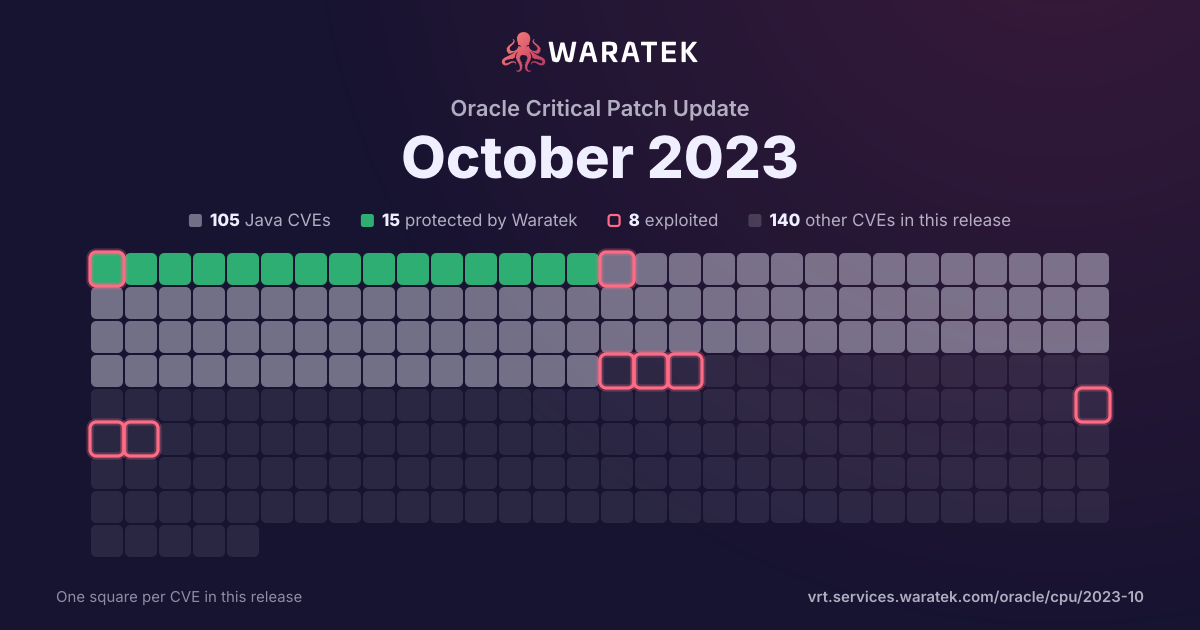
By status
15Protected by Waratek3Mitigation candidate87No exploit published44Outside Waratek scope96Not applicable
8Exploited, marked by the ring
No exploit published. For 35 of them, Oracle's security advisory is the source of public detail.
Protected by Waratek. Waratek RASP can block exploitation of these on systems that have not applied the patch yet.
Overview 25 matches · 15 in Waratek scope · 5 protected · 5 exploited · 0 CISA KEV · 6 public PoC · 4 EPSS ≥ 0.5
25matches
15in Waratek scope60.0%
5protected20.0%
5exploited20.0%
0CISA KEV0.0%
6public PoC24.0%
4EPSS ≥ 0.516.0%
Protected by Waratek
5
20.0%
Rule in development
0
0.0%
Mitigation candidate
2
8.0%
No exploit published
8
32.0%
Outside Waratek scope
1
4.0%
Not applicable
9
36.0%
Withdrawn CVE
0
0.0%
blocked by ARMR today
5
20.0%
partly blocked
0
0.0%
not blocked
19
76.0%
not established
1
4.0%
unrecorded
0
0.0%
Exploited
5
20.0%
Working exploit published
0
0.0%
Proof of concept only
8
32.0%
Forecast only
0
0.0%
No public exploit
12
48.0%
split by
peak 5 / quarter
Q1 201
No exploit published1
Critical1
not blocked1
No public exploit1
Q2 200
Q3 200
Q4 200
Q1 210
Q2 210
Q3 210
Q4 210
Q1 220
Q2 224
Protected by Waratek2
No exploit published1
Not applicable1
Critical4
blocked by ARMR today2
not blocked2
No public exploit4
Q3 223
Protected by Waratek1
Mitigation candidate1
Not applicable1
Critical3
blocked by ARMR today1
not blocked2
Proof of concept only2
No public exploit1
Q4 223
Protected by Waratek2
Not applicable1
Critical3
blocked by ARMR today2
not blocked1
Exploited1
Proof of concept only1
No public exploit1
Q1 233
Not applicable3
Critical3
not blocked3
Exploited1
Proof of concept only2
Q2 232
No exploit published2
Critical2
not blocked2
No public exploit2
Q3 235
No exploit published2
Not applicable3
Critical5
not blocked5
Exploited2
Proof of concept only2
No public exploit1
Q4 234
Mitigation candidate1
No exploit published2
Outside Waratek scope1
Critical4
not blocked3
not established1
Exploited1
Proof of concept only1
No public exploit2
Q2 20Q4 20Q2 21Q4 21Q2 22Q4 22Q2 23Q4 23
| CVE | Severity | Published▾ | Status | Exploitation | Description |
|---|---|---|---|---|---|
| CVE-2023-38545 | Critical | 2023-10-18 | Outside Waratek scope | Proof of concept only | This flaw makes curl overflow a heap based buffer in the SOCKS5 proxy handshake. When curl is asked to pass along the host name to the SOCKS5 proxy to allow that to resolve the address instead of it getting done by curl itself, the maximum length that host name can be is 255 bytes. If the host name is detected to be longer, curl switches to local name resolving and instead passes on the resolved address only. Due to this bug, the local variable that means "let the host resolve the name" could get the wrong value during a slow SOCKS5 handshake, and contrary to the intention, copy the too long host name to the target buffer instead of copying just the resolved address there. The target buffer being a heap based buffer, and the host name coming from the URL that curl has been told to operate with. |
| CVE-2023-22089 | Critical | 2023-10-17 | No exploit published | No public exploit | Vulnerability in the Oracle WebLogic Server product of Oracle Fusion Middleware (component: Core). Supported versions that are affected are 12.2.1.4.0 and 14.1.1.0.0. Easily exploitable vulnerability allows unauthenticated attacker with network access via T3, IIOP to compromise Oracle WebLogic Server. Successful attacks of this vulnerability can result in takeover of Oracle WebLogic Server. CVSS 3.1 Base Score 9.8 (Confidentiality, Integrity and Availability impacts). CVSS Vector: (CVSS:3.1/AV:N/AC:L/PR:N/UI:N/S:U/C:H/I:H/A:H). |
| CVE-2023-22072 | Critical | 2023-10-17 | No exploit published | No public exploit | Vulnerability in the Oracle WebLogic Server product of Oracle Fusion Middleware (component: Core). The supported version that is affected is 12.2.1.3.0. Easily exploitable vulnerability allows unauthenticated attacker with network access via T3, IIOP to compromise Oracle WebLogic Server. Successful attacks of this vulnerability can result in takeover of Oracle WebLogic Server. CVSS 3.1 Base Score 9.8 (Confidentiality, Integrity and Availability impacts). CVSS Vector: (CVSS:3.1/AV:N/AC:L/PR:N/UI:N/S:U/C:H/I:H/A:H). |
| CVE-2023-22069 | Critical | 2023-10-17 | Mitigation candidate | Exploited | Vulnerability in the Oracle WebLogic Server product of Oracle Fusion Middleware (component: Core). Supported versions that are affected are 12.2.1.4.0 and 14.1.1.0.0. Easily exploitable vulnerability allows unauthenticated attacker with network access via T3, IIOP to compromise Oracle WebLogic Server. Successful attacks of this vulnerability can result in takeover of Oracle WebLogic Server. CVSS 3.1 Base Score 9.8 (Confidentiality, Integrity and Availability impacts). CVSS Vector: (CVSS:3.1/AV:N/AC:L/PR:N/UI:N/S:U/C:H/I:H/A:H). |
| CVE-2023-3824 | Critical | 2023-08-11 | Not applicable | Exploited | In PHP version 8.0.* before 8.0.30, 8.1.* before 8.1.22, and 8.2.* before 8.2.8, when loading phar file, while reading PHAR directory entries, insufficient length checking may lead to a stack buffer overflow, leading potentially to memory corruption or RCE. |
| CVE-2023-39022 | Critical | 2023-07-28 | No exploit published | Proof of concept only | oscore v2.2.6 and below was discovered to contain a code injection vulnerability in the component com.opensymphony.util.EJBUtils.createStateless. This vulnerability is exploited via passing an unchecked argument. |
| CVE-2023-39017 | Critical | 2023-07-28 | Not applicable | Proof of concept only | quartz-jobs 2.3.2 and below was discovered to contain a code injection vulnerability in the component org.quartz.jobs.ee.jms.SendQueueMessageJob.execute. This vulnerability is exploited via passing an unchecked argument. NOTE: this is disputed by multiple parties because it is not plausible that untrusted user input would reach the code location where injection must occur. |
| CVE-2023-38408 | Critical | 2023-07-20 | Not applicable | Exploited | The PKCS#11 feature in ssh-agent in OpenSSH before 9.3p2 has an insufficiently trustworthy search path, leading to remote code execution if an agent is forwarded to an attacker-controlled system. (Code in /usr/lib is not necessarily safe for loading into ssh-agent.) NOTE: this issue exists because of an incomplete fix for CVE-2016-10009. |
| CVE-2023-34034 | Critical | 2023-07-19 | No exploit published | No public exploit | Using "**" as a pattern in Spring Security configuration for WebFlux creates a mismatch in pattern matching between Spring Security and Spring WebFlux, and the potential for a security bypass. |
| CVE-2023-20873 | Critical | 2023-04-20 | No exploit published | No public exploit | In Spring Boot versions 3.0.0 - 3.0.5, 2.7.0 - 2.7.10, and older unsupported versions, an application that is deployed to Cloud Foundry could be susceptible to a security bypass. Users of affected versions should apply the following mitigation: 3.0.x users should upgrade to 3.0.6+. 2.7.x users should upgrade to 2.7.11+. Users of older, unsupported versions should upgrade to 3.0.6+ or 2.7.11+. |
| CVE-2023-22946 | Critical | 2023-04-17 | No exploit published | No public exploit | In Apache Spark versions prior to 3.4.0, applications using spark-submit can specify a 'proxy-user' to run as, limiting privileges. The application can execute code with the privileges of the submitting user, however, by providing malicious configuration-related classes on the classpath. This affects architectures relying on proxy-user, for example those using Apache Livy to manage submitted applications. Update to Apache Spark 3.4.0 or later, and ensure that spark.submit.proxyUser.allowCustomClasspathInClusterMode is set to its default of "false", and is not overridden by submitted applications. |
| CVE-2023-27533 | Critical | 2023-03-30 | Not applicable | Proof of concept only | A vulnerability in input validation exists in curl <8.0 during communication using the TELNET protocol may allow an attacker to pass on maliciously crafted user name and "telnet options" during server negotiation. The lack of proper input scrubbing allows an attacker to send content or perform option negotiation without the application's intent. This vulnerability could be exploited if an application allows user input, thereby enabling attackers to execute arbitrary code on the system. |
| CVE-2023-25690 | Critical | 2023-03-07 | Not applicable | Exploited | Some mod_proxy configurations on Apache HTTP Server versions 2.4.0 through 2.4.55 allow a HTTP Request Smuggling attack. Configurations are affected when mod_proxy is enabled along with some form of RewriteRule or ProxyPassMatch in which a non-specific pattern matches some portion of the user-supplied request-target (URL) data and is then re-inserted into the proxied request-target using variable substitution. For example, something like: RewriteEngine on RewriteRule "^/here/(.*)" "http://example.com:8080/elsewhere?$1"; [P] ProxyPassReverse /here/ http://example.com:8080/ Request splitting/smuggling could result in bypass of access controls in the proxy server, proxying unintended URLs to existing origin servers, and cache poisoning. Users are recommended to update to at least version 2.4.56 of Apache HTTP Server. |
| CVE-2023-23914 | Critical | 2023-02-23 | Not applicable | Proof of concept only | A cleartext transmission of sensitive information vulnerability exists in curl <v7.88.0 that could cause HSTS functionality fail when multiple URLs are requested serially. Using its HSTS support, curl can be instructed to use HTTPS instead of usingan insecure clear-text HTTP step even when HTTP is provided in the URL. ThisHSTS mechanism would however surprisingly be ignored by subsequent transferswhen done on the same command line because the state would not be properlycarried on. |
| CVE-2022-1471 | Critical | 2022-12-01 | Protected by Waratek | Exploited | SnakeYaml's Constructor() class does not restrict types which can be instantiated during deserialization. Deserializing yaml content provided by an attacker can lead to remote code execution. We recommend using SnakeYaml's SafeConsturctor when parsing untrusted content to restrict deserialization. We recommend upgrading to version 2.0 and beyond. |
| CVE-2022-42920 | Critical | 2022-11-07 | Protected by Waratek | No public exploit | Apache Commons BCEL has a number of APIs that would normally only allow changing specific class characteristics. However, due to an out-of-bounds writing issue, these APIs can be used to produce arbitrary bytecode. This could be abused in applications that pass attacker-controllable data to those APIs, giving the attacker more control over the resulting bytecode than otherwise expected. Update to Apache Commons BCEL 6.6.0. |
| CVE-2022-37454 | Critical | 2022-10-21 | Not applicable | Proof of concept only | The Keccak XKCP SHA-3 reference implementation before fdc6fef has an integer overflow and resultant buffer overflow that allows attackers to execute arbitrary code or eliminate expected cryptographic properties. This occurs in the sponge function interface. |
| CVE-2022-36944 | Critical | 2022-09-23 | Protected by Waratek | Proof of concept only | Scala 2.13.x before 2.13.9 has a Java deserialization chain in its JAR file. On its own, it cannot be exploited. There is only a risk in conjunction with Java object deserialization within an application. In such situations, it allows attackers to erase contents of arbitrary files, make network connections, or possibly run arbitrary code (specifically, Function0 functions) via a gadget chain. |
| CVE-2022-25168 | Critical | 2022-08-04 | Not applicable | No public exploit | Apache Hadoop's FileUtil.unTar(File, File) API does not escape the input file name before being passed to the shell. An attacker can inject arbitrary commands. This is only used in Hadoop 3.3 InMemoryAliasMap.completeBootstrapTransfer, which is only ever run by a local user. It has been used in Hadoop 2.x for yarn localization, which does enable remote code execution. It is used in Apache Spark, from the SQL command ADD ARCHIVE. As the ADD ARCHIVE command adds new binaries to the classpath, being able to execute shell scripts does not confer new permissions to the caller. SPARK-38305. "Check existence of file before untarring/zipping", which is included in 3.3.0, 3.1.4, 3.2.2, prevents shell commands being executed, regardless of which version of the hadoop libraries are in use. Users should upgrade to Apache Hadoop 2.10.2, 3.2.4, 3.3.3 or upper (including HADOOP-18136). |
| CVE-2022-33980 | Critical | 2022-07-06 | Mitigation candidate | Proof of concept only | Apache Commons Configuration performs variable interpolation, allowing properties to be dynamically evaluated and expanded. The standard format for interpolation is "${prefix:name}", where "prefix" is used to locate an instance of org.apache.commons.configuration2.interpol.Lookup that performs the interpolation. Starting with version 2.4 and continuing through 2.7, the set of default Lookup instances included interpolators that could result in arbitrary code execution or contact with remote servers. These lookups are: - "script" - execute expressions using the JVM script execution engine (javax.script) - "dns" - resolve dns records - "url" - load values from urls, including from remote servers Applications using the interpolation defaults in the affected versions may be vulnerable to remote code execution or unintentional contact with remote servers if untrusted configuration values are used. Users are recommended to upgrade to Apache Commons Configuration 2.8.0, which disables the problematic interpolators by default. |
| CVE-2021-37404 | Critical | 2022-06-13 | No exploit published | No public exploit | There is a potential heap buffer overflow in Apache Hadoop libhdfs native code. Opening a file path provided by user without validation may result in a denial of service or arbitrary code execution. Users should upgrade to Apache Hadoop 2.10.2, 3.2.3, 3.3.2 or higher. |
| CVE-2022-29599 | Critical | 2022-05-23 | Protected by Waratek | No public exploit | In Apache Maven maven-shared-utils prior to version 3.3.3, the Commandline class can emit double-quoted strings without proper escaping, allowing shell injection attacks. |
| CVE-2021-41945 | Critical | 2022-04-28 | Not applicable | No public exploit | Encode OSS httpx < 0.23.0 is affected by improper input validation in `httpx.URL`, `httpx.Client` and some functions using `httpx.URL.copy_with`. |
| CVE-2022-26612 | Critical | 2022-04-07 | Protected by Waratek | No public exploit | In Apache Hadoop, The unTar function uses unTarUsingJava function on Windows and the built-in tar utility on Unix and other OSes. As a result, a TAR entry may create a symlink under the expected extraction directory which points to an external directory. A subsequent TAR entry may extract an arbitrary file into the external directory using the symlink name. This however would be caught by the same targetDirPath check on Unix because of the getCanonicalPath call. However on Windows, getCanonicalPath doesn't resolve symbolic links, which bypasses the check. unpackEntries during TAR extraction follows symbolic links which allows writing outside expected base directory on Windows. This was addressed in Apache Hadoop 3.2.3 |
| CVE-2020-1953 | Critical | 2020-03-13 | No exploit published | No public exploit | Apache Commons Configuration uses a third-party library to parse YAML files which by default allows the instantiation of classes if the YAML includes special statements. Apache Commons Configuration versions 2.2, 2.3, 2.4, 2.5, 2.6 did not change the default settings of this library. So if a YAML file was loaded from an untrusted source, it could therefore load and execute code out of the control of the host application. |