
Oracle Critical Patch Update October 2023
Released October 2023 · Oracle's advisory ↗ · ← Critical Patch Update, July 2023 · Critical Patch Update, January 2024 →
245 CVEs in this release, one square each
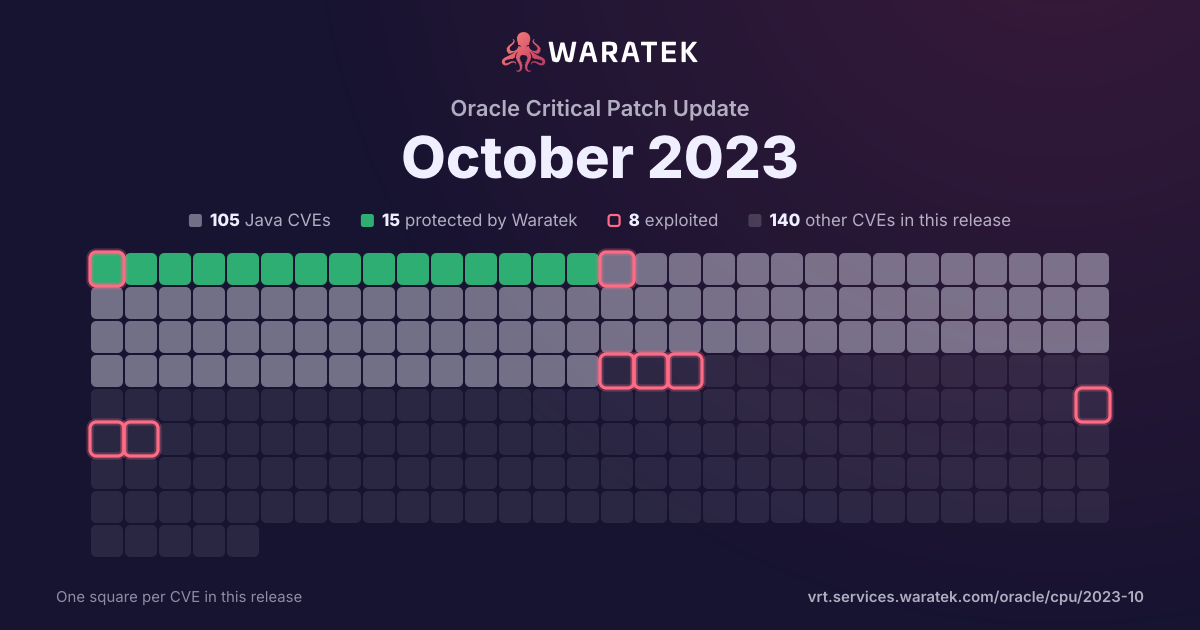
By status
15Protected by Waratek3Mitigation candidate87No exploit published44Outside Waratek scope96Not applicable
8Exploited, marked by the ring
No exploit published. For 35 of them, Oracle's security advisory is the source of public detail.
Protected by Waratek. Waratek RASP can block exploitation of these on systems that have not applied the patch yet.
Overview 16 matches · 4 in Waratek scope · 2 protected · 6 exploited · 1 CISA KEV · 7 EPSS ≥ 0.5
Protected by Waratek
2
12.5%
Rule in development
0
0.0%
Mitigation candidate
2
12.5%
No exploit published
0
0.0%
Outside Waratek scope
5
31.2%
Not applicable
7
43.8%
Withdrawn CVE
0
0.0%
blocked by ARMR today
2
12.5%
partly blocked
0
0.0%
not blocked
14
87.5%
not established
0
0.0%
unrecorded
0
0.0%
Exploited
6
37.5%
Working exploit published
0
0.0%
Proof of concept only
10
62.5%
Forecast only
0
0.0%
No public exploit
0
0.0%
split by
peak 5 / quarter
Q2 191
Outside Waratek scope1
Medium1
not blocked1
Exploited1
Q3 190
Q4 190
Q1 200
Q2 202
Outside Waratek scope2
Medium2
not blocked2
Exploited2
Q3 200
Q4 200
Q1 210
Q2 210
Q3 210
Q4 211
Outside Waratek scope1
Medium1
not blocked1
Proof of concept only1
Q1 220
Q2 220
Q3 222
Protected by Waratek1
Mitigation candidate1
Critical2
blocked by ARMR today1
not blocked1
Proof of concept only2
Q4 221
Protected by Waratek1
Critical1
blocked by ARMR today1
Exploited1
Q1 231
Not applicable1
Critical1
not blocked1
Exploited1
Q2 231
Not applicable1
Medium1
not blocked1
Proof of concept only1
Q3 235
Mitigation candidate1
Not applicable4
Critical1
High2
Medium2
not blocked5
Exploited1
Proof of concept only4
Q4 232
Outside Waratek scope1
Not applicable1
Critical1
High1
not blocked2
Proof of concept only2
Q2 19Q4 19Q2 20Q4 20Q2 21Q4 21Q2 22Q4 22Q2 23Q4 23
| CVE | Severity | Published▾ | Status | Exploitation | Description |
|---|---|---|---|---|---|
| CVE-2023-38545 | Critical | 2023-10-18 | Outside Waratek scope | Proof of concept only | This flaw makes curl overflow a heap based buffer in the SOCKS5 proxy handshake. When curl is asked to pass along the host name to the SOCKS5 proxy to allow that to resolve the address instead of it getting done by curl itself, the maximum length that host name can be is 255 bytes. If the host name is detected to be longer, curl switches to local name resolving and instead passes on the resolved address only. Due to this bug, the local variable that means "let the host resolve the name" could get the wrong value during a slow SOCKS5 handshake, and contrary to the intention, copy the too long host name to the target buffer instead of copying just the resolved address there. The target buffer being a heap based buffer, and the host name coming from the URL that curl has been told to operate with. |
| CVE-2023-22098 | High | 2023-10-17 | Not applicable | Proof of concept only | Vulnerability in the Oracle VM VirtualBox product of Oracle Virtualization (component: Core). Supported versions that are affected are Prior to 7.0.12. Easily exploitable vulnerability allows high privileged attacker with logon to the infrastructure where Oracle VM VirtualBox executes to compromise Oracle VM VirtualBox. While the vulnerability is in Oracle VM VirtualBox, attacks may significantly impact additional products (scope change). Successful attacks of this vulnerability can result in takeover of Oracle VM VirtualBox. Note: Only applicable to 7.0.x platform. CVSS 3.1 Base Score 8.2 (Confidentiality, Integrity and Availability impacts). CVSS Vector: (CVSS:3.1/AV:L/AC:L/PR:H/UI:N/S:C/C:H/I:H/A:H). |
| CVE-2023-41080 | Medium | 2023-08-25 | Mitigation candidate | Proof of concept only | URL Redirection to Untrusted Site ('Open Redirect') vulnerability in FORM authentication feature Apache Tomcat.This issue affects Apache Tomcat: from 11.0.0-M1 through 11.0.0-M10, from 10.1.0-M1 through 10.0.12, from 9.0.0-M1 through 9.0.79 and from 8.5.0 through 8.5.92. Older, EOL versions may also be affected. The vulnerability is limited to the ROOT (default) web application. |
| CVE-2023-20593 | Medium | 2023-07-24 | Not applicable | Proof of concept only | An issue in “Zen 2” CPUs, under specific microarchitectural circumstances, may allow an attacker to potentially access sensitive information. |
| CVE-2023-38408 | Critical | 2023-07-20 | Not applicable | Exploited | The PKCS#11 feature in ssh-agent in OpenSSH before 9.3p2 has an insufficiently trustworthy search path, leading to remote code execution if an agent is forwarded to an attacker-controlled system. (Code in /usr/lib is not necessarily safe for loading into ssh-agent.) NOTE: this issue exists because of an incomplete fix for CVE-2016-10009. |
| CVE-2022-24834 | High | 2023-07-13 | Not applicable | Proof of concept only | Redis is an in-memory database that persists on disk. A specially crafted Lua script executing in Redis can trigger a heap overflow in the cjson library, and result with heap corruption and potentially remote code execution. The problem exists in all versions of Redis with Lua scripting support, starting from 2.6, and affects only authenticated and authorized users. The problem is fixed in versions 7.0.12, 6.2.13, and 6.0.20. |
| CVE-2023-35001 | High | 2023-07-05 | Not applicable | Proof of concept only | Linux Kernel nftables Out-Of-Bounds Read/Write Vulnerability; nft_byteorder poorly handled vm register contents when CAP_NET_ADMIN is in any user or network namespace |
| CVE-2023-2002 | Medium | 2023-05-26 | Not applicable | Proof of concept only | A vulnerability was found in the HCI sockets implementation due to a missing capability check in net/bluetooth/hci_sock.c in the Linux Kernel. This flaw allows an attacker to unauthorized execution of management commands, compromising the confidentiality, integrity, and availability of Bluetooth communication. |
| CVE-2023-25690 | Critical | 2023-03-07 | Not applicable | Exploited | Some mod_proxy configurations on Apache HTTP Server versions 2.4.0 through 2.4.55 allow a HTTP Request Smuggling attack. Configurations are affected when mod_proxy is enabled along with some form of RewriteRule or ProxyPassMatch in which a non-specific pattern matches some portion of the user-supplied request-target (URL) data and is then re-inserted into the proxied request-target using variable substitution. For example, something like: RewriteEngine on RewriteRule "^/here/(.*)" "http://example.com:8080/elsewhere?$1"; [P] ProxyPassReverse /here/ http://example.com:8080/ Request splitting/smuggling could result in bypass of access controls in the proxy server, proxying unintended URLs to existing origin servers, and cache poisoning. Users are recommended to update to at least version 2.4.56 of Apache HTTP Server. |
| CVE-2022-1471 | Critical | 2022-12-01 | Protected by Waratek | Exploited | SnakeYaml's Constructor() class does not restrict types which can be instantiated during deserialization. Deserializing yaml content provided by an attacker can lead to remote code execution. We recommend using SnakeYaml's SafeConsturctor when parsing untrusted content to restrict deserialization. We recommend upgrading to version 2.0 and beyond. |
| CVE-2022-36944 | Critical | 2022-09-23 | Protected by Waratek | Proof of concept only | Scala 2.13.x before 2.13.9 has a Java deserialization chain in its JAR file. On its own, it cannot be exploited. There is only a risk in conjunction with Java object deserialization within an application. In such situations, it allows attackers to erase contents of arbitrary files, make network connections, or possibly run arbitrary code (specifically, Function0 functions) via a gadget chain. |
| CVE-2022-33980 | Critical | 2022-07-06 | Mitigation candidate | Proof of concept only | Apache Commons Configuration performs variable interpolation, allowing properties to be dynamically evaluated and expanded. The standard format for interpolation is "${prefix:name}", where "prefix" is used to locate an instance of org.apache.commons.configuration2.interpol.Lookup that performs the interpolation. Starting with version 2.4 and continuing through 2.7, the set of default Lookup instances included interpolators that could result in arbitrary code execution or contact with remote servers. These lookups are: - "script" - execute expressions using the JVM script execution engine (javax.script) - "dns" - resolve dns records - "url" - load values from urls, including from remote servers Applications using the interpolation defaults in the affected versions may be vulnerable to remote code execution or unintentional contact with remote servers if untrusted configuration values are used. Users are recommended to upgrade to Apache Commons Configuration 2.8.0, which disables the problematic interpolators by default. |
| CVE-2021-41184 | Medium | 2021-10-26 | Outside Waratek scope | Proof of concept only | jQuery-UI is the official jQuery user interface library. Prior to version 1.13.0, accepting the value of the `of` option of the `.position()` util from untrusted sources may execute untrusted code. The issue is fixed in jQuery UI 1.13.0. Any string value passed to the `of` option is now treated as a CSS selector. A workaround is to not accept the value of the `of` option from untrusted sources. |
| CVE-2020-11023 | Medium | 2020-04-29 | Outside Waratek scope | Exploited | In jQuery versions greater than or equal to 1.0.3 and before 3.5.0, passing HTML containing <option> elements from untrusted sources - even after sanitizing it - to one of jQuery's DOM manipulation methods (i.e. .html(), .append(), and others) may execute untrusted code. This problem is patched in jQuery 3.5.0. |
| CVE-2020-11022 | Medium | 2020-04-29 | Outside Waratek scope | Exploited | In jQuery starting with 1.12.0 and before 3.5.0, passing HTML from untrusted sources - even after sanitizing it - to one of jQuery's DOM manipulation methods (i.e. .html(), .append(), and others) may execute untrusted code. This problem is patched in jQuery 3.5.0. |
| CVE-2019-11358 | Medium | 2019-04-20 | Outside Waratek scope | Exploited | jQuery before 3.4.0, as used in Drupal, Backdrop CMS, and other products, mishandles jQuery.extend(true, {}, ...) because of Object.prototype pollution. If an unsanitized source object contained an enumerable __proto__ property, it could extend the native Object.prototype. |