
Oracle Critical Patch Update July 2023
Released July 2023 · Oracle's advisory ↗ · ← Critical Patch Update, April 2023 · Critical Patch Update, October 2023 →
269 CVEs in this release, one square each
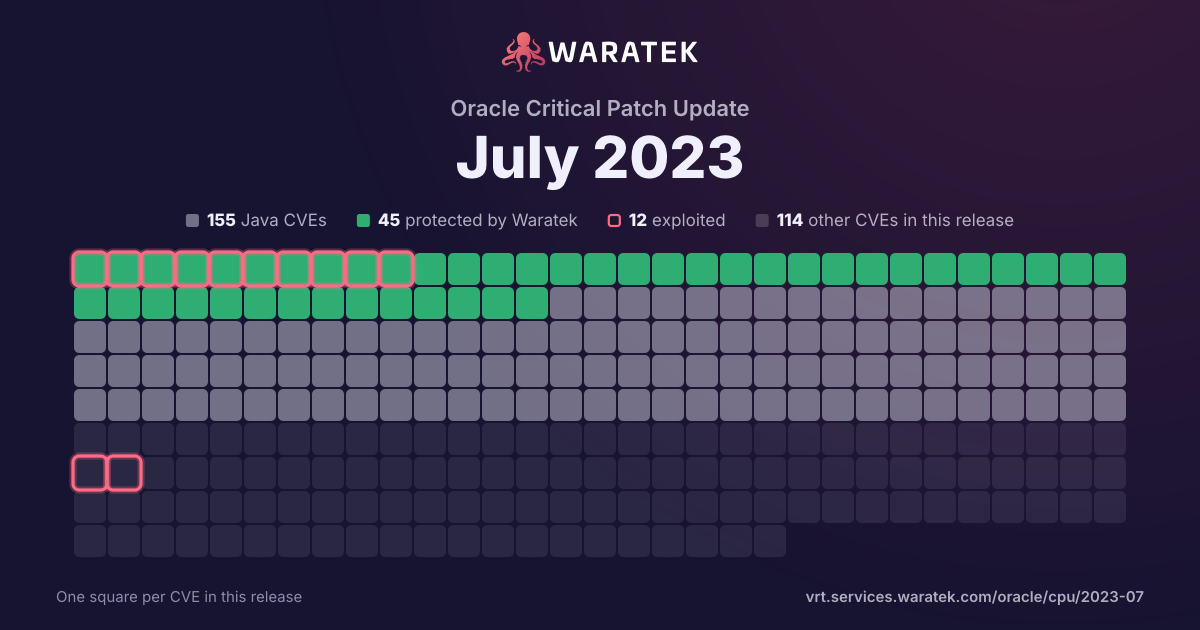
By status
45Protected by Waratek5Mitigation candidate105No exploit published31Outside Waratek scope83Not applicable
12Exploited, marked by the ring
No exploit published. For 37 of them, Oracle's security advisory is the source of public detail.
Protected by Waratek. Waratek RASP can block exploitation of these on systems that have not applied the patch yet.
Overview 39 matches · 0 in Waratek scope · 0 protected · 1 exploited · 0 CISA KEV · 4 public PoC · 5 EPSS ≥ 0.5
39matches
0in Waratek scope0.0%
0protected0.0%
1exploited2.6%
0CISA KEV0.0%
4public PoC10.3%
5EPSS ≥ 0.512.8%
Protected by Waratek
0
0.0%
Rule in development
0
0.0%
Mitigation candidate
0
0.0%
No exploit published
0
0.0%
Outside Waratek scope
0
0.0%
Not applicable
39
100.0%
Withdrawn CVE
0
0.0%
blocked by ARMR today
0
0.0%
partly blocked
0
0.0%
not blocked
39
100.0%
not established
0
0.0%
unrecorded
0
0.0%
Exploited
1
2.6%
Working exploit published
0
0.0%
Proof of concept only
7
17.9%
Forecast only
2
5.1%
No public exploit
29
74.4%
split by
peak 8 / month
Feb 221
Not applicable1
High1
not blocked1
No public exploit1
Mar 220
Apr 222
Not applicable2
High2
not blocked2
No public exploit2
May 220
Jun 220
Jul 222
Not applicable2
High2
not blocked2
Proof of concept only1
No public exploit1
Aug 220
Sep 221
Not applicable1
High1
not blocked1
No public exploit1
Oct 223
Not applicable3
High3
not blocked3
Proof of concept only1
No public exploit2
Nov 225
Not applicable5
High5
not blocked5
Proof of concept only3
No public exploit2
Dec 224
Not applicable4
High4
not blocked4
No public exploit4
Jan 233
Not applicable3
High3
not blocked3
Exploited1
No public exploit2
Feb 238
Not applicable8
High8
not blocked8
Proof of concept only1
Forecast only1
No public exploit6
Mar 233
Not applicable3
High3
not blocked3
No public exploit3
Apr 232
Not applicable2
High2
not blocked2
Proof of concept only1
Forecast only1
May 231
Not applicable1
High1
not blocked1
No public exploit1
Jun 232
Not applicable2
High2
not blocked2
No public exploit2
Jul 232
Not applicable2
High2
not blocked2
No public exploit2
Mar 22May 22Jul 22Sep 22Nov 22Jan 23Mar 23May 23Jul 23
| CVE | Severity | Published▾ | Status | Exploitation | Description |
|---|---|---|---|---|---|
| CVE-2023-22023 | High | 2023-07-18 | Not applicable | No public exploit | Vulnerability in the Oracle Solaris product of Oracle Systems (component: Device Driver Interface). The supported version that is affected is 11. Easily exploitable vulnerability allows low privileged attacker with logon to the infrastructure where Oracle Solaris executes to compromise Oracle Solaris. Successful attacks of this vulnerability can result in takeover of Oracle Solaris. Note: CVE-2023-22023 is equivalent to CVE-2023-31284. CVSS 3.1 Base Score 7.8 (Confidentiality, Integrity and Availability impacts). CVSS Vector: (CVSS:3.1/AV:L/AC:L/PR:L/UI:N/S:U/C:H/I:H/A:H). |
| CVE-2023-22018 | High | 2023-07-18 | Not applicable | No public exploit | Vulnerability in the Oracle VM VirtualBox product of Oracle Virtualization (component: Core). Supported versions that are affected are Prior to 6.1.46 and Prior to 7.0.10. Difficult to exploit vulnerability allows unauthenticated attacker with network access via RDP to compromise Oracle VM VirtualBox. Successful attacks of this vulnerability can result in takeover of Oracle VM VirtualBox. CVSS 3.1 Base Score 8.1 (Confidentiality, Integrity and Availability impacts). CVSS Vector: (CVSS:3.1/AV:N/AC:H/PR:N/UI:N/S:U/C:H/I:H/A:H). |
| CVE-2023-1999 | High | 2023-06-20 | Not applicable | No public exploit | There exists a use after free/double free in libwebp. An attacker can use the ApplyFiltersAndEncode() function and loop through to free best.bw and assign best = trial pointer. The second loop will then return 0 because of an Out of memory error in VP8 encoder, the pointer is still assigned to trial and the AddressSanitizer will attempt a double free. |
| CVE-2023-0767 | High | 2023-06-02 | Not applicable | No public exploit | An attacker could construct a PKCS 12 cert bundle in such a way that could allow for arbitrary memory writes via PKCS 12 Safe Bag attributes being mishandled. This vulnerability affects Firefox < 110, Thunderbird < 102.8, and Firefox ESR < 102.8. |
| CVE-2023-30861 | High | 2023-05-02 | Not applicable | No public exploit | Flask is a lightweight WSGI web application framework. When all of the following conditions are met, a response containing data intended for one client may be cached and subsequently sent by the proxy to other clients. If the proxy also caches `Set-Cookie` headers, it may send one client's `session` cookie to other clients. The severity depends on the application's use of the session and the proxy's behavior regarding cookies. The risk depends on all these conditions being met. 1. The application must be hosted behind a caching proxy that does not strip cookies or ignore responses with cookies. 2. The application sets `session.permanent = True` 3. The application does not access or modify the session at any point during a request. 4. `SESSION_REFRESH_EACH_REQUEST` enabled (the default). 5. The application does not set a `Cache-Control` header to indicate that a page is private or should not be cached. This happens because vulnerable versions of Flask only set the `Vary: Cookie` header when the session is accessed or modified, not when it is refreshed (re-sent to update the expiration) without being accessed or modified. This issue has been fixed in versions 2.3.2 and 2.2.5. |
| CVE-2023-29007 | High | 2023-04-25 | Not applicable | Proof of concept only | Git is a revision control system. Prior to versions 2.30.9, 2.31.8, 2.32.7, 2.33.8, 2.34.8, 2.35.8, 2.36.6, 2.37.7, 2.38.5, 2.39.3, and 2.40.1, a specially crafted `.gitmodules` file with submodule URLs that are longer than 1024 characters can used to exploit a bug in `config.c::git_config_copy_or_rename_section_in_file()`. This bug can be used to inject arbitrary configuration into a user's `$GIT_DIR/config` when attempting to remove the configuration section associated with that submodule. When the attacker injects configuration values which specify executables to run (such as `core.pager`, `core.editor`, `core.sshCommand`, etc.) this can lead to a remote code execution. A fix A fix is available in versions 2.30.9, 2.31.8, 2.32.7, 2.33.8, 2.34.8, 2.35.8, 2.36.6, 2.37.7, 2.38.5, 2.39.3, and 2.40.1. As a workaround, avoid running `git submodule deinit` on untrusted repositories or without prior inspection of any submodule sections in `$GIT_DIR/config`. |
| CVE-2023-25652 | High | 2023-04-25 | Not applicable | Forecast only | Git is a revision control system. Prior to versions 2.30.9, 2.31.8, 2.32.7, 2.33.8, 2.34.8, 2.35.8, 2.36.6, 2.37.7, 2.38.5, 2.39.3, and 2.40.1, by feeding specially crafted input to `git apply --reject`, a path outside the working tree can be overwritten with partially controlled contents (corresponding to the rejected hunk(s) from the given patch). A fix is available in versions 2.30.9, 2.31.8, 2.32.7, 2.33.8, 2.34.8, 2.35.8, 2.36.6, 2.37.7, 2.38.5, 2.39.3, and 2.40.1. As a workaround, avoid using `git apply` with `--reject` when applying patches from an untrusted source. Use `git apply --stat` to inspect a patch before applying; avoid applying one that create a conflict where a link corresponding to the `*.rej` file exists. |
| CVE-2022-4899 | High | 2023-03-31 | Not applicable | No public exploit | A vulnerability was found in zstd v1.4.10, where an attacker can supply empty string as an argument to the command line tool to cause buffer overrun. |
| CVE-2023-0464 | High | 2023-03-22 | Not applicable | No public exploit | A security vulnerability has been identified in all supported versions of OpenSSL related to the verification of X.509 certificate chains that include policy constraints. Attackers may be able to exploit this vulnerability by creating a malicious certificate chain that triggers exponential use of computational resources, leading to a denial-of-service (DoS) attack on affected systems. Policy processing is disabled by default but can be enabled by passing the `-policy' argument to the command line utilities or by calling the `X509_VERIFY_PARAM_set1_policies()' function. |
| CVE-2023-27522 | High | 2023-03-07 | Not applicable | No public exploit | HTTP Response Smuggling vulnerability in Apache HTTP Server via mod_proxy_uwsgi. This issue affects Apache HTTP Server: from 2.4.30 through 2.4.55. Special characters in the origin response header can truncate/split the response forwarded to the client. |
| CVE-2023-0361 | High | 2023-02-15 | Not applicable | Proof of concept only | A timing side-channel in the handling of RSA ClientKeyExchange messages was discovered in GnuTLS. This side-channel can be sufficient to recover the key encrypted in the RSA ciphertext across a network in a Bleichenbacher style attack. To achieve a successful decryption the attacker would need to send a large amount of specially crafted messages to the vulnerable server. By recovering the secret from the ClientKeyExchange message, the attacker would be able to decrypt the application data exchanged over that connection. |
| CVE-2023-0401 | High | 2023-02-08 | Not applicable | No public exploit | A NULL pointer can be dereferenced when signatures are being verified on PKCS7 signed or signedAndEnveloped data. In case the hash algorithm used for the signature is known to the OpenSSL library but the implementation of the hash algorithm is not available the digest initialization will fail. There is a missing check for the return value from the initialization function which later leads to invalid usage of the digest API most likely leading to a crash. The unavailability of an algorithm can be caused by using FIPS enabled configuration of providers or more commonly by not loading the legacy provider. PKCS7 data is processed by the SMIME library calls and also by the time stamp (TS) library calls. The TLS implementation in OpenSSL does not call these functions however third party applications would be affected if they call these functions to verify signatures on untrusted data. |
| CVE-2023-0286 | High | 2023-02-08 | Not applicable | Forecast only | There is a type confusion vulnerability relating to X.400 address processing inside an X.509 GeneralName. X.400 addresses were parsed as an ASN1_STRING but the public structure definition for GENERAL_NAME incorrectly specified the type of the x400Address field as ASN1_TYPE. This field is subsequently interpreted by the OpenSSL function GENERAL_NAME_cmp as an ASN1_TYPE rather than an ASN1_STRING. When CRL checking is enabled (i.e. the application sets the X509_V_FLAG_CRL_CHECK flag), this vulnerability may allow an attacker to pass arbitrary pointers to a memcmp call, enabling them to read memory contents or enact a denial of service. In most cases, the attack requires the attacker to provide both the certificate chain and CRL, neither of which need to have a valid signature. If the attacker only controls one of these inputs, the other input must already contain an X.400 address as a CRL distribution point, which is uncommon. As such, this vulnerability is most likely to only affect applications which have implemented their own functionality for retrieving CRLs over a network. |
| CVE-2023-0217 | High | 2023-02-08 | Not applicable | No public exploit | An invalid pointer dereference on read can be triggered when an application tries to check a malformed DSA public key by the EVP_PKEY_public_check() function. This will most likely lead to an application crash. This function can be called on public keys supplied from untrusted sources which could allow an attacker to cause a denial of service attack. The TLS implementation in OpenSSL does not call this function but applications might call the function if there are additional security requirements imposed by standards such as FIPS 140-3. |
| CVE-2023-0216 | High | 2023-02-08 | Not applicable | No public exploit | An invalid pointer dereference on read can be triggered when an application tries to load malformed PKCS7 data with the d2i_PKCS7(), d2i_PKCS7_bio() or d2i_PKCS7_fp() functions. The result of the dereference is an application crash which could lead to a denial of service attack. The TLS implementation in OpenSSL does not call this function however third party applications might call these functions on untrusted data. |
| CVE-2023-0215 | High | 2023-02-08 | Not applicable | No public exploit | The public API function BIO_new_NDEF is a helper function used for streaming ASN.1 data via a BIO. It is primarily used internally to OpenSSL to support the SMIME, CMS and PKCS7 streaming capabilities, but may also be called directly by end user applications. The function receives a BIO from the caller, prepends a new BIO_f_asn1 filter BIO onto the front of it to form a BIO chain, and then returns the new head of the BIO chain to the caller. Under certain conditions, for example if a CMS recipient public key is invalid, the new filter BIO is freed and the function returns a NULL result indicating a failure. However, in this case, the BIO chain is not properly cleaned up and the BIO passed by the caller still retains internal pointers to the previously freed filter BIO. If the caller then goes on to call BIO_pop() on the BIO then a use-after-free will occur. This will most likely result in a crash. This scenario occurs directly in the internal function B64_write_ASN1() which may cause BIO_new_NDEF() to be called and will subsequently call BIO_pop() on the BIO. This internal function is in turn called by the public API functions PEM_write_bio_ASN1_stream, PEM_write_bio_CMS_stream, PEM_write_bio_PKCS7_stream, SMIME_write_ASN1, SMIME_write_CMS and SMIME_write_PKCS7. Other public API functions that may be impacted by this include i2d_ASN1_bio_stream, BIO_new_CMS, BIO_new_PKCS7, i2d_CMS_bio_stream and i2d_PKCS7_bio_stream. The OpenSSL cms and smime command line applications are similarly affected. |
| CVE-2022-4450 | High | 2023-02-08 | Not applicable | No public exploit | The function PEM_read_bio_ex() reads a PEM file from a BIO and parses and decodes the "name" (e.g. "CERTIFICATE"), any header data and the payload data. If the function succeeds then the "name_out", "header" and "data" arguments are populated with pointers to buffers containing the relevant decoded data. The caller is responsible for freeing those buffers. It is possible to construct a PEM file that results in 0 bytes of payload data. In this case PEM_read_bio_ex() will return a failure code but will populate the header argument with a pointer to a buffer that has already been freed. If the caller also frees this buffer then a double free will occur. This will most likely lead to a crash. This could be exploited by an attacker who has the ability to supply malicious PEM files for parsing to achieve a denial of service attack. The functions PEM_read_bio() and PEM_read() are simple wrappers around PEM_read_bio_ex() and therefore these functions are also directly affected. These functions are also called indirectly by a number of other OpenSSL functions including PEM_X509_INFO_read_bio_ex() and SSL_CTX_use_serverinfo_file() which are also vulnerable. Some OpenSSL internal uses of these functions are not vulnerable because the caller does not free the header argument if PEM_read_bio_ex() returns a failure code. These locations include the PEM_read_bio_TYPE() functions as well as the decoders introduced in OpenSSL 3.0. The OpenSSL asn1parse command line application is also impacted by this issue. |
| CVE-2023-25193 | High | 2023-02-04 | Not applicable | No public exploit | hb-ot-layout-gsubgpos.hh in HarfBuzz through 6.0.0 allows attackers to trigger O(n^2) growth via consecutive marks during the process of looking back for base glyphs when attaching marks. |
| CVE-2022-48285 | High | 2023-01-29 | Not applicable | No public exploit | loadAsync in JSZip before 3.8.0 allows Directory Traversal via a crafted ZIP archive. |
| CVE-2023-22809 | High | 2023-01-18 | Not applicable | Exploited | In Sudo before 1.9.12p2, the sudoedit (aka -e) feature mishandles extra arguments passed in the user-provided environment variables (SUDO_EDITOR, VISUAL, and EDITOR), allowing a local attacker to append arbitrary entries to the list of files to process. This can lead to privilege escalation. Affected versions are 1.8.0 through 1.9.12.p1. The problem exists because a user-specified editor may contain a "--" argument that defeats a protection mechanism, e.g., an EDITOR='vim -- /path/to/extra/file' value. |
| CVE-2006-20001 | High | 2023-01-17 | Not applicable | No public exploit | A carefully crafted If: request header can cause a memory read, or write of a single zero byte, in a pool (heap) memory location beyond the header value sent. This could cause the process to crash. This issue affects Apache HTTP Server 2.4.54 and earlier. |
| CVE-2022-42898 | High | 2022-12-25 | Not applicable | No public exploit | PAC parsing in MIT Kerberos 5 (aka krb5) before 1.19.4 and 1.20.x before 1.20.1 has integer overflows that may lead to remote code execution (in KDC, kadmind, or a GSS or Kerberos application server) on 32-bit platforms (which have a resultant heap-based buffer overflow), and cause a denial of service on other platforms. This occurs in krb5_pac_parse in lib/krb5/krb/pac.c. Heimdal before 7.7.1 has "a similar bug." |
| CVE-2022-3996 | High | 2022-12-13 | Not applicable | No public exploit | If an X.509 certificate contains a malformed policy constraint and policy processing is enabled, then a write lock will be taken twice recursively. On some operating systems (most widely: Windows) this results in a denial of service when the affected process hangs. Policy processing being enabled on a publicly facing server is not considered to be a common setup. Policy processing is enabled by passing the `-policy' argument to the command line utilities or by calling the `X509_VERIFY_PARAM_set1_policies()' function. Update (31 March 2023): The description of the policy processing enablement was corrected based on CVE-2023-0466. |
| CVE-2022-46153 | High | 2022-12-08 | Not applicable | No public exploit | Traefik is an open source HTTP reverse proxy and load balancer. In affected versions there is a potential vulnerability in Traefik managing TLS connections. A router configured with a not well-formatted TLSOption is exposed with an empty TLSOption. For instance, a route secured using an mTLS connection set with a wrong CA file is exposed without verifying the client certificates. Users are advised to upgrade to version 2.9.6. Users unable to upgrade should check their logs to detect the error messages and fix your TLS options. |
| CVE-2022-43548 | High | 2022-12-05 | Not applicable | No public exploit | A OS Command Injection vulnerability exists in Node.js versions <14.21.1, <16.18.1, <18.12.1, <19.0.1 due to an insufficient IsAllowedHost check that can easily be bypassed because IsIPAddress does not properly check if an IP address is invalid before making DBS requests allowing rebinding attacks.The fix for this issue in https://cve.mitre.org/cgi-bin/cvename.cgi?name=CVE-2022-32212 was incomplete and this new CVE is to complete the fix. |
| CVE-2022-45199 | High | 2022-11-14 | Not applicable | No public exploit | Pillow before 9.3.0 allows denial of service via SAMPLESPERPIXEL. |
| CVE-2022-45061 | High | 2022-11-09 | Not applicable | Proof of concept only | An issue was discovered in Python before 3.11.1. An unnecessary quadratic algorithm exists in one path when processing some inputs to the IDNA (RFC 3490) decoder, such that a crafted, unreasonably long name being presented to the decoder could lead to a CPU denial of service. Hostnames are often supplied by remote servers that could be controlled by a malicious actor; in such a scenario, they could trigger excessive CPU consumption on the client attempting to make use of an attacker-supplied supposed hostname. For example, the attack payload could be placed in the Location header of an HTTP response with status code 302. A fix is planned in 3.11.1, 3.10.9, 3.9.16, 3.8.16, and 3.7.16. |
| CVE-2022-42919 | High | 2022-11-07 | Not applicable | No public exploit | Python 3.9.x before 3.9.16 and 3.10.x before 3.10.9 on Linux allows local privilege escalation in a non-default configuration. The Python multiprocessing library, when used with the forkserver start method on Linux, allows pickles to be deserialized from any user in the same machine local network namespace, which in many system configurations means any user on the same machine. Pickles can execute arbitrary code. Thus, this allows for local user privilege escalation to the user that any forkserver process is running as. Setting multiprocessing.util.abstract_sockets_supported to False is a workaround. The forkserver start method for multiprocessing is not the default start method. This issue is Linux specific because only Linux supports abstract namespace sockets. CPython before 3.9 does not make use of Linux abstract namespace sockets by default. Support for users manually specifying an abstract namespace socket was added as a bugfix in 3.7.8 and 3.8.3, but users would need to make specific uncommon API calls in order to do that in CPython before 3.9. |
| CVE-2022-3786 | High | 2022-11-01 | Not applicable | Proof of concept only | A buffer overrun can be triggered in X.509 certificate verification, specifically in name constraint checking. Note that this occurs after certificate chain signature verification and requires either a CA to have signed a malicious certificate or for an application to continue certificate verification despite failure to construct a path to a trusted issuer. An attacker can craft a malicious email address in a certificate to overflow an arbitrary number of bytes containing the `.' character (decimal 46) on the stack. This buffer overflow could result in a crash (causing a denial of service). In a TLS client, this can be triggered by connecting to a malicious server. In a TLS server, this can be triggered if the server requests client authentication and a malicious client connects. |
| CVE-2022-3602 | High | 2022-11-01 | Not applicable | Proof of concept only | A buffer overrun can be triggered in X.509 certificate verification, specifically in name constraint checking. Note that this occurs after certificate chain signature verification and requires either a CA to have signed the malicious certificate or for the application to continue certificate verification despite failure to construct a path to a trusted issuer. An attacker can craft a malicious email address to overflow four attacker-controlled bytes on the stack. This buffer overflow could result in a crash (causing a denial of service) or potentially remote code execution. Many platforms implement stack overflow protections which would mitigate against the risk of remote code execution. The risk may be further mitigated based on stack layout for any given platform/compiler. Pre-announcements of CVE-2022-3602 described this issue as CRITICAL. Further analysis based on some of the mitigating factors described above have led this to be downgraded to HIGH. Users are still encouraged to upgrade to a new version as soon as possible. In a TLS client, this can be triggered by connecting to a malicious server. In a TLS server, this can be triggered if the server requests client authentication and a malicious client connects. Fixed in OpenSSL 3.0.7 (Affected 3.0.0,3.0.1,3.0.2,3.0.3,3.0.4,3.0.5,3.0.6). |
| CVE-2022-43680 | High | 2022-10-24 | Not applicable | No public exploit | In libexpat through 2.4.9, there is a use-after free caused by overeager destruction of a shared DTD in XML_ExternalEntityParserCreate in out-of-memory situations. |
| CVE-2022-3479 | High | 2022-10-14 | Not applicable | No public exploit | A vulnerability found in nss. By this security vulnerability, nss client auth crash without a user certificate in the database and this can lead us to a segmentation fault or crash. |
| CVE-2022-2963 | High | 2022-10-14 | Not applicable | Proof of concept only | A vulnerability found in jasper. This security vulnerability happens because of a memory leak bug in function cmdopts_parse that can cause a crash or segmentation fault. |
| CVE-2020-10735 | High | 2022-09-09 | Not applicable | No public exploit | A flaw was found in python. In algorithms with quadratic time complexity using non-binary bases, when using int("text"), a system could take 50ms to parse an int string with 100,000 digits and 5s for 1,000,000 digits (float, decimal, int.from_bytes(), and int() for binary bases 2, 4, 8, 16, and 32 are not affected). The highest threat from this vulnerability is to system availability. |
| CVE-2020-35164 | High | 2022-07-11 | Not applicable | No public exploit | Dell BSAFE Crypto-C Micro Edition, versions before 4.1.5, and Dell BSAFE Micro Edition Suite, versions before 4.6, contain an Observable Timing Discrepancy Vulnerability. |
| CVE-2022-31129 | High | 2022-07-06 | Not applicable | Proof of concept only | moment is a JavaScript date library for parsing, validating, manipulating, and formatting dates. Affected versions of moment were found to use an inefficient parsing algorithm. Specifically using string-to-date parsing in moment (more specifically rfc2822 parsing, which is tried by default) has quadratic (N^2) complexity on specific inputs. Users may notice a noticeable slowdown is observed with inputs above 10k characters. Users who pass user-provided strings without sanity length checks to moment constructor are vulnerable to (Re)DoS attacks. The problem is patched in 2.29.4, the patch can be applied to all affected versions with minimal tweaking. Users are advised to upgrade. Users unable to upgrade should consider limiting date lengths accepted from user input. |
| CVE-2022-27406 | High | 2022-04-22 | Not applicable | No public exploit | FreeType commit 22a0cccb4d9d002f33c1ba7a4b36812c7d4f46b5 was discovered to contain a segmentation violation via the function FT_Request_Size. |
| CVE-2022-27405 | High | 2022-04-22 | Not applicable | No public exploit | FreeType commit 53dfdcd8198d2b3201a23c4bad9190519ba918db was discovered to contain a segmentation violation via the function FNT_Size_Request. |
| CVE-2022-24409 | High | 2022-02-23 | Not applicable | No public exploit | Dell BSAFE SSL-J contains remediation for a covert timing channel vulnerability that may be exploited by malicious users to compromise the affected system. Only customers with active BSAFE maintenance contracts can receive details about this vulnerability. Public disclosure of the vulnerability details will be shared at a later date. |