
Oracle Critical Patch Update July 2023
Released July 2023 · Oracle's advisory ↗ · ← Critical Patch Update, April 2023 · Critical Patch Update, October 2023 →
269 CVEs in this release, one square each
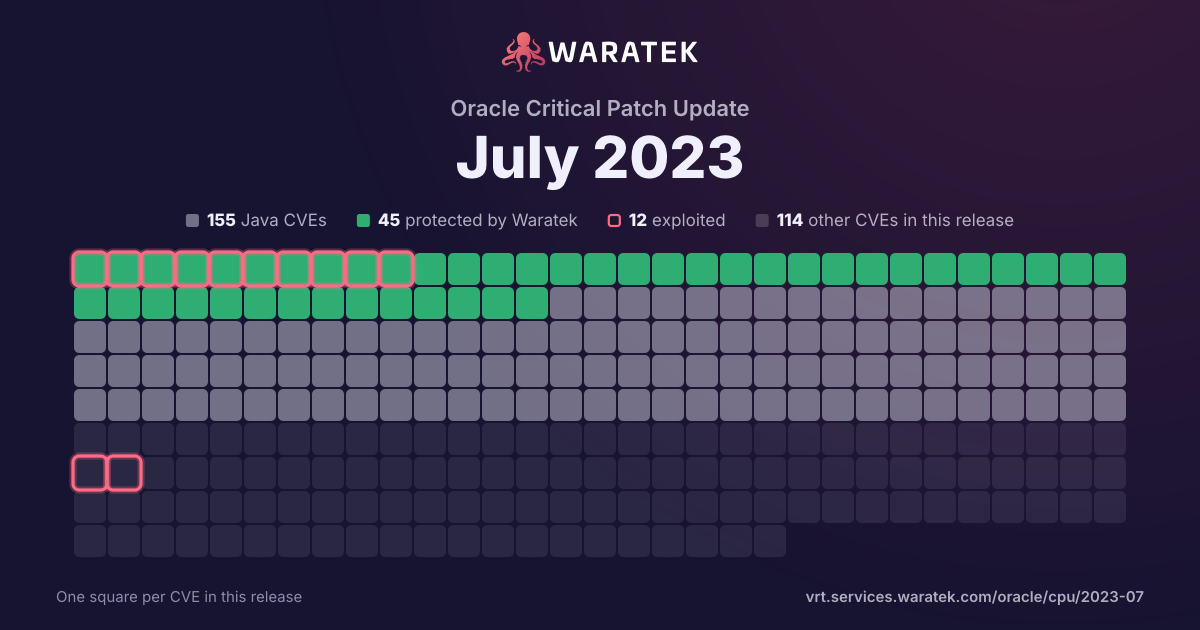
By status
45Protected by Waratek5Mitigation candidate105No exploit published31Outside Waratek scope83Not applicable
12Exploited, marked by the ring
No exploit published. For 37 of them, Oracle's security advisory is the source of public detail.
Protected by Waratek. Waratek RASP can block exploitation of these on systems that have not applied the patch yet.
Overview 6 matches · 0 in Waratek scope · 0 protected · 2 exploited · 0 CISA KEV · 4 EPSS ≥ 0.5
Protected by Waratek
0
0.0%
Rule in development
0
0.0%
Mitigation candidate
0
0.0%
No exploit published
0
0.0%
Outside Waratek scope
0
0.0%
Not applicable
6
100.0%
Withdrawn CVE
0
0.0%
blocked by ARMR today
0
0.0%
partly blocked
0
0.0%
not blocked
6
100.0%
not established
0
0.0%
unrecorded
0
0.0%
Exploited
2
33.3%
Working exploit published
0
0.0%
Proof of concept only
4
66.7%
Forecast only
0
0.0%
No public exploit
0
0.0%
split by
peak 2 / month
May 221
Not applicable1
Critical1
not blocked1
Proof of concept only1
Jun 220
Jul 220
Aug 220
Sep 220
Oct 220
Nov 222
Not applicable2
High2
not blocked2
Proof of concept only2
Dec 220
Jan 231
Not applicable1
High1
not blocked1
Exploited1
Feb 230
Mar 231
Not applicable1
Critical1
not blocked1
Exploited1
Apr 231
Not applicable1
High1
not blocked1
Proof of concept only1
May 22Jun 22Jul 22Aug 22Sep 22Oct 22Nov 22Dec 22Jan 23Feb 23Mar 23Apr 23
| CVE | Severity | Published▾ | Status | Exploitation | Description |
|---|---|---|---|---|---|
| CVE-2023-29007 | High | 2023-04-25 | Not applicable | Proof of concept only | Git is a revision control system. Prior to versions 2.30.9, 2.31.8, 2.32.7, 2.33.8, 2.34.8, 2.35.8, 2.36.6, 2.37.7, 2.38.5, 2.39.3, and 2.40.1, a specially crafted `.gitmodules` file with submodule URLs that are longer than 1024 characters can used to exploit a bug in `config.c::git_config_copy_or_rename_section_in_file()`. This bug can be used to inject arbitrary configuration into a user's `$GIT_DIR/config` when attempting to remove the configuration section associated with that submodule. When the attacker injects configuration values which specify executables to run (such as `core.pager`, `core.editor`, `core.sshCommand`, etc.) this can lead to a remote code execution. A fix A fix is available in versions 2.30.9, 2.31.8, 2.32.7, 2.33.8, 2.34.8, 2.35.8, 2.36.6, 2.37.7, 2.38.5, 2.39.3, and 2.40.1. As a workaround, avoid running `git submodule deinit` on untrusted repositories or without prior inspection of any submodule sections in `$GIT_DIR/config`. |
| CVE-2023-25690 | Critical | 2023-03-07 | Not applicable | Exploited | Some mod_proxy configurations on Apache HTTP Server versions 2.4.0 through 2.4.55 allow a HTTP Request Smuggling attack. Configurations are affected when mod_proxy is enabled along with some form of RewriteRule or ProxyPassMatch in which a non-specific pattern matches some portion of the user-supplied request-target (URL) data and is then re-inserted into the proxied request-target using variable substitution. For example, something like: RewriteEngine on RewriteRule "^/here/(.*)" "http://example.com:8080/elsewhere?$1"; [P] ProxyPassReverse /here/ http://example.com:8080/ Request splitting/smuggling could result in bypass of access controls in the proxy server, proxying unintended URLs to existing origin servers, and cache poisoning. Users are recommended to update to at least version 2.4.56 of Apache HTTP Server. |
| CVE-2023-22809 | High | 2023-01-18 | Not applicable | Exploited | In Sudo before 1.9.12p2, the sudoedit (aka -e) feature mishandles extra arguments passed in the user-provided environment variables (SUDO_EDITOR, VISUAL, and EDITOR), allowing a local attacker to append arbitrary entries to the list of files to process. This can lead to privilege escalation. Affected versions are 1.8.0 through 1.9.12.p1. The problem exists because a user-specified editor may contain a "--" argument that defeats a protection mechanism, e.g., an EDITOR='vim -- /path/to/extra/file' value. |
| CVE-2022-3786 | High | 2022-11-01 | Not applicable | Proof of concept only | A buffer overrun can be triggered in X.509 certificate verification, specifically in name constraint checking. Note that this occurs after certificate chain signature verification and requires either a CA to have signed a malicious certificate or for an application to continue certificate verification despite failure to construct a path to a trusted issuer. An attacker can craft a malicious email address in a certificate to overflow an arbitrary number of bytes containing the `.' character (decimal 46) on the stack. This buffer overflow could result in a crash (causing a denial of service). In a TLS client, this can be triggered by connecting to a malicious server. In a TLS server, this can be triggered if the server requests client authentication and a malicious client connects. |
| CVE-2022-3602 | High | 2022-11-01 | Not applicable | Proof of concept only | A buffer overrun can be triggered in X.509 certificate verification, specifically in name constraint checking. Note that this occurs after certificate chain signature verification and requires either a CA to have signed the malicious certificate or for the application to continue certificate verification despite failure to construct a path to a trusted issuer. An attacker can craft a malicious email address to overflow four attacker-controlled bytes on the stack. This buffer overflow could result in a crash (causing a denial of service) or potentially remote code execution. Many platforms implement stack overflow protections which would mitigate against the risk of remote code execution. The risk may be further mitigated based on stack layout for any given platform/compiler. Pre-announcements of CVE-2022-3602 described this issue as CRITICAL. Further analysis based on some of the mitigating factors described above have led this to be downgraded to HIGH. Users are still encouraged to upgrade to a new version as soon as possible. In a TLS client, this can be triggered by connecting to a malicious server. In a TLS server, this can be triggered if the server requests client authentication and a malicious client connects. Fixed in OpenSSL 3.0.7 (Affected 3.0.0,3.0.1,3.0.2,3.0.3,3.0.4,3.0.5,3.0.6). |
| CVE-2022-29361 | Critical | 2022-05-25 | Not applicable | Proof of concept only | Improper parsing of HTTP requests in Pallets Werkzeug v2.1.0 and below allows attackers to perform HTTP Request Smuggling using a crafted HTTP request with multiple requests included inside the body. NOTE: the vendor's position is that this behavior can only occur in unsupported configurations involving development mode and an HTTP server from outside the Werkzeug project |