
Oracle Critical Patch Update July 2023
Released July 2023 · Oracle's advisory ↗ · ← Critical Patch Update, April 2023 · Critical Patch Update, October 2023 →
269 CVEs in this release, one square each
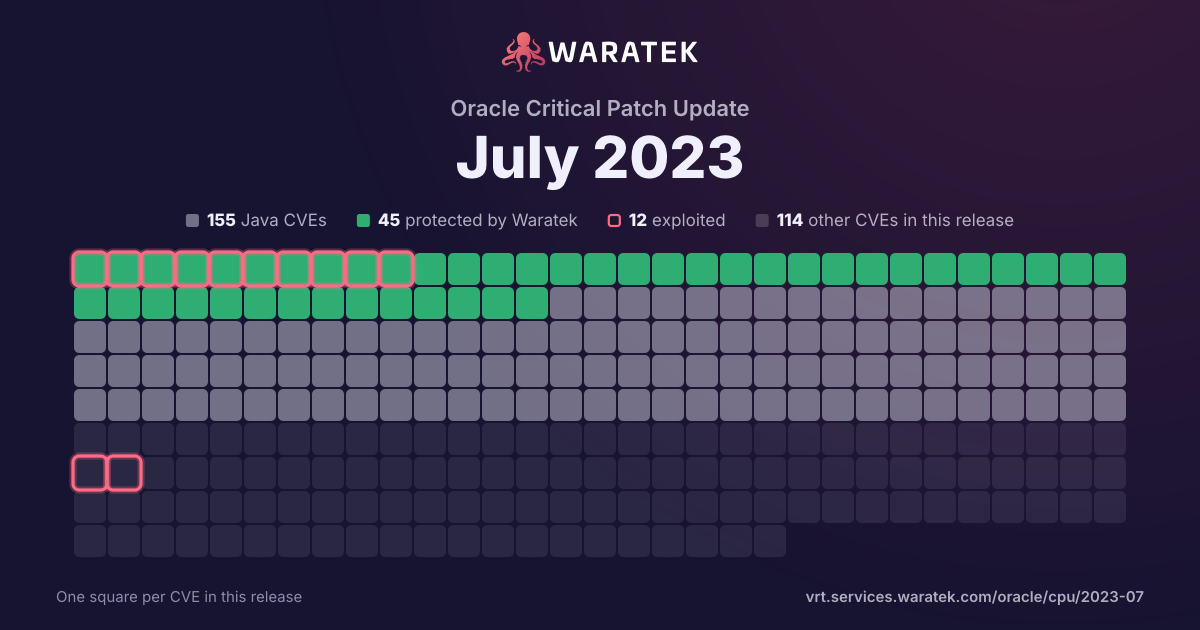
By status
45Protected by Waratek5Mitigation candidate105No exploit published31Outside Waratek scope83Not applicable
12Exploited, marked by the ring
No exploit published. For 37 of them, Oracle's security advisory is the source of public detail.
Protected by Waratek. Waratek RASP can block exploitation of these on systems that have not applied the patch yet.
Overview 8 matches · 0 exploited · 0 CISA KEV · 0 public PoC · 0 EPSS ≥ 0.5
8matches
0exploited0.0%
0CISA KEV0.0%
0public PoC0.0%
0EPSS ≥ 0.50.0%
Protected by Waratek
8
100.0%
Rule in development
0
0.0%
Mitigation candidate
0
0.0%
No exploit published
0
0.0%
blocked by ARMR today
8
100.0%
partly blocked
0
0.0%
not blocked
0
0.0%
not established
0
0.0%
unrecorded
0
0.0%
Exploited
0
0.0%
Working exploit published
0
0.0%
Proof of concept only
0
0.0%
Forecast only
0
0.0%
No public exploit
8
100.0%
split by
peak 2 / quarter
Q3 191
Protected by Waratek1
High1
blocked by ARMR today1
No public exploit1
Q4 190
Q1 200
Q2 200
Q3 200
Q4 200
Q1 210
Q2 211
Protected by Waratek1
High1
blocked by ARMR today1
No public exploit1
Q3 210
Q4 210
Q1 220
Q2 221
Protected by Waratek1
High1
blocked by ARMR today1
No public exploit1
Q3 221
Protected by Waratek1
High1
blocked by ARMR today1
No public exploit1
Q4 222
Protected by Waratek2
High2
blocked by ARMR today2
No public exploit2
Q1 231
Protected by Waratek1
High1
blocked by ARMR today1
No public exploit1
Q2 231
Protected by Waratek1
High1
blocked by ARMR today1
No public exploit1
Q4 19Q2 20Q4 20Q2 21Q4 21Q2 22Q4 22Q2 23
| CVE | Severity | Published▾ | Status | Exploitation | Description |
|---|---|---|---|---|---|
| CVE-2023-30535 | High | 2023-04-14 | Protected by Waratek | No public exploit | Snowflake JDBC provides a JDBC type 4 driver that supports core functionality, allowing Java program to connect to Snowflake. Users of the Snowflake JDBC driver were vulnerable to a command injection vulnerability. An attacker could set up a malicious, publicly accessible server which responds to the SSO URL with an attack payload. If the attacker then tricked a user into visiting the maliciously crafted connection URL, the user’s local machine would render the malicious payload, leading to a remote code execution. The vulnerability was patched on March 17, 2023 as part of Snowflake JDBC driver Version 3.13.29. All users should immediately upgrade the Snowflake JDBC driver to the latest version: 3.13.29. |
| CVE-2021-46877 | High | 2023-03-18 | Protected by Waratek | No public exploit | jackson-databind 2.10.x through 2.12.x before 2.12.6 and 2.13.x before 2.13.1 allows attackers to cause a denial of service (2 GB transient heap usage per read) in uncommon situations involving JsonNode JDK serialization. |
| CVE-2022-37866 | High | 2022-11-07 | Protected by Waratek | No public exploit | When Apache Ivy downloads artifacts from a repository it stores them in the local file system based on a user-supplied "pattern" that may include placeholders for artifacts coordinates like the organisation, module or version. If said coordinates contain "../" sequences - which are valid characters for Ivy coordinates in general - it is possible the artifacts are stored outside of Ivy's local cache or repository or can overwrite different artifacts inside of the local cache. In order to exploit this vulnerability an attacker needs collaboration by the remote repository as Ivy will issue http requests containing ".." sequences and a "normal" repository will not interpret them as part of the artifact coordinates. Users of Apache Ivy 2.0.0 to 2.5.1 should upgrade to Ivy 2.5.1. |
| CVE-2022-42004 | High | 2022-10-02 | Protected by Waratek | No public exploit | In FasterXML jackson-databind before 2.13.4, resource exhaustion can occur because of a lack of a check in BeanDeserializer._deserializeFromArray to prevent use of deeply nested arrays. An application is vulnerable only with certain customized choices for deserialization. |
| CVE-2022-40705 | High | 2022-09-22 | Protected by Waratek | No public exploit | An Improper Restriction of XML External Entity Reference vulnerability in RPCRouterServlet of Apache SOAP allows an attacker to read arbitrary files over HTTP. This issue affects Apache SOAP version 2.2 and later versions. It is unknown whether previous versions are also affected. NOTE: This vulnerability only affects products that are no longer supported by the maintainer |
| CVE-2022-25647 | High | 2022-05-01 | Protected by Waratek | No public exploit | The package com.google.code.gson:gson before 2.8.9 are vulnerable to Deserialization of Untrusted Data via the writeReplace() method in internal classes, which may lead to DoS attacks. |
| CVE-2021-33813 | High | 2021-06-16 | Protected by Waratek | No public exploit | An XXE issue in SAXBuilder in JDOM through 2.0.6 allows attackers to cause a denial of service via a crafted HTTP request. |
| CVE-2019-10086 | High | 2019-08-20 | Protected by Waratek | No public exploit | In Apache Commons Beanutils 1.9.2, a special BeanIntrospector class was added which allows suppressing the ability for an attacker to access the classloader via the class property available on all Java objects. We, however were not using this by default characteristic of the PropertyUtilsBean. |