
Oracle Critical Patch Update July 2023
Released July 2023 · Oracle's advisory ↗ · ← Critical Patch Update, April 2023 · Critical Patch Update, October 2023 →
269 CVEs in this release, one square each
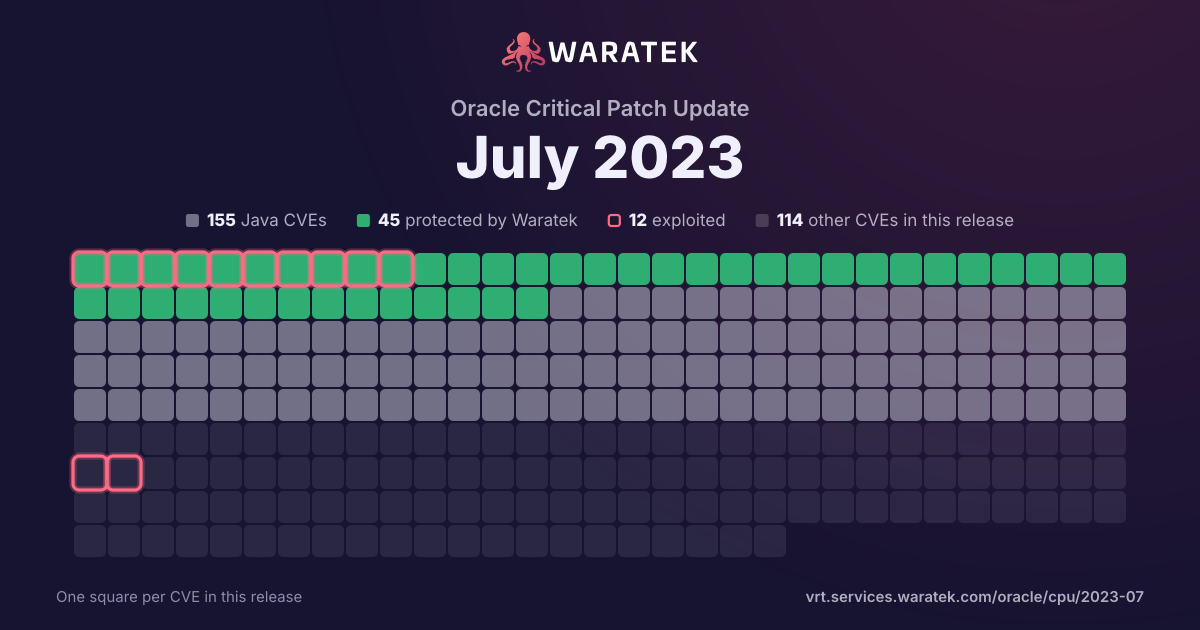
By status
45Protected by Waratek5Mitigation candidate105No exploit published31Outside Waratek scope83Not applicable
12Exploited, marked by the ring
No exploit published. For 37 of them, Oracle's security advisory is the source of public detail.
Protected by Waratek. Waratek RASP can block exploitation of these on systems that have not applied the patch yet.
Overview 18 matches · 10 protected · 0 exploited · 0 CISA KEV · 0 public PoC · 0 EPSS ≥ 0.5
Protected by Waratek
10
55.6%
Rule in development
0
0.0%
Mitigation candidate
0
0.0%
No exploit published
8
44.4%
blocked by ARMR today
10
55.6%
partly blocked
0
0.0%
not blocked
8
44.4%
not established
0
0.0%
unrecorded
0
0.0%
Exploited
0
0.0%
Working exploit published
0
0.0%
Proof of concept only
0
0.0%
Forecast only
0
0.0%
No public exploit
18
100.0%
split by
peak 3 / quarter
Q2 181
Protected by Waratek1
Critical1
blocked by ARMR today1
No public exploit1
Q3 180
Q4 180
Q1 190
Q2 190
Q3 190
Q4 191
No exploit published1
Critical1
not blocked1
No public exploit1
Q1 201
No exploit published1
Critical1
not blocked1
No public exploit1
Q2 200
Q3 201
Protected by Waratek1
Critical1
blocked by ARMR today1
No public exploit1
Q4 200
Q1 211
Protected by Waratek1
Critical1
blocked by ARMR today1
No public exploit1
Q2 211
Protected by Waratek1
Critical1
blocked by ARMR today1
No public exploit1
Q3 210
Q4 212
Protected by Waratek2
Critical2
blocked by ARMR today2
No public exploit2
Q1 220
Q2 221
Protected by Waratek1
Critical1
blocked by ARMR today1
No public exploit1
Q3 223
No exploit published3
Critical3
not blocked3
No public exploit3
Q4 223
Protected by Waratek3
Critical3
blocked by ARMR today3
No public exploit3
Q1 231
No exploit published1
Critical1
not blocked1
No public exploit1
Q2 232
No exploit published2
Critical2
not blocked2
No public exploit2
Q2 18Q4 18Q2 19Q4 19Q2 20Q4 20Q2 21Q4 21Q2 22Q4 22Q2 23
| CVE | Severity | Published▾ | Status | Exploitation | Description |
|---|---|---|---|---|---|
| CVE-2023-20873 | Critical | 2023-04-20 | No exploit published | No public exploit | In Spring Boot versions 3.0.0 - 3.0.5, 2.7.0 - 2.7.10, and older unsupported versions, an application that is deployed to Cloud Foundry could be susceptible to a security bypass. Users of affected versions should apply the following mitigation: 3.0.x users should upgrade to 3.0.6+. 2.7.x users should upgrade to 2.7.11+. Users of older, unsupported versions should upgrade to 3.0.6+ or 2.7.11+. |
| CVE-2023-26119 | Critical | 2023-04-03 | No exploit published | No public exploit | Versions of the package net.sourceforge.htmlunit:htmlunit from 0 and before 3.0.0 are vulnerable to Remote Code Execution (RCE) via XSTL, when browsing the attacker’s webpage. |
| CVE-2023-27898 | Critical | 2023-03-10 | No exploit published | No public exploit | Jenkins 2.270 through 2.393 (both inclusive), LTS 2.277.1 through 2.375.3 (both inclusive) does not escape the Jenkins version a plugin depends on when rendering the error message stating its incompatibility with the current version of Jenkins, resulting in a stored cross-site scripting (XSS) vulnerability exploitable by attackers able to provide plugins to the configured update sites and have this message shown by Jenkins instances. |
| CVE-2022-42920 | Critical | 2022-11-07 | Protected by Waratek | No public exploit | Apache Commons BCEL has a number of APIs that would normally only allow changing specific class characteristics. However, due to an out-of-bounds writing issue, these APIs can be used to produce arbitrary bytecode. This could be abused in applications that pass attacker-controllable data to those APIs, giving the attacker more control over the resulting bytecode than otherwise expected. Update to Apache Commons BCEL 6.6.0. |
| CVE-2022-37865 | Critical | 2022-11-07 | Protected by Waratek | No public exploit | With Apache Ivy 2.4.0 an optional packaging attribute has been introduced that allows artifacts to be unpacked on the fly if they used pack200 or zip packaging. For artifacts using the "zip", "jar" or "war" packaging Ivy prior to 2.5.1 doesn't verify the target path when extracting the archive. An archive containing absolute paths or paths that try to traverse "upwards" using ".." sequences can then write files to any location on the local fie system that the user executing Ivy has write access to. Ivy users of version 2.4.0 to 2.5.0 should upgrade to Ivy 2.5.1. |
| CVE-2022-41853 | Critical | 2022-10-06 | Protected by Waratek | No public exploit | Those using java.sql.Statement or java.sql.PreparedStatement in hsqldb (HyperSQL DataBase) to process untrusted input may be vulnerable to a remote code execution attack. By default it is allowed to call any static method of any Java class in the classpath resulting in code execution. The issue can be prevented by updating to 2.7.1 or by setting the system property "hsqldb.method_class_names" to classes which are allowed to be called. For example, System.setProperty("hsqldb.method_class_names", "abc") or Java argument -Dhsqldb.method_class_names="abc" can be used. From version 2.7.1 all classes by default are not accessible except those in java.lang.Math and need to be manually enabled. |
| CVE-2020-35169 | Critical | 2022-07-11 | No exploit published | No public exploit | Dell BSAFE Crypto-C Micro Edition, versions before 4.1.5, and Dell BSAFE Micro Edition Suite, versions before 4.5.2, contain an Improper Input Validation Vulnerability. |
| CVE-2020-35166 | Critical | 2022-07-11 | No exploit published | No public exploit | Dell BSAFE Crypto-C Micro Edition, versions before 4.1.5, and Dell BSAFE Micro Edition Suite, versions before 4.6, contain an Observable Timing Discrepancy Vulnerability. |
| CVE-2020-29508 | Critical | 2022-07-11 | No exploit published | No public exploit | Dell BSAFE Crypto-C Micro Edition, versions before 4.1.5, and Dell BSAFE Micro Edition Suite, versions before 4.6, contain an Improper Input Validation Vulnerability. |
| CVE-2022-26612 | Critical | 2022-04-07 | Protected by Waratek | No public exploit | In Apache Hadoop, The unTar function uses unTarUsingJava function on Windows and the built-in tar utility on Unix and other OSes. As a result, a TAR entry may create a symlink under the expected extraction directory which points to an external directory. A subsequent TAR entry may extract an arbitrary file into the external directory using the symlink name. This however would be caught by the same targetDirPath check on Unix because of the getCanonicalPath call. However on Windows, getCanonicalPath doesn't resolve symbolic links, which bypasses the check. unpackEntries during TAR extraction follows symbolic links which allows writing outside expected base directory on Windows. This was addressed in Apache Hadoop 3.2.3 |
| CVE-2021-43113 | Critical | 2021-12-15 | Protected by Waratek | No public exploit | iTextPDF in iText 7 and up to (excluding 4.4.13.3) 7.1.17 allows command injection via a CompareTool filename that is mishandled on the gs (aka Ghostscript) command line in GhostscriptHelper.java. |
| CVE-2021-42575 | Critical | 2021-10-18 | Protected by Waratek | No public exploit | The OWASP Java HTML Sanitizer before 20211018.1 does not properly enforce policies associated with the SELECT, STYLE, and OPTION elements. |
| CVE-2020-9493 | Critical | 2021-06-16 | Protected by Waratek | No public exploit | A deserialization flaw was found in Apache Chainsaw versions prior to 2.1.0 which could lead to malicious code execution. |
| CVE-2021-23926 | Critical | 2021-01-14 | Protected by Waratek | No public exploit | The XML parsers used by XMLBeans up to version 2.6.0 did not set the properties needed to protect the user from malicious XML input. Vulnerabilities include possibilities for XML Entity Expansion attacks. Affects XMLBeans up to and including v2.6.0. |
| CVE-2020-11998 | Critical | 2020-09-10 | Protected by Waratek | No public exploit | A regression has been introduced in the commit preventing JMX re-bind. By passing an empty environment map to RMIConnectorServer, instead of the map that contains the authentication credentials, it leaves ActiveMQ open to the following attack: https://docs.oracle.com/javase/8/docs/technotes/guides/management/agent.html "A remote client could create a javax.management.loading.MLet MBean and use it to create new MBeans from arbitrary URLs, at least if there is no security manager. In other words, a rogue remote client could make your Java application execute arbitrary code." Mitigation: Upgrade to Apache ActiveMQ 5.15.13 |
| CVE-2020-1953 | Critical | 2020-03-13 | No exploit published | No public exploit | Apache Commons Configuration uses a third-party library to parse YAML files which by default allows the instantiation of classes if the YAML includes special statements. Apache Commons Configuration versions 2.2, 2.3, 2.4, 2.5, 2.6 did not change the default settings of this library. So if a YAML file was loaded from an untrusted source, it could therefore load and execute code out of the control of the host application. |
| CVE-2019-17531 | Critical | 2019-10-12 | No exploit published | No public exploit | A Polymorphic Typing issue was discovered in FasterXML jackson-databind 2.0.0 through 2.9.10. When Default Typing is enabled (either globally or for a specific property) for an externally exposed JSON endpoint and the service has the apache-log4j-extra (version 1.2.x) jar in the classpath, and an attacker can provide a JNDI service to access, it is possible to make the service execute a malicious payload. |
| CVE-2018-1282 | Critical | 2018-04-05 | Protected by Waratek | No public exploit | This vulnerability in Apache Hive JDBC driver 0.7.1 to 2.3.2 allows carefully crafted arguments to be used to bypass the argument escaping/cleanup that JDBC driver does in PreparedStatement implementation. |