
Oracle Critical Patch Update July 2023
Released July 2023 · Oracle's advisory ↗ · ← Critical Patch Update, April 2023 · Critical Patch Update, October 2023 →
269 CVEs in this release, one square each
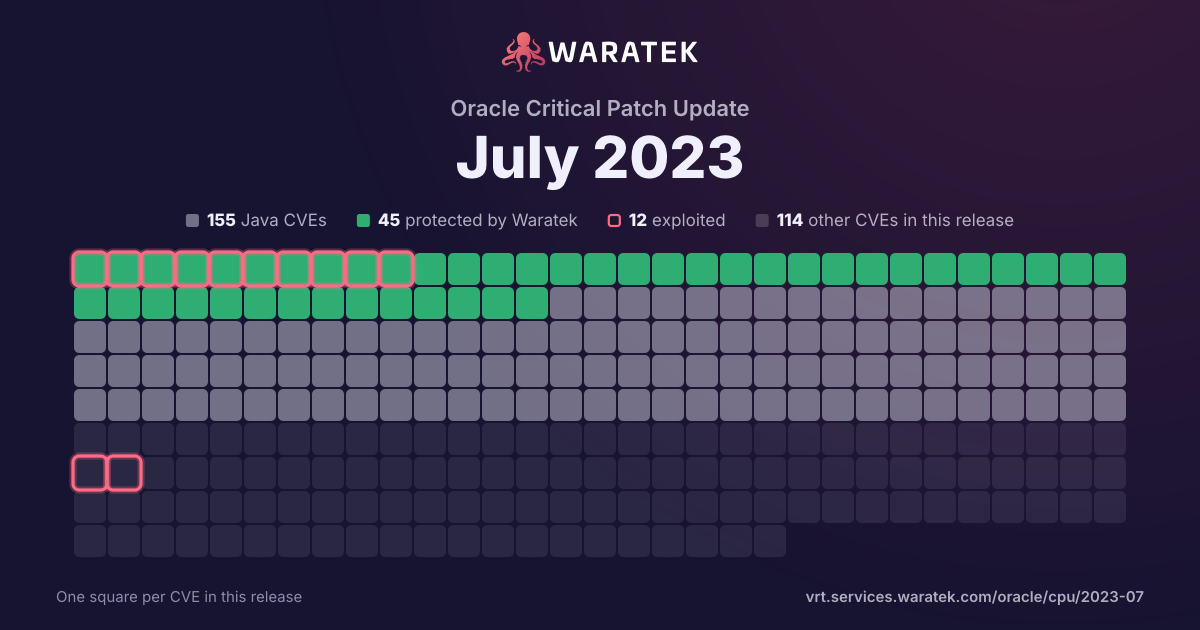
By status
43Protected by Waratek9Mitigation candidate113No exploit published6Outside Waratek scope98Not applicable
12Exploited, marked by the ring
No exploit published. For 28 of them, Oracle's security advisory is the source of public detail.
Protected by Waratek. Waratek RASP can block exploitation of these on systems that have not applied the patch yet.
Overview 7 matches · 4 protected · 0 exploited · 0 CISA KEV · 0 public PoC · 0 EPSS ≥ 0.5
Protected by Waratek
4
57.1%
Rule in development
0
0.0%
Mitigation candidate
0
0.0%
No exploit published
3
42.9%
blocked by ARMR today
4
57.1%
partly blocked
0
0.0%
not blocked
3
42.9%
not established
0
0.0%
unrecorded
0
0.0%
Exploited
0
0.0%
Working exploit published
0
0.0%
Proof of concept only
0
0.0%
Forecast only
0
0.0%
No public exploit
7
100.0%
split by
peak 3 / month
Apr 223
Protected by Waratek2
No exploit published1
Critical1
High1
Medium1
blocked by ARMR today2
not blocked1
No public exploit3
May 223
Protected by Waratek2
No exploit published1
High1
Medium2
blocked by ARMR today2
not blocked1
No public exploit3
Jun 221
No exploit published1
Low1
not blocked1
No public exploit1
Apr 22May 22Jun 22
| CVE | Severity | Published▾ | Status | Exploitation | Description |
|---|---|---|---|---|---|
| CVE-2022-33879 | Low | 2022-06-27 | No exploit published | No public exploit | The initial fixes in CVE-2022-30126 and CVE-2022-30973 for regexes in the StandardsExtractingContentHandler were insufficient, and we found a separate, new regex DoS in a different regex in the StandardsExtractingContentHandler. These are now fixed in 1.28.4 and 2.4.1. |
| CVE-2022-22971 | Medium | 2022-05-12 | Protected by Waratek | No public exploit | In spring framework versions prior to 5.3.20+ , 5.2.22+ and old unsupported versions, application with a STOMP over WebSocket endpoint is vulnerable to a denial of service attack by an authenticated user. |
| CVE-2022-22970 | Medium | 2022-05-12 | No exploit published | No public exploit | In spring framework versions prior to 5.3.20+ , 5.2.22+ and old unsupported versions, applications that handle file uploads are vulnerable to DoS attack if they rely on data binding to set a MultipartFile or javax.servlet.Part to a field in a model object. |
| CVE-2022-25647 | High | 2022-05-01 | Protected by Waratek | No public exploit | The package com.google.code.gson:gson before 2.8.9 are vulnerable to Deserialization of Untrusted Data via the writeReplace() method in internal classes, which may lead to DoS attacks. |
| CVE-2022-29546 | High | 2022-04-25 | No exploit published | No public exploit | HtmlUnit NekoHtml Parser before 2.61.0 suffers from a denial of service vulnerability. Crafted input associated with the parsing of Processing Instruction (PI) data leads to heap memory consumption. This is similar to CVE-2022-28366 but affects a much later version of the product. |
| CVE-2022-26612 | Critical | 2022-04-07 | Protected by Waratek | No public exploit | In Apache Hadoop, The unTar function uses unTarUsingJava function on Windows and the built-in tar utility on Unix and other OSes. As a result, a TAR entry may create a symlink under the expected extraction directory which points to an external directory. A subsequent TAR entry may extract an arbitrary file into the external directory using the symlink name. This however would be caught by the same targetDirPath check on Unix because of the getCanonicalPath call. However on Windows, getCanonicalPath doesn't resolve symbolic links, which bypasses the check. unpackEntries during TAR extraction follows symbolic links which allows writing outside expected base directory on Windows. This was addressed in Apache Hadoop 3.2.3 |
| CVE-2022-22950 | Medium | 2022-04-01 | Protected by Waratek | No public exploit | n Spring Framework versions 5.3.0 - 5.3.16 and older unsupported versions, it is possible for a user to provide a specially crafted SpEL expression that may cause a denial of service condition. |