
Oracle Critical Patch Update July 2023
Released July 2023 · Oracle's advisory ↗ · ← Critical Patch Update, April 2023 · Critical Patch Update, October 2023 →
269 CVEs in this release, one square each
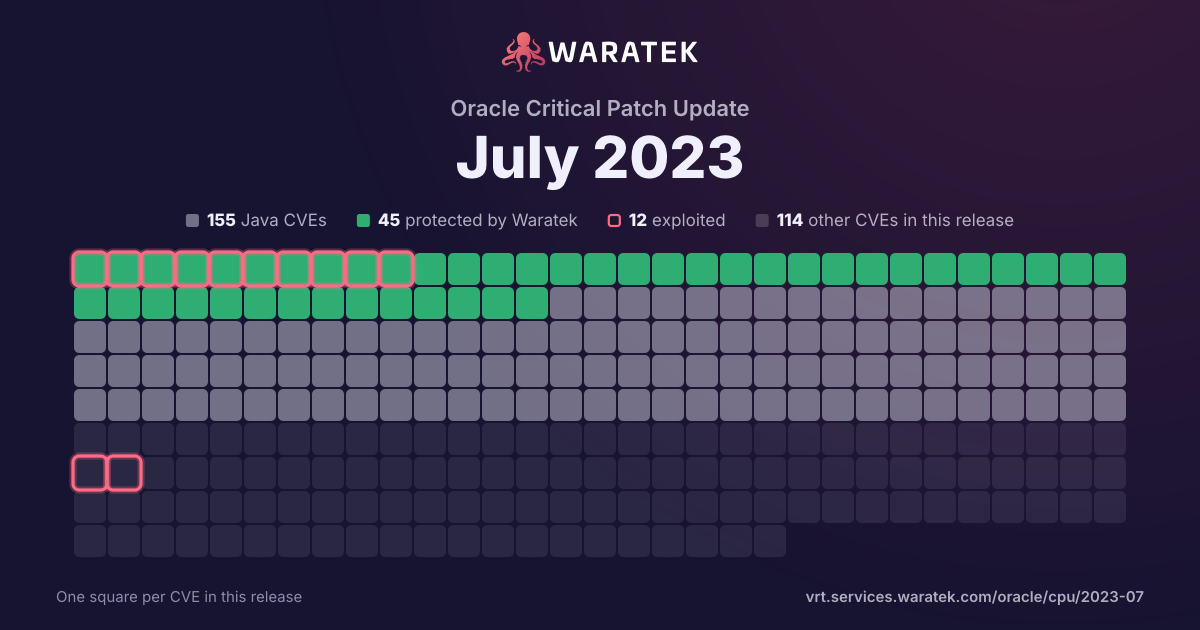
By status
45Protected by Waratek5Mitigation candidate105No exploit published31Outside Waratek scope83Not applicable
12Exploited, marked by the ring
No exploit published. For 37 of them, Oracle's security advisory is the source of public detail.
Protected by Waratek. Waratek RASP can block exploitation of these on systems that have not applied the patch yet.
Overview 4 matches · 3 in Waratek scope · 3 protected · 0 CISA KEV · 3 public PoC · 3 EPSS ≥ 0.5
Protected by Waratek
3
75.0%
Rule in development
0
0.0%
Mitigation candidate
0
0.0%
No exploit published
0
0.0%
Outside Waratek scope
0
0.0%
Not applicable
1
25.0%
Withdrawn CVE
0
0.0%
blocked by ARMR today
3
75.0%
partly blocked
0
0.0%
not blocked
1
25.0%
not established
0
0.0%
unrecorded
0
0.0%
Exploited
4
100.0%
Working exploit published
0
0.0%
Proof of concept only
0
0.0%
Forecast only
0
0.0%
No public exploit
0
0.0%
split by
peak 1 / month
Dec 211
Protected by Waratek1
High1
blocked by ARMR today1
Exploited1
Jan 220
Feb 220
Mar 220
Apr 220
May 220
Jun 220
Jul 220
Aug 221
Protected by Waratek1
High1
blocked by ARMR today1
Exploited1
Sep 220
Oct 220
Nov 220
Dec 220
Jan 231
Not applicable1
High1
not blocked1
Exploited1
Feb 231
Protected by Waratek1
High1
blocked by ARMR today1
Exploited1
Dec 21Feb 22Apr 22Jun 22Aug 22Oct 22Dec 22Feb 23
| CVE | Severity | Published▾ | Status | Exploitation | Description |
|---|---|---|---|---|---|
| CVE-2023-25194 | High | 2023-02-07 | Protected by Waratek | Exploited | A possible security vulnerability has been identified in Apache Kafka Connect API. This requires access to a Kafka Connect worker, and the ability to create/modify connectors on it with an arbitrary Kafka client SASL JAAS config and a SASL-based security protocol, which has been possible on Kafka Connect clusters since Apache Kafka Connect 2.3.0. When configuring the connector via the Kafka Connect REST API, an authenticated operator can set the `sasl.jaas.config` property for any of the connector's Kafka clients to "com.sun.security.auth.module.JndiLoginModule", which can be done via the `producer.override.sasl.jaas.config`, `consumer.override.sasl.jaas.config`, or `admin.override.sasl.jaas.config` properties. This will allow the server to connect to the attacker's LDAP server and deserialize the LDAP response, which the attacker can use to execute java deserialization gadget chains on the Kafka connect server. Attacker can cause unrestricted deserialization of untrusted data (or) RCE vulnerability when there are gadgets in the classpath. Since Apache Kafka 3.0.0, users are allowed to specify these properties in connector configurations for Kafka Connect clusters running with out-of-the-box configurations. Before Apache Kafka 3.0.0, users may not specify these properties unless the Kafka Connect cluster has been reconfigured with a connector client override policy that permits them. Since Apache Kafka 3.4.0, we have added a system property ("-Dorg.apache.kafka.disallowed.login.modules") to disable the problematic login modules usage in SASL JAAS configuration. Also by default "com.sun.security.auth.module.JndiLoginModule" is disabled in Apache Kafka Connect 3.4.0. We advise the Kafka Connect users to validate connector configurations and only allow trusted JNDI configurations. Also examine connector dependencies for vulnerable versions and either upgrade their connectors, upgrading that specific dependency, or removing the connectors as options for remediation. Finally, in addition to leveraging the "org.apache.kafka.disallowed.login.modules" system property, Kafka Connect users can also implement their own connector client config override policy, which can be used to control which Kafka client properties can be overridden directly in a connector config and which cannot. |
| CVE-2023-22809 | High | 2023-01-18 | Not applicable | Exploited | In Sudo before 1.9.12p2, the sudoedit (aka -e) feature mishandles extra arguments passed in the user-provided environment variables (SUDO_EDITOR, VISUAL, and EDITOR), allowing a local attacker to append arbitrary entries to the list of files to process. This can lead to privilege escalation. Affected versions are 1.8.0 through 1.9.12.p1. The problem exists because a user-specified editor may contain a "--" argument that defeats a protection mechanism, e.g., an EDITOR='vim -- /path/to/extra/file' value. |
| CVE-2022-31197 | High | 2022-08-03 | Protected by Waratek | Exploited | PostgreSQL JDBC Driver (PgJDBC for short) allows Java programs to connect to a PostgreSQL database using standard, database independent Java code. The PGJDBC implementation of the `java.sql.ResultRow.refreshRow()` method is not performing escaping of column names so a malicious column name that contains a statement terminator, e.g. `;`, could lead to SQL injection. This could lead to executing additional SQL commands as the application's JDBC user. User applications that do not invoke the `ResultSet.refreshRow()` method are not impacted. User application that do invoke that method are impacted if the underlying database that they are querying via their JDBC application may be under the control of an attacker. The attack requires the attacker to trick the user into executing SQL against a table name who's column names would contain the malicious SQL and subsequently invoke the `refreshRow()` method on the ResultSet. Note that the application's JDBC user and the schema owner need not be the same. A JDBC application that executes as a privileged user querying database schemas owned by potentially malicious less-privileged users would be vulnerable. In that situation it may be possible for the malicious user to craft a schema that causes the application to execute commands as the privileged user. Patched versions will be released as `42.2.26` and `42.4.1`. Users are advised to upgrade. There are no known workarounds for this issue. |
| CVE-2021-4104 | High | 2021-12-14 | Protected by Waratek | Exploited | JMSAppender in Log4j 1.2 is vulnerable to deserialization of untrusted data when the attacker has write access to the Log4j configuration. The attacker can provide TopicBindingName and TopicConnectionFactoryBindingName configurations causing JMSAppender to perform JNDI requests that result in remote code execution in a similar fashion to CVE-2021-44228. Note this issue only affects Log4j 1.2 when specifically configured to use JMSAppender, which is not the default. Apache Log4j 1.2 reached end of life in August 2015. Users should upgrade to Log4j 2 as it addresses numerous other issues from the previous versions. |