
Oracle Critical Patch Update July 2023
Released July 2023 · Oracle's advisory ↗ · ← Critical Patch Update, April 2023 · Critical Patch Update, October 2023 →
269 CVEs in this release, one square each
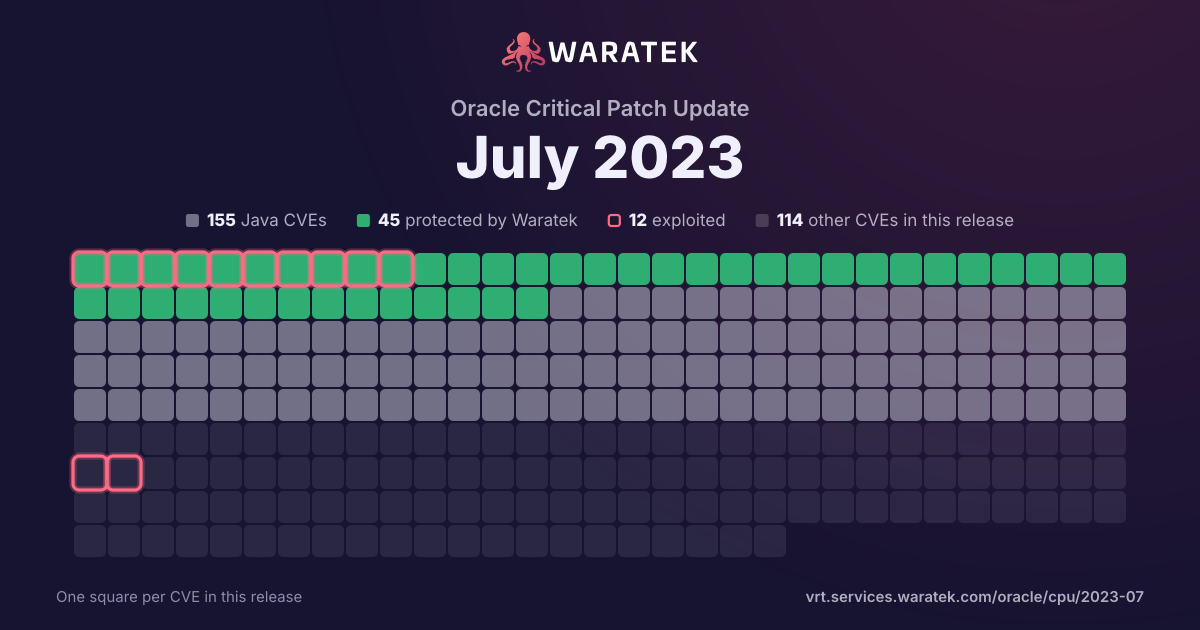
By status
46Protected by Waratek7Mitigation candidate112No exploit published6Outside Waratek scope98Not applicable
12Exploited, marked by the ring
No exploit published. For 37 of them, Oracle's security advisory is the source of public detail.
Protected by Waratek. Waratek RASP can block exploitation of these on systems that have not applied the patch yet.
Overview 4 matches · 3 protected · 0 exploited · 0 CISA KEV · 0 public PoC · 0 EPSS ≥ 0.5
Protected by Waratek
3
75.0%
Rule in development
0
0.0%
Mitigation candidate
0
0.0%
No exploit published
1
25.0%
blocked by ARMR today
3
75.0%
partly blocked
0
0.0%
not blocked
1
25.0%
not established
0
0.0%
unrecorded
0
0.0%
Exploited
0
0.0%
Working exploit published
0
0.0%
Proof of concept only
0
0.0%
Forecast only
0
0.0%
No public exploit
4
100.0%
split by
peak 1 / quarter
Q3 191
Protected by Waratek1
Critical1
blocked by ARMR today1
No public exploit1
Q4 190
Q1 200
Q2 200
Q3 201
Protected by Waratek1
Critical1
blocked by ARMR today1
No public exploit1
Q4 200
Q1 210
Q2 210
Q3 210
Q4 210
Q1 220
Q2 220
Q3 220
Q4 221
Protected by Waratek1
Critical1
blocked by ARMR today1
No public exploit1
Q1 230
Q2 231
No exploit published1
Critical1
not blocked1
No public exploit1
Q4 19Q2 20Q4 20Q2 21Q4 21Q2 22Q4 22Q2 23
| CVE | Severity | Published▾ | Status | Exploitation | Description |
|---|---|---|---|---|---|
| CVE-2023-20873 | Critical | 2023-04-20 | No exploit published | No public exploit | In Spring Boot versions 3.0.0 - 3.0.5, 2.7.0 - 2.7.10, and older unsupported versions, an application that is deployed to Cloud Foundry could be susceptible to a security bypass. Users of affected versions should apply the following mitigation: 3.0.x users should upgrade to 3.0.6+. 2.7.x users should upgrade to 2.7.11+. Users of older, unsupported versions should upgrade to 3.0.6+ or 2.7.11+. |
| CVE-2022-42920 | Critical | 2022-11-07 | Protected by Waratek | No public exploit | Apache Commons BCEL has a number of APIs that would normally only allow changing specific class characteristics. However, due to an out-of-bounds writing issue, these APIs can be used to produce arbitrary bytecode. This could be abused in applications that pass attacker-controllable data to those APIs, giving the attacker more control over the resulting bytecode than otherwise expected. Update to Apache Commons BCEL 6.6.0. |
| CVE-2020-11998 | Critical | 2020-09-10 | Protected by Waratek | No public exploit | A regression has been introduced in the commit preventing JMX re-bind. By passing an empty environment map to RMIConnectorServer, instead of the map that contains the authentication credentials, it leaves ActiveMQ open to the following attack: https://docs.oracle.com/javase/8/docs/technotes/guides/management/agent.html "A remote client could create a javax.management.loading.MLet MBean and use it to create new MBeans from arbitrary URLs, at least if there is no security manager. In other words, a rogue remote client could make your Java application execute arbitrary code." Mitigation: Upgrade to Apache ActiveMQ 5.15.13 |
| CVE-2019-13990 | Critical | 2019-07-26 | Protected by Waratek | No public exploit | initDocumentParser in xml/XMLSchedulingDataProcessor.java in Terracotta Quartz Scheduler through 2.3.0 allows XXE attacks via a job description. |