
Oracle Critical Patch Update July 2023
Released July 2023 · Oracle's advisory ↗ · ← Critical Patch Update, April 2023 · Critical Patch Update, October 2023 →
269 CVEs in this release, one square each
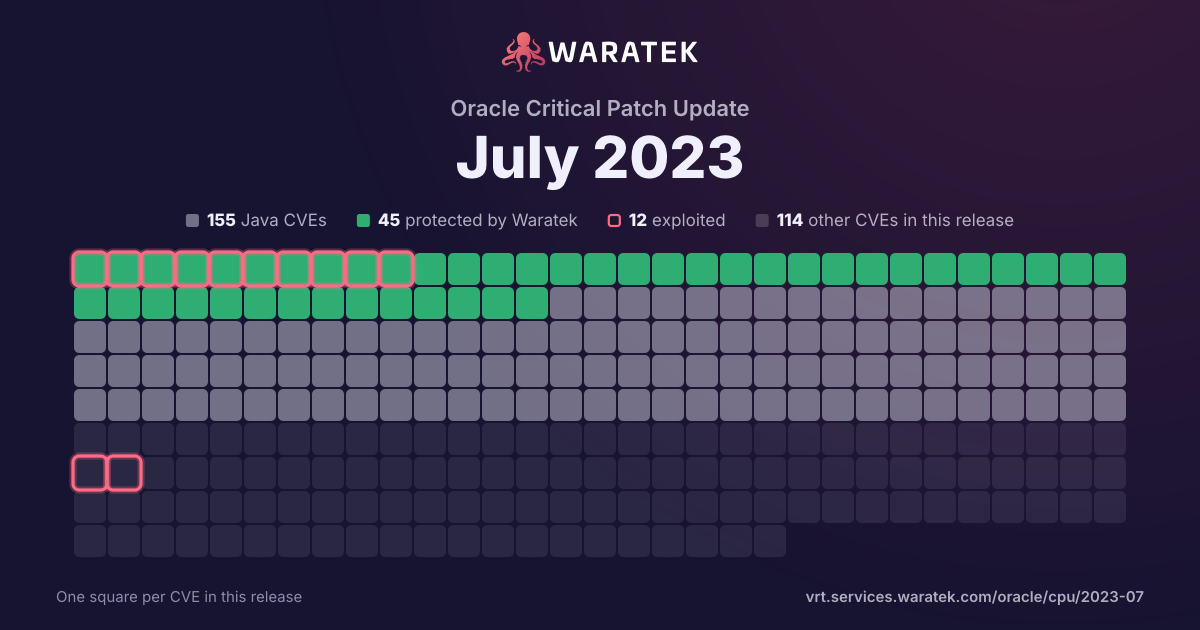
By status
43Protected by Waratek1Rule in development6Mitigation candidate112No exploit published5Outside Waratek scope102Not applicable
12Exploited, marked by the ring
No exploit published. For 28 of them, Oracle's security advisory is the source of public detail.
Protected by Waratek. Waratek RASP can block exploitation of these on systems that have not applied the patch yet.
Overview 8 matches · 1 exploited · 0 CISA KEV · 2 public PoC · 1 EPSS ≥ 0.5
Protected by Waratek
8
100.0%
Rule in development
0
0.0%
Mitigation candidate
0
0.0%
No exploit published
0
0.0%
blocked by ARMR today
8
100.0%
partly blocked
0
0.0%
not blocked
0
0.0%
not established
0
0.0%
unrecorded
0
0.0%
Exploited
1
12.5%
Working exploit published
0
0.0%
Proof of concept only
4
50.0%
Forecast only
0
0.0%
No public exploit
3
37.5%
split by
peak 4 / month
Aug 221
Protected by Waratek1
Medium1
blocked by ARMR today1
Proof of concept only1
Sep 222
Protected by Waratek2
Critical1
Medium1
blocked by ARMR today2
Proof of concept only2
Oct 220
Nov 224
Protected by Waratek4
Critical3
High1
blocked by ARMR today4
Proof of concept only1
No public exploit3
Dec 221
Protected by Waratek1
Critical1
blocked by ARMR today1
Exploited1
Aug 22Sep 22Oct 22Nov 22Dec 22
| CVE | Severity | Published▾ | Status | Exploitation | Description |
|---|---|---|---|---|---|
| CVE-2022-1471 | Critical | 2022-12-01 | Protected by Waratek | Exploited | SnakeYaml's Constructor() class does not restrict types which can be instantiated during deserialization. Deserializing yaml content provided by an attacker can lead to remote code execution. We recommend using SnakeYaml's SafeConsturctor when parsing untrusted content to restrict deserialization. We recommend upgrading to version 2.0 and beyond. |
| CVE-2022-45047 | Critical | 2022-11-16 | Protected by Waratek | Proof of concept only | Class org.apache.sshd.server.keyprovider.SimpleGeneratorHostKeyProvider in Apache MINA SSHD <= 2.9.1 uses Java deserialization to load a serialized java.security.PrivateKey. The class is one of several implementations that an implementor using Apache MINA SSHD can choose for loading the host keys of an SSH server. |
| CVE-2022-42920 | Critical | 2022-11-07 | Protected by Waratek | No public exploit | Apache Commons BCEL has a number of APIs that would normally only allow changing specific class characteristics. However, due to an out-of-bounds writing issue, these APIs can be used to produce arbitrary bytecode. This could be abused in applications that pass attacker-controllable data to those APIs, giving the attacker more control over the resulting bytecode than otherwise expected. Update to Apache Commons BCEL 6.6.0. |
| CVE-2022-37866 | High | 2022-11-07 | Protected by Waratek | No public exploit | When Apache Ivy downloads artifacts from a repository it stores them in the local file system based on a user-supplied "pattern" that may include placeholders for artifacts coordinates like the organisation, module or version. If said coordinates contain "../" sequences - which are valid characters for Ivy coordinates in general - it is possible the artifacts are stored outside of Ivy's local cache or repository or can overwrite different artifacts inside of the local cache. In order to exploit this vulnerability an attacker needs collaboration by the remote repository as Ivy will issue http requests containing ".." sequences and a "normal" repository will not interpret them as part of the artifact coordinates. Users of Apache Ivy 2.0.0 to 2.5.1 should upgrade to Ivy 2.5.1. |
| CVE-2022-37865 | Critical | 2022-11-07 | Protected by Waratek | No public exploit | With Apache Ivy 2.4.0 an optional packaging attribute has been introduced that allows artifacts to be unpacked on the fly if they used pack200 or zip packaging. For artifacts using the "zip", "jar" or "war" packaging Ivy prior to 2.5.1 doesn't verify the target path when extracting the archive. An archive containing absolute paths or paths that try to traverse "upwards" using ".." sequences can then write files to any location on the local fie system that the user executing Ivy has write access to. Ivy users of version 2.4.0 to 2.5.0 should upgrade to Ivy 2.5.1. |
| CVE-2022-36944 | Critical | 2022-09-23 | Protected by Waratek | Proof of concept only | Scala 2.13.x before 2.13.9 has a Java deserialization chain in its JAR file. On its own, it cannot be exploited. There is only a risk in conjunction with Java object deserialization within an application. In such situations, it allows attackers to erase contents of arbitrary files, make network connections, or possibly run arbitrary code (specifically, Function0 functions) via a gadget chain. |
| CVE-2022-38752 | Medium | 2022-09-05 | Protected by Waratek | Proof of concept only | Using snakeYAML to parse untrusted YAML files may be vulnerable to Denial of Service attacks (DOS). If the parser is running on user supplied input, an attacker may supply content that causes the parser to crash by stack-overflow. |
| CVE-2022-36033 | Medium | 2022-08-29 | Protected by Waratek | Proof of concept only | jsoup is a Java HTML parser, built for HTML editing, cleaning, scraping, and cross-site scripting (XSS) safety. jsoup may incorrectly sanitize HTML including `javascript:` URL expressions, which could allow XSS attacks when a reader subsequently clicks that link. If the non-default `SafeList.preserveRelativeLinks` option is enabled, HTML including `javascript:` URLs that have been crafted with control characters will not be sanitized. If the site that this HTML is published on does not set a Content Security Policy, an XSS attack is then possible. This issue is patched in jsoup 1.15.3. Users should upgrade to this version. Additionally, as the unsanitized input may have been persisted, old content should be cleaned again using the updated version. To remediate this issue without immediately upgrading: - disable `SafeList.preserveRelativeLinks`, which will rewrite input URLs as absolute URLs - ensure an appropriate [Content Security Policy](https://developer.mozilla.org/en-US/docs/Web/HTTP/CSP) is defined. (This should be used regardless of upgrading, as a defence-in-depth best practice.) |