
Oracle Critical Patch Update April 2023
Released April 2023 · Oracle's advisory ↗ · ← Critical Patch Update, January 2023 · Critical Patch Update, July 2023 →
328 CVEs in this release, one square each
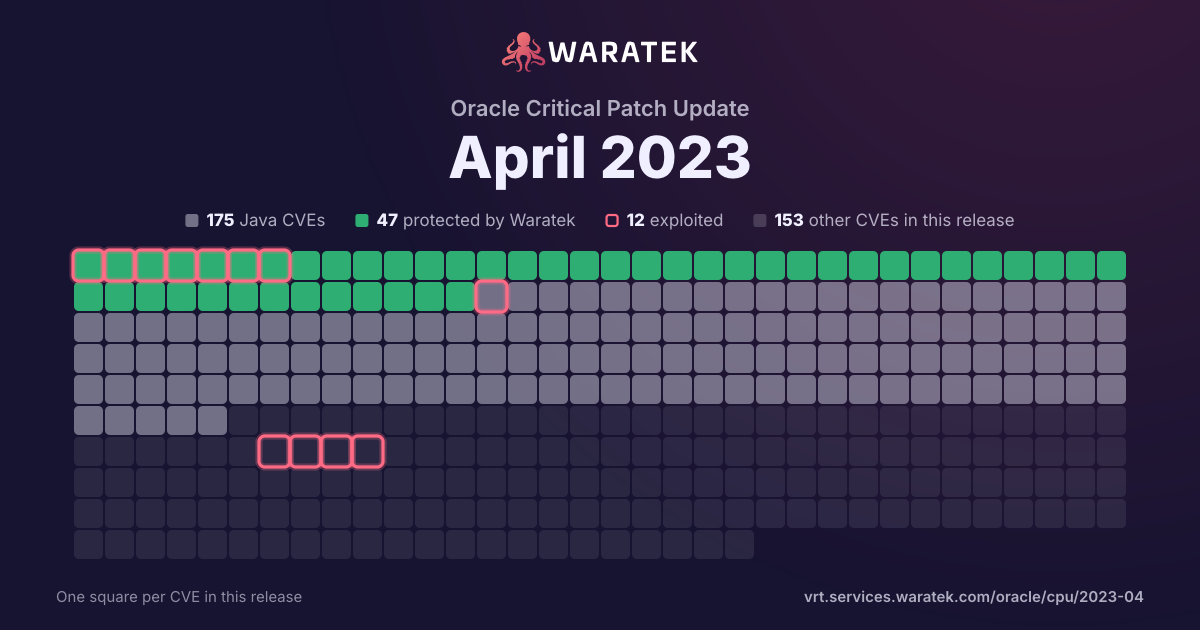
By status
47Protected by Waratek9Mitigation candidate119No exploit published35Outside Waratek scope118Not applicable
12Exploited, marked by the ring
No exploit published. For 56 of them, Oracle's security advisory is the source of public detail.
Protected by Waratek. Waratek RASP can block exploitation of these on systems that have not applied the patch yet.
Overview 35 matches · 0 in Waratek scope · 0 protected · 0 exploited · 0 CISA KEV · 3 public PoC · 3 EPSS ≥ 0.5
35matches
0in Waratek scope0.0%
0protected0.0%
0exploited0.0%
0CISA KEV0.0%
3public PoC8.6%
3EPSS ≥ 0.58.6%
Protected by Waratek
0
0.0%
Rule in development
0
0.0%
Mitigation candidate
0
0.0%
No exploit published
0
0.0%
Outside Waratek scope
35
100.0%
Not applicable
0
0.0%
Withdrawn CVE
0
0.0%
blocked by ARMR today
0
0.0%
partly blocked
0
0.0%
not blocked
35
100.0%
not established
0
0.0%
unrecorded
0
0.0%
Exploited
0
0.0%
Working exploit published
0
0.0%
Proof of concept only
7
20.0%
Forecast only
1
2.9%
No public exploit
27
77.1%
split by
peak 13 / quarter
Q2 201
Outside Waratek scope1
Medium1
not blocked1
No public exploit1
Q3 202
Outside Waratek scope2
High2
not blocked2
No public exploit2
Q4 200
Q1 211
Outside Waratek scope1
Critical1
not blocked1
No public exploit1
Q2 210
Q3 212
Outside Waratek scope2
High2
not blocked2
Forecast only1
No public exploit1
Q4 214
Outside Waratek scope4
High1
Medium3
not blocked4
Proof of concept only1
No public exploit3
Q1 221
Outside Waratek scope1
High1
not blocked1
No public exploit1
Q2 224
Outside Waratek scope4
Critical4
not blocked4
Proof of concept only2
No public exploit2
Q3 224
Outside Waratek scope4
Critical2
Medium2
not blocked4
Proof of concept only3
No public exploit1
Q4 223
Outside Waratek scope3
High3
not blocked3
Proof of concept only1
No public exploit2
Q1 230
Q2 2313
Outside Waratek scope13
Medium13
not blocked13
No public exploit13
Q2 20Q4 20Q2 21Q4 21Q2 22Q4 22Q2 23
| CVE | Severity | Published▾ | Status | Exploitation | Description |
|---|---|---|---|---|---|
| CVE-2023-21962 | Medium | 2023-04-18 | Outside Waratek scope | No public exploit | Vulnerability in the MySQL Server product of Oracle MySQL (component: Server: Components Services). Supported versions that are affected are 8.0.32 and prior. Easily exploitable vulnerability allows high privileged attacker with network access via multiple protocols to compromise MySQL Server. Successful attacks of this vulnerability can result in unauthorized ability to cause a hang or frequently repeatable crash (complete DOS) of MySQL Server. CVSS 3.1 Base Score 4.9 (Availability impacts). CVSS Vector: (CVSS:3.1/AV:N/AC:L/PR:H/UI:N/S:U/C:N/I:N/A:H). |
| CVE-2023-21955 | Medium | 2023-04-18 | Outside Waratek scope | No public exploit | Vulnerability in the MySQL Server product of Oracle MySQL (component: Server: Partition). Supported versions that are affected are 8.0.32 and prior. Easily exploitable vulnerability allows high privileged attacker with network access via multiple protocols to compromise MySQL Server. Successful attacks of this vulnerability can result in unauthorized ability to cause a hang or frequently repeatable crash (complete DOS) of MySQL Server. CVSS 3.1 Base Score 4.9 (Availability impacts). CVSS Vector: (CVSS:3.1/AV:N/AC:L/PR:H/UI:N/S:U/C:N/I:N/A:H). |
| CVE-2023-21953 | Medium | 2023-04-18 | Outside Waratek scope | No public exploit | Vulnerability in the MySQL Server product of Oracle MySQL (component: Server: Partition). Supported versions that are affected are 8.0.32 and prior. Easily exploitable vulnerability allows high privileged attacker with network access via multiple protocols to compromise MySQL Server. Successful attacks of this vulnerability can result in unauthorized ability to cause a hang or frequently repeatable crash (complete DOS) of MySQL Server. CVSS 3.1 Base Score 4.9 (Availability impacts). CVSS Vector: (CVSS:3.1/AV:N/AC:L/PR:H/UI:N/S:U/C:N/I:N/A:H). |
| CVE-2023-21947 | Medium | 2023-04-18 | Outside Waratek scope | No public exploit | Vulnerability in the MySQL Server product of Oracle MySQL (component: Server: Components Services). Supported versions that are affected are 8.0.32 and prior. Difficult to exploit vulnerability allows high privileged attacker with network access via multiple protocols to compromise MySQL Server. Successful attacks of this vulnerability can result in unauthorized ability to cause a hang or frequently repeatable crash (complete DOS) of MySQL Server. CVSS 3.1 Base Score 4.4 (Availability impacts). CVSS Vector: (CVSS:3.1/AV:N/AC:H/PR:H/UI:N/S:U/C:N/I:N/A:H). |
| CVE-2023-21946 | Medium | 2023-04-18 | Outside Waratek scope | No public exploit | Vulnerability in the MySQL Server product of Oracle MySQL (component: Server: Optimizer). Supported versions that are affected are 8.0.32 and prior. Easily exploitable vulnerability allows low privileged attacker with network access via multiple protocols to compromise MySQL Server. Successful attacks of this vulnerability can result in unauthorized ability to cause a hang or frequently repeatable crash (complete DOS) of MySQL Server. CVSS 3.1 Base Score 6.5 (Availability impacts). CVSS Vector: (CVSS:3.1/AV:N/AC:L/PR:L/UI:N/S:U/C:N/I:N/A:H). |
| CVE-2023-21945 | Medium | 2023-04-18 | Outside Waratek scope | No public exploit | Vulnerability in the MySQL Server product of Oracle MySQL (component: Server: Optimizer). Supported versions that are affected are 8.0.32 and prior. Easily exploitable vulnerability allows high privileged attacker with network access via multiple protocols to compromise MySQL Server. Successful attacks of this vulnerability can result in unauthorized ability to cause a hang or frequently repeatable crash (complete DOS) of MySQL Server. CVSS 3.1 Base Score 4.9 (Availability impacts). CVSS Vector: (CVSS:3.1/AV:N/AC:L/PR:H/UI:N/S:U/C:N/I:N/A:H). |
| CVE-2023-21940 | Medium | 2023-04-18 | Outside Waratek scope | No public exploit | Vulnerability in the MySQL Server product of Oracle MySQL (component: Server: Components Services). Supported versions that are affected are 8.0.32 and prior. Difficult to exploit vulnerability allows high privileged attacker with network access via multiple protocols to compromise MySQL Server. Successful attacks of this vulnerability can result in unauthorized ability to cause a hang or frequently repeatable crash (complete DOS) of MySQL Server. CVSS 3.1 Base Score 4.4 (Availability impacts). CVSS Vector: (CVSS:3.1/AV:N/AC:H/PR:H/UI:N/S:U/C:N/I:N/A:H). |
| CVE-2023-21935 | Medium | 2023-04-18 | Outside Waratek scope | No public exploit | Vulnerability in the MySQL Server product of Oracle MySQL (component: Server: Optimizer). Supported versions that are affected are 8.0.32 and prior. Easily exploitable vulnerability allows high privileged attacker with network access via multiple protocols to compromise MySQL Server. Successful attacks of this vulnerability can result in unauthorized ability to cause a hang or frequently repeatable crash (complete DOS) of MySQL Server. CVSS 3.1 Base Score 4.9 (Availability impacts). CVSS Vector: (CVSS:3.1/AV:N/AC:L/PR:H/UI:N/S:U/C:N/I:N/A:H). |
| CVE-2023-21933 | Medium | 2023-04-18 | Outside Waratek scope | No public exploit | Vulnerability in the MySQL Server product of Oracle MySQL (component: Server: DDL). Supported versions that are affected are 8.0.32 and prior. Easily exploitable vulnerability allows high privileged attacker with network access via multiple protocols to compromise MySQL Server. Successful attacks of this vulnerability can result in unauthorized ability to cause a hang or frequently repeatable crash (complete DOS) of MySQL Server. CVSS 3.1 Base Score 4.9 (Availability impacts). CVSS Vector: (CVSS:3.1/AV:N/AC:L/PR:H/UI:N/S:U/C:N/I:N/A:H). |
| CVE-2023-21929 | Medium | 2023-04-18 | Outside Waratek scope | No public exploit | Vulnerability in the MySQL Server product of Oracle MySQL (component: Server: DDL). Supported versions that are affected are 8.0.32 and prior. Easily exploitable vulnerability allows high privileged attacker with network access via multiple protocols to compromise MySQL Server. Successful attacks of this vulnerability can result in unauthorized ability to cause a hang or frequently repeatable crash (complete DOS) of MySQL Server as well as unauthorized update, insert or delete access to some of MySQL Server accessible data. CVSS 3.1 Base Score 5.5 (Integrity and Availability impacts). CVSS Vector: (CVSS:3.1/AV:N/AC:L/PR:H/UI:N/S:U/C:N/I:L/A:H). |
| CVE-2023-21920 | Medium | 2023-04-18 | Outside Waratek scope | No public exploit | Vulnerability in the MySQL Server product of Oracle MySQL (component: Server: Optimizer). Supported versions that are affected are 8.0.32 and prior. Easily exploitable vulnerability allows high privileged attacker with network access via multiple protocols to compromise MySQL Server. Successful attacks of this vulnerability can result in unauthorized ability to cause a hang or frequently repeatable crash (complete DOS) of MySQL Server. CVSS 3.1 Base Score 4.9 (Availability impacts). CVSS Vector: (CVSS:3.1/AV:N/AC:L/PR:H/UI:N/S:U/C:N/I:N/A:H). |
| CVE-2023-21919 | Medium | 2023-04-18 | Outside Waratek scope | No public exploit | Vulnerability in the MySQL Server product of Oracle MySQL (component: Server: DDL). Supported versions that are affected are 8.0.32 and prior. Easily exploitable vulnerability allows high privileged attacker with network access via multiple protocols to compromise MySQL Server. Successful attacks of this vulnerability can result in unauthorized ability to cause a hang or frequently repeatable crash (complete DOS) of MySQL Server. CVSS 3.1 Base Score 4.9 (Availability impacts). CVSS Vector: (CVSS:3.1/AV:N/AC:L/PR:H/UI:N/S:U/C:N/I:N/A:H). |
| CVE-2023-21911 | Medium | 2023-04-18 | Outside Waratek scope | No public exploit | Vulnerability in the MySQL Server product of Oracle MySQL (component: InnoDB). Supported versions that are affected are 8.0.32 and prior. Easily exploitable vulnerability allows high privileged attacker with network access via multiple protocols to compromise MySQL Server. Successful attacks of this vulnerability can result in unauthorized ability to cause a hang or frequently repeatable crash (complete DOS) of MySQL Server. CVSS 3.1 Base Score 4.9 (Availability impacts). CVSS Vector: (CVSS:3.1/AV:N/AC:L/PR:H/UI:N/S:U/C:N/I:N/A:H). |
| CVE-2022-43551 | High | 2022-12-23 | Outside Waratek scope | Proof of concept only | A vulnerability exists in curl <7.87.0 HSTS check that could be bypassed to trick it to keep using HTTP. Using its HSTS support, curl can be instructed to use HTTPS instead of using an insecure clear-text HTTP step even when HTTP is provided in the URL. However, the HSTS mechanism could be bypassed if the host name in the given URL first uses IDN characters that get replaced to ASCII counterparts as part of the IDN conversion. Like using the character UTF-8 U+3002 (IDEOGRAPHIC FULL STOP) instead of the common ASCII full stop (U+002E) `.`. Then in a subsequent request, it does not detect the HSTS state and makes a clear text transfer. Because it would store the info IDN encoded but look for it IDN decoded. |
| CVE-2022-23491 | High | 2022-12-07 | Outside Waratek scope | No public exploit | Certifi is a curated collection of Root Certificates for validating the trustworthiness of SSL certificates while verifying the identity of TLS hosts. Certifi 2022.12.07 removes root certificates from "TrustCor" from the root store. These are in the process of being removed from Mozilla's trust store. TrustCor's root certificates are being removed pursuant to an investigation prompted by media reporting that TrustCor's ownership also operated a business that produced spyware. Conclusions of Mozilla's investigation can be found in the linked google group discussion. |
| CVE-2022-31123 | High | 2022-10-13 | Outside Waratek scope | No public exploit | Grafana is an open source observability and data visualization platform. Versions prior to 9.1.8 and 8.5.14 are vulnerable to a bypass in the plugin signature verification. An attacker can convince a server admin to download and successfully run a malicious plugin even though unsigned plugins are not allowed. Versions 9.1.8 and 8.5.14 contain a patch for this issue. As a workaround, do not install plugins downloaded from untrusted sources. |
| CVE-2022-37434 | Critical | 2022-08-05 | Outside Waratek scope | Proof of concept only | zlib through 1.2.12 has a heap-based buffer over-read or buffer overflow in inflate in inflate.c via a large gzip header extra field. NOTE: only applications that call inflateGetHeader are affected. Some common applications bundle the affected zlib source code but may be unable to call inflateGetHeader (e.g., see the nodejs/node reference). |
| CVE-2022-31160 | Medium | 2022-07-20 | Outside Waratek scope | Proof of concept only | jQuery UI is a curated set of user interface interactions, effects, widgets, and themes built on top of jQuery. Versions prior to 1.13.2 are potentially vulnerable to cross-site scripting. Initializing a checkboxradio widget on an input enclosed within a label makes that parent label contents considered as the input label. Calling `.checkboxradio( "refresh" )` on such a widget and the initial HTML contained encoded HTML entities will make them erroneously get decoded. This can lead to potentially executing JavaScript code. The bug has been patched in jQuery UI 1.13.2. To remediate the issue, someone who can change the initial HTML can wrap all the non-input contents of the `label` in a `span`. |
| CVE-2022-2097 | Medium | 2022-07-05 | Outside Waratek scope | No public exploit | AES OCB mode for 32-bit x86 platforms using the AES-NI assembly optimised implementation will not encrypt the entirety of the data under some circumstances. This could reveal sixteen bytes of data that was preexisting in the memory that wasn't written. In the special case of "in place" encryption, sixteen bytes of the plaintext would be revealed. Since OpenSSL does not support OCB based cipher suites for TLS and DTLS, they are both unaffected. Fixed in OpenSSL 3.0.5 (Affected 3.0.0-3.0.4). Fixed in OpenSSL 1.1.1q (Affected 1.1.1-1.1.1p). |
| CVE-2022-2274 | Critical | 2022-07-01 | Outside Waratek scope | Proof of concept only | The OpenSSL 3.0.4 release introduced a serious bug in the RSA implementation for X86_64 CPUs supporting the AVX512IFMA instructions. This issue makes the RSA implementation with 2048 bit private keys incorrect on such machines and memory corruption will happen during the computation. As a consequence of the memory corruption an attacker may be able to trigger a remote code execution on the machine performing the computation. SSL/TLS servers or other servers using 2048 bit RSA private keys running on machines supporting AVX512IFMA instructions of the X86_64 architecture are affected by this issue. |
| CVE-2022-2068 | Critical | 2022-06-21 | Outside Waratek scope | Proof of concept only | In addition to the c_rehash shell command injection identified in CVE-2022-1292, further circumstances where the c_rehash script does not properly sanitise shell metacharacters to prevent command injection were found by code review. When the CVE-2022-1292 was fixed it was not discovered that there are other places in the script where the file names of certificates being hashed were possibly passed to a command executed through the shell. This script is distributed by some operating systems in a manner where it is automatically executed. On such operating systems, an attacker could execute arbitrary commands with the privileges of the script. Use of the c_rehash script is considered obsolete and should be replaced by the OpenSSL rehash command line tool. Fixed in OpenSSL 3.0.4 (Affected 3.0.0,3.0.1,3.0.2,3.0.3). Fixed in OpenSSL 1.1.1p (Affected 1.1.1-1.1.1o). Fixed in OpenSSL 1.0.2zf (Affected 1.0.2-1.0.2ze). |
| CVE-2022-1587 | Critical | 2022-05-16 | Outside Waratek scope | No public exploit | An out-of-bounds read vulnerability was discovered in the PCRE2 library in the get_recurse_data_length() function of the pcre2_jit_compile.c file. This issue affects recursions in JIT-compiled regular expressions caused by duplicate data transfers. |
| CVE-2022-1586 | Critical | 2022-05-16 | Outside Waratek scope | No public exploit | An out-of-bounds read vulnerability was discovered in the PCRE2 library in the compile_xclass_matchingpath() function of the pcre2_jit_compile.c file. This involves a unicode property matching issue in JIT-compiled regular expressions. The issue occurs because the character was not fully read in case-less matching within JIT. |
| CVE-2022-1292 | Critical | 2022-05-03 | Outside Waratek scope | Proof of concept only | The c_rehash script does not properly sanitise shell metacharacters to prevent command injection. This script is distributed by some operating systems in a manner where it is automatically executed. On such operating systems, an attacker could execute arbitrary commands with the privileges of the script. Use of the c_rehash script is considered obsolete and should be replaced by the OpenSSL rehash command line tool. Fixed in OpenSSL 3.0.3 (Affected 3.0.0,3.0.1,3.0.2). Fixed in OpenSSL 1.1.1o (Affected 1.1.1-1.1.1n). Fixed in OpenSSL 1.0.2ze (Affected 1.0.2-1.0.2zd). |
| CVE-2022-24729 | High | 2022-03-16 | Outside Waratek scope | No public exploit | CKEditor4 is an open source what-you-see-is-what-you-get HTML editor. CKEditor4 prior to version 4.18.0 contains a vulnerability in the `dialog` plugin. The vulnerability allows abuse of a dialog input validator regular expression, which can cause a significant performance drop resulting in a browser tab freeze. A patch is available in version 4.18.0. There are currently no known workarounds. |
| CVE-2021-41184 | Medium | 2021-10-26 | Outside Waratek scope | Proof of concept only | jQuery-UI is the official jQuery user interface library. Prior to version 1.13.0, accepting the value of the `of` option of the `.position()` util from untrusted sources may execute untrusted code. The issue is fixed in jQuery UI 1.13.0. Any string value passed to the `of` option is now treated as a CSS selector. A workaround is to not accept the value of the `of` option from untrusted sources. |
| CVE-2021-41183 | Medium | 2021-10-26 | Outside Waratek scope | No public exploit | jQuery-UI is the official jQuery user interface library. Prior to version 1.13.0, accepting the value of various `*Text` options of the Datepicker widget from untrusted sources may execute untrusted code. The issue is fixed in jQuery UI 1.13.0. The values passed to various `*Text` options are now always treated as pure text, not HTML. A workaround is to not accept the value of the `*Text` options from untrusted sources. |
| CVE-2021-41182 | Medium | 2021-10-26 | Outside Waratek scope | No public exploit | jQuery-UI is the official jQuery user interface library. Prior to version 1.13.0, accepting the value of the `altField` option of the Datepicker widget from untrusted sources may execute untrusted code. The issue is fixed in jQuery UI 1.13.0. Any string value passed to the `altField` option is now treated as a CSS selector. A workaround is to not accept the value of the `altField` option from untrusted sources. |
| CVE-2021-37137 | High | 2021-10-19 | Outside Waratek scope | No public exploit | The Snappy frame decoder function doesn't restrict the chunk length which may lead to excessive memory usage. Beside this it also may buffer reserved skippable chunks until the whole chunk was received which may lead to excessive memory usage as well. This vulnerability can be triggered by supplying malicious input that decompresses to a very big size (via a network stream or a file) or by sending a huge skippable chunk. |
| CVE-2021-34798 | High | 2021-09-16 | Outside Waratek scope | Forecast only | Malformed requests may cause the server to dereference a NULL pointer. This issue affects Apache HTTP Server 2.4.48 and earlier. |
| CVE-2021-3712 | High | 2021-08-24 | Outside Waratek scope | No public exploit | ASN.1 strings are represented internally within OpenSSL as an ASN1_STRING structure which contains a buffer holding the string data and a field holding the buffer length. This contrasts with normal C strings which are repesented as a buffer for the string data which is terminated with a NUL (0) byte. Although not a strict requirement, ASN.1 strings that are parsed using OpenSSL's own "d2i" functions (and other similar parsing functions) as well as any string whose value has been set with the ASN1_STRING_set() function will additionally NUL terminate the byte array in the ASN1_STRING structure. However, it is possible for applications to directly construct valid ASN1_STRING structures which do not NUL terminate the byte array by directly setting the "data" and "length" fields in the ASN1_STRING array. This can also happen by using the ASN1_STRING_set0() function. Numerous OpenSSL functions that print ASN.1 data have been found to assume that the ASN1_STRING byte array will be NUL terminated, even though this is not guaranteed for strings that have been directly constructed. Where an application requests an ASN.1 structure to be printed, and where that ASN.1 structure contains ASN1_STRINGs that have been directly constructed by the application without NUL terminating the "data" field, then a read buffer overrun can occur. The same thing can also occur during name constraints processing of certificates (for example if a certificate has been directly constructed by the application instead of loading it via the OpenSSL parsing functions, and the certificate contains non NUL terminated ASN1_STRING structures). It can also occur in the X509_get1_email(), X509_REQ_get1_email() and X509_get1_ocsp() functions. If a malicious actor can cause an application to directly construct an ASN1_STRING and then process it through one of the affected OpenSSL functions then this issue could be hit. This might result in a crash (causing a Denial of Service attack). It could also result in the disclosure of private memory contents (such as private keys, or sensitive plaintext). Fixed in OpenSSL 1.1.1l (Affected 1.1.1-1.1.1k). Fixed in OpenSSL 1.0.2za (Affected 1.0.2-1.0.2y). |
| CVE-2020-14343 | Critical | 2021-02-09 | Outside Waratek scope | No public exploit | A vulnerability was discovered in the PyYAML library in versions before 5.4, where it is susceptible to arbitrary code execution when it processes untrusted YAML files through the full_load method or with the FullLoader loader. Applications that use the library to process untrusted input may be vulnerable to this flaw. This flaw allows an attacker to execute arbitrary code on the system by abusing the python/object/new constructor. This flaw is due to an incomplete fix for CVE-2020-1747. |
| CVE-2019-20916 | High | 2020-09-04 | Outside Waratek scope | No public exploit | The pip package before 19.2 for Python allows Directory Traversal when a URL is given in an install command, because a Content-Disposition header can have ../ in a filename, as demonstrated by overwriting the /root/.ssh/authorized_keys file. This occurs in _download_http_url in _internal/download.py. |
| CVE-2019-20907 | High | 2020-07-13 | Outside Waratek scope | No public exploit | In Lib/tarfile.py in Python through 3.8.3, an attacker is able to craft a TAR archive leading to an infinite loop when opened by tarfile.open, because _proc_pax lacks header validation. |
| CVE-2020-1945 | Medium | 2020-05-14 | Outside Waratek scope | No public exploit | Apache Ant 1.1 to 1.9.14 and 1.10.0 to 1.10.7 uses the default temporary directory identified by the Java system property java.io.tmpdir for several tasks and may thus leak sensitive information. The fixcrlf and replaceregexp tasks also copy files from the temporary directory back into the build tree allowing an attacker to inject modified source files into the build process. |