
Oracle Critical Patch Update April 2023
Released April 2023 · Oracle's advisory ↗ · ← Critical Patch Update, January 2023 · Critical Patch Update, July 2023 →
328 CVEs in this release, one square each
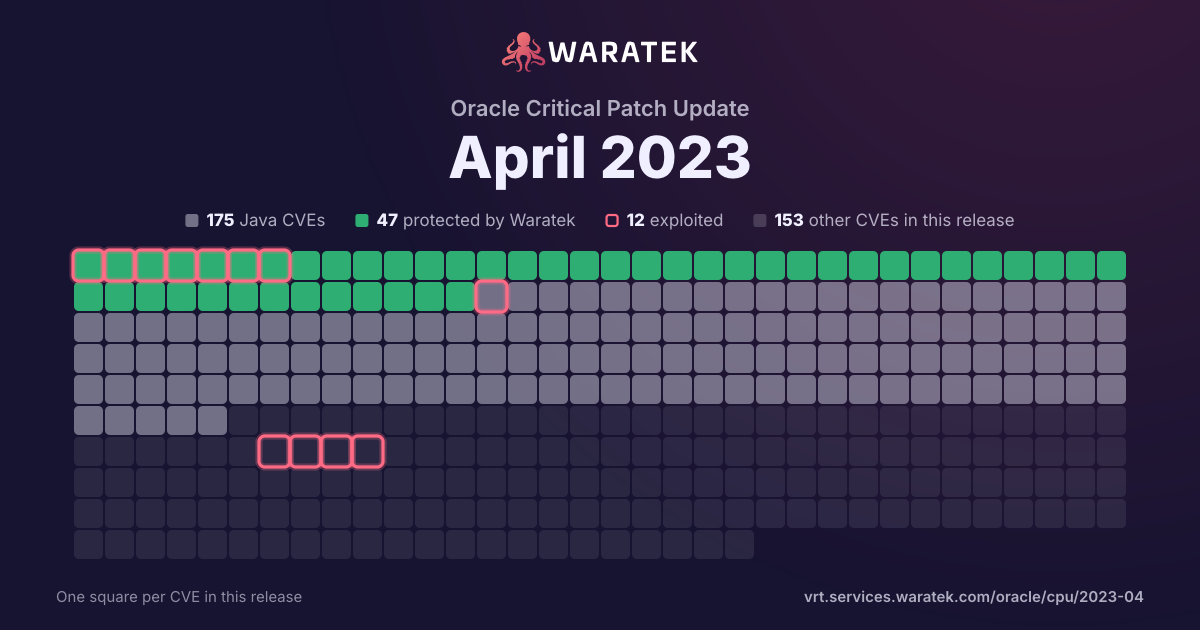
By status
47Protected by Waratek9Mitigation candidate119No exploit published35Outside Waratek scope118Not applicable
12Exploited, marked by the ring
No exploit published. For 56 of them, Oracle's security advisory is the source of public detail.
Protected by Waratek. Waratek RASP can block exploitation of these on systems that have not applied the patch yet.
Overview 35 matches · 0 in Waratek scope · 0 protected · 0 exploited · 0 CISA KEV · 1 public PoC · 3 EPSS ≥ 0.5
35matches
0in Waratek scope0.0%
0protected0.0%
0exploited0.0%
0CISA KEV0.0%
1public PoC2.9%
3EPSS ≥ 0.58.6%
Protected by Waratek
0
0.0%
Rule in development
0
0.0%
Mitigation candidate
0
0.0%
No exploit published
0
0.0%
Outside Waratek scope
0
0.0%
Not applicable
35
100.0%
Withdrawn CVE
0
0.0%
blocked by ARMR today
0
0.0%
partly blocked
0
0.0%
not blocked
35
100.0%
not established
0
0.0%
unrecorded
0
0.0%
Exploited
0
0.0%
Working exploit published
0
0.0%
Proof of concept only
5
14.3%
Forecast only
2
5.7%
No public exploit
28
80.0%
split by
peak 15 / quarter
Q3 212
Not applicable2
Medium2
not blocked2
No public exploit2
Q4 210
Q1 223
Not applicable3
Medium3
not blocked3
No public exploit3
Q2 221
Not applicable1
Medium1
not blocked1
No public exploit1
Q3 223
Not applicable3
Medium3
not blocked3
Forecast only1
No public exploit2
Q4 222
Not applicable2
Medium2
not blocked2
No public exploit2
Q1 238
Not applicable8
Medium8
not blocked8
Proof of concept only5
Forecast only1
No public exploit2
Q2 2315
Not applicable15
Medium15
not blocked15
No public exploit15
Q3 230
Q4 230
Q1 240
Q2 241
Not applicable1
Medium1
not blocked1
No public exploit1
Q3 21Q4 21Q1 22Q2 22Q3 22Q4 22Q1 23Q2 23Q3 23Q4 23Q1 24Q2 24
| CVE | Severity | Published▾ | Status | Exploitation | Description |
|---|---|---|---|---|---|
| CVE-2020-35165 | Medium | 2024-05-22 | Not applicable | No public exploit | Dell BSAFE Crypto-C Micro Edition, versions before 4.1.5, and Dell BSAFE Micro Edition Suite, versions before 4.6, contain an Observable Timing Discrepancy Vulnerability. |
| CVE-2023-22002 | Medium | 2023-04-18 | Not applicable | No public exploit | Vulnerability in the Oracle VM VirtualBox product of Oracle Virtualization (component: Core). Supported versions that are affected are Prior to 6.1.44 and Prior to 7.0.8. Easily exploitable vulnerability allows high privileged attacker with logon to the infrastructure where Oracle VM VirtualBox executes to compromise Oracle VM VirtualBox. While the vulnerability is in Oracle VM VirtualBox, attacks may significantly impact additional products (scope change). Successful attacks of this vulnerability can result in unauthorized access to critical data or complete access to all Oracle VM VirtualBox accessible data. CVSS 3.1 Base Score 6.0 (Confidentiality impacts). CVSS Vector: (CVSS:3.1/AV:L/AC:L/PR:H/UI:N/S:C/C:H/I:N/A:N). |
| CVE-2023-22001 | Medium | 2023-04-18 | Not applicable | No public exploit | Vulnerability in the Oracle VM VirtualBox product of Oracle Virtualization (component: Core). Supported versions that are affected are Prior to 6.1.44 and Prior to 7.0.8. Easily exploitable vulnerability allows high privileged attacker with logon to the infrastructure where Oracle VM VirtualBox executes to compromise Oracle VM VirtualBox. While the vulnerability is in Oracle VM VirtualBox, attacks may significantly impact additional products (scope change). Successful attacks of this vulnerability can result in unauthorized update, insert or delete access to some of Oracle VM VirtualBox accessible data as well as unauthorized read access to a subset of Oracle VM VirtualBox accessible data. CVSS 3.1 Base Score 4.6 (Confidentiality and Integrity impacts). CVSS Vector: (CVSS:3.1/AV:L/AC:L/PR:H/UI:N/S:C/C:L/I:L/A:N). |
| CVE-2023-22000 | Medium | 2023-04-18 | Not applicable | No public exploit | Vulnerability in the Oracle VM VirtualBox product of Oracle Virtualization (component: Core). Supported versions that are affected are Prior to 6.1.44 and Prior to 7.0.8. Easily exploitable vulnerability allows high privileged attacker with logon to the infrastructure where Oracle VM VirtualBox executes to compromise Oracle VM VirtualBox. While the vulnerability is in Oracle VM VirtualBox, attacks may significantly impact additional products (scope change). Successful attacks of this vulnerability can result in unauthorized update, insert or delete access to some of Oracle VM VirtualBox accessible data as well as unauthorized read access to a subset of Oracle VM VirtualBox accessible data. CVSS 3.1 Base Score 4.6 (Confidentiality and Integrity impacts). CVSS Vector: (CVSS:3.1/AV:L/AC:L/PR:H/UI:N/S:C/C:L/I:L/A:N). |
| CVE-2023-21998 | Medium | 2023-04-18 | Not applicable | No public exploit | Vulnerability in the Oracle VM VirtualBox product of Oracle Virtualization (component: Core). Supported versions that are affected are Prior to 6.1.44 and Prior to 7.0.8. Easily exploitable vulnerability allows high privileged attacker with logon to the infrastructure where Oracle VM VirtualBox executes to compromise Oracle VM VirtualBox. While the vulnerability is in Oracle VM VirtualBox, attacks may significantly impact additional products (scope change). Successful attacks of this vulnerability can result in unauthorized update, insert or delete access to some of Oracle VM VirtualBox accessible data as well as unauthorized read access to a subset of Oracle VM VirtualBox accessible data. Note: This vulnerability applies to Windows VMs only. CVSS 3.1 Base Score 4.6 (Confidentiality and Integrity impacts). CVSS Vector: (CVSS:3.1/AV:L/AC:L/PR:H/UI:N/S:C/C:L/I:L/A:N). |
| CVE-2023-21989 | Medium | 2023-04-18 | Not applicable | No public exploit | Vulnerability in the Oracle VM VirtualBox product of Oracle Virtualization (component: Core). Supported versions that are affected are Prior to 6.1.44 and Prior to 7.0.8. Easily exploitable vulnerability allows high privileged attacker with logon to the infrastructure where Oracle VM VirtualBox executes to compromise Oracle VM VirtualBox. While the vulnerability is in Oracle VM VirtualBox, attacks may significantly impact additional products (scope change). Successful attacks of this vulnerability can result in unauthorized access to critical data or complete access to all Oracle VM VirtualBox accessible data. CVSS 3.1 Base Score 6.0 (Confidentiality impacts). CVSS Vector: (CVSS:3.1/AV:L/AC:L/PR:H/UI:N/S:C/C:H/I:N/A:N). |
| CVE-2023-21984 | Medium | 2023-04-18 | Not applicable | No public exploit | Vulnerability in the Oracle Solaris product of Oracle Systems (component: Libraries). The supported version that is affected is 11. Easily exploitable vulnerability allows low privileged attacker with network access via HTTP to compromise Oracle Solaris. Successful attacks of this vulnerability can result in unauthorized ability to cause a hang or frequently repeatable crash (complete DOS) of Oracle Solaris. CVSS 3.1 Base Score 6.5 (Availability impacts). CVSS Vector: (CVSS:3.1/AV:N/AC:L/PR:L/UI:N/S:U/C:N/I:N/A:H). |
| CVE-2023-21982 | Medium | 2023-04-18 | Not applicable | No public exploit | Vulnerability in the MySQL Server product of Oracle MySQL (component: Server: Optimizer). Supported versions that are affected are 8.0.32 and prior. Easily exploitable vulnerability allows high privileged attacker with network access via multiple protocols to compromise MySQL Server. Successful attacks of this vulnerability can result in unauthorized ability to cause a hang or frequently repeatable crash (complete DOS) of MySQL Server. CVSS 3.1 Base Score 4.9 (Availability impacts). CVSS Vector: (CVSS:3.1/AV:N/AC:L/PR:H/UI:N/S:U/C:N/I:N/A:H). |
| CVE-2023-21977 | Medium | 2023-04-18 | Not applicable | No public exploit | Vulnerability in the MySQL Server product of Oracle MySQL (component: Server: Optimizer). Supported versions that are affected are 8.0.32 and prior. Easily exploitable vulnerability allows high privileged attacker with network access via multiple protocols to compromise MySQL Server. Successful attacks of this vulnerability can result in unauthorized ability to cause a hang or frequently repeatable crash (complete DOS) of MySQL Server. CVSS 3.1 Base Score 4.9 (Availability impacts). CVSS Vector: (CVSS:3.1/AV:N/AC:L/PR:H/UI:N/S:U/C:N/I:N/A:H). |
| CVE-2023-21976 | Medium | 2023-04-18 | Not applicable | No public exploit | Vulnerability in the MySQL Server product of Oracle MySQL (component: Server: Optimizer). Supported versions that are affected are 8.0.32 and prior. Easily exploitable vulnerability allows high privileged attacker with network access via multiple protocols to compromise MySQL Server. Successful attacks of this vulnerability can result in unauthorized ability to cause a hang or frequently repeatable crash (complete DOS) of MySQL Server. CVSS 3.1 Base Score 4.9 (Availability impacts). CVSS Vector: (CVSS:3.1/AV:N/AC:L/PR:H/UI:N/S:U/C:N/I:N/A:H). |
| CVE-2023-21972 | Medium | 2023-04-18 | Not applicable | No public exploit | Vulnerability in the MySQL Server product of Oracle MySQL (component: Server: DML). Supported versions that are affected are 8.0.32 and prior. Easily exploitable vulnerability allows high privileged attacker with network access via multiple protocols to compromise MySQL Server. Successful attacks of this vulnerability can result in unauthorized ability to cause a hang or frequently repeatable crash (complete DOS) of MySQL Server. CVSS 3.1 Base Score 4.9 (Availability impacts). CVSS Vector: (CVSS:3.1/AV:N/AC:L/PR:H/UI:N/S:U/C:N/I:N/A:H). |
| CVE-2023-21966 | Medium | 2023-04-18 | Not applicable | No public exploit | Vulnerability in the MySQL Server product of Oracle MySQL (component: Server: JSON). Supported versions that are affected are 8.0.32 and prior. Easily exploitable vulnerability allows high privileged attacker with network access via multiple protocols to compromise MySQL Server. Successful attacks of this vulnerability can result in unauthorized ability to cause a hang or frequently repeatable crash (complete DOS) of MySQL Server. CVSS 3.1 Base Score 4.9 (Availability impacts). CVSS Vector: (CVSS:3.1/AV:N/AC:L/PR:H/UI:N/S:U/C:N/I:N/A:H). |
| CVE-2023-21934 | Medium | 2023-04-18 | Not applicable | No public exploit | Vulnerability in the Java VM component of Oracle Database Server. Supported versions that are affected are 19c and 21c. Difficult to exploit vulnerability allows low privileged attacker having User Account privilege with network access via TLS to compromise Java VM. Successful attacks of this vulnerability can result in unauthorized creation, deletion or modification access to critical data or all Java VM accessible data as well as unauthorized access to critical data or complete access to all Java VM accessible data. CVSS 3.1 Base Score 6.8 (Confidentiality and Integrity impacts). CVSS Vector: (CVSS:3.1/AV:N/AC:H/PR:L/UI:N/S:U/C:H/I:H/A:N). |
| CVE-2023-21918 | Medium | 2023-04-18 | Not applicable | No public exploit | Vulnerability in the Oracle Database Recovery Manager component of Oracle Database Server. Supported versions that are affected are 19c and 21c. Easily exploitable vulnerability allows high privileged attacker having Local SYSDBA privilege with network access via Oracle Net to compromise Oracle Database Recovery Manager. While the vulnerability is in Oracle Database Recovery Manager, attacks may significantly impact additional products (scope change). Successful attacks of this vulnerability can result in unauthorized ability to cause a hang or frequently repeatable crash (complete DOS) of Oracle Database Recovery Manager. CVSS 3.1 Base Score 6.8 (Availability impacts). CVSS Vector: (CVSS:3.1/AV:N/AC:L/PR:H/UI:N/S:C/C:N/I:N/A:H). |
| CVE-2023-21917 | Medium | 2023-04-18 | Not applicable | No public exploit | Vulnerability in the MySQL Server product of Oracle MySQL (component: Server: Optimizer). Supported versions that are affected are 8.0.30 and prior. Easily exploitable vulnerability allows high privileged attacker with network access via multiple protocols to compromise MySQL Server. Successful attacks of this vulnerability can result in unauthorized ability to cause a hang or frequently repeatable crash (complete DOS) of MySQL Server. CVSS 3.1 Base Score 4.9 (Availability impacts). CVSS Vector: (CVSS:3.1/AV:N/AC:L/PR:H/UI:N/S:U/C:N/I:N/A:H). |
| CVE-2023-21913 | Medium | 2023-04-18 | Not applicable | No public exploit | Vulnerability in the MySQL Server product of Oracle MySQL (component: Server: Optimizer). Supported versions that are affected are 8.0.31 and prior. Easily exploitable vulnerability allows high privileged attacker with network access via multiple protocols to compromise MySQL Server. Successful attacks of this vulnerability can result in unauthorized ability to cause a hang or frequently repeatable crash (complete DOS) of MySQL Server. CVSS 3.1 Base Score 4.9 (Availability impacts). CVSS Vector: (CVSS:3.1/AV:N/AC:L/PR:H/UI:N/S:U/C:N/I:N/A:H). |
| CVE-2023-23916 | Medium | 2023-02-23 | Not applicable | Proof of concept only | An allocation of resources without limits or throttling vulnerability exists in curl <v7.88.0 based on the "chained" HTTP compression algorithms, meaning that a server response can be compressed multiple times and potentially with differentalgorithms. The number of acceptable "links" in this "decompression chain" wascapped, but the cap was implemented on a per-header basis allowing a maliciousserver to insert a virtually unlimited number of compression steps simply byusing many headers. The use of such a decompression chain could result in a "malloc bomb", making curl end up spending enormous amounts of allocated heap memory, or trying to and returning out of memory errors. |
| CVE-2023-23915 | Medium | 2023-02-23 | Not applicable | No public exploit | A cleartext transmission of sensitive information vulnerability exists in curl <v7.88.0 that could cause HSTS functionality to behave incorrectly when multiple URLs are requested in parallel. Using its HSTS support, curl can be instructed to use HTTPS instead of using an insecure clear-text HTTP step even when HTTP is provided in the URL. This HSTS mechanism would however surprisingly fail when multiple transfers are done in parallel as the HSTS cache file gets overwritten by the most recentlycompleted transfer. A later HTTP-only transfer to the earlier host name would then *not* get upgraded properly to HSTS. |
| CVE-2022-4304 | Medium | 2023-02-08 | Not applicable | No public exploit | A timing based side channel exists in the OpenSSL RSA Decryption implementation which could be sufficient to recover a plaintext across a network in a Bleichenbacher style attack. To achieve a successful decryption an attacker would have to be able to send a very large number of trial messages for decryption. The vulnerability affects all RSA padding modes: PKCS#1 v1.5, RSA-OEAP and RSASVE. For example, in a TLS connection, RSA is commonly used by a client to send an encrypted pre-master secret to the server. An attacker that had observed a genuine connection between a client and a server could use this flaw to send trial messages to the server and record the time taken to process them. After a sufficiently large number of messages the attacker could recover the pre-master secret used for the original connection and thus be able to decrypt the application data sent over that connection. |
| CVE-2023-23931 | Medium | 2023-02-07 | Not applicable | Proof of concept only | cryptography is a package designed to expose cryptographic primitives and recipes to Python developers. In affected versions `Cipher.update_into` would accept Python objects which implement the buffer protocol, but provide only immutable buffers. This would allow immutable objects (such as `bytes`) to be mutated, thus violating fundamental rules of Python and resulting in corrupted output. This now correctly raises an exception. This issue has been present since `update_into` was originally introduced in cryptography 1.8. |
| CVE-2023-25136 | Medium | 2023-02-03 | Not applicable | Proof of concept only | OpenSSH server (sshd) 9.1 introduced a double-free vulnerability during options.kex_algorithms handling. This is fixed in OpenSSH 9.2. The double free can be leveraged, by an unauthenticated remote attacker in the default configuration, to jump to any location in the sshd address space. One third-party report states "remote code execution is theoretically possible." |
| CVE-2021-37519 | Medium | 2023-02-03 | Not applicable | Proof of concept only | Buffer Overflow vulnerability in authfile.c memcached 1.6.9 allows attackers to cause a denial of service via crafted authenticattion file. |
| CVE-2022-37436 | Medium | 2023-01-17 | Not applicable | Forecast only | Prior to Apache HTTP Server 2.4.55, a malicious backend can cause the response headers to be truncated early, resulting in some headers being incorporated into the response body. If the later headers have any security purpose, they will not be interpreted by the client. |
| CVE-2022-4415 | Medium | 2023-01-11 | Not applicable | Proof of concept only | A vulnerability was found in systemd. This security flaw can cause a local information leak due to systemd-coredump not respecting the fs.suid_dumpable kernel setting. |
| CVE-2022-3821 | Medium | 2022-11-08 | Not applicable | No public exploit | An off-by-one Error issue was discovered in Systemd in format_timespan() function of time-util.c. An attacker could supply specific values for time and accuracy that leads to buffer overrun in format_timespan(), leading to a Denial of Service. |
| CVE-2022-39229 | Medium | 2022-10-13 | Not applicable | No public exploit | Grafana is an open source data visualization platform for metrics, logs, and traces. Versions prior to 9.1.8 and 8.5.14 allow one user to block another user's login attempt by registering someone else'e email address as a username. A Grafana user’s username and email address are unique fields, that means no other user can have the same username or email address as another user. A user can have an email address as a username. However, the login system allows users to log in with either username or email address. Since Grafana allows a user to log in with either their username or email address, this creates an usual behavior where `user_1` can register with one email address and `user_2` can register their username as `user_1`’s email address. This prevents `user_1` logging into the application since `user_1`'s password won’t match with `user_2`'s email address. Versions 9.1.8 and 8.5.14 contain a patch. There are no workarounds for this issue. |
| CVE-2022-32222 | Medium | 2022-07-14 | Not applicable | No public exploit | A cryptographic vulnerability exists on Node.js on linux in versions of 18.x prior to 18.40.0 which allowed a default path for openssl.cnf that might be accessible under some circumstances to a non-admin user instead of /etc/ssl as was the case in versions prior to the upgrade to OpenSSL 3. |
| CVE-2022-32215 | Medium | 2022-07-14 | Not applicable | Forecast only | The llhttp parser <v14.20.1, <v16.17.1 and <v18.9.1 in the http module in Node.js does not correctly handle multi-line Transfer-Encoding headers. This can lead to HTTP Request Smuggling (HRS). |
| CVE-2022-32213 | Medium | 2022-07-14 | Not applicable | No public exploit | The llhttp parser <v14.20.1, <v16.17.1 and <v18.9.1 in the http module in Node.js does not correctly parse and validate Transfer-Encoding headers and can lead to HTTP Request Smuggling (HRS). |
| CVE-2022-28614 | Medium | 2022-06-09 | Not applicable | No public exploit | The ap_rwrite() function in Apache HTTP Server 2.4.53 and earlier may read unintended memory if an attacker can cause the server to reflect very large input using ap_rwrite() or ap_rputs(), such as with mod_luas r:puts() function. Modules compiled and distributed separately from Apache HTTP Server that use the 'ap_rputs' function and may pass it a very large (INT_MAX or larger) string must be compiled against current headers to resolve the issue. |
| CVE-2022-24728 | Medium | 2022-03-16 | Not applicable | No public exploit | CKEditor4 is an open source what-you-see-is-what-you-get HTML editor. A vulnerability has been discovered in the core HTML processing module and may affect all plugins used by CKEditor 4 prior to version 4.18.0. The vulnerability allows someone to inject malformed HTML bypassing content sanitization, which could result in executing JavaScript code. This problem has been patched in version 4.18.0. There are currently no known workarounds. |
| CVE-2021-44533 | Medium | 2022-02-24 | Not applicable | No public exploit | Node.js < 12.22.9, < 14.18.3, < 16.13.2, and < 17.3.1 did not handle multi-value Relative Distinguished Names correctly. Attackers could craft certificate subjects containing a single-value Relative Distinguished Name that would be interpreted as a multi-value Relative Distinguished Name, for example, in order to inject a Common Name that would allow bypassing the certificate subject verification.Affected versions of Node.js that do not accept multi-value Relative Distinguished Names and are thus not vulnerable to such attacks themselves. However, third-party code that uses node's ambiguous presentation of certificate subjects may be vulnerable. |
| CVE-2021-44532 | Medium | 2022-02-24 | Not applicable | No public exploit | Node.js < 12.22.9, < 14.18.3, < 16.13.2, and < 17.3.1 converts SANs (Subject Alternative Names) to a string format. It uses this string to check peer certificates against hostnames when validating connections. The string format was subject to an injection vulnerability when name constraints were used within a certificate chain, allowing the bypass of these name constraints.Versions of Node.js with the fix for this escape SANs containing the problematic characters in order to prevent the injection. This behavior can be reverted through the --security-revert command-line option. |
| CVE-2021-32809 | Medium | 2021-08-12 | Not applicable | No public exploit | ckeditor is an open source WYSIWYG HTML editor with rich content support. A potential vulnerability has been discovered in CKEditor 4 [Clipboard](https://ckeditor.com/cke4/addon/clipboard) package. The vulnerability allowed to abuse paste functionality using malformed HTML, which could result in injecting arbitrary HTML into the editor. It affects all users using the CKEditor 4 plugins listed above at version >= 4.5.2. The problem has been recognized and patched. The fix will be available in version 4.16.2. |
| CVE-2021-23413 | Medium | 2021-07-25 | Not applicable | No public exploit | This affects the package jszip before 3.7.0. Crafting a new zip file with filenames set to Object prototype values (e.g __proto__, toString, etc) results in a returned object with a modified prototype instance. |