
Oracle Critical Patch Update April 2023
Released April 2023 · Oracle's advisory ↗ · ← Critical Patch Update, January 2023 · Critical Patch Update, July 2023 →
328 CVEs in this release, one square each
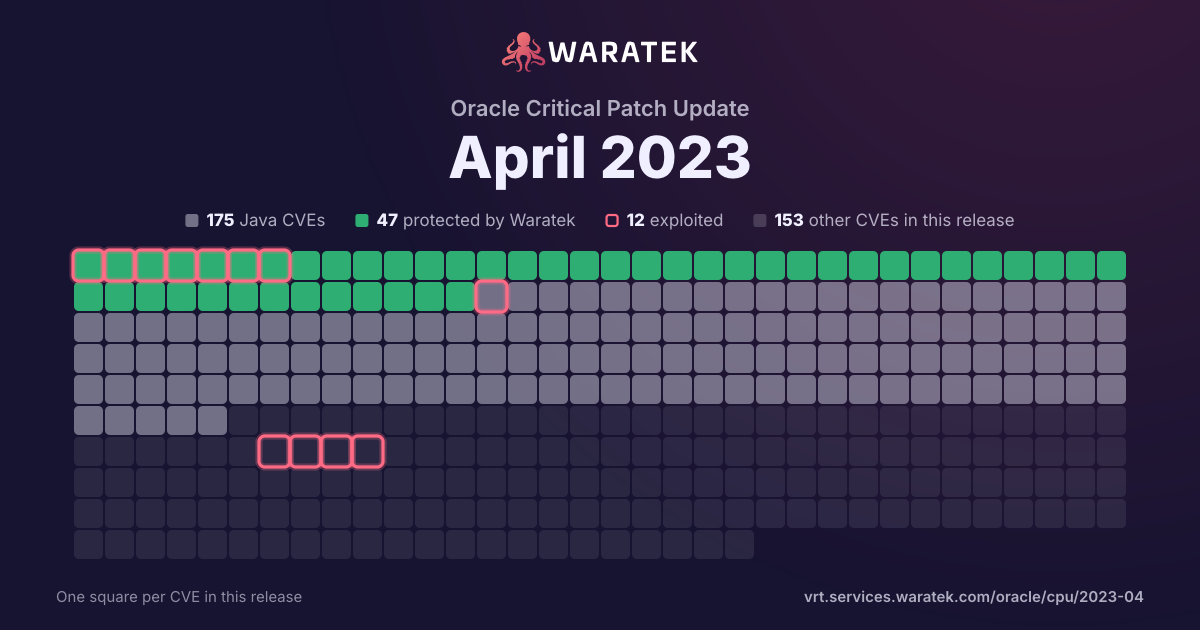
By status
47Protected by Waratek9Mitigation candidate119No exploit published35Outside Waratek scope118Not applicable
12Exploited, marked by the ring
No exploit published. For 56 of them, Oracle's security advisory is the source of public detail.
Protected by Waratek. Waratek RASP can block exploitation of these on systems that have not applied the patch yet.
Overview 21 matches · 0 in Waratek scope · 0 protected · 2 exploited · 1 CISA KEV · 2 public PoC · 2 EPSS ≥ 0.5
21matches
0in Waratek scope0.0%
0protected0.0%
2exploited9.5%
1CISA KEV4.8%
2public PoC9.5%
2EPSS ≥ 0.59.5%
Protected by Waratek
0
0.0%
Rule in development
0
0.0%
Mitigation candidate
0
0.0%
No exploit published
0
0.0%
Outside Waratek scope
0
0.0%
Not applicable
21
100.0%
Withdrawn CVE
0
0.0%
blocked by ARMR today
0
0.0%
partly blocked
0
0.0%
not blocked
21
100.0%
not established
0
0.0%
unrecorded
0
0.0%
Exploited
2
9.5%
Working exploit published
0
0.0%
Proof of concept only
3
14.3%
Forecast only
0
0.0%
No public exploit
16
76.2%
split by
peak 5 / quarter
Q4 181
Not applicable1
Critical1
not blocked1
No public exploit1
Q1 190
Q2 190
Q3 190
Q4 191
Not applicable1
Critical1
not blocked1
Exploited1
Q1 200
Q2 200
Q3 200
Q4 200
Q1 210
Q2 210
Q3 210
Q4 211
Not applicable1
Critical1
not blocked1
No public exploit1
Q1 223
Not applicable3
Critical3
not blocked3
Proof of concept only1
No public exploit2
Q2 222
Not applicable2
Critical2
not blocked2
No public exploit2
Q3 225
Not applicable5
Critical5
not blocked5
No public exploit5
Q4 223
Not applicable3
Critical3
not blocked3
Proof of concept only1
No public exploit2
Q1 233
Not applicable3
Critical3
not blocked3
Exploited1
Proof of concept only1
No public exploit1
Q2 230
Q3 230
Q4 230
Q1 242
Not applicable2
Critical2
not blocked2
No public exploit2
Q1 19Q3 19Q1 20Q3 20Q1 21Q3 21Q1 22Q3 22Q1 23Q3 23Q1 24
| CVE | Severity | Published▾ | Status | Exploitation | Description |
|---|---|---|---|---|---|
| CVE-2021-21575 | Critical | 2024-02-02 | Not applicable | No public exploit | Dell BSAFE Micro Edition Suite, versions before 4.5.2, contain an Observable Timing Discrepancy Vulnerability. |
| CVE-2020-29504 | Critical | 2024-02-02 | Not applicable | No public exploit | Dell BSAFE Crypto-C Micro Edition, versions before 4.1.5, and Dell BSAFE Micro Edition Suite, versions before 4.5.2, contain a Missing Required Cryptographic Step Vulnerability. |
| CVE-2023-25690 | Critical | 2023-03-07 | Not applicable | Exploited | Some mod_proxy configurations on Apache HTTP Server versions 2.4.0 through 2.4.55 allow a HTTP Request Smuggling attack. Configurations are affected when mod_proxy is enabled along with some form of RewriteRule or ProxyPassMatch in which a non-specific pattern matches some portion of the user-supplied request-target (URL) data and is then re-inserted into the proxied request-target using variable substitution. For example, something like: RewriteEngine on RewriteRule "^/here/(.*)" "http://example.com:8080/elsewhere?$1"; [P] ProxyPassReverse /here/ http://example.com:8080/ Request splitting/smuggling could result in bypass of access controls in the proxy server, proxying unintended URLs to existing origin servers, and cache poisoning. Users are recommended to update to at least version 2.4.56 of Apache HTTP Server. |
| CVE-2023-23914 | Critical | 2023-02-23 | Not applicable | Proof of concept only | A cleartext transmission of sensitive information vulnerability exists in curl <v7.88.0 that could cause HSTS functionality fail when multiple URLs are requested serially. Using its HSTS support, curl can be instructed to use HTTPS instead of usingan insecure clear-text HTTP step even when HTTP is provided in the URL. ThisHSTS mechanism would however surprisingly be ignored by subsequent transferswhen done on the same command line because the state would not be properlycarried on. |
| CVE-2022-36760 | Critical | 2023-01-17 | Not applicable | No public exploit | Inconsistent Interpretation of HTTP Requests ('HTTP Request Smuggling') vulnerability in mod_proxy_ajp of Apache HTTP Server allows an attacker to smuggle requests to the AJP server it forwards requests to. This issue affects Apache HTTP Server Apache HTTP Server 2.4 version 2.4.54 and prior versions. |
| CVE-2022-47629 | Critical | 2022-12-20 | Not applicable | No public exploit | Libksba before 1.6.3 is prone to an integer overflow vulnerability in the CRL signature parser. |
| CVE-2021-46848 | Critical | 2022-10-24 | Not applicable | No public exploit | GNU Libtasn1 before 4.19.0 has an ETYPE_OK off-by-one array size check that affects asn1_encode_simple_der. |
| CVE-2022-37454 | Critical | 2022-10-21 | Not applicable | Proof of concept only | The Keccak XKCP SHA-3 reference implementation before fdc6fef has an integer overflow and resultant buffer overflow that allows attackers to execute arbitrary code or eliminate expected cryptographic properties. This occurs in the sponge function interface. |
| CVE-2020-35168 | Critical | 2022-07-11 | Not applicable | No public exploit | Dell BSAFE Crypto-C Micro Edition, versions before 4.1.5, and Dell BSAFE Micro Edition Suite, versions before 4.6, contain an Observable Timing Discrepancy Vulnerability. |
| CVE-2020-35167 | Critical | 2022-07-11 | Not applicable | No public exploit | Dell BSAFE Crypto-C Micro Edition, versions before 4.1.5, and Dell BSAFE Micro Edition Suite, versions before 4.6, contain an Observable Timing Discrepancy Vulnerability. |
| CVE-2020-35163 | Critical | 2022-07-11 | Not applicable | No public exploit | Dell BSAFE Crypto-C Micro Edition, versions before 4.1.5, and Dell BSAFE Micro Edition Suite, versions before 4.6, contain a Use of Insufficiently Random Values Vulnerability. |
| CVE-2020-29507 | Critical | 2022-07-11 | Not applicable | No public exploit | Dell BSAFE Crypto-C Micro Edition, versions before 4.1.4, and Dell BSAFE Micro Edition Suite, versions before 4.4, contain an Improper Input Validation Vulnerability. |
| CVE-2020-29506 | Critical | 2022-07-11 | Not applicable | No public exploit | Dell BSAFE Crypto-C Micro Edition, versions before 4.1.5, and Dell BSAFE Micro Edition Suite, versions before 4.5.2, contain an Observable Timing Discrepancy Vulnerability. |
| CVE-2022-28738 | Critical | 2022-05-09 | Not applicable | No public exploit | A double free was found in the Regexp compiler in Ruby 3.x before 3.0.4 and 3.1.x before 3.1.2. If a victim attempts to create a Regexp from untrusted user input, an attacker may be able to write to unexpected memory locations. |
| CVE-2022-27404 | Critical | 2022-04-22 | Not applicable | No public exploit | FreeType commit 1e2eb65048f75c64b68708efed6ce904c31f3b2f was discovered to contain a heap buffer overflow via the function sfnt_init_face. |
| CVE-2022-25315 | Critical | 2022-02-18 | Not applicable | Proof of concept only | In Expat (aka libexpat) before 2.4.5, there is an integer overflow in storeRawNames. |
| CVE-2022-25236 | Critical | 2022-02-16 | Not applicable | No public exploit | xmlparse.c in Expat (aka libexpat) before 2.4.5 allows attackers to insert namespace-separator characters into namespace URIs. |
| CVE-2022-25235 | Critical | 2022-02-16 | Not applicable | No public exploit | xmltok_impl.c in Expat (aka libexpat) before 2.4.5 lacks certain validation of encoding, such as checks for whether a UTF-8 character is valid in a certain context. |
| CVE-2021-4048 | Critical | 2021-12-08 | Not applicable | No public exploit | An out-of-bounds read flaw was found in the CLARRV, DLARRV, SLARRV, and ZLARRV functions in lapack through version 3.10.0, as also used in OpenBLAS before version 0.3.18. Specially crafted inputs passed to these functions could cause an application using lapack to crash or possibly disclose portions of its memory. |
| CVE-2019-18935 | Critical | 2019-12-11 | Not applicable | Exploited | Progress Telerik UI for ASP.NET AJAX through 2019.3.1023 contains a .NET deserialization vulnerability in the RadAsyncUpload function. This is exploitable when the encryption keys are known due to the presence of CVE-2017-11317 or CVE-2017-11357, or other means. Exploitation can result in remote code execution. (As of 2020.1.114, a default setting prevents the exploit. In 2019.3.1023, but not earlier versions, a non-default setting can prevent exploitation.) |
| CVE-2018-20060 | Critical | 2018-12-11 | Not applicable | No public exploit | urllib3 before version 1.23 does not remove the Authorization HTTP header when following a cross-origin redirect (i.e., a redirect that differs in host, port, or scheme). This can allow for credentials in the Authorization header to be exposed to unintended hosts or transmitted in cleartext. |