
Oracle Critical Patch Update April 2023
Released April 2023 · Oracle's advisory ↗ · ← Critical Patch Update, January 2023 · Critical Patch Update, July 2023 →
328 CVEs in this release, one square each
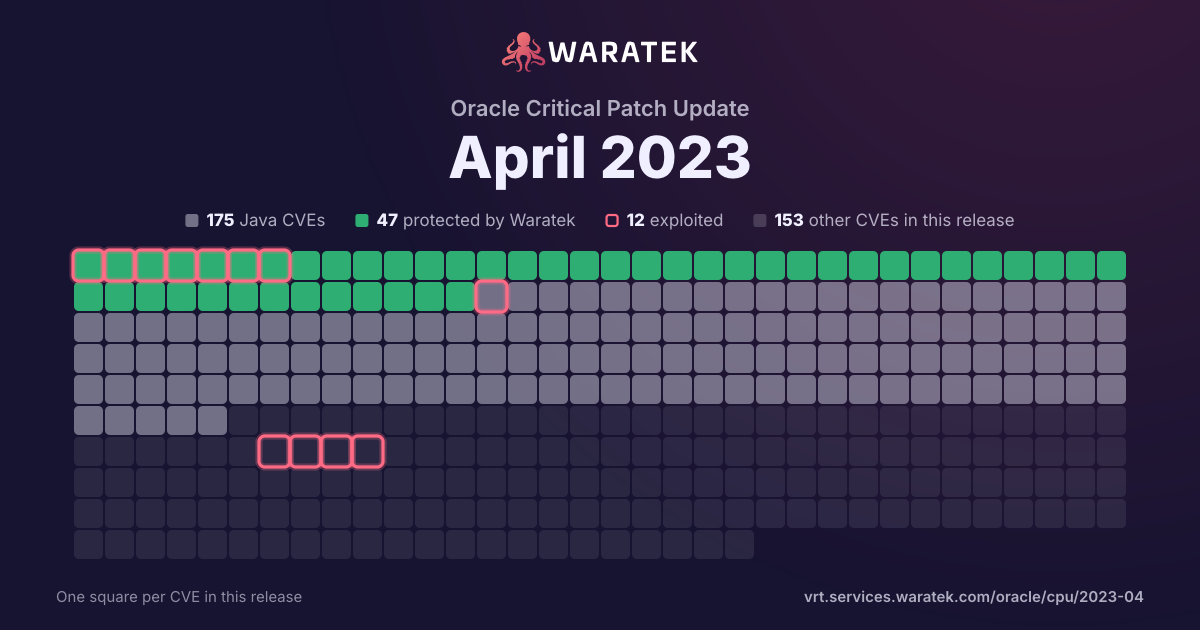
By status
47Protected by Waratek10Mitigation candidate123No exploit published3Outside Waratek scope145Not applicable
10Exploited, marked by the ring
No exploit published. For 55 of them, Oracle's security advisory is the source of public detail.
Protected by Waratek. Waratek RASP can block exploitation of these on systems that have not applied the patch yet.
Overview 6 matches · 0 protected · 0 exploited · 0 CISA KEV · 1 public PoC · 0 EPSS ≥ 0.5
Protected by Waratek
0
0.0%
Rule in development
0
0.0%
Mitigation candidate
1
16.7%
No exploit published
5
83.3%
blocked by ARMR today
0
0.0%
partly blocked
0
0.0%
not blocked
6
100.0%
not established
0
0.0%
unrecorded
0
0.0%
Exploited
0
0.0%
Working exploit published
0
0.0%
Proof of concept only
2
33.3%
Forecast only
0
0.0%
No public exploit
4
66.7%
split by
peak 3 / month
Apr 22May 22Jun 22
| CVE | Severity | Published▾ | Status | Exploitation | Description |
|---|---|---|---|---|---|
| CVE-2022-22979 | High | 2022-06-21 | No exploit published | No public exploit | In Spring Cloud Function versions prior to 3.2.6, it is possible for a user who directly interacts with framework provided lookup functionality to cause a denial-of-service condition due to the caching issue in the Function Catalog component of the framework. |
| CVE-2022-22978 | Critical | 2022-05-19 | Mitigation candidate | Proof of concept only | In spring security versions prior to 5.4.11+, 5.5.7+ , 5.6.4+ and older unsupported versions, RegexRequestMatcher can easily be misconfigured to be bypassed on some servlet containers. Applications using RegexRequestMatcher with `.` in the regular expression are possibly vulnerable to an authorization bypass. |
| CVE-2022-22976 | Medium | 2022-05-19 | No exploit published | No public exploit | Spring Security versions 5.5.x prior to 5.5.7, 5.6.x prior to 5.6.4, and earlier unsupported versions contain an integer overflow vulnerability. When using the BCrypt class with the maximum work factor (31), the encoder does not perform any salt rounds, due to an integer overflow error. The default settings are not affected by this CVE. |
| CVE-2022-22970 | Medium | 2022-05-12 | No exploit published | No public exploit | In spring framework versions prior to 5.3.20+ , 5.2.22+ and old unsupported versions, applications that handle file uploads are vulnerable to DoS attack if they rely on data binding to set a MultipartFile or javax.servlet.Part to a field in a model object. |
| CVE-2022-24891 | Medium | 2022-04-27 | No exploit published | Proof of concept only | ESAPI (The OWASP Enterprise Security API) is a free, open source, web application security control library. Prior to version 2.3.0.0, there is a potential for a cross-site scripting vulnerability in ESAPI caused by a incorrect regular expression for "onsiteURL" in the **antisamy-esapi.xml** configuration file that can cause "javascript:" URLs to fail to be correctly sanitized. This issue is patched in ESAPI 2.3.0.0. As a workaround, manually edit the **antisamy-esapi.xml** configuration files to change the "onsiteURL" regular expression. More information about remediation of the vulnerability, including the workaround, is available in the maintainers' release notes and security bulletin. |
| CVE-2022-24839 | High | 2022-04-11 | No exploit published | No public exploit | org.cyberneko.html is an html parser written in Java. The fork of `org.cyberneko.html` used by Nokogiri (Rubygem) raises a `java.lang.OutOfMemoryError` exception when parsing ill-formed HTML markup. Users are advised to upgrade to `>= 1.9.22.noko2`. Note: The upstream library `org.cyberneko.html` is no longer maintained. Nokogiri uses its own fork of this library located at https://github.com/sparklemotion/nekohtml and this CVE applies only to that fork. Other forks of nekohtml may have a similar vulnerability. |