
Oracle Critical Patch Update April 2023
Released April 2023 · Oracle's advisory ↗ · ← Critical Patch Update, January 2023 · Critical Patch Update, July 2023 →
328 CVEs in this release, one square each
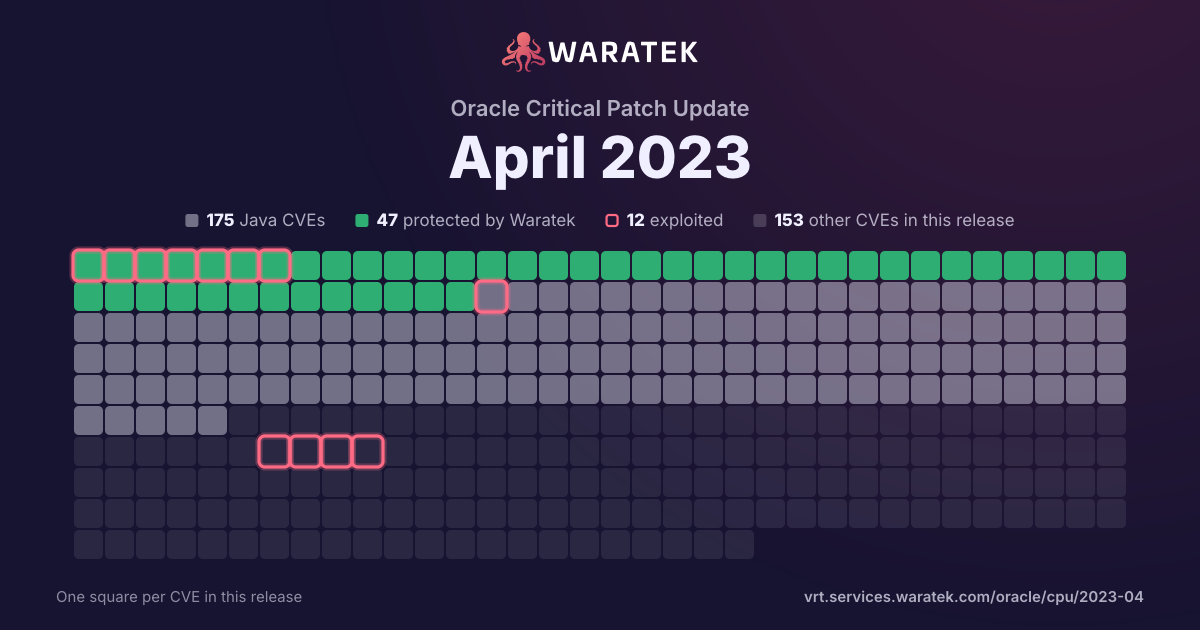
By status
47Protected by Waratek9Mitigation candidate119No exploit published35Outside Waratek scope118Not applicable
12Exploited, marked by the ring
No exploit published. For 56 of them, Oracle's security advisory is the source of public detail.
Protected by Waratek. Waratek RASP can block exploitation of these on systems that have not applied the patch yet.
Overview 118 matches · 0 in Waratek scope · 0 protected · 4 exploited · 1 CISA KEV · 7 public PoC · 9 EPSS ≥ 0.5
118matches
0in Waratek scope0.0%
0protected0.0%
4exploited3.4%
1CISA KEV0.8%
7public PoC5.9%
9EPSS ≥ 0.57.6%
Protected by Waratek
0
0.0%
Rule in development
0
0.0%
Mitigation candidate
0
0.0%
No exploit published
0
0.0%
Outside Waratek scope
0
0.0%
Not applicable
118
100.0%
Withdrawn CVE
0
0.0%
blocked by ARMR today
0
0.0%
partly blocked
0
0.0%
not blocked
118
100.0%
not established
0
0.0%
unrecorded
0
0.0%
split by
peak 28 / quarter
Q3 181
Not applicable1
High1
not blocked1
No public exploit1
Q4 182
Not applicable2
Critical1
High1
not blocked2
No public exploit2
Q1 190
Q2 190
Q3 190
Q4 193
Not applicable3
Critical1
High2
not blocked3
Exploited1
No public exploit2
Q1 200
Q2 201
Not applicable1
High1
not blocked1
No public exploit1
Q3 200
Q4 200
Q1 210
Q2 211
Not applicable1
High1
not blocked1
Working exploit published1
Q3 214
Not applicable4
High2
Medium2
not blocked4
No public exploit4
Q4 211
Not applicable1
Critical1
not blocked1
No public exploit1
Q1 228
Not applicable8
Critical3
High2
Medium3
not blocked8
Proof of concept only1
No public exploit7
Q2 229
Not applicable9
Critical2
High6
Medium1
not blocked9
Proof of concept only1
No public exploit8
Q3 2213
Not applicable13
Critical5
High5
Medium3
not blocked13
Proof of concept only2
Forecast only1
No public exploit10
Q4 2223
Not applicable23
Critical3
High18
Medium2
not blocked23
Exploited2
Proof of concept only5
No public exploit16
Q1 2321
Not applicable21
Critical3
High9
Medium8
Low1
not blocked21
Exploited1
Proof of concept only7
Forecast only2
No public exploit11
Q2 2328
Not applicable28
High7
Medium15
Low6
not blocked28
No public exploit28
Q3 230
Q4 230
Q1 242
Not applicable2
Critical2
not blocked2
No public exploit2
Q2 241
Not applicable1
Medium1
not blocked1
No public exploit1
Q4 18Q2 19Q4 19Q2 20Q4 20Q2 21Q4 21Q2 22Q4 22Q2 23Q4 23Q2 24
| CVE | Severity | Published▾ | Status | Exploitation | Description |
|---|---|---|---|---|---|
| CVE-2021-44532 | Medium | 2022-02-24 | Not applicable | No public exploit | Node.js < 12.22.9, < 14.18.3, < 16.13.2, and < 17.3.1 converts SANs (Subject Alternative Names) to a string format. It uses this string to check peer certificates against hostnames when validating connections. The string format was subject to an injection vulnerability when name constraints were used within a certificate chain, allowing the bypass of these name constraints.Versions of Node.js with the fix for this escape SANs containing the problematic characters in order to prevent the injection. This behavior can be reverted through the --security-revert command-line option. |
| CVE-2021-44531 | High | 2022-02-24 | Not applicable | No public exploit | Accepting arbitrary Subject Alternative Name (SAN) types, unless a PKI is specifically defined to use a particular SAN type, can result in bypassing name-constrained intermediates. Node.js < 12.22.9, < 14.18.3, < 16.13.2, and < 17.3.1 was accepting URI SAN types, which PKIs are often not defined to use. Additionally, when a protocol allows URI SANs, Node.js did not match the URI correctly.Versions of Node.js with the fix for this disable the URI SAN type when checking a certificate against a hostname. This behavior can be reverted through the --security-revert command-line option. |
| CVE-2022-25315 | Critical | 2022-02-18 | Not applicable | Proof of concept only | In Expat (aka libexpat) before 2.4.5, there is an integer overflow in storeRawNames. |
| CVE-2022-25236 | Critical | 2022-02-16 | Not applicable | No public exploit | xmlparse.c in Expat (aka libexpat) before 2.4.5 allows attackers to insert namespace-separator characters into namespace URIs. |
| CVE-2022-25235 | Critical | 2022-02-16 | Not applicable | No public exploit | xmltok_impl.c in Expat (aka libexpat) before 2.4.5 lacks certain validation of encoding, such as checks for whether a UTF-8 character is valid in a certain context. |
| CVE-2021-4048 | Critical | 2021-12-08 | Not applicable | No public exploit | An out-of-bounds read flaw was found in the CLARRV, DLARRV, SLARRV, and ZLARRV functions in lapack through version 3.10.0, as also used in OpenBLAS before version 0.3.18. Specially crafted inputs passed to these functions could cause an application using lapack to crash or possibly disclose portions of its memory. |
| CVE-2021-37695 | High | 2021-08-13 | Not applicable | No public exploit | ckeditor is an open source WYSIWYG HTML editor with rich content support. A potential vulnerability has been discovered in CKEditor 4 [Fake Objects](https://ckeditor.com/cke4/addon/fakeobjects) package. The vulnerability allowed to inject malformed Fake Objects HTML, which could result in executing JavaScript code. It affects all users using the CKEditor 4 plugins listed above at version < 4.16.2. The problem has been recognized and patched. The fix will be available in version 4.16.2. |
| CVE-2021-32809 | Medium | 2021-08-12 | Not applicable | No public exploit | ckeditor is an open source WYSIWYG HTML editor with rich content support. A potential vulnerability has been discovered in CKEditor 4 [Clipboard](https://ckeditor.com/cke4/addon/clipboard) package. The vulnerability allowed to abuse paste functionality using malformed HTML, which could result in injecting arbitrary HTML into the editor. It affects all users using the CKEditor 4 plugins listed above at version >= 4.5.2. The problem has been recognized and patched. The fix will be available in version 4.16.2. |
| CVE-2021-32808 | High | 2021-08-12 | Not applicable | No public exploit | ckeditor is an open source WYSIWYG HTML editor with rich content support. A vulnerability has been discovered in the clipboard Widget plugin if used alongside the undo feature. The vulnerability allows a user to abuse undo functionality using malformed widget HTML, which could result in executing JavaScript code. It affects all users using the CKEditor 4 plugins listed above at version >= 4.13.0. The problem has been recognized and patched. The fix will be available in version 4.16.2. |
| CVE-2021-23413 | Medium | 2021-07-25 | Not applicable | No public exploit | This affects the package jszip before 3.7.0. Crafting a new zip file with filenames set to Object prototype values (e.g __proto__, toString, etc) results in a returned object with a modified prototype instance. |
| CVE-2021-23017 | High | 2021-06-01 | Not applicable | Working exploit published | A security issue in nginx resolver was identified, which might allow an attacker who is able to forge UDP packets from the DNS server to cause 1-byte memory overwrite, resulting in worker process crash or potential other impact. |
| CVE-2018-20225 | High | 2020-05-08 | Not applicable | No public exploit | An issue was discovered in pip (all versions) because it installs the version with the highest version number, even if the user had intended to obtain a private package from a private index. This only affects use of the --extra-index-url option, and exploitation requires that the package does not already exist in the public index (and thus the attacker can put the package there with an arbitrary version number). NOTE: it has been reported that this is intended functionality and the user is responsible for using --extra-index-url securely |
| CVE-2018-1311 | High | 2019-12-18 | Not applicable | No public exploit | The Apache Xerces-C 3.0.0 to 3.2.3 XML parser contains a use-after-free error triggered during the scanning of external DTDs. This flaw has not been addressed in the maintained version of the library and has no current mitigation other than to disable DTD processing. This can be accomplished via the DOM using a standard parser feature, or via SAX using the XERCES_DISABLE_DTD environment variable. |
| CVE-2019-18935 | Critical | 2019-12-11 | Not applicable | Exploited | Progress Telerik UI for ASP.NET AJAX through 2019.3.1023 contains a .NET deserialization vulnerability in the RadAsyncUpload function. This is exploitable when the encryption keys are known due to the presence of CVE-2017-11317 or CVE-2017-11357, or other means. Exploitation can result in remote code execution. (As of 2020.1.114, a default setting prevents the exploit. In 2019.3.1023, but not earlier versions, a non-default setting can prevent exploitation.) |
| CVE-2019-11287 | High | 2019-11-23 | Not applicable | No public exploit | Pivotal RabbitMQ, versions 3.7.x prior to 3.7.21 and 3.8.x prior to 3.8.1, and RabbitMQ for Pivotal Platform, 1.16.x versions prior to 1.16.7 and 1.17.x versions prior to 1.17.4, contain a web management plugin that is vulnerable to a denial of service attack. The "X-Reason" HTTP Header can be leveraged to insert a malicious Erlang format string that will expand and consume the heap, resulting in the server crashing. |
| CVE-2018-20060 | Critical | 2018-12-11 | Not applicable | No public exploit | urllib3 before version 1.23 does not remove the Authorization HTTP header when following a cross-origin redirect (i.e., a redirect that differs in host, port, or scheme). This can allow for credentials in the Authorization header to be exposed to unintended hosts or transmitted in cleartext. |
| CVE-2018-18074 | High | 2018-10-09 | Not applicable | No public exploit | The Requests package before 2.20.0 for Python sends an HTTP Authorization header to an http URI upon receiving a same-hostname https-to-http redirect, which makes it easier for remote attackers to discover credentials by sniffing the network. |
| CVE-2018-1000656 | High | 2018-08-20 | Not applicable | No public exploit | The Pallets Project flask version Before 0.12.3 contains a CWE-20: Improper Input Validation vulnerability in flask that can result in Large amount of memory usage possibly leading to denial of service. This attack appear to be exploitable via Attacker provides JSON data in incorrect encoding. This vulnerability appears to have been fixed in 0.12.3. NOTE: this may overlap CVE-2019-1010083. |