
Oracle Critical Patch Update April 2023
Released April 2023 · Oracle's advisory ↗ · ← Critical Patch Update, January 2023 · Critical Patch Update, July 2023 →
328 CVEs in this release, one square each
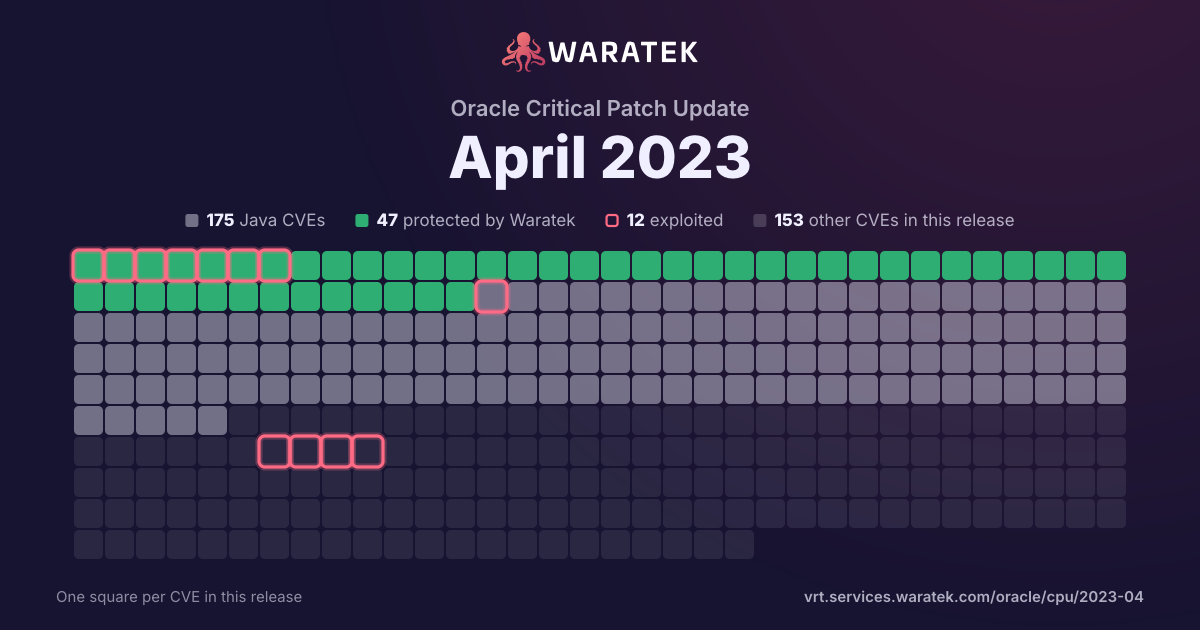
By status
47Protected by Waratek9Mitigation candidate119No exploit published35Outside Waratek scope118Not applicable
12Exploited, marked by the ring
No exploit published. For 56 of them, Oracle's security advisory is the source of public detail.
Protected by Waratek. Waratek RASP can block exploitation of these on systems that have not applied the patch yet.
Overview 127 matches · 73 in Waratek scope · 15 protected · 2 exploited · 0 CISA KEV · 5 public PoC · 4 EPSS ≥ 0.5
127matches
73in Waratek scope57.5%
15protected11.8%
2exploited1.6%
0CISA KEV0.0%
5public PoC3.9%
4EPSS ≥ 0.53.1%
Protected by Waratek
15
11.8%
Rule in development
0
0.0%
Mitigation candidate
0
0.0%
No exploit published
58
45.7%
Outside Waratek scope
19
15.0%
Not applicable
35
27.6%
Withdrawn CVE
0
0.0%
blocked by ARMR today
15
11.8%
partly blocked
0
0.0%
not blocked
112
88.2%
not established
0
0.0%
unrecorded
0
0.0%
split by
peak 68 / quarter
Q4 192
Protected by Waratek2
Medium2
blocked by ARMR today2
No public exploit2
Q1 200
Q2 202
No exploit published1
Outside Waratek scope1
Medium2
not blocked2
No public exploit2
Q3 200
Q4 203
Protected by Waratek2
No exploit published1
Medium3
blocked by ARMR today2
not blocked1
No public exploit3
Q1 211
Protected by Waratek1
Medium1
blocked by ARMR today1
No public exploit1
Q2 213
Protected by Waratek2
No exploit published1
Medium3
blocked by ARMR today2
not blocked1
Working exploit published1
No public exploit2
Q3 216
No exploit published4
Not applicable2
Medium6
not blocked6
No public exploit6
Q4 215
Protected by Waratek1
No exploit published1
Outside Waratek scope3
Medium5
blocked by ARMR today1
not blocked4
Exploited1
Proof of concept only1
No public exploit3
Q1 224
No exploit published1
Not applicable3
Medium4
not blocked4
No public exploit4
Q2 228
Protected by Waratek4
No exploit published3
Not applicable1
Medium8
blocked by ARMR today4
not blocked4
Exploited1
Proof of concept only1
No public exploit6
Q3 2210
Protected by Waratek2
No exploit published3
Outside Waratek scope2
Not applicable3
Medium10
blocked by ARMR today2
not blocked8
Proof of concept only3
Forecast only1
No public exploit6
Q4 224
No exploit published2
Not applicable2
Medium4
not blocked4
Proof of concept only1
No public exploit3
Q1 2310
No exploit published2
Not applicable8
Medium10
not blocked10
Proof of concept only6
Forecast only1
No public exploit3
Q2 2368
Protected by Waratek1
No exploit published39
Outside Waratek scope13
Not applicable15
Medium68
blocked by ARMR today1
not blocked67
Proof of concept only1
No public exploit67
Q3 230
Q4 230
Q1 240
Q2 241
Not applicable1
Medium1
not blocked1
No public exploit1
Q4 19Q2 20Q4 20Q2 21Q4 21Q2 22Q4 22Q2 23Q4 23Q2 24
| CVE | Severity | Published▾ | Status | Exploitation | Description |
|---|---|---|---|---|---|
| CVE-2022-22950 | Medium | 2022-04-01 | Protected by Waratek | No public exploit | n Spring Framework versions 5.3.0 - 5.3.16 and older unsupported versions, it is possible for a user to provide a specially crafted SpEL expression that may cause a denial of service condition. |
| CVE-2022-24728 | Medium | 2022-03-16 | Not applicable | No public exploit | CKEditor4 is an open source what-you-see-is-what-you-get HTML editor. A vulnerability has been discovered in the core HTML processing module and may affect all plugins used by CKEditor 4 prior to version 4.18.0. The vulnerability allows someone to inject malformed HTML bypassing content sanitization, which could result in executing JavaScript code. This problem has been patched in version 4.18.0. There are currently no known workarounds. |
| CVE-2021-44533 | Medium | 2022-02-24 | Not applicable | No public exploit | Node.js < 12.22.9, < 14.18.3, < 16.13.2, and < 17.3.1 did not handle multi-value Relative Distinguished Names correctly. Attackers could craft certificate subjects containing a single-value Relative Distinguished Name that would be interpreted as a multi-value Relative Distinguished Name, for example, in order to inject a Common Name that would allow bypassing the certificate subject verification.Affected versions of Node.js that do not accept multi-value Relative Distinguished Names and are thus not vulnerable to such attacks themselves. However, third-party code that uses node's ambiguous presentation of certificate subjects may be vulnerable. |
| CVE-2021-44532 | Medium | 2022-02-24 | Not applicable | No public exploit | Node.js < 12.22.9, < 14.18.3, < 16.13.2, and < 17.3.1 converts SANs (Subject Alternative Names) to a string format. It uses this string to check peer certificates against hostnames when validating connections. The string format was subject to an injection vulnerability when name constraints were used within a certificate chain, allowing the bypass of these name constraints.Versions of Node.js with the fix for this escape SANs containing the problematic characters in order to prevent the injection. This behavior can be reverted through the --security-revert command-line option. |
| CVE-2022-23437 | Medium | 2022-01-24 | No exploit published | No public exploit | There's a vulnerability within the Apache Xerces Java (XercesJ) XML parser when handling specially crafted XML document payloads. This causes, the XercesJ XML parser to wait in an infinite loop, which may sometimes consume system resources for prolonged duration. This vulnerability is present within XercesJ version 2.12.1 and the previous versions. |
| CVE-2021-44832 | Medium | 2021-12-28 | Protected by Waratek | Exploited | Apache Log4j2 versions 2.0-beta7 through 2.17.0 (excluding security fix releases 2.3.2 and 2.12.4) are vulnerable to a remote code execution (RCE) attack when a configuration uses a JDBC Appender with a JNDI LDAP data source URI when an attacker has control of the target LDAP server. This issue is fixed by limiting JNDI data source names to the java protocol in Log4j2 versions 2.17.1, 2.12.4, and 2.3.2. |
| CVE-2021-41973 | Medium | 2021-11-01 | No exploit published | No public exploit | In Apache MINA, a specifically crafted, malformed HTTP request may cause the HTTP Header decoder to loop indefinitely. The decoder assumed that the HTTP Header begins at the beginning of the buffer and loops if there is more data than expected. Please update MINA to 2.1.5 or greater. |
| CVE-2021-41184 | Medium | 2021-10-26 | Outside Waratek scope | Proof of concept only | jQuery-UI is the official jQuery user interface library. Prior to version 1.13.0, accepting the value of the `of` option of the `.position()` util from untrusted sources may execute untrusted code. The issue is fixed in jQuery UI 1.13.0. Any string value passed to the `of` option is now treated as a CSS selector. A workaround is to not accept the value of the `of` option from untrusted sources. |
| CVE-2021-41183 | Medium | 2021-10-26 | Outside Waratek scope | No public exploit | jQuery-UI is the official jQuery user interface library. Prior to version 1.13.0, accepting the value of various `*Text` options of the Datepicker widget from untrusted sources may execute untrusted code. The issue is fixed in jQuery UI 1.13.0. The values passed to various `*Text` options are now always treated as pure text, not HTML. A workaround is to not accept the value of the `*Text` options from untrusted sources. |
| CVE-2021-41182 | Medium | 2021-10-26 | Outside Waratek scope | No public exploit | jQuery-UI is the official jQuery user interface library. Prior to version 1.13.0, accepting the value of the `altField` option of the Datepicker widget from untrusted sources may execute untrusted code. The issue is fixed in jQuery UI 1.13.0. Any string value passed to the `altField` option is now treated as a CSS selector. A workaround is to not accept the value of the `altField` option from untrusted sources. |
| CVE-2021-32809 | Medium | 2021-08-12 | Not applicable | No public exploit | ckeditor is an open source WYSIWYG HTML editor with rich content support. A potential vulnerability has been discovered in CKEditor 4 [Clipboard](https://ckeditor.com/cke4/addon/clipboard) package. The vulnerability allowed to abuse paste functionality using malformed HTML, which could result in injecting arbitrary HTML into the editor. It affects all users using the CKEditor 4 plugins listed above at version >= 4.5.2. The problem has been recognized and patched. The fix will be available in version 4.16.2. |
| CVE-2021-23413 | Medium | 2021-07-25 | Not applicable | No public exploit | This affects the package jszip before 3.7.0. Crafting a new zip file with filenames set to Object prototype values (e.g __proto__, toString, etc) results in a returned object with a modified prototype instance. |
| CVE-2021-35043 | Medium | 2021-07-19 | No exploit published | No public exploit | OWASP AntiSamy before 1.6.4 allows XSS via HTML attributes when using the HTML output serializer (XHTML is not affected). This was demonstrated by a javascript: URL with : as the replacement for the : character. |
| CVE-2021-36374 | Medium | 2021-07-14 | No exploit published | No public exploit | When reading a specially crafted ZIP archive, or a derived formats, an Apache Ant build can be made to allocate large amounts of memory that leads to an out of memory error, even for small inputs. This can be used to disrupt builds using Apache Ant. Commonly used derived formats from ZIP archives are for instance JAR files and many office files. Apache Ant prior to 1.9.16 and 1.10.11 were affected. |
| CVE-2021-36373 | Medium | 2021-07-14 | No exploit published | No public exploit | When reading a specially crafted TAR archive an Apache Ant build can be made to allocate large amounts of memory that finally leads to an out of memory error, even for small inputs. This can be used to disrupt builds using Apache Ant. Apache Ant prior to 1.9.16 and 1.10.11 were affected. |
| CVE-2021-30129 | Medium | 2021-07-12 | No exploit published | No public exploit | A vulnerability in sshd-core of Apache Mina SSHD allows an attacker to overflow the server causing an OutOfMemory error. This issue affects the SFTP and port forwarding features of Apache Mina SSHD version 2.0.0 and later versions. It was addressed in Apache Mina SSHD 2.7.0 |
| CVE-2020-6950 | Medium | 2021-06-02 | Protected by Waratek | Working exploit published | Directory traversal in Eclipse Mojarra before 2.3.14 allows attackers to read arbitrary files via the loc parameter or con parameter. |
| CVE-2020-15522 | Medium | 2021-05-20 | No exploit published | No public exploit | Bouncy Castle BC Java before 1.66, BC C# .NET before 1.8.7, BC-FJA before 1.0.1.2, 1.0.2.1, and BC-FNA before 1.0.1.1 have a timing issue within the EC math library that can expose information about the private key when an attacker is able to observe timing information for the generation of multiple deterministic ECDSA signatures. |
| CVE-2021-29425 | Medium | 2021-04-13 | Protected by Waratek | No public exploit | In Apache Commons IO before 2.7, When invoking the method FileNameUtils.normalize with an improper input string, like "//../foo", or "\\..\foo", the result would be the same value, thus possibly providing access to files in the parent directory, but not further above (thus "limited" path traversal), if the calling code would use the result to construct a path value. |
| CVE-2021-27568 | Medium | 2021-02-23 | Protected by Waratek | No public exploit | An issue was discovered in netplex json-smart-v1 through 2015-10-23 and json-smart-v2 through 2.4. An exception is thrown from a function, but it is not caught, as demonstrated by NumberFormatException. When it is not caught, it may cause programs using the library to crash or expose sensitive information. |
| CVE-2020-17521 | Medium | 2020-12-07 | Protected by Waratek | No public exploit | Apache Groovy provides extension methods to aid with creating temporary directories. Prior to this fix, Groovy's implementation of those extension methods was using a now superseded Java JDK method call that is potentially not secure on some operating systems in some contexts. Users not using the extension methods mentioned in the advisory are not affected, but may wish to read the advisory for further details. Versions Affected: 2.0 to 2.4.20, 2.5.0 to 2.5.13, 3.0.0 to 3.0.6, and 4.0.0-alpha-1. Fixed in versions 2.4.21, 2.5.14, 3.0.7, 4.0.0-alpha-2. |
| CVE-2020-13954 | Medium | 2020-11-12 | No exploit published | No public exploit | By default, Apache CXF creates a /services page containing a listing of the available endpoint names and addresses. This webpage is vulnerable to a reflected Cross-Site Scripting (XSS) attack via the styleSheetPath, which allows a malicious actor to inject javascript into the web page. This vulnerability affects all versions of Apache CXF prior to 3.4.1 and 3.3.8. Please note that this is a separate issue to CVE-2019-17573. |
| CVE-2020-15250 | Medium | 2020-10-12 | Protected by Waratek | No public exploit | In JUnit4 from version 4.7 and before 4.13.1, the test rule TemporaryFolder contains a local information disclosure vulnerability. On Unix like systems, the system's temporary directory is shared between all users on that system. Because of this, when files and directories are written into this directory they are, by default, readable by other users on that same system. This vulnerability does not allow other users to overwrite the contents of these directories or files. This is purely an information disclosure vulnerability. This vulnerability impacts you if the JUnit tests write sensitive information, like API keys or passwords, into the temporary folder, and the JUnit tests execute in an environment where the OS has other untrusted users. Because certain JDK file system APIs were only added in JDK 1.7, this this fix is dependent upon the version of the JDK you are using. For Java 1.7 and higher users: this vulnerability is fixed in 4.13.1. For Java 1.6 and lower users: no patch is available, you must use the workaround below. If you are unable to patch, or are stuck running on Java 1.6, specifying the `java.io.tmpdir` system environment variable to a directory that is exclusively owned by the executing user will fix this vulnerability. For more information, including an example of vulnerable code, see the referenced GitHub Security Advisory. |
| CVE-2020-1945 | Medium | 2020-05-14 | Outside Waratek scope | No public exploit | Apache Ant 1.1 to 1.9.14 and 1.10.0 to 1.10.7 uses the default temporary directory identified by the Java system property java.io.tmpdir for several tasks and may thus leak sensitive information. The fixcrlf and replaceregexp tasks also copy files from the temporary directory back into the build tree allowing an attacker to inject modified source files into the build process. |
| CVE-2020-10693 | Medium | 2020-05-06 | No exploit published | No public exploit | A flaw was found in Hibernate Validator version 6.1.2.Final. A bug in the message interpolation processor enables invalid EL expressions to be evaluated as if they were valid. This flaw allows attackers to bypass input sanitation (escaping, stripping) controls that developers may have put in place when handling user-controlled data in error messages. |
| CVE-2019-12415 | Medium | 2019-10-23 | Protected by Waratek | No public exploit | In Apache POI up to 4.1.0, when using the tool XSSFExportToXml to convert user-provided Microsoft Excel documents, a specially crafted document can allow an attacker to read files from the local filesystem or from internal network resources via XML External Entity (XXE) Processing. |
| CVE-2019-17091 | Medium | 2019-10-02 | Protected by Waratek | No public exploit | faces/context/PartialViewContextImpl.java in Eclipse Mojarra, as used in Mojarra for Eclipse EE4J before 2.3.10 and Mojarra JavaServer Faces before 2.2.20, allows Reflected XSS because a client window field is mishandled. |