
Oracle Critical Patch Update April 2023
Released April 2023 · Oracle's advisory ↗ · ← Critical Patch Update, January 2023 · Critical Patch Update, July 2023 →
328 CVEs in this release, one square each
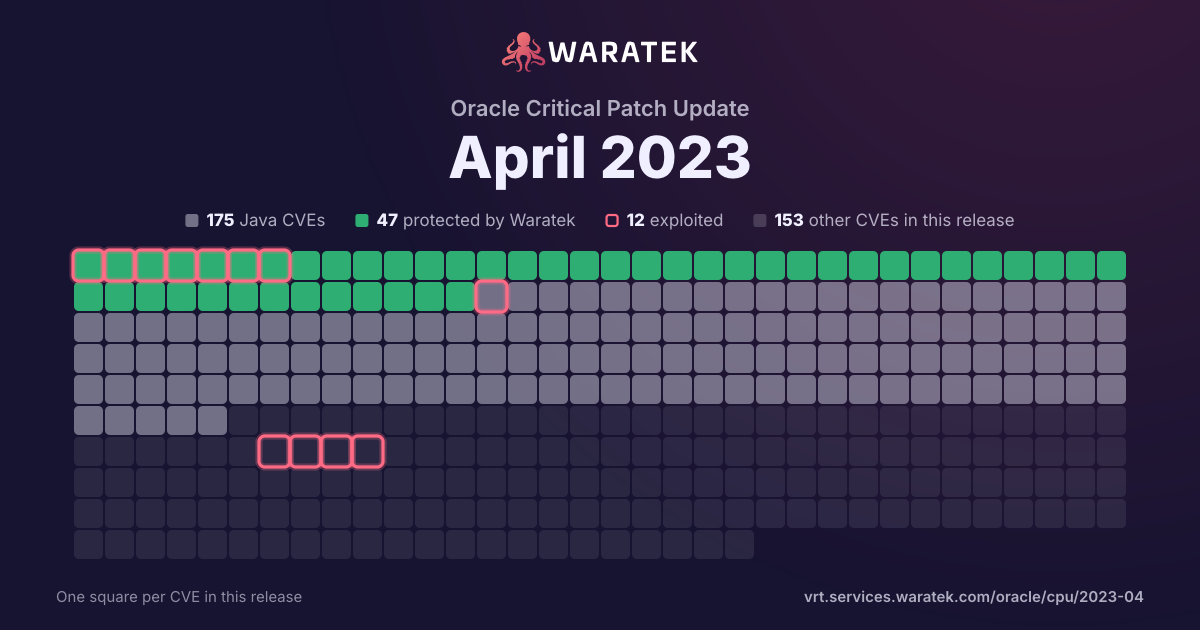
By status
42Protected by Waratek13Mitigation candidate125No exploit published3Outside Waratek scope145Not applicable
10Exploited, marked by the ring
No exploit published. For 44 of them, Oracle's security advisory is the source of public detail.
Protected by Waratek. Waratek RASP can block exploitation of these on systems that have not applied the patch yet.
Overview 133 matches · 0 protected · 2 exploited · 0 CISA KEV · 12 public PoC · 1 EPSS ≥ 0.5
Protected by Waratek
0
0.0%
Rule in development
0
0.0%
Mitigation candidate
12
9.0%
No exploit published
121
91.0%
blocked by ARMR today
0
0.0%
partly blocked
0
0.0%
not blocked
133
100.0%
not established
0
0.0%
unrecorded
0
0.0%
Exploited
2
1.5%
Working exploit published
0
0.0%
Proof of concept only
21
15.8%
Forecast only
0
0.0%
No public exploit
110
82.7%
split by
peak 43 / quarter
Q4 207
Mitigation candidate1
No exploit published6
High5
Medium1
Low1
not blocked7
Proof of concept only1
No public exploit6
Q1 2115
Mitigation candidate3
No exploit published12
Critical1
High14
not blocked15
Proof of concept only3
No public exploit12
Q2 212
No exploit published2
High1
Medium1
not blocked2
No public exploit2
Q3 2110
No exploit published10
High6
Medium4
not blocked10
No public exploit10
Q4 217
Mitigation candidate1
No exploit published6
Critical1
High2
Medium4
not blocked7
Proof of concept only1
No public exploit6
Q1 223
No exploit published3
High3
not blocked3
Proof of concept only2
No public exploit1
Q2 227
Mitigation candidate2
No exploit published5
Critical1
High2
Medium4
not blocked7
Exploited1
Proof of concept only2
No public exploit4
Q3 2214
Mitigation candidate2
No exploit published12
Critical3
High7
Medium3
Low1
not blocked14
Proof of concept only4
No public exploit10
Q4 2218
Mitigation candidate2
No exploit published16
Critical4
High12
Medium2
not blocked18
Proof of concept only6
No public exploit12
Q1 237
Mitigation candidate1
No exploit published6
Critical1
High4
Medium2
not blocked7
Exploited1
Proof of concept only2
No public exploit4
Q2 2343
No exploit published43
High4
Medium39
not blocked43
No public exploit43
Q4 20Q1 21Q2 21Q3 21Q4 21Q1 22Q2 22Q3 22Q4 22Q1 23Q2 23
| CVE | Severity | Published▾ | Status | Exploitation | Description |
|---|---|---|---|---|---|
| CVE-2021-2351 | High | 2021-07-21 | No exploit published | No public exploit | Vulnerability in the Advanced Networking Option component of Oracle Database Server. Supported versions that are affected are 12.1.0.2, 12.2.0.1 and 19c. Difficult to exploit vulnerability allows unauthenticated attacker with network access via Oracle Net to compromise Advanced Networking Option. Successful attacks require human interaction from a person other than the attacker and while the vulnerability is in Advanced Networking Option, attacks may significantly impact additional products. Successful attacks of this vulnerability can result in takeover of Advanced Networking Option. Note: The July 2021 Critical Patch Update introduces a number of Native Network Encryption changes to deal with vulnerability CVE-2021-2351 and prevent the use of weaker ciphers. Customers should review: "Changes in Native Network Encryption with the July 2021 Critical Patch Update" (Doc ID 2791571.1). CVSS 3.1 Base Score 8.3 (Confidentiality, Integrity and Availability impacts). CVSS Vector: (CVSS:3.1/AV:N/AC:H/PR:N/UI:R/S:C/C:H/I:H/A:H). |
| CVE-2021-35043 | Medium | 2021-07-19 | No exploit published | No public exploit | OWASP AntiSamy before 1.6.4 allows XSS via HTML attributes when using the HTML output serializer (XHTML is not affected). This was demonstrated by a javascript: URL with : as the replacement for the : character. |
| CVE-2021-36374 | Medium | 2021-07-14 | No exploit published | No public exploit | When reading a specially crafted ZIP archive, or a derived formats, an Apache Ant build can be made to allocate large amounts of memory that leads to an out of memory error, even for small inputs. This can be used to disrupt builds using Apache Ant. Commonly used derived formats from ZIP archives are for instance JAR files and many office files. Apache Ant prior to 1.9.16 and 1.10.11 were affected. |
| CVE-2021-36373 | Medium | 2021-07-14 | No exploit published | No public exploit | When reading a specially crafted TAR archive an Apache Ant build can be made to allocate large amounts of memory that finally leads to an out of memory error, even for small inputs. This can be used to disrupt builds using Apache Ant. Apache Ant prior to 1.9.16 and 1.10.11 were affected. |
| CVE-2021-36090 | High | 2021-07-13 | No exploit published | No public exploit | When reading a specially crafted ZIP archive, Compress can be made to allocate large amounts of memory that finally leads to an out of memory error even for very small inputs. This could be used to mount a denial of service attack against services that use Compress' zip package. |
| CVE-2021-35517 | High | 2021-07-13 | No exploit published | No public exploit | When reading a specially crafted TAR archive, Compress can be made to allocate large amounts of memory that finally leads to an out of memory error even for very small inputs. This could be used to mount a denial of service attack against services that use Compress' tar package. |
| CVE-2021-35516 | High | 2021-07-13 | No exploit published | No public exploit | When reading a specially crafted 7Z archive, Compress can be made to allocate large amounts of memory that finally leads to an out of memory error even for very small inputs. This could be used to mount a denial of service attack against services that use Compress' sevenz package. |
| CVE-2021-35515 | High | 2021-07-13 | No exploit published | No public exploit | When reading a specially crafted 7Z archive, the construction of the list of codecs that decompress an entry can result in an infinite loop. This could be used to mount a denial of service attack against services that use Compress' sevenz package. |
| CVE-2021-30129 | Medium | 2021-07-12 | No exploit published | No public exploit | A vulnerability in sshd-core of Apache Mina SSHD allows an attacker to overflow the server causing an OutOfMemory error. This issue affects the SFTP and port forwarding features of Apache Mina SSHD version 2.0.0 and later versions. It was addressed in Apache Mina SSHD 2.7.0 |
| CVE-2021-31684 | High | 2021-06-01 | No exploit published | No public exploit | A vulnerability was discovered in the indexOf function of JSONParserByteArray in JSON Smart versions 1.3 and 2.4 which causes a denial of service (DOS) via a crafted web request. |
| CVE-2020-15522 | Medium | 2021-05-20 | No exploit published | No public exploit | Bouncy Castle BC Java before 1.66, BC C# .NET before 1.8.7, BC-FJA before 1.0.1.2, 1.0.2.1, and BC-FNA before 1.0.1.1 have a timing issue within the EC math library that can expose information about the private key when an attacker is able to observe timing information for the generation of multiple deterministic ECDSA signatures. |
| CVE-2020-13936 | High | 2021-03-10 | No exploit published | No public exploit | An attacker that is able to modify Velocity templates may execute arbitrary Java code or run arbitrary system commands with the same privileges as the account running the Servlet container. This applies to applications that allow untrusted users to upload/modify velocity templates running Apache Velocity Engine versions up to 2.2. |
| CVE-2020-11988 | High | 2021-02-24 | No exploit published | No public exploit | Apache XmlGraphics Commons 2.4 and earlier is vulnerable to server-side request forgery, caused by improper input validation by the XMPParser. By using a specially-crafted argument, an attacker could exploit this vulnerability to cause the underlying server to make arbitrary GET requests. Users should upgrade to 2.6 or later. |
| CVE-2020-11987 | High | 2021-02-24 | No exploit published | No public exploit | Apache Batik 1.13 is vulnerable to server-side request forgery, caused by improper input validation by the NodePickerPanel. By using a specially-crafted argument, an attacker could exploit this vulnerability to cause the underlying server to make arbitrary GET requests. |
| CVE-2020-14343 | Critical | 2021-02-09 | No exploit published | No public exploit | A vulnerability was discovered in the PyYAML library in versions before 5.4, where it is susceptible to arbitrary code execution when it processes untrusted YAML files through the full_load method or with the FullLoader loader. Applications that use the library to process untrusted input may be vulnerable to this flaw. This flaw allows an attacker to execute arbitrary code on the system by abusing the python/object/new constructor. This flaw is due to an incomplete fix for CVE-2020-1747. |
| CVE-2020-36183 | High | 2021-01-07 | No exploit published | No public exploit | FasterXML jackson-databind 2.x before 2.9.10.8 mishandles the interaction between serialization gadgets and typing, related to org.docx4j.org.apache.xalan.lib.sql.JNDIConnectionPool. |
| CVE-2020-36182 | High | 2021-01-07 | No exploit published | No public exploit | FasterXML jackson-databind 2.x before 2.9.10.8 mishandles the interaction between serialization gadgets and typing, related to org.apache.tomcat.dbcp.dbcp2.cpdsadapter.DriverAdapterCPDS. |
| CVE-2020-36180 | High | 2021-01-07 | No exploit published | No public exploit | FasterXML jackson-databind 2.x before 2.9.10.8 mishandles the interaction between serialization gadgets and typing, related to org.apache.commons.dbcp2.cpdsadapter.DriverAdapterCPDS. |
| CVE-2020-36179 | High | 2021-01-07 | Mitigation candidate | Proof of concept only | FasterXML jackson-databind 2.x before 2.9.10.8 mishandles the interaction between serialization gadgets and typing, related to oadd.org.apache.commons.dbcp.cpdsadapter.DriverAdapterCPDS. |
| CVE-2020-36189 | High | 2021-01-06 | No exploit published | No public exploit | FasterXML jackson-databind 2.x before 2.9.10.8 mishandles the interaction between serialization gadgets and typing, related to com.newrelic.agent.deps.ch.qos.logback.core.db.DriverManagerConnectionSource. |
| CVE-2020-36188 | High | 2021-01-06 | Mitigation candidate | Proof of concept only | FasterXML jackson-databind 2.x before 2.9.10.8 mishandles the interaction between serialization gadgets and typing, related to com.newrelic.agent.deps.ch.qos.logback.core.db.JNDIConnectionSource. |
| CVE-2020-36187 | High | 2021-01-06 | No exploit published | No public exploit | FasterXML jackson-databind 2.x before 2.9.10.8 mishandles the interaction between serialization gadgets and typing, related to org.apache.tomcat.dbcp.dbcp.datasources.SharedPoolDataSource. |
| CVE-2020-36186 | High | 2021-01-06 | No exploit published | No public exploit | FasterXML jackson-databind 2.x before 2.9.10.8 mishandles the interaction between serialization gadgets and typing, related to org.apache.tomcat.dbcp.dbcp.datasources.PerUserPoolDataSource. |
| CVE-2020-36185 | High | 2021-01-06 | No exploit published | No public exploit | FasterXML jackson-databind 2.x before 2.9.10.8 mishandles the interaction between serialization gadgets and typing, related to org.apache.tomcat.dbcp.dbcp2.datasources.SharedPoolDataSource. |
| CVE-2020-36184 | High | 2021-01-06 | Mitigation candidate | Proof of concept only | FasterXML jackson-databind 2.x before 2.9.10.8 mishandles the interaction between serialization gadgets and typing, related to org.apache.tomcat.dbcp.dbcp2.datasources.PerUserPoolDataSource. |
| CVE-2020-36181 | High | 2021-01-06 | No exploit published | No public exploit | FasterXML jackson-databind 2.x before 2.9.10.8 mishandles the interaction between serialization gadgets and typing, related to org.apache.tomcat.dbcp.dbcp.cpdsadapter.DriverAdapterCPDS. |
| CVE-2020-35728 | High | 2020-12-27 | Mitigation candidate | Proof of concept only | FasterXML jackson-databind 2.x before 2.9.10.8 mishandles the interaction between serialization gadgets and typing, related to com.oracle.wls.shaded.org.apache.xalan.lib.sql.JNDIConnectionPool (aka embedded Xalan in org.glassfish.web/javax.servlet.jsp.jstl). |
| CVE-2020-28052 | High | 2020-12-18 | No exploit published | No public exploit | An issue was discovered in Legion of the Bouncy Castle BC Java 1.65 and 1.66. The OpenBSDBCrypt.checkPassword utility method compared incorrect data when checking the password, allowing incorrect passwords to indicate they were matching with previously hashed ones that were different. |
| CVE-2020-35491 | High | 2020-12-17 | No exploit published | No public exploit | FasterXML jackson-databind 2.x before 2.9.10.8 mishandles the interaction between serialization gadgets and typing, related to org.apache.commons.dbcp2.datasources.SharedPoolDataSource. |
| CVE-2020-35490 | High | 2020-12-17 | No exploit published | No public exploit | FasterXML jackson-databind 2.x before 2.9.10.8 mishandles the interaction between serialization gadgets and typing, related to org.apache.commons.dbcp2.datasources.PerUserPoolDataSource. |
| CVE-2020-8908 | Low | 2020-12-10 | No exploit published | No public exploit | A temp directory creation vulnerability exists in all versions of Guava, allowing an attacker with access to the machine to potentially access data in a temporary directory created by the Guava API com.google.common.io.Files.createTempDir(). By default, on unix-like systems, the created directory is world-readable (readable by an attacker with access to the system). The method in question has been marked @Deprecated in versions 30.0 and later and should not be used. For Android developers, we recommend choosing a temporary directory API provided by Android, such as context.getCacheDir(). For other Java developers, we recommend migrating to the Java 7 API java.nio.file.Files.createTempDirectory() which explicitly configures permissions of 700, or configuring the Java runtime's java.io.tmpdir system property to point to a location whose permissions are appropriately configured. |
| CVE-2020-13954 | Medium | 2020-11-12 | No exploit published | No public exploit | By default, Apache CXF creates a /services page containing a listing of the available endpoint names and addresses. This webpage is vulnerable to a reflected Cross-Site Scripting (XSS) attack via the styleSheetPath, which allows a malicious actor to inject javascript into the web page. This vulnerability affects all versions of Apache CXF prior to 3.4.1 and 3.3.8. Please note that this is a separate issue to CVE-2019-17573. |
| CVE-2020-11979 | High | 2020-10-01 | No exploit published | No public exploit | As mitigation for CVE-2020-1945 Apache Ant 1.10.8 changed the permissions of temporary files it created so that only the current user was allowed to access them. Unfortunately the fixcrlf task deleted the temporary file and created a new one without said protection, effectively nullifying the effort. This would still allow an attacker to inject modified source files into the build process. |