
Oracle Critical Patch Update April 2023
Released April 2023 · Oracle's advisory ↗ · ← Critical Patch Update, January 2023 · Critical Patch Update, July 2023 →
328 CVEs in this release, one square each
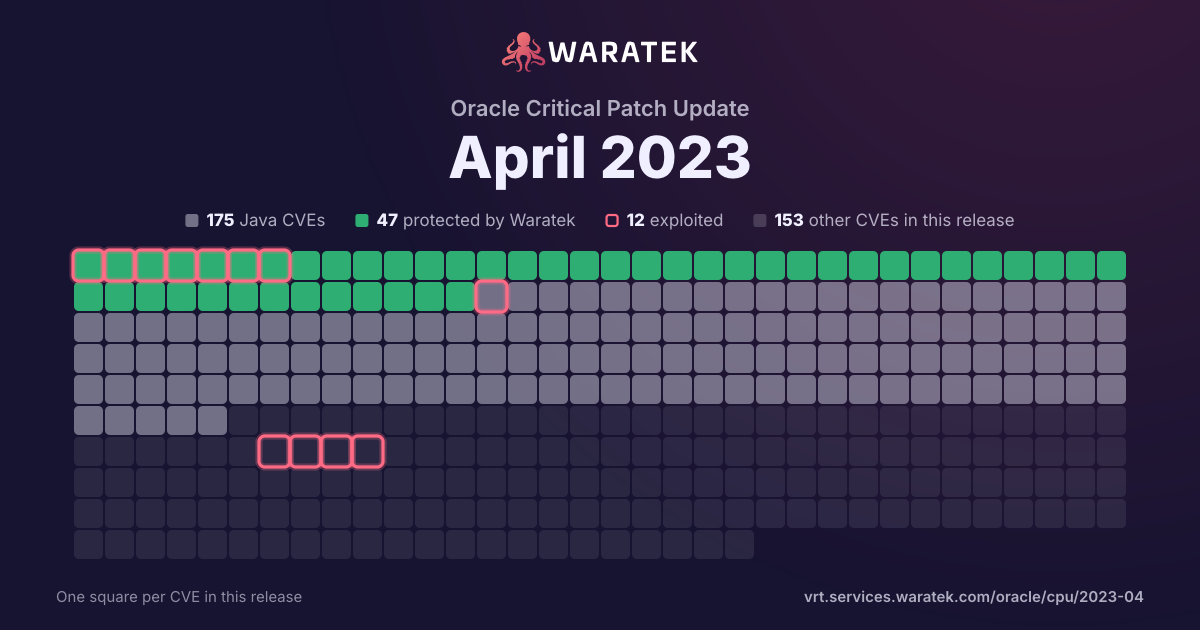
By status
47Protected by Waratek10Mitigation candidate123No exploit published3Outside Waratek scope145Not applicable
10Exploited, marked by the ring
No exploit published. For 55 of them, Oracle's security advisory is the source of public detail.
Protected by Waratek. Waratek RASP can block exploitation of these on systems that have not applied the patch yet.
Overview 11 matches · 6 in Waratek scope · 4 protected · 0 exploited · 0 CISA KEV · 0 public PoC · 0 EPSS ≥ 0.5
11matches
6in Waratek scope54.5%
4protected36.4%
0exploited0.0%
0CISA KEV0.0%
0public PoC0.0%
0EPSS ≥ 0.50.0%
Protected by Waratek
4
36.4%
Rule in development
0
0.0%
Mitigation candidate
0
0.0%
No exploit published
2
18.2%
Outside Waratek scope
0
0.0%
Not applicable
5
45.5%
Withdrawn CVE
0
0.0%
blocked by ARMR today
4
36.4%
partly blocked
0
0.0%
not blocked
7
63.6%
not established
0
0.0%
unrecorded
0
0.0%
Exploited
0
0.0%
Working exploit published
0
0.0%
Proof of concept only
0
0.0%
Forecast only
0
0.0%
No public exploit
11
100.0%
split by
peak 4 / quarter
Q3 182
Protected by Waratek1
Not applicable1
High2
blocked by ARMR today1
not blocked1
No public exploit2
Q4 182
Not applicable2
Critical1
High1
not blocked2
No public exploit2
Q1 190
Q2 190
Q3 192
Protected by Waratek1
No exploit published1
High2
blocked by ARMR today1
not blocked1
No public exploit2
Q4 194
Protected by Waratek2
Not applicable2
High2
Medium2
blocked by ARMR today2
not blocked2
No public exploit4
Q1 201
No exploit published1
High1
not blocked1
No public exploit1
Q3 18Q4 18Q1 19Q2 19Q3 19Q4 19Q1 20
| CVE | Severity | Published▾ | Status | Exploitation | Description |
|---|---|---|---|---|---|
| CVE-2020-7009 | High | 2020-03-31 | No exploit published | No public exploit | Elasticsearch versions from 6.7.0 before 6.8.8 and 7.0.0 before 7.6.2 contain a privilege escalation flaw if an attacker is able to create API keys. An attacker who is able to generate an API key can perform a series of steps that result in an API key being generated with elevated privileges. |
| CVE-2018-1311 | High | 2019-12-18 | Not applicable | No public exploit | The Apache Xerces-C 3.0.0 to 3.2.3 XML parser contains a use-after-free error triggered during the scanning of external DTDs. This flaw has not been addressed in the maintained version of the library and has no current mitigation other than to disable DTD processing. This can be accomplished via the DOM using a standard parser feature, or via SAX using the XERCES_DISABLE_DTD environment variable. |
| CVE-2019-11287 | High | 2019-11-23 | Not applicable | No public exploit | Pivotal RabbitMQ, versions 3.7.x prior to 3.7.21 and 3.8.x prior to 3.8.1, and RabbitMQ for Pivotal Platform, 1.16.x versions prior to 1.16.7 and 1.17.x versions prior to 1.17.4, contain a web management plugin that is vulnerable to a denial of service attack. The "X-Reason" HTTP Header can be leveraged to insert a malicious Erlang format string that will expand and consume the heap, resulting in the server crashing. |
| CVE-2019-12415 | Medium | 2019-10-23 | Protected by Waratek | No public exploit | In Apache POI up to 4.1.0, when using the tool XSSFExportToXml to convert user-provided Microsoft Excel documents, a specially crafted document can allow an attacker to read files from the local filesystem or from internal network resources via XML External Entity (XXE) Processing. |
| CVE-2019-17091 | Medium | 2019-10-02 | Protected by Waratek | No public exploit | faces/context/PartialViewContextImpl.java in Eclipse Mojarra, as used in Mojarra for Eclipse EE4J before 2.3.10 and Mojarra JavaServer Faces before 2.2.20, allows Reflected XSS because a client window field is mishandled. |
| CVE-2019-12402 | High | 2019-08-30 | No exploit published | No public exploit | The file name encoding algorithm used internally in Apache Commons Compress 1.15 to 1.18 can get into an infinite loop when faced with specially crafted inputs. This can lead to a denial of service attack if an attacker can choose the file names inside of an archive created by Compress. |
| CVE-2019-10086 | High | 2019-08-20 | Protected by Waratek | No public exploit | In Apache Commons Beanutils 1.9.2, a special BeanIntrospector class was added which allows suppressing the ability for an attacker to access the classloader via the class property available on all Java objects. We, however were not using this by default characteristic of the PropertyUtilsBean. |
| CVE-2018-20060 | Critical | 2018-12-11 | Not applicable | No public exploit | urllib3 before version 1.23 does not remove the Authorization HTTP header when following a cross-origin redirect (i.e., a redirect that differs in host, port, or scheme). This can allow for credentials in the Authorization header to be exposed to unintended hosts or transmitted in cleartext. |
| CVE-2018-18074 | High | 2018-10-09 | Not applicable | No public exploit | The Requests package before 2.20.0 for Python sends an HTTP Authorization header to an http URI upon receiving a same-hostname https-to-http redirect, which makes it easier for remote attackers to discover credentials by sniffing the network. |
| CVE-2018-1000656 | High | 2018-08-20 | Not applicable | No public exploit | The Pallets Project flask version Before 0.12.3 contains a CWE-20: Improper Input Validation vulnerability in flask that can result in Large amount of memory usage possibly leading to denial of service. This attack appear to be exploitable via Attacker provides JSON data in incorrect encoding. This vulnerability appears to have been fixed in 0.12.3. NOTE: this may overlap CVE-2019-1010083. |
| CVE-2018-14371 | High | 2018-07-18 | Protected by Waratek | No public exploit | The getLocalePrefix function in ResourceManager.java in Eclipse Mojarra before 2.3.7 is affected by Directory Traversal via the loc parameter. A remote attacker can download configuration files or Java bytecodes from applications. |