
Oracle Critical Patch Update April 2023
Released April 2023 · Oracle's advisory ↗ · ← Critical Patch Update, January 2023 · Critical Patch Update, July 2023 →
328 CVEs in this release, one square each
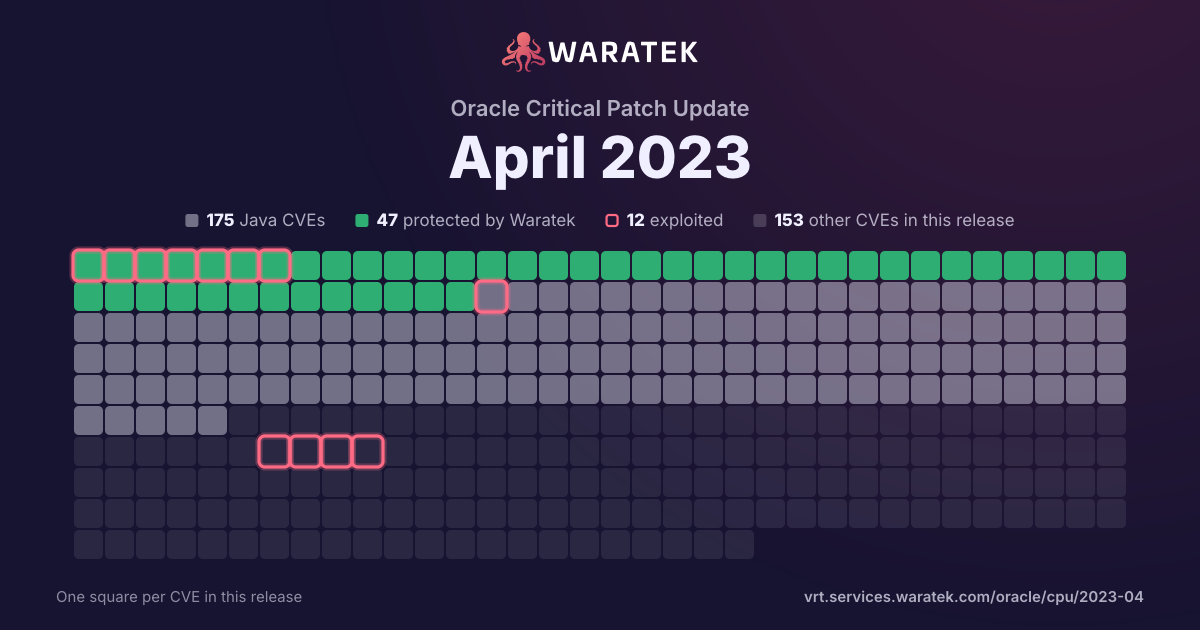
By status
43Protected by Waratek12Mitigation candidate125No exploit published3Outside Waratek scope145Not applicable
10Exploited, marked by the ring
No exploit published. For 44 of them, Oracle's security advisory is the source of public detail.
Protected by Waratek. Waratek RASP can block exploitation of these on systems that have not applied the patch yet.
Overview 14 matches · 2 protected · 0 exploited · 0 CISA KEV · 0 public PoC · 0 EPSS ≥ 0.5
Protected by Waratek
2
14.3%
Rule in development
0
0.0%
Mitigation candidate
0
0.0%
No exploit published
12
85.7%
blocked by ARMR today
2
14.3%
partly blocked
0
0.0%
not blocked
12
85.7%
not established
0
0.0%
unrecorded
0
0.0%
Exploited
0
0.0%
Working exploit published
0
0.0%
Proof of concept only
0
0.0%
Forecast only
0
0.0%
No public exploit
14
100.0%
split by
peak 8 / month
Oct 22Nov 22Dec 22
| CVE | Severity | Published▾ | Status | Exploitation | Description |
|---|---|---|---|---|---|
| CVE-2022-46363 | High | 2022-12-13 | No exploit published | No public exploit | A vulnerability in Apache CXF before versions 3.5.5 and 3.4.10 allows an attacker to perform a remote directory listing or code exfiltration. The vulnerability only applies when the CXFServlet is configured with both the static-resources-list and redirect-query-check attributes. These attributes are not supposed to be used together, and so the vulnerability can only arise if the CXF service is misconfigured. |
| CVE-2022-45685 | High | 2022-12-13 | No exploit published | No public exploit | A stack overflow in Jettison before v1.5.2 allows attackers to cause a Denial of Service (DoS) via crafted JSON data. |
| CVE-2021-37533 | Medium | 2022-12-03 | No exploit published | No public exploit | Prior to Apache Commons Net 3.9.0, Net's FTP client trusts the host from PASV response by default. A malicious server can redirect the Commons Net code to use a different host, but the user has to connect to the malicious server in the first place. This may lead to leakage of information about services running on the private network of the client. The default in version 3.9.0 is now false to ignore such hosts, as cURL does. See https://issues.apache.org/jira/browse/NET-711. |
| CVE-2022-37866 | High | 2022-11-07 | Protected by Waratek | No public exploit | When Apache Ivy downloads artifacts from a repository it stores them in the local file system based on a user-supplied "pattern" that may include placeholders for artifacts coordinates like the organisation, module or version. If said coordinates contain "../" sequences - which are valid characters for Ivy coordinates in general - it is possible the artifacts are stored outside of Ivy's local cache or repository or can overwrite different artifacts inside of the local cache. In order to exploit this vulnerability an attacker needs collaboration by the remote repository as Ivy will issue http requests containing ".." sequences and a "normal" repository will not interpret them as part of the artifact coordinates. Users of Apache Ivy 2.0.0 to 2.5.1 should upgrade to Ivy 2.5.1. |
| CVE-2022-37865 | Critical | 2022-11-07 | Protected by Waratek | No public exploit | With Apache Ivy 2.4.0 an optional packaging attribute has been introduced that allows artifacts to be unpacked on the fly if they used pack200 or zip packaging. For artifacts using the "zip", "jar" or "war" packaging Ivy prior to 2.5.1 doesn't verify the target path when extracting the archive. An archive containing absolute paths or paths that try to traverse "upwards" using ".." sequences can then write files to any location on the local fie system that the user executing Ivy has write access to. Ivy users of version 2.4.0 to 2.5.0 should upgrade to Ivy 2.5.1. |
| CVE-2022-42252 | High | 2022-11-01 | No exploit published | No public exploit | If Apache Tomcat 8.5.0 to 8.5.82, 9.0.0-M1 to 9.0.67, 10.0.0-M1 to 10.0.26 or 10.1.0-M1 to 10.1.0 was configured to ignore invalid HTTP headers via setting rejectIllegalHeader to false (the default for 8.5.x only), Tomcat did not reject a request containing an invalid Content-Length header making a request smuggling attack possible if Tomcat was located behind a reverse proxy that also failed to reject the request with the invalid header. |
| CVE-2022-31690 | High | 2022-10-31 | No exploit published | No public exploit | Spring Security, versions 5.7 prior to 5.7.5, and 5.6 prior to 5.6.9, and older unsupported versions could be susceptible to a privilege escalation under certain conditions. A malicious user or attacker can modify a request initiated by the Client (via the browser) to the Authorization Server which can lead to a privilege escalation on the subsequent approval. This scenario can happen if the Authorization Server responds with an OAuth2 Access Token Response containing an empty scope list (per RFC 6749, Section 5.1) on the subsequent request to the token endpoint to obtain the access token. |
| CVE-2022-42890 | High | 2022-10-25 | No exploit published | No public exploit | A vulnerability in Batik of Apache XML Graphics allows an attacker to run Java code from untrusted SVG via JavaScript. This issue affects Apache XML Graphics prior to 1.16. Users are recommended to upgrade to version 1.16. |
| CVE-2022-41704 | High | 2022-10-25 | No exploit published | No public exploit | A vulnerability in Batik of Apache XML Graphics allows an attacker to run untrusted Java code from an SVG. This issue affects Apache XML Graphics prior to 1.16. It is recommended to update to version 1.16. |
| CVE-2022-43402 | Critical | 2022-10-19 | No exploit published | No public exploit | A sandbox bypass vulnerability involving various casts performed implicitly by the Groovy language runtime in Jenkins Pipeline: Groovy Plugin 2802.v5ea_628154b_c2 and earlier allows attackers with permission to define and run sandboxed scripts, including Pipelines, to bypass the sandbox protection and execute arbitrary code in the context of the Jenkins controller JVM. |
| CVE-2022-43401 | Critical | 2022-10-19 | No exploit published | No public exploit | A sandbox bypass vulnerability involving various casts performed implicitly by the Groovy language runtime in Jenkins Script Security Plugin 1183.v774b_0b_0a_a_451 and earlier allows attackers with permission to define and run sandboxed scripts, including Pipelines, to bypass the sandbox protection and execute arbitrary code in the context of the Jenkins controller JVM. |
| CVE-2022-3171 | High | 2022-10-12 | No exploit published | No public exploit | A parsing issue with binary data in protobuf-java core and lite versions prior to 3.21.7, 3.20.3, 3.19.6 and 3.16.3 can lead to a denial of service attack. Inputs containing multiple instances of non-repeated embedded messages with repeated or unknown fields causes objects to be converted back-n-forth between mutable and immutable forms, resulting in potentially long garbage collection pauses. We recommend updating to the versions mentioned above. |
| CVE-2022-42004 | High | 2022-10-02 | No exploit published | No public exploit | In FasterXML jackson-databind before 2.13.4, resource exhaustion can occur because of a lack of a check in BeanDeserializer._deserializeFromArray to prevent use of deeply nested arrays. An application is vulnerable only with certain customized choices for deserialization. |
| CVE-2022-42003 | High | 2022-10-02 | No exploit published | No public exploit | In FasterXML jackson-databind before versions 2.13.4.1 and 2.12.17.1, resource exhaustion can occur because of a lack of a check in primitive value deserializers to avoid deep wrapper array nesting, when the UNWRAP_SINGLE_VALUE_ARRAYS feature is enabled. |