
Oracle Critical Patch Update April 2023
Released April 2023 · Oracle's advisory ↗ · ← Critical Patch Update, January 2023 · Critical Patch Update, July 2023 →
328 CVEs in this release, one square each
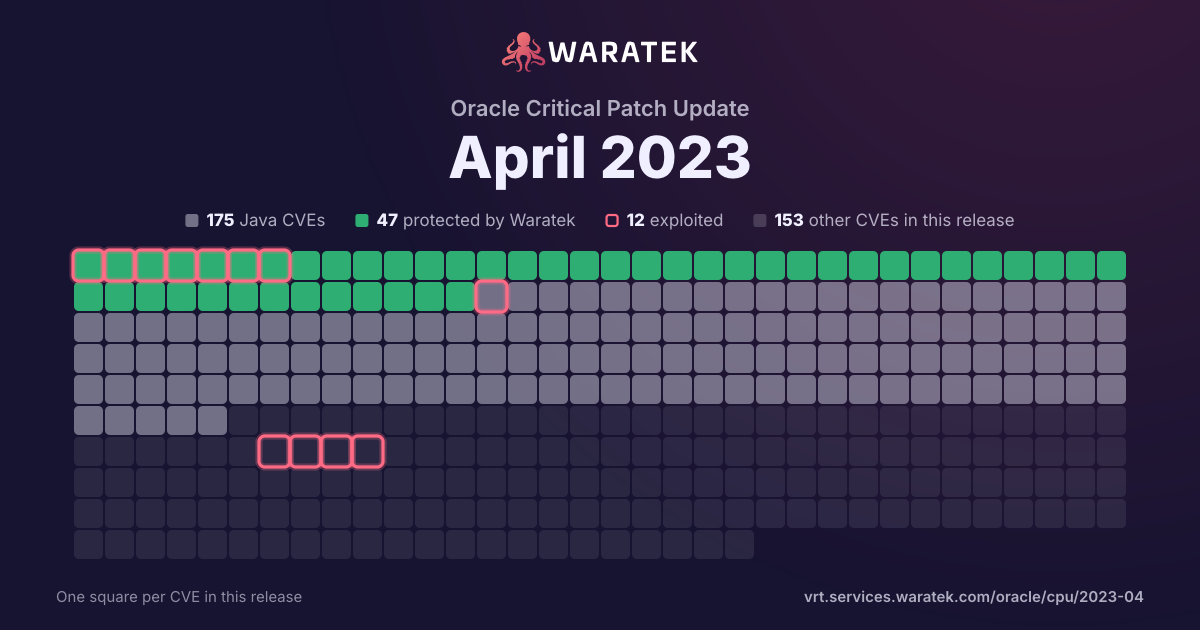
By status
47Protected by Waratek9Mitigation candidate119No exploit published35Outside Waratek scope118Not applicable
12Exploited, marked by the ring
No exploit published. For 56 of them, Oracle's security advisory is the source of public detail.
Protected by Waratek. Waratek RASP can block exploitation of these on systems that have not applied the patch yet.
Overview 108 matches · 0 protected · 0 exploited · 0 CISA KEV · 0 public PoC · 0 EPSS ≥ 0.5
108matches
0protected0.0%
0exploited0.0%
0CISA KEV0.0%
0public PoC0.0%
0EPSS ≥ 0.50.0%
Protected by Waratek
0
0.0%
Rule in development
0
0.0%
Mitigation candidate
0
0.0%
No exploit published
108
100.0%
blocked by ARMR today
0
0.0%
partly blocked
0
0.0%
not blocked
108
100.0%
not established
0
0.0%
unrecorded
0
0.0%
Exploited
0
0.0%
Working exploit published
0
0.0%
Proof of concept only
0
0.0%
Forecast only
0
0.0%
No public exploit
108
100.0%
split by
peak 43 / quarter
Q3 191
No exploit published1
High1
not blocked1
No public exploit1
Q4 190
Q1 201
No exploit published1
High1
not blocked1
No public exploit1
Q2 201
No exploit published1
Medium1
not blocked1
No public exploit1
Q3 200
Q4 206
No exploit published6
High4
Medium1
Low1
not blocked6
No public exploit6
Q1 2111
No exploit published11
High11
not blocked11
No public exploit11
Q2 212
No exploit published2
High1
Medium1
not blocked2
No public exploit2
Q3 2110
No exploit published10
High6
Medium4
not blocked10
No public exploit10
Q4 211
No exploit published1
Medium1
not blocked1
No public exploit1
Q1 222
No exploit published2
High1
Medium1
not blocked2
No public exploit2
Q2 224
No exploit published4
High2
Medium2
not blocked4
No public exploit4
Q3 2211
No exploit published11
Critical3
High4
Medium3
Low1
not blocked11
No public exploit11
Q4 2211
No exploit published11
Critical2
High8
Medium1
not blocked11
No public exploit11
Q1 234
No exploit published4
Critical1
High2
Medium1
not blocked4
No public exploit4
Q2 2343
No exploit published43
High4
Medium39
not blocked43
No public exploit43
Q4 19Q2 20Q4 20Q2 21Q4 21Q2 22Q4 22Q2 23
| CVE | Severity | Published▾ | Status | Exploitation | Description |
|---|---|---|---|---|---|
| CVE-2020-35491 | High | 2020-12-17 | No exploit published | No public exploit | FasterXML jackson-databind 2.x before 2.9.10.8 mishandles the interaction between serialization gadgets and typing, related to org.apache.commons.dbcp2.datasources.SharedPoolDataSource. |
| CVE-2020-35490 | High | 2020-12-17 | No exploit published | No public exploit | FasterXML jackson-databind 2.x before 2.9.10.8 mishandles the interaction between serialization gadgets and typing, related to org.apache.commons.dbcp2.datasources.PerUserPoolDataSource. |
| CVE-2020-8908 | Low | 2020-12-10 | No exploit published | No public exploit | A temp directory creation vulnerability exists in all versions of Guava, allowing an attacker with access to the machine to potentially access data in a temporary directory created by the Guava API com.google.common.io.Files.createTempDir(). By default, on unix-like systems, the created directory is world-readable (readable by an attacker with access to the system). The method in question has been marked @Deprecated in versions 30.0 and later and should not be used. For Android developers, we recommend choosing a temporary directory API provided by Android, such as context.getCacheDir(). For other Java developers, we recommend migrating to the Java 7 API java.nio.file.Files.createTempDirectory() which explicitly configures permissions of 700, or configuring the Java runtime's java.io.tmpdir system property to point to a location whose permissions are appropriately configured. |
| CVE-2020-13954 | Medium | 2020-11-12 | No exploit published | No public exploit | By default, Apache CXF creates a /services page containing a listing of the available endpoint names and addresses. This webpage is vulnerable to a reflected Cross-Site Scripting (XSS) attack via the styleSheetPath, which allows a malicious actor to inject javascript into the web page. This vulnerability affects all versions of Apache CXF prior to 3.4.1 and 3.3.8. Please note that this is a separate issue to CVE-2019-17573. |
| CVE-2020-11979 | High | 2020-10-01 | No exploit published | No public exploit | As mitigation for CVE-2020-1945 Apache Ant 1.10.8 changed the permissions of temporary files it created so that only the current user was allowed to access them. Unfortunately the fixcrlf task deleted the temporary file and created a new one without said protection, effectively nullifying the effort. This would still allow an attacker to inject modified source files into the build process. |
| CVE-2020-10693 | Medium | 2020-05-06 | No exploit published | No public exploit | A flaw was found in Hibernate Validator version 6.1.2.Final. A bug in the message interpolation processor enables invalid EL expressions to be evaluated as if they were valid. This flaw allows attackers to bypass input sanitation (escaping, stripping) controls that developers may have put in place when handling user-controlled data in error messages. |
| CVE-2020-7009 | High | 2020-03-31 | No exploit published | No public exploit | Elasticsearch versions from 6.7.0 before 6.8.8 and 7.0.0 before 7.6.2 contain a privilege escalation flaw if an attacker is able to create API keys. An attacker who is able to generate an API key can perform a series of steps that result in an API key being generated with elevated privileges. |
| CVE-2019-12402 | High | 2019-08-30 | No exploit published | No public exploit | The file name encoding algorithm used internally in Apache Commons Compress 1.15 to 1.18 can get into an infinite loop when faced with specially crafted inputs. This can lead to a denial of service attack if an attacker can choose the file names inside of an archive created by Compress. |