
Oracle Critical Patch Update April 2023
Released April 2023 · Oracle's advisory ↗ · ← Critical Patch Update, January 2023 · Critical Patch Update, July 2023 →
328 CVEs in this release, one square each
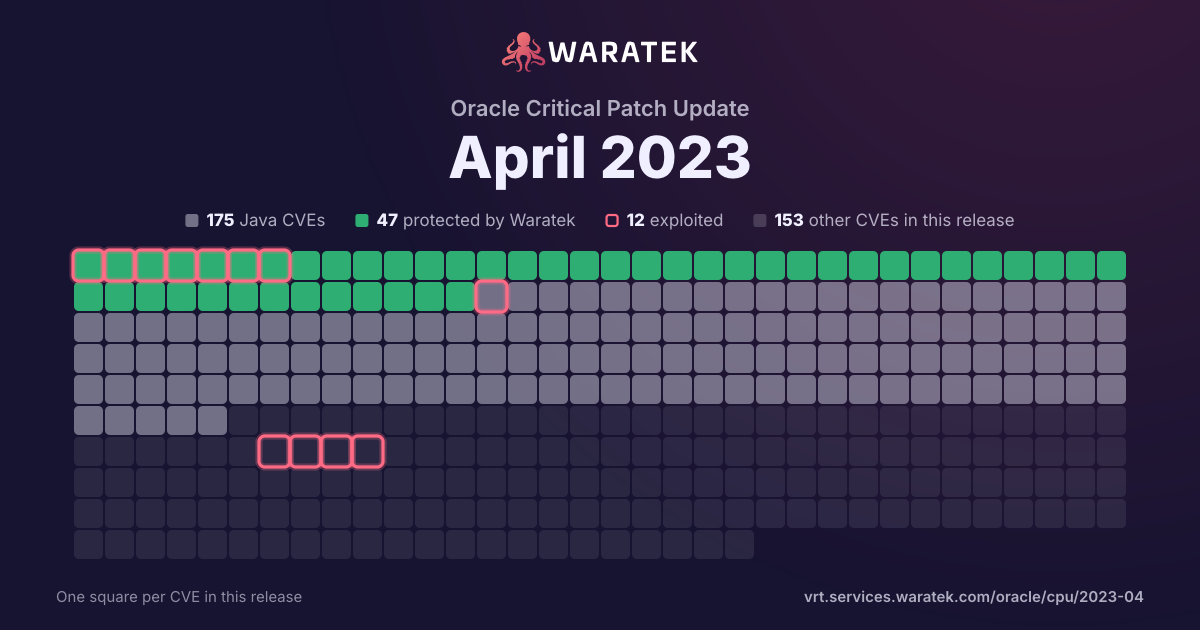
By status
43Protected by Waratek1Rule in development10Mitigation candidate123No exploit published2Outside Waratek scope149Not applicable
10Exploited, marked by the ring
No exploit published. For 44 of them, Oracle's security advisory is the source of public detail.
Protected by Waratek. Waratek RASP can block exploitation of these on systems that have not applied the patch yet.
Overview 14 matches · 3 protected · 2 exploited · 0 CISA KEV · 2 public PoC · 2 EPSS ≥ 0.5
Protected by Waratek
3
21.4%
Rule in development
0
0.0%
Mitigation candidate
0
0.0%
No exploit published
11
78.6%
blocked by ARMR today
3
21.4%
partly blocked
0
0.0%
not blocked
11
78.6%
not established
0
0.0%
unrecorded
0
0.0%
Exploited
2
14.3%
Working exploit published
0
0.0%
Proof of concept only
5
35.7%
Forecast only
0
0.0%
No public exploit
7
50.0%
split by
peak 7 / month
Oct 226
Protected by Waratek1
No exploit published5
Critical1
High5
blocked by ARMR today1
not blocked5
Exploited1
No public exploit5
Nov 221
Protected by Waratek1
Critical1
blocked by ARMR today1
Proof of concept only1
Dec 227
Protected by Waratek1
No exploit published6
Critical1
High4
Medium2
blocked by ARMR today1
not blocked6
Exploited1
Proof of concept only4
No public exploit2
Oct 22Nov 22Dec 22
| CVE | Severity | Published▾ | Status | Exploitation | Description |
|---|---|---|---|---|---|
| CVE-2022-41966 | High | 2022-12-28 | No exploit published | Proof of concept only | XStream serializes Java objects to XML and back again. Versions prior to 1.4.20 may allow a remote attacker to terminate the application with a stack overflow error, resulting in a denial of service only via manipulation the processed input stream. The attack uses the hash code implementation for collections and maps to force recursive hash calculation causing a stack overflow. This issue is patched in version 1.4.20 which handles the stack overflow and raises an InputManipulationException instead. A potential workaround for users who only use HashMap or HashSet and whose XML refers these only as default map or set, is to change the default implementation of java.util.Map and java.util per the code example in the referenced advisory. However, this implies that your application does not care about the implementation of the map and all elements are comparable. |
| CVE-2022-45693 | High | 2022-12-13 | No exploit published | Proof of concept only | Jettison before v1.5.2 was discovered to contain a stack overflow via the map parameter. This vulnerability allows attackers to cause a Denial of Service (DoS) via a crafted string. |
| CVE-2022-45685 | High | 2022-12-13 | No exploit published | No public exploit | A stack overflow in Jettison before v1.5.2 allows attackers to cause a Denial of Service (DoS) via crafted JSON data. |
| CVE-2022-41915 | Medium | 2022-12-13 | No exploit published | Proof of concept only | Netty project is an event-driven asynchronous network application framework. Starting in version 4.1.83.Final and prior to 4.1.86.Final, when calling `DefaultHttpHeadesr.set` with an _iterator_ of values, header value validation was not performed, allowing malicious header values in the iterator to perform HTTP Response Splitting. This issue has been patched in version 4.1.86.Final. Integrators can work around the issue by changing the `DefaultHttpHeaders.set(CharSequence, Iterator<?>)` call, into a `remove()` call, and call `add()` in a loop over the iterator of values. |
| CVE-2022-41881 | High | 2022-12-12 | No exploit published | Proof of concept only | Netty project is an event-driven asynchronous network application framework. In versions prior to 4.1.86.Final, a StackOverflowError can be raised when parsing a malformed crafted message due to an infinite recursion. This issue is patched in version 4.1.86.Final. There is no workaround, except using a custom HaProxyMessageDecoder. |
| CVE-2021-37533 | Medium | 2022-12-03 | No exploit published | No public exploit | Prior to Apache Commons Net 3.9.0, Net's FTP client trusts the host from PASV response by default. A malicious server can redirect the Commons Net code to use a different host, but the user has to connect to the malicious server in the first place. This may lead to leakage of information about services running on the private network of the client. The default in version 3.9.0 is now false to ignore such hosts, as cURL does. See https://issues.apache.org/jira/browse/NET-711. |
| CVE-2022-1471 | Critical | 2022-12-01 | Protected by Waratek | Exploited | SnakeYaml's Constructor() class does not restrict types which can be instantiated during deserialization. Deserializing yaml content provided by an attacker can lead to remote code execution. We recommend using SnakeYaml's SafeConsturctor when parsing untrusted content to restrict deserialization. We recommend upgrading to version 2.0 and beyond. |
| CVE-2022-45047 | Critical | 2022-11-16 | Protected by Waratek | Proof of concept only | Class org.apache.sshd.server.keyprovider.SimpleGeneratorHostKeyProvider in Apache MINA SSHD <= 2.9.1 uses Java deserialization to load a serialized java.security.PrivateKey. The class is one of several implementations that an implementor using Apache MINA SSHD can choose for loading the host keys of an SSH server. |
| CVE-2022-42890 | High | 2022-10-25 | No exploit published | No public exploit | A vulnerability in Batik of Apache XML Graphics allows an attacker to run Java code from untrusted SVG via JavaScript. This issue affects Apache XML Graphics prior to 1.16. Users are recommended to upgrade to version 1.16. |
| CVE-2022-41704 | High | 2022-10-25 | No exploit published | No public exploit | A vulnerability in Batik of Apache XML Graphics allows an attacker to run untrusted Java code from an SVG. This issue affects Apache XML Graphics prior to 1.16. It is recommended to update to version 1.16. |
| CVE-2022-42889 | Critical | 2022-10-13 | Protected by Waratek | Exploited | Apache Commons Text performs variable interpolation, allowing properties to be dynamically evaluated and expanded. The standard format for interpolation is "${prefix:name}", where "prefix" is used to locate an instance of org.apache.commons.text.lookup.StringLookup that performs the interpolation. Starting with version 1.5 and continuing through 1.9, the set of default Lookup instances included interpolators that could result in arbitrary code execution or contact with remote servers. These lookups are: - "script" - execute expressions using the JVM script execution engine (javax.script) - "dns" - resolve dns records - "url" - load values from urls, including from remote servers Applications using the interpolation defaults in the affected versions may be vulnerable to remote code execution or unintentional contact with remote servers if untrusted configuration values are used. Users are recommended to upgrade to Apache Commons Text 1.10.0, which disables the problematic interpolators by default. |
| CVE-2022-3171 | High | 2022-10-12 | No exploit published | No public exploit | A parsing issue with binary data in protobuf-java core and lite versions prior to 3.21.7, 3.20.3, 3.19.6 and 3.16.3 can lead to a denial of service attack. Inputs containing multiple instances of non-repeated embedded messages with repeated or unknown fields causes objects to be converted back-n-forth between mutable and immutable forms, resulting in potentially long garbage collection pauses. We recommend updating to the versions mentioned above. |
| CVE-2022-42004 | High | 2022-10-02 | No exploit published | No public exploit | In FasterXML jackson-databind before 2.13.4, resource exhaustion can occur because of a lack of a check in BeanDeserializer._deserializeFromArray to prevent use of deeply nested arrays. An application is vulnerable only with certain customized choices for deserialization. |
| CVE-2022-42003 | High | 2022-10-02 | No exploit published | No public exploit | In FasterXML jackson-databind before versions 2.13.4.1 and 2.12.17.1, resource exhaustion can occur because of a lack of a check in primitive value deserializers to avoid deep wrapper array nesting, when the UNWRAP_SINGLE_VALUE_ARRAYS feature is enabled. |