
Oracle Critical Patch Update April 2023
Released April 2023 · Oracle's advisory ↗ · ← Critical Patch Update, January 2023 · Critical Patch Update, July 2023 →
328 CVEs in this release, one square each
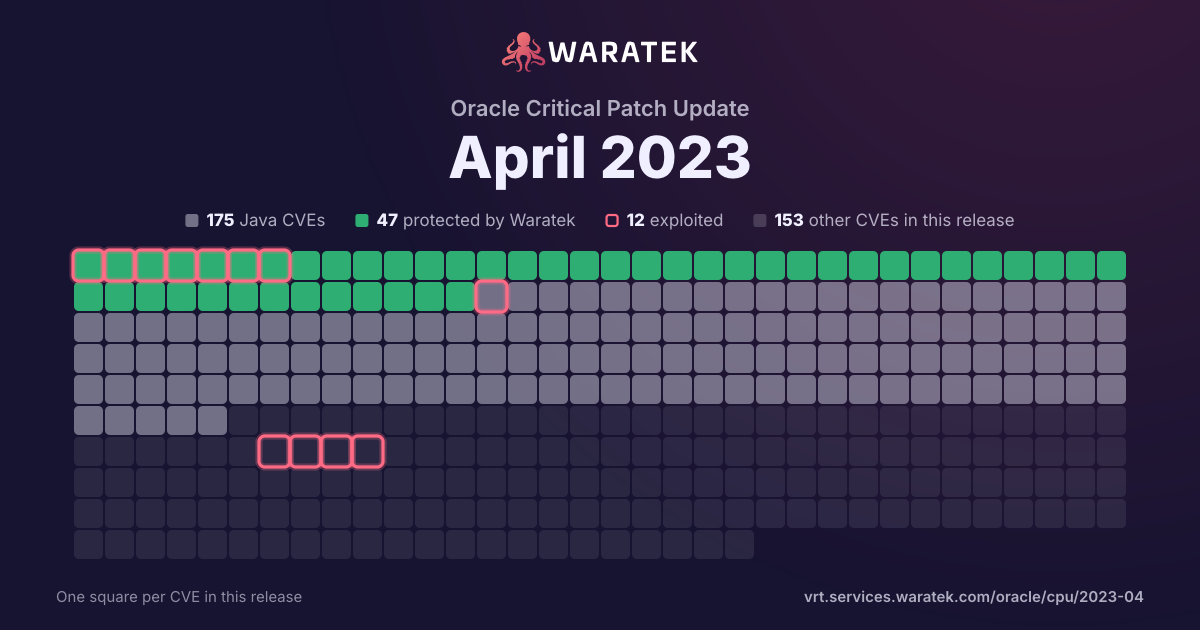
By status
43Protected by Waratek1Rule in development10Mitigation candidate123No exploit published2Outside Waratek scope149Not applicable
10Exploited, marked by the ring
No exploit published. For 44 of them, Oracle's security advisory is the source of public detail.
Protected by Waratek. Waratek RASP can block exploitation of these on systems that have not applied the patch yet.
Overview 9 matches · 5 protected · 0 exploited · 0 CISA KEV · 1 public PoC · 0 EPSS ≥ 0.5
Protected by Waratek
5
55.6%
Rule in development
0
0.0%
Mitigation candidate
0
0.0%
No exploit published
4
44.4%
blocked by ARMR today
5
55.6%
partly blocked
0
0.0%
not blocked
4
44.4%
not established
0
0.0%
unrecorded
0
0.0%
Exploited
0
0.0%
Working exploit published
1
11.1%
Proof of concept only
0
0.0%
Forecast only
0
0.0%
No public exploit
8
88.9%
split by
peak 3 / quarter
Q4 192
Protected by Waratek2
Medium2
blocked by ARMR today2
No public exploit2
Q1 200
Q2 201
No exploit published1
Medium1
not blocked1
No public exploit1
Q3 200
Q4 201
Protected by Waratek1
Medium1
blocked by ARMR today1
No public exploit1
Q1 210
Q2 212
Protected by Waratek2
Medium2
blocked by ARMR today2
Working exploit published1
No public exploit1
Q3 213
No exploit published3
Medium3
not blocked3
No public exploit3
Q4 19Q1 20Q2 20Q3 20Q4 20Q1 21Q2 21Q3 21
| CVE | Severity | Published▾ | Status | Exploitation | Description |
|---|---|---|---|---|---|
| CVE-2021-35043 | Medium | 2021-07-19 | No exploit published | No public exploit | OWASP AntiSamy before 1.6.4 allows XSS via HTML attributes when using the HTML output serializer (XHTML is not affected). This was demonstrated by a javascript: URL with : as the replacement for the : character. |
| CVE-2021-36374 | Medium | 2021-07-14 | No exploit published | No public exploit | When reading a specially crafted ZIP archive, or a derived formats, an Apache Ant build can be made to allocate large amounts of memory that leads to an out of memory error, even for small inputs. This can be used to disrupt builds using Apache Ant. Commonly used derived formats from ZIP archives are for instance JAR files and many office files. Apache Ant prior to 1.9.16 and 1.10.11 were affected. |
| CVE-2021-30129 | Medium | 2021-07-12 | No exploit published | No public exploit | A vulnerability in sshd-core of Apache Mina SSHD allows an attacker to overflow the server causing an OutOfMemory error. This issue affects the SFTP and port forwarding features of Apache Mina SSHD version 2.0.0 and later versions. It was addressed in Apache Mina SSHD 2.7.0 |
| CVE-2020-6950 | Medium | 2021-06-02 | Protected by Waratek | Working exploit published | Directory traversal in Eclipse Mojarra before 2.3.14 allows attackers to read arbitrary files via the loc parameter or con parameter. |
| CVE-2021-29425 | Medium | 2021-04-13 | Protected by Waratek | No public exploit | In Apache Commons IO before 2.7, When invoking the method FileNameUtils.normalize with an improper input string, like "//../foo", or "\\..\foo", the result would be the same value, thus possibly providing access to files in the parent directory, but not further above (thus "limited" path traversal), if the calling code would use the result to construct a path value. |
| CVE-2020-15250 | Medium | 2020-10-12 | Protected by Waratek | No public exploit | In JUnit4 from version 4.7 and before 4.13.1, the test rule TemporaryFolder contains a local information disclosure vulnerability. On Unix like systems, the system's temporary directory is shared between all users on that system. Because of this, when files and directories are written into this directory they are, by default, readable by other users on that same system. This vulnerability does not allow other users to overwrite the contents of these directories or files. This is purely an information disclosure vulnerability. This vulnerability impacts you if the JUnit tests write sensitive information, like API keys or passwords, into the temporary folder, and the JUnit tests execute in an environment where the OS has other untrusted users. Because certain JDK file system APIs were only added in JDK 1.7, this this fix is dependent upon the version of the JDK you are using. For Java 1.7 and higher users: this vulnerability is fixed in 4.13.1. For Java 1.6 and lower users: no patch is available, you must use the workaround below. If you are unable to patch, or are stuck running on Java 1.6, specifying the `java.io.tmpdir` system environment variable to a directory that is exclusively owned by the executing user will fix this vulnerability. For more information, including an example of vulnerable code, see the referenced GitHub Security Advisory. |
| CVE-2020-1945 | Medium | 2020-05-14 | No exploit published | No public exploit | Apache Ant 1.1 to 1.9.14 and 1.10.0 to 1.10.7 uses the default temporary directory identified by the Java system property java.io.tmpdir for several tasks and may thus leak sensitive information. The fixcrlf and replaceregexp tasks also copy files from the temporary directory back into the build tree allowing an attacker to inject modified source files into the build process. |
| CVE-2019-12415 | Medium | 2019-10-23 | Protected by Waratek | No public exploit | In Apache POI up to 4.1.0, when using the tool XSSFExportToXml to convert user-provided Microsoft Excel documents, a specially crafted document can allow an attacker to read files from the local filesystem or from internal network resources via XML External Entity (XXE) Processing. |
| CVE-2019-17091 | Medium | 2019-10-02 | Protected by Waratek | No public exploit | faces/context/PartialViewContextImpl.java in Eclipse Mojarra, as used in Mojarra for Eclipse EE4J before 2.3.10 and Mojarra JavaServer Faces before 2.2.20, allows Reflected XSS because a client window field is mishandled. |