
Oracle Critical Patch Update April 2023
Released April 2023 · Oracle's advisory ↗ · ← Critical Patch Update, January 2023 · Critical Patch Update, July 2023 →
328 CVEs in this release, one square each
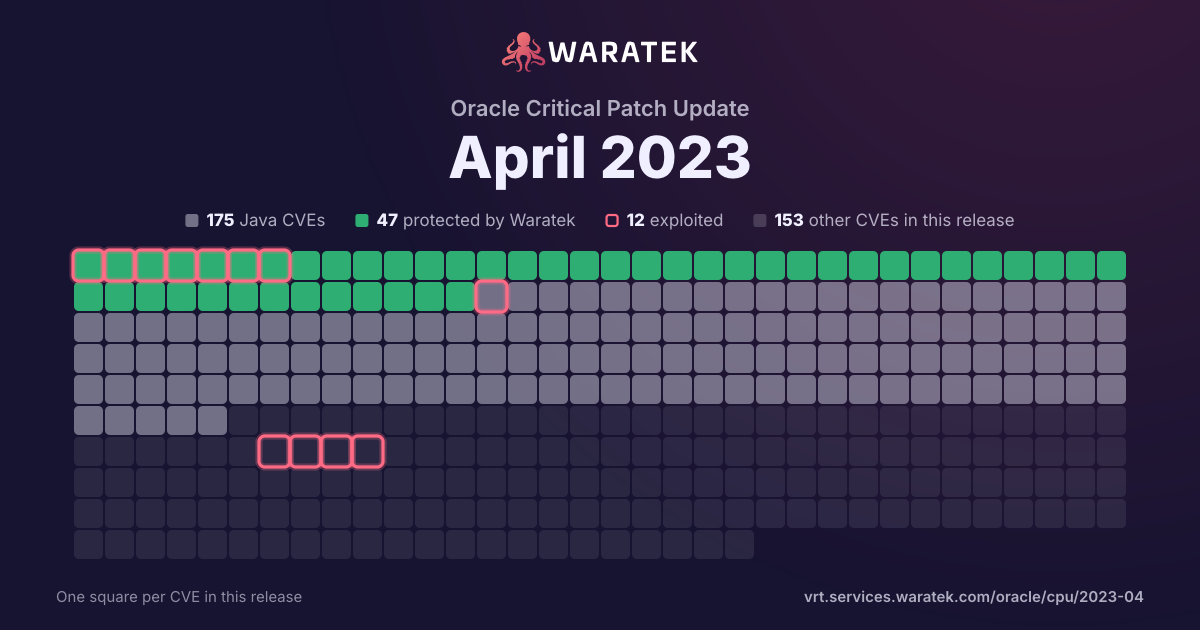
By status
47Protected by Waratek9Mitigation candidate119No exploit published35Outside Waratek scope118Not applicable
12Exploited, marked by the ring
No exploit published. For 56 of them, Oracle's security advisory is the source of public detail.
Protected by Waratek. Waratek RASP can block exploitation of these on systems that have not applied the patch yet.
Overview 4 matches · 1 in Waratek scope · 1 protected · 1 exploited · 0 CISA KEV · 1 public PoC
Protected by Waratek
1
25.0%
Rule in development
0
0.0%
Mitigation candidate
0
0.0%
No exploit published
0
0.0%
Outside Waratek scope
0
0.0%
Not applicable
3
75.0%
Withdrawn CVE
0
0.0%
blocked by ARMR today
1
25.0%
partly blocked
0
0.0%
not blocked
3
75.0%
not established
0
0.0%
unrecorded
0
0.0%
Exploited
1
25.0%
Working exploit published
0
0.0%
Proof of concept only
1
25.0%
Forecast only
2
50.0%
No public exploit
0
0.0%
split by
peak 1 / month
Dec 211
Protected by Waratek1
Medium1
blocked by ARMR today1
Exploited1
Jan 220
Feb 220
Mar 220
Apr 220
May 220
Jun 220
Jul 221
Not applicable1
Medium1
not blocked1
Forecast only1
Aug 220
Sep 220
Oct 220
Nov 220
Dec 220
Jan 231
Not applicable1
Medium1
not blocked1
Forecast only1
Feb 231
Not applicable1
Medium1
not blocked1
Proof of concept only1
Dec 21Feb 22Apr 22Jun 22Aug 22Oct 22Dec 22Feb 23
| CVE | Severity | Published▾ | Status | Exploitation | Description |
|---|---|---|---|---|---|
| CVE-2023-25136 | Medium | 2023-02-03 | Not applicable | Proof of concept only | OpenSSH server (sshd) 9.1 introduced a double-free vulnerability during options.kex_algorithms handling. This is fixed in OpenSSH 9.2. The double free can be leveraged, by an unauthenticated remote attacker in the default configuration, to jump to any location in the sshd address space. One third-party report states "remote code execution is theoretically possible." |
| CVE-2022-37436 | Medium | 2023-01-17 | Not applicable | Forecast only | Prior to Apache HTTP Server 2.4.55, a malicious backend can cause the response headers to be truncated early, resulting in some headers being incorporated into the response body. If the later headers have any security purpose, they will not be interpreted by the client. |
| CVE-2022-32215 | Medium | 2022-07-14 | Not applicable | Forecast only | The llhttp parser <v14.20.1, <v16.17.1 and <v18.9.1 in the http module in Node.js does not correctly handle multi-line Transfer-Encoding headers. This can lead to HTTP Request Smuggling (HRS). |
| CVE-2021-44832 | Medium | 2021-12-28 | Protected by Waratek | Exploited | Apache Log4j2 versions 2.0-beta7 through 2.17.0 (excluding security fix releases 2.3.2 and 2.12.4) are vulnerable to a remote code execution (RCE) attack when a configuration uses a JDBC Appender with a JNDI LDAP data source URI when an attacker has control of the target LDAP server. This issue is fixed by limiting JNDI data source names to the java protocol in Log4j2 versions 2.17.1, 2.12.4, and 2.3.2. |