
Oracle Critical Patch Update January 2023
Released January 2023 · Oracle's advisory ↗ · ← Critical Patch Update, October 2022 · Critical Patch Update, April 2023 →
183 CVEs in this release, one square each
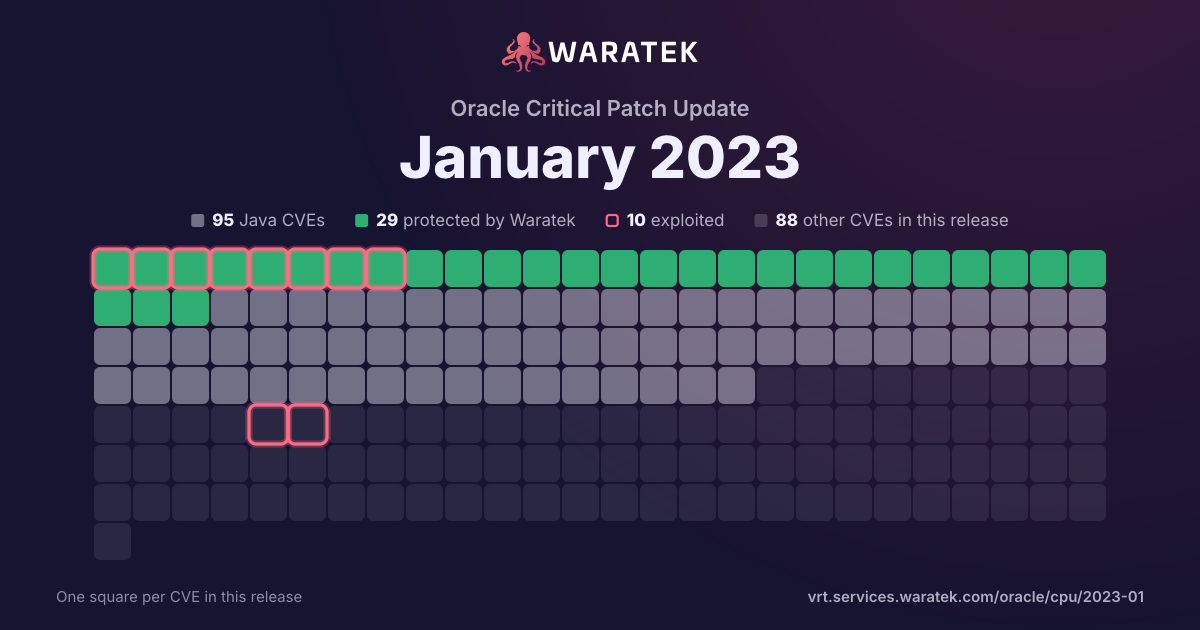
By status
29Protected by Waratek4Mitigation candidate62No exploit published13Outside Waratek scope74Not applicable1Withdrawn CVE
10Exploited, marked by the ring
No exploit published. For 39 of them, Oracle's security advisory is the source of public detail.
Protected by Waratek. Waratek RASP can block exploitation of these on systems that have not applied the patch yet.
Overview 13 matches · 0 in Waratek scope · 0 protected · 0 exploited · 0 CISA KEV · 2 public PoC · 1 EPSS ≥ 0.5
13matches
0in Waratek scope0.0%
0protected0.0%
0exploited0.0%
0CISA KEV0.0%
2public PoC15.4%
1EPSS ≥ 0.57.7%
Protected by Waratek
0
0.0%
Rule in development
0
0.0%
Mitigation candidate
0
0.0%
No exploit published
0
0.0%
Outside Waratek scope
13
100.0%
Not applicable
0
0.0%
Withdrawn CVE
0
0.0%
blocked by ARMR today
0
0.0%
partly blocked
0
0.0%
not blocked
13
100.0%
not established
0
0.0%
unrecorded
0
0.0%
Exploited
0
0.0%
Working exploit published
0
0.0%
Proof of concept only
5
38.5%
Forecast only
0
0.0%
No public exploit
8
61.5%
split by
peak 3 / quarter
Q4 201
Outside Waratek scope1
Medium1
not blocked1
No public exploit1
Q1 211
Outside Waratek scope1
Critical1
not blocked1
No public exploit1
Q2 210
Q3 210
Q4 212
Outside Waratek scope2
Medium2
not blocked2
Proof of concept only1
No public exploit1
Q1 223
Outside Waratek scope3
Critical1
High2
not blocked3
Proof of concept only2
No public exploit1
Q2 221
Outside Waratek scope1
High1
not blocked1
No public exploit1
Q3 223
Outside Waratek scope3
Critical3
not blocked3
Proof of concept only2
No public exploit1
Q4 220
Q1 232
Outside Waratek scope2
High1
Medium1
not blocked2
No public exploit2
Q4 20Q1 21Q2 21Q3 21Q4 21Q1 22Q2 22Q3 22Q4 22Q1 23
| CVE | Severity | Published▾ | Status | Exploitation | Description |
|---|---|---|---|---|---|
| CVE-2023-21893 | High | 2023-01-18 | Outside Waratek scope | No public exploit | Vulnerability in the Oracle Data Provider for .NET component of Oracle Database Server. Supported versions that are affected are 19c and 21c. Difficult to exploit vulnerability allows unauthenticated attacker with network access via TCPS to compromise Oracle Data Provider for .NET. Successful attacks require human interaction from a person other than the attacker. Successful attacks of this vulnerability can result in takeover of Oracle Data Provider for .NET. Note: Applies also to Database client-only on Windows platform. CVSS 3.1 Base Score 7.5 (Confidentiality, Integrity and Availability impacts). CVSS Vector: (CVSS:3.1/AV:N/AC:H/PR:N/UI:R/S:U/C:H/I:H/A:H). |
| CVE-2023-21835 | Medium | 2023-01-18 | Outside Waratek scope | No public exploit | Vulnerability in the Oracle Java SE, Oracle GraalVM Enterprise Edition product of Oracle Java SE (component: JSSE). Supported versions that are affected are Oracle Java SE: 11.0.17, 17.0.5, 19.0.1; Oracle GraalVM Enterprise Edition: 20.3.8, 21.3.4 and 22.3.0. Easily exploitable vulnerability allows unauthenticated attacker with network access via DTLS to compromise Oracle Java SE, Oracle GraalVM Enterprise Edition. Successful attacks of this vulnerability can result in unauthorized ability to cause a partial denial of service (partial DOS) of Oracle Java SE, Oracle GraalVM Enterprise Edition. Note: This vulnerability applies to Java deployments, typically in clients running sandboxed Java Web Start applications or sandboxed Java applets, that load and run untrusted code (e.g., code that comes from the internet) and rely on the Java sandbox for security. This vulnerability does not apply to Java deployments, typically in servers, that load and run only trusted code (e.g., code installed by an administrator). CVSS 3.1 Base Score 5.3 (Availability impacts). CVSS Vector: (CVSS:3.1/AV:N/AC:L/PR:N/UI:N/S:U/C:N/I:N/A:L). |
| CVE-2022-2526 | Critical | 2022-09-09 | Outside Waratek scope | No public exploit | A use-after-free vulnerability was found in systemd. This issue occurs due to the on_stream_io() function and dns_stream_complete() function in 'resolved-dns-stream.c' not incrementing the reference counting for the DnsStream object. Therefore, other functions and callbacks called can dereference the DNSStream object, causing the use-after-free when the reference is still used later. |
| CVE-2022-37434 | Critical | 2022-08-05 | Outside Waratek scope | Proof of concept only | zlib through 1.2.12 has a heap-based buffer over-read or buffer overflow in inflate in inflate.c via a large gzip header extra field. NOTE: only applications that call inflateGetHeader are affected. Some common applications bundle the affected zlib source code but may be unable to call inflateGetHeader (e.g., see the nodejs/node reference). |
| CVE-2022-2274 | Critical | 2022-07-01 | Outside Waratek scope | Proof of concept only | The OpenSSL 3.0.4 release introduced a serious bug in the RSA implementation for X86_64 CPUs supporting the AVX512IFMA instructions. This issue makes the RSA implementation with 2048 bit private keys incorrect on such machines and memory corruption will happen during the computation. As a consequence of the memory corruption an attacker may be able to trigger a remote code execution on the machine performing the computation. SSL/TLS servers or other servers using 2048 bit RSA private keys running on machines supporting AVX512IFMA instructions of the X86_64 architecture are affected by this issue. |
| CVE-2022-24903 | High | 2022-05-06 | Outside Waratek scope | No public exploit | Rsyslog is a rocket-fast system for log processing. Modules for TCP syslog reception have a potential heap buffer overflow when octet-counted framing is used. This can result in a segfault or some other malfunction. As of our understanding, this vulnerability can not be used for remote code execution. But there may still be a slight chance for experts to do that. The bug occurs when the octet count is read. While there is a check for the maximum number of octets, digits are written to a heap buffer even when the octet count is over the maximum, This can be used to overrun the memory buffer. However, once the sequence of digits stop, no additional characters can be added to the buffer. In our opinion, this makes remote exploits impossible or at least highly complex. Octet-counted framing is one of two potential framing modes. It is relatively uncommon, but enabled by default on receivers. Modules `imtcp`, `imptcp`, `imgssapi`, and `imhttp` are used for regular syslog message reception. It is best practice not to directly expose them to the public. When this practice is followed, the risk is considerably lower. Module `imdiag` is a diagnostics module primarily intended for testbench runs. We do not expect it to be present on any production installation. Octet-counted framing is not very common. Usually, it needs to be specifically enabled at senders. If users do not need it, they can turn it off for the most important modules. This will mitigate the vulnerability. |
| CVE-2018-25032 | High | 2022-03-25 | Outside Waratek scope | Proof of concept only | zlib before 1.2.12 allows memory corruption when deflating (i.e., when compressing) if the input has many distant matches. |
| CVE-2022-24407 | High | 2022-02-24 | Outside Waratek scope | No public exploit | In Cyrus SASL 2.1.17 through 2.1.27 before 2.1.28, plugins/sql.c does not escape the password for a SQL INSERT or UPDATE statement. |
| CVE-2022-23219 | Critical | 2022-01-14 | Outside Waratek scope | Proof of concept only | The deprecated compatibility function clnt_create in the sunrpc module of the GNU C Library (aka glibc) through 2.34 copies its hostname argument on the stack without validating its length, which may result in a buffer overflow, potentially resulting in a denial of service or (if an application is not built with a stack protector enabled) arbitrary code execution. |
| CVE-2021-43797 | Medium | 2021-12-09 | Outside Waratek scope | No public exploit | Netty is an asynchronous event-driven network application framework for rapid development of maintainable high performance protocol servers & clients. Netty prior to version 4.1.71.Final skips control chars when they are present at the beginning / end of the header name. It should instead fail fast as these are not allowed by the spec and could lead to HTTP request smuggling. Failing to do the validation might cause netty to "sanitize" header names before it forward these to another remote system when used as proxy. This remote system can't see the invalid usage anymore, and therefore does not do the validation itself. Users should upgrade to version 4.1.71.Final. |
| CVE-2021-41184 | Medium | 2021-10-26 | Outside Waratek scope | Proof of concept only | jQuery-UI is the official jQuery user interface library. Prior to version 1.13.0, accepting the value of the `of` option of the `.position()` util from untrusted sources may execute untrusted code. The issue is fixed in jQuery UI 1.13.0. Any string value passed to the `of` option is now treated as a CSS selector. A workaround is to not accept the value of the `of` option from untrusted sources. |
| CVE-2020-36242 | Critical | 2021-02-07 | Outside Waratek scope | No public exploit | In the cryptography package before 3.3.2 for Python, certain sequences of update calls to symmetrically encrypt multi-GB values could result in an integer overflow and buffer overflow, as demonstrated by the Fernet class. |
| CVE-2020-13956 | Medium | 2020-12-02 | Outside Waratek scope | No public exploit | Apache HttpClient versions prior to version 4.5.13 and 5.0.3 can misinterpret malformed authority component in request URIs passed to the library as java.net.URI object and pick the wrong target host for request execution. |