
Oracle Critical Patch Update January 2023
Released January 2023 · Oracle's advisory ↗ · ← Critical Patch Update, October 2022 · Critical Patch Update, April 2023 →
183 CVEs in this release, one square each
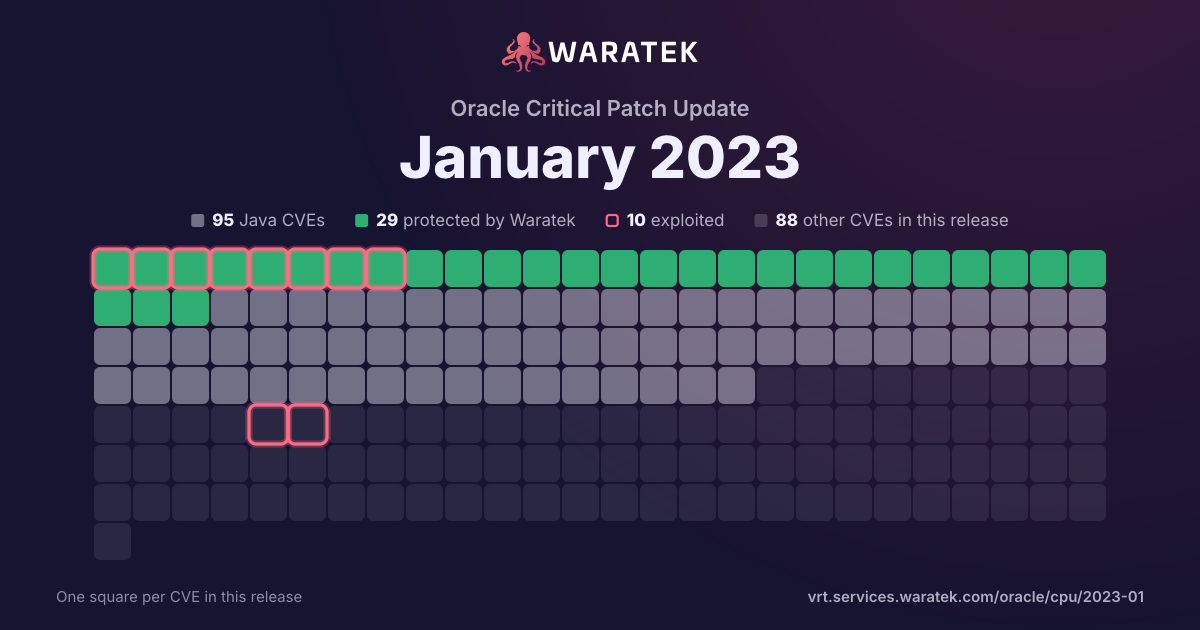
By status
29Protected by Waratek4Mitigation candidate62No exploit published13Outside Waratek scope74Not applicable1Withdrawn CVE
10Exploited, marked by the ring
No exploit published. For 39 of them, Oracle's security advisory is the source of public detail.
Protected by Waratek. Waratek RASP can block exploitation of these on systems that have not applied the patch yet.
Overview 74 matches · 0 in Waratek scope · 0 protected · 2 exploited · 1 CISA KEV · 2 public PoC · 0 EPSS ≥ 0.5
74matches
0in Waratek scope0.0%
0protected0.0%
2exploited2.7%
1CISA KEV1.4%
2public PoC2.7%
0EPSS ≥ 0.50.0%
Protected by Waratek
0
0.0%
Rule in development
0
0.0%
Mitigation candidate
0
0.0%
No exploit published
0
0.0%
Outside Waratek scope
0
0.0%
Not applicable
74
100.0%
Withdrawn CVE
0
0.0%
blocked by ARMR today
0
0.0%
partly blocked
0
0.0%
not blocked
74
100.0%
not established
0
0.0%
unrecorded
0
0.0%
Exploited
2
2.7%
Working exploit published
0
0.0%
Proof of concept only
7
9.5%
Forecast only
0
0.0%
No public exploit
65
87.8%
split by
peak 35 / quarter
Q1 191
Not applicable1
Medium1
not blocked1
No public exploit1
Q2 190
Q3 190
Q4 190
Q1 200
Q2 200
Q3 200
Q4 200
Q1 212
Not applicable2
High2
not blocked2
Proof of concept only1
No public exploit1
Q2 210
Q3 213
Not applicable3
High2
Medium1
not blocked3
No public exploit3
Q4 213
Not applicable3
Critical1
High2
not blocked3
No public exploit3
Q1 226
Not applicable6
Critical2
High3
Medium1
not blocked6
Exploited1
Proof of concept only1
No public exploit4
Q2 226
Not applicable6
Critical2
High3
Medium1
not blocked6
Proof of concept only1
No public exploit5
Q3 2210
Not applicable10
High8
Medium2
not blocked10
Proof of concept only2
No public exploit8
Q4 228
Not applicable8
Critical2
High6
not blocked8
Exploited1
Proof of concept only2
No public exploit5
Q1 2335
Not applicable35
High1
Medium30
Low4
not blocked35
No public exploit35
Q1 19Q3 19Q1 20Q3 20Q1 21Q3 21Q1 22Q3 22Q1 23
| CVE | Severity | Published▾ | Status | Exploitation | Description |
|---|---|---|---|---|---|
| CVE-2023-21900 | Medium | 2023-01-18 | Not applicable | No public exploit | Vulnerability in the Oracle Solaris product of Oracle Systems (component: NSSwitch). Supported versions that are affected are 10 and 11. Difficult to exploit vulnerability allows high privileged attacker with network access via multiple protocols to compromise Oracle Solaris. Successful attacks require human interaction from a person other than the attacker and while the vulnerability is in Oracle Solaris, attacks may significantly impact additional products (scope change). Successful attacks of this vulnerability can result in unauthorized update, insert or delete access to some of Oracle Solaris accessible data and unauthorized ability to cause a partial denial of service (partial DOS) of Oracle Solaris. CVSS 3.1 Base Score 4.0 (Integrity and Availability impacts). CVSS Vector: (CVSS:3.1/AV:N/AC:H/PR:H/UI:R/S:C/C:N/I:L/A:L). |
| CVE-2023-21899 | Medium | 2023-01-18 | Not applicable | No public exploit | Vulnerability in the Oracle VM VirtualBox product of Oracle Virtualization (component: Core). Supported versions that are affected are Prior to 6.1.42 and prior to 7.0.6. Easily exploitable vulnerability allows low privileged attacker with logon to the infrastructure where Oracle VM VirtualBox executes to compromise Oracle VM VirtualBox. Successful attacks of this vulnerability can result in unauthorized ability to cause a hang or frequently repeatable crash (complete DOS) of Oracle VM VirtualBox. Note: Applies to VirtualBox VMs running Windows 7 and later. CVSS 3.1 Base Score 5.5 (Availability impacts). CVSS Vector: (CVSS:3.1/AV:L/AC:L/PR:L/UI:N/S:U/C:N/I:N/A:H). |
| CVE-2023-21898 | Medium | 2023-01-18 | Not applicable | No public exploit | Vulnerability in the Oracle VM VirtualBox product of Oracle Virtualization (component: Core). Supported versions that are affected are Prior to 6.1.42 and prior to 7.0.6. Easily exploitable vulnerability allows low privileged attacker with logon to the infrastructure where Oracle VM VirtualBox executes to compromise Oracle VM VirtualBox. Successful attacks of this vulnerability can result in unauthorized ability to cause a hang or frequently repeatable crash (complete DOS) of Oracle VM VirtualBox. Note: Applies to VirtualBox VMs running Windows 7 and later. CVSS 3.1 Base Score 5.5 (Availability impacts). CVSS Vector: (CVSS:3.1/AV:L/AC:L/PR:L/UI:N/S:U/C:N/I:N/A:H). |
| CVE-2023-21889 | Low | 2023-01-18 | Not applicable | No public exploit | Vulnerability in the Oracle VM VirtualBox product of Oracle Virtualization (component: Core). Supported versions that are affected are Prior to 6.1.42 and prior to 7.0.6. Easily exploitable vulnerability allows low privileged attacker with logon to the infrastructure where Oracle VM VirtualBox executes to compromise Oracle VM VirtualBox. While the vulnerability is in Oracle VM VirtualBox, attacks may significantly impact additional products (scope change). Successful attacks of this vulnerability can result in unauthorized read access to a subset of Oracle VM VirtualBox accessible data. CVSS 3.1 Base Score 3.8 (Confidentiality impacts). CVSS Vector: (CVSS:3.1/AV:L/AC:L/PR:L/UI:N/S:C/C:L/I:N/A:N). |
| CVE-2023-21887 | Medium | 2023-01-18 | Not applicable | No public exploit | Vulnerability in the MySQL Server product of Oracle MySQL (component: Server: GIS). Supported versions that are affected are 8.0.31 and prior. Easily exploitable vulnerability allows high privileged attacker with network access via multiple protocols to compromise MySQL Server. Successful attacks of this vulnerability can result in unauthorized ability to cause a hang or frequently repeatable crash (complete DOS) of MySQL Server. CVSS 3.1 Base Score 4.9 (Availability impacts). CVSS Vector: (CVSS:3.1/AV:N/AC:L/PR:H/UI:N/S:U/C:N/I:N/A:H). |
| CVE-2023-21886 | High | 2023-01-18 | Not applicable | No public exploit | Vulnerability in the Oracle VM VirtualBox product of Oracle Virtualization (component: Core). Supported versions that are affected are Prior to 6.1.42 and prior to 7.0.6. Difficult to exploit vulnerability allows unauthenticated attacker with network access via multiple protocols to compromise Oracle VM VirtualBox. Successful attacks of this vulnerability can result in takeover of Oracle VM VirtualBox. CVSS 3.1 Base Score 8.1 (Confidentiality, Integrity and Availability impacts). CVSS Vector: (CVSS:3.1/AV:N/AC:H/PR:N/UI:N/S:U/C:H/I:H/A:H). |
| CVE-2023-21885 | Low | 2023-01-18 | Not applicable | No public exploit | Vulnerability in the Oracle VM VirtualBox product of Oracle Virtualization (component: Core). Supported versions that are affected are Prior to 6.1.42 and prior to 7.0.6. Easily exploitable vulnerability allows low privileged attacker with logon to the infrastructure where Oracle VM VirtualBox executes to compromise Oracle VM VirtualBox. While the vulnerability is in Oracle VM VirtualBox, attacks may significantly impact additional products (scope change). Successful attacks of this vulnerability can result in unauthorized read access to a subset of Oracle VM VirtualBox accessible data. Note: Applies to Windows only. CVSS 3.1 Base Score 3.8 (Confidentiality impacts). CVSS Vector: (CVSS:3.1/AV:L/AC:L/PR:L/UI:N/S:C/C:L/I:N/A:N). |
| CVE-2023-21884 | Medium | 2023-01-18 | Not applicable | No public exploit | Vulnerability in the Oracle VM VirtualBox product of Oracle Virtualization (component: Core). Supported versions that are affected are Prior to 6.1.42 and prior to 7.0.6. Easily exploitable vulnerability allows high privileged attacker with logon to the infrastructure where Oracle VM VirtualBox executes to compromise Oracle VM VirtualBox. Successful attacks of this vulnerability can result in unauthorized ability to cause a hang or frequently repeatable crash (complete DOS) of Oracle VM VirtualBox. CVSS 3.1 Base Score 4.4 (Availability impacts). CVSS Vector: (CVSS:3.1/AV:L/AC:L/PR:H/UI:N/S:U/C:N/I:N/A:H). |
| CVE-2023-21883 | Medium | 2023-01-18 | Not applicable | No public exploit | Vulnerability in the MySQL Server product of Oracle MySQL (component: Server: Optimizer). Supported versions that are affected are 8.0.31 and prior. Easily exploitable vulnerability allows high privileged attacker with network access via multiple protocols to compromise MySQL Server. Successful attacks of this vulnerability can result in unauthorized ability to cause a hang or frequently repeatable crash (complete DOS) of MySQL Server. CVSS 3.1 Base Score 4.9 (Availability impacts). CVSS Vector: (CVSS:3.1/AV:N/AC:L/PR:H/UI:N/S:U/C:N/I:N/A:H). |
| CVE-2023-21882 | Low | 2023-01-18 | Not applicable | No public exploit | Vulnerability in the MySQL Server product of Oracle MySQL (component: Server: Optimizer). Supported versions that are affected are 8.0.31 and prior. Easily exploitable vulnerability allows high privileged attacker with network access via multiple protocols to compromise MySQL Server. Successful attacks of this vulnerability can result in unauthorized update, insert or delete access to some of MySQL Server accessible data. CVSS 3.1 Base Score 2.7 (Integrity impacts). CVSS Vector: (CVSS:3.1/AV:N/AC:L/PR:H/UI:N/S:U/C:N/I:L/A:N). |
| CVE-2023-21881 | Medium | 2023-01-18 | Not applicable | No public exploit | Vulnerability in the MySQL Server product of Oracle MySQL (component: Server: Optimizer). Supported versions that are affected are 8.0.31 and prior. Easily exploitable vulnerability allows high privileged attacker with network access via multiple protocols to compromise MySQL Server. Successful attacks of this vulnerability can result in unauthorized ability to cause a hang or frequently repeatable crash (complete DOS) of MySQL Server. CVSS 3.1 Base Score 4.9 (Availability impacts). CVSS Vector: (CVSS:3.1/AV:N/AC:L/PR:H/UI:N/S:U/C:N/I:N/A:H). |
| CVE-2023-21880 | Medium | 2023-01-18 | Not applicable | No public exploit | Vulnerability in the MySQL Server product of Oracle MySQL (component: InnoDB). Supported versions that are affected are 8.0.31 and prior. Easily exploitable vulnerability allows high privileged attacker with network access via multiple protocols to compromise MySQL Server. Successful attacks of this vulnerability can result in unauthorized ability to cause a hang or frequently repeatable crash (complete DOS) of MySQL Server as well as unauthorized update, insert or delete access to some of MySQL Server accessible data. CVSS 3.1 Base Score 5.5 (Integrity and Availability impacts). CVSS Vector: (CVSS:3.1/AV:N/AC:L/PR:H/UI:N/S:U/C:N/I:L/A:H). |
| CVE-2023-21879 | Medium | 2023-01-18 | Not applicable | No public exploit | Vulnerability in the MySQL Server product of Oracle MySQL (component: Server: Optimizer). Supported versions that are affected are 8.0.31 and prior. Easily exploitable vulnerability allows high privileged attacker with network access via multiple protocols to compromise MySQL Server. Successful attacks of this vulnerability can result in unauthorized ability to cause a hang or frequently repeatable crash (complete DOS) of MySQL Server. CVSS 3.1 Base Score 4.9 (Availability impacts). CVSS Vector: (CVSS:3.1/AV:N/AC:L/PR:H/UI:N/S:U/C:N/I:N/A:H). |
| CVE-2023-21878 | Medium | 2023-01-18 | Not applicable | No public exploit | Vulnerability in the MySQL Server product of Oracle MySQL (component: Server: Optimizer). Supported versions that are affected are 8.0.31 and prior. Easily exploitable vulnerability allows high privileged attacker with network access via multiple protocols to compromise MySQL Server. Successful attacks of this vulnerability can result in unauthorized ability to cause a hang or frequently repeatable crash (complete DOS) of MySQL Server. CVSS 3.1 Base Score 4.9 (Availability impacts). CVSS Vector: (CVSS:3.1/AV:N/AC:L/PR:H/UI:N/S:U/C:N/I:N/A:H). |
| CVE-2023-21877 | Medium | 2023-01-18 | Not applicable | No public exploit | Vulnerability in the MySQL Server product of Oracle MySQL (component: InnoDB). Supported versions that are affected are 8.0.31 and prior. Easily exploitable vulnerability allows high privileged attacker with network access via multiple protocols to compromise MySQL Server. Successful attacks of this vulnerability can result in unauthorized ability to cause a hang or frequently repeatable crash (complete DOS) of MySQL Server as well as unauthorized update, insert or delete access to some of MySQL Server accessible data. CVSS 3.1 Base Score 5.5 (Integrity and Availability impacts). CVSS Vector: (CVSS:3.1/AV:N/AC:L/PR:H/UI:N/S:U/C:N/I:L/A:H). |
| CVE-2023-21876 | Medium | 2023-01-18 | Not applicable | No public exploit | Vulnerability in the MySQL Server product of Oracle MySQL (component: Server: Optimizer). Supported versions that are affected are 8.0.31 and prior. Easily exploitable vulnerability allows high privileged attacker with network access via multiple protocols to compromise MySQL Server. Successful attacks of this vulnerability can result in unauthorized ability to cause a hang or frequently repeatable crash (complete DOS) of MySQL Server. CVSS 3.1 Base Score 4.9 (Availability impacts). CVSS Vector: (CVSS:3.1/AV:N/AC:L/PR:H/UI:N/S:U/C:N/I:N/A:H). |
| CVE-2023-21875 | Medium | 2023-01-18 | Not applicable | No public exploit | Vulnerability in the MySQL Server product of Oracle MySQL (component: Server: Security: Encryption). Supported versions that are affected are 8.0.31 and prior. Difficult to exploit vulnerability allows high privileged attacker with network access via multiple protocols to compromise MySQL Server. Successful attacks of this vulnerability can result in unauthorized creation, deletion or modification access to critical data or all MySQL Server accessible data and unauthorized ability to cause a hang or frequently repeatable crash (complete DOS) of MySQL Server. CVSS 3.1 Base Score 5.9 (Integrity and Availability impacts). CVSS Vector: (CVSS:3.1/AV:N/AC:H/PR:H/UI:N/S:U/C:N/I:H/A:H). |
| CVE-2023-21874 | Low | 2023-01-18 | Not applicable | No public exploit | Vulnerability in the MySQL Server product of Oracle MySQL (component: Server: Thread Pooling). Supported versions that are affected are 8.0.30 and prior. Easily exploitable vulnerability allows high privileged attacker with network access via multiple protocols to compromise MySQL Server. Successful attacks of this vulnerability can result in unauthorized ability to cause a partial denial of service (partial DOS) of MySQL Server. CVSS 3.1 Base Score 2.7 (Availability impacts). CVSS Vector: (CVSS:3.1/AV:N/AC:L/PR:H/UI:N/S:U/C:N/I:N/A:L). |
| CVE-2023-21873 | Medium | 2023-01-18 | Not applicable | No public exploit | Vulnerability in the MySQL Server product of Oracle MySQL (component: Server: Optimizer). Supported versions that are affected are 8.0.31 and prior. Easily exploitable vulnerability allows high privileged attacker with network access via multiple protocols to compromise MySQL Server. Successful attacks of this vulnerability can result in unauthorized ability to cause a hang or frequently repeatable crash (complete DOS) of MySQL Server. CVSS 3.1 Base Score 4.9 (Availability impacts). CVSS Vector: (CVSS:3.1/AV:N/AC:L/PR:H/UI:N/S:U/C:N/I:N/A:H). |
| CVE-2023-21872 | Medium | 2023-01-18 | Not applicable | No public exploit | Vulnerability in the MySQL Server product of Oracle MySQL (component: Server: Optimizer). Supported versions that are affected are 8.0.29 and prior. Easily exploitable vulnerability allows high privileged attacker with network access via multiple protocols to compromise MySQL Server. Successful attacks of this vulnerability can result in unauthorized ability to cause a hang or frequently repeatable crash (complete DOS) of MySQL Server as well as unauthorized update, insert or delete access to some of MySQL Server accessible data. CVSS 3.1 Base Score 5.5 (Integrity and Availability impacts). CVSS Vector: (CVSS:3.1/AV:N/AC:L/PR:H/UI:N/S:U/C:N/I:L/A:H). |
| CVE-2023-21871 | Medium | 2023-01-18 | Not applicable | No public exploit | Vulnerability in the MySQL Server product of Oracle MySQL (component: InnoDB). Supported versions that are affected are 8.0.31 and prior. Easily exploitable vulnerability allows high privileged attacker with network access via multiple protocols to compromise MySQL Server. Successful attacks of this vulnerability can result in unauthorized ability to cause a hang or frequently repeatable crash (complete DOS) of MySQL Server. CVSS 3.1 Base Score 4.9 (Availability impacts). CVSS Vector: (CVSS:3.1/AV:N/AC:L/PR:H/UI:N/S:U/C:N/I:N/A:H). |
| CVE-2023-21870 | Medium | 2023-01-18 | Not applicable | No public exploit | Vulnerability in the MySQL Server product of Oracle MySQL (component: Server: Optimizer). Supported versions that are affected are 8.0.31 and prior. Easily exploitable vulnerability allows high privileged attacker with network access via multiple protocols to compromise MySQL Server. Successful attacks of this vulnerability can result in unauthorized ability to cause a hang or frequently repeatable crash (complete DOS) of MySQL Server. CVSS 3.1 Base Score 4.9 (Availability impacts). CVSS Vector: (CVSS:3.1/AV:N/AC:L/PR:H/UI:N/S:U/C:N/I:N/A:H). |
| CVE-2023-21869 | Medium | 2023-01-18 | Not applicable | No public exploit | Vulnerability in the MySQL Server product of Oracle MySQL (component: InnoDB). Supported versions that are affected are 8.0.31 and prior. Easily exploitable vulnerability allows high privileged attacker with network access via multiple protocols to compromise MySQL Server. Successful attacks of this vulnerability can result in unauthorized ability to cause a hang or frequently repeatable crash (complete DOS) of MySQL Server as well as unauthorized update, insert or delete access to some of MySQL Server accessible data. CVSS 3.1 Base Score 5.5 (Integrity and Availability impacts). CVSS Vector: (CVSS:3.1/AV:N/AC:L/PR:H/UI:N/S:U/C:N/I:L/A:H). |
| CVE-2023-21868 | Medium | 2023-01-18 | Not applicable | No public exploit | Vulnerability in the MySQL Server product of Oracle MySQL (component: Server: Optimizer). Supported versions that are affected are 8.0.31 and prior. Easily exploitable vulnerability allows low privileged attacker with network access via multiple protocols to compromise MySQL Server. Successful attacks of this vulnerability can result in unauthorized ability to cause a hang or frequently repeatable crash (complete DOS) of MySQL Server. CVSS 3.1 Base Score 6.5 (Availability impacts). CVSS Vector: (CVSS:3.1/AV:N/AC:L/PR:L/UI:N/S:U/C:N/I:N/A:H). |
| CVE-2023-21867 | Medium | 2023-01-18 | Not applicable | No public exploit | Vulnerability in the MySQL Server product of Oracle MySQL (component: Server: Optimizer). Supported versions that are affected are 8.0.31 and prior. Easily exploitable vulnerability allows high privileged attacker with network access via multiple protocols to compromise MySQL Server. Successful attacks of this vulnerability can result in unauthorized ability to cause a hang or frequently repeatable crash (complete DOS) of MySQL Server. CVSS 3.1 Base Score 4.9 (Availability impacts). CVSS Vector: (CVSS:3.1/AV:N/AC:L/PR:H/UI:N/S:U/C:N/I:N/A:H). |
| CVE-2023-21866 | Medium | 2023-01-18 | Not applicable | No public exploit | Vulnerability in the MySQL Server product of Oracle MySQL (component: Server: Optimizer). Supported versions that are affected are 8.0.28 and prior. Easily exploitable vulnerability allows high privileged attacker with network access via multiple protocols to compromise MySQL Server. Successful attacks of this vulnerability can result in unauthorized ability to cause a hang or frequently repeatable crash (complete DOS) of MySQL Server. CVSS 3.1 Base Score 4.9 (Availability impacts). CVSS Vector: (CVSS:3.1/AV:N/AC:L/PR:H/UI:N/S:U/C:N/I:N/A:H). |
| CVE-2023-21865 | Medium | 2023-01-18 | Not applicable | No public exploit | Vulnerability in the MySQL Server product of Oracle MySQL (component: Server: Optimizer). Supported versions that are affected are 8.0.30 and prior. Easily exploitable vulnerability allows high privileged attacker with network access via multiple protocols to compromise MySQL Server. Successful attacks of this vulnerability can result in unauthorized ability to cause a hang or frequently repeatable crash (complete DOS) of MySQL Server. CVSS 3.1 Base Score 4.9 (Availability impacts). CVSS Vector: (CVSS:3.1/AV:N/AC:L/PR:H/UI:N/S:U/C:N/I:N/A:H). |
| CVE-2023-21864 | Medium | 2023-01-18 | Not applicable | No public exploit | Vulnerability in the MySQL Server product of Oracle MySQL (component: Server: Optimizer). Supported versions that are affected are 8.0.30 and prior. Easily exploitable vulnerability allows high privileged attacker with network access via multiple protocols to compromise MySQL Server. Successful attacks of this vulnerability can result in unauthorized ability to cause a hang or frequently repeatable crash (complete DOS) of MySQL Server. CVSS 3.1 Base Score 4.9 (Availability impacts). CVSS Vector: (CVSS:3.1/AV:N/AC:L/PR:H/UI:N/S:U/C:N/I:N/A:H). |
| CVE-2023-21863 | Medium | 2023-01-18 | Not applicable | No public exploit | Vulnerability in the MySQL Server product of Oracle MySQL (component: Server: Optimizer). Supported versions that are affected are 8.0.31 and prior. Easily exploitable vulnerability allows high privileged attacker with network access via multiple protocols to compromise MySQL Server. Successful attacks of this vulnerability can result in unauthorized ability to cause a hang or frequently repeatable crash (complete DOS) of MySQL Server. CVSS 3.1 Base Score 4.9 (Availability impacts). CVSS Vector: (CVSS:3.1/AV:N/AC:L/PR:H/UI:N/S:U/C:N/I:N/A:H). |
| CVE-2023-21860 | Medium | 2023-01-18 | Not applicable | No public exploit | Vulnerability in the MySQL Cluster product of Oracle MySQL (component: Cluster: Internal Operations). Supported versions that are affected are 7.4.38 and prior, 7.5.28 and prior, 7.6.24 and prior and 8.0.31 and prior. Difficult to exploit vulnerability allows high privileged attacker with access to the physical communication segment attached to the hardware where the MySQL Cluster executes to compromise MySQL Cluster. Successful attacks require human interaction from a person other than the attacker. Successful attacks of this vulnerability can result in takeover of MySQL Cluster. CVSS 3.1 Base Score 6.3 (Confidentiality, Integrity and Availability impacts). CVSS Vector: (CVSS:3.1/AV:A/AC:H/PR:H/UI:R/S:U/C:H/I:H/A:H). |
| CVE-2023-21840 | Medium | 2023-01-18 | Not applicable | No public exploit | Vulnerability in the MySQL Server product of Oracle MySQL (component: Server: PS). Supported versions that are affected are 5.7.40 and prior. Easily exploitable vulnerability allows high privileged attacker with network access via multiple protocols to compromise MySQL Server. Successful attacks of this vulnerability can result in unauthorized ability to cause a hang or frequently repeatable crash (complete DOS) of MySQL Server. CVSS 3.1 Base Score 4.9 (Availability impacts). CVSS Vector: (CVSS:3.1/AV:N/AC:L/PR:H/UI:N/S:U/C:N/I:N/A:H). |
| CVE-2023-21836 | Medium | 2023-01-18 | Not applicable | No public exploit | Vulnerability in the MySQL Server product of Oracle MySQL (component: Server: DML). Supported versions that are affected are 8.0.31 and prior. Easily exploitable vulnerability allows high privileged attacker with network access via multiple protocols to compromise MySQL Server. Successful attacks of this vulnerability can result in unauthorized ability to cause a hang or frequently repeatable crash (complete DOS) of MySQL Server. CVSS 3.1 Base Score 4.9 (Availability impacts). CVSS Vector: (CVSS:3.1/AV:N/AC:L/PR:H/UI:N/S:U/C:N/I:N/A:H). |
| CVE-2023-21829 | Medium | 2023-01-18 | Not applicable | No public exploit | Vulnerability in the Oracle Database RDBMS Security component of Oracle Database Server. Supported versions that are affected are 19c and 21c. Easily exploitable vulnerability allows low privileged attacker having Create Session privilege with network access via Oracle Net to compromise Oracle Database RDBMS Security. Successful attacks require human interaction from a person other than the attacker. Successful attacks of this vulnerability can result in unauthorized creation, deletion or modification access to critical data or all Oracle Database RDBMS Security accessible data as well as unauthorized read access to a subset of Oracle Database RDBMS Security accessible data. CVSS 3.1 Base Score 6.3 (Confidentiality and Integrity impacts). CVSS Vector: (CVSS:3.1/AV:N/AC:L/PR:L/UI:R/S:U/C:L/I:H/A:N). |
| CVE-2023-21827 | Medium | 2023-01-18 | Not applicable | No public exploit | Vulnerability in the Oracle Database Data Redaction component of Oracle Database Server. Supported versions that are affected are 19c and 21c. Easily exploitable vulnerability allows low privileged attacker having Create Session privilege with network access via Oracle Net to compromise Oracle Database Data Redaction. Successful attacks of this vulnerability can result in unauthorized read access to a subset of Oracle Database Data Redaction accessible data. CVSS 3.1 Base Score 4.3 (Confidentiality impacts). CVSS Vector: (CVSS:3.1/AV:N/AC:L/PR:L/UI:N/S:U/C:L/I:N/A:N). |
| CVE-2022-39429 | Medium | 2023-01-18 | Not applicable | No public exploit | Vulnerability in the Java VM component of Oracle Database Server. Supported versions that are affected are 19c and 21c. Easily exploitable vulnerability allows low privileged attacker having Create Procedure privilege with network access via Oracle Net to compromise Java VM. Successful attacks of this vulnerability can result in unauthorized ability to cause a partial denial of service (partial DOS) of Java VM. CVSS 3.1 Base Score 4.3 (Availability impacts). CVSS Vector: (CVSS:3.1/AV:N/AC:L/PR:L/UI:N/S:U/C:N/I:N/A:L). |
| CVE-2022-41720 | High | 2022-12-07 | Not applicable | No public exploit | On Windows, restricted files can be accessed via os.DirFS and http.Dir. The os.DirFS function and http.Dir type provide access to a tree of files rooted at a given directory. These functions permit access to Windows device files under that root. For example, os.DirFS("C:/tmp").Open("COM1") opens the COM1 device. Both os.DirFS and http.Dir only provide read-only filesystem access. In addition, on Windows, an os.DirFS for the directory (the root of the current drive) can permit a maliciously crafted path to escape from the drive and access any path on the system. With fix applied, the behavior of os.DirFS("") has changed. Previously, an empty root was treated equivalently to "/", so os.DirFS("").Open("tmp") would open the path "/tmp". This now returns an error. |
| CVE-2022-43548 | High | 2022-12-05 | Not applicable | No public exploit | A OS Command Injection vulnerability exists in Node.js versions <14.21.1, <16.18.1, <18.12.1, <19.0.1 due to an insufficient IsAllowedHost check that can easily be bypassed because IsIPAddress does not properly check if an IP address is invalid before making DBS requests allowing rebinding attacks.The fix for this issue in https://cve.mitre.org/cgi-bin/cvename.cgi?name=CVE-2022-32212 was incomplete and this new CVE is to complete the fix. |
| CVE-2022-32221 | Critical | 2022-12-05 | Not applicable | Proof of concept only | When doing HTTP(S) transfers, libcurl might erroneously use the read callback (`CURLOPT_READFUNCTION`) to ask for data to send, even when the `CURLOPT_POSTFIELDS` option has been set, if the same handle previously was used to issue a `PUT` request which used that callback. This flaw may surprise the application and cause it to misbehave and either send off the wrong data or use memory after free or similar in the subsequent `POST` request. The problem exists in the logic for a reused handle when it is changed from a PUT to a POST. |
| CVE-2022-40304 | High | 2022-11-23 | Not applicable | Exploited | An issue was discovered in libxml2 before 2.10.3. Certain invalid XML entity definitions can corrupt a hash table key, potentially leading to subsequent logic errors. In one case, a double-free can be provoked. |
| CVE-2022-42915 | High | 2022-10-29 | Not applicable | No public exploit | curl before 7.86.0 has a double free. If curl is told to use an HTTP proxy for a transfer with a non-HTTP(S) URL, it sets up the connection to the remote server by issuing a CONNECT request to the proxy, and then tunnels the rest of the protocol through. An HTTP proxy might refuse this request (HTTP proxies often only allow outgoing connections to specific port numbers, like 443 for HTTPS) and instead return a non-200 status code to the client. Due to flaws in the error/cleanup handling, this could trigger a double free in curl if one of the following schemes were used in the URL for the transfer: dict, gopher, gophers, ldap, ldaps, rtmp, rtmps, or telnet. The earliest affected version is 7.77.0. |
| CVE-2022-43680 | High | 2022-10-24 | Not applicable | No public exploit | In libexpat through 2.4.9, there is a use-after free caused by overeager destruction of a shared DTD in XML_ExternalEntityParserCreate in out-of-memory situations. |
| CVE-2022-37454 | Critical | 2022-10-21 | Not applicable | Proof of concept only | The Keccak XKCP SHA-3 reference implementation before fdc6fef has an integer overflow and resultant buffer overflow that allows attackers to execute arbitrary code or eliminate expected cryptographic properties. This occurs in the sponge function interface. |
| CVE-2022-39271 | High | 2022-10-11 | Not applicable | No public exploit | Traefik (pronounced traffic) is a modern HTTP reverse proxy and load balancer that assists in deploying microservices. There is a potential vulnerability in Traefik managing HTTP/2 connections. A closing HTTP/2 server connection could hang forever because of a subsequent fatal error. This failure mode could be exploited to cause a denial of service. There has been a patch released in versions 2.8.8 and 2.9.0-rc5. There are currently no known workarounds. |
| CVE-2022-31629 | Medium | 2022-09-28 | Not applicable | No public exploit | In PHP versions before 7.4.31, 8.0.24 and 8.1.11, the vulnerability enables network and same-site attackers to set a standard insecure cookie in the victim's browser which is treated as a `__Host-` or `__Secure-` cookie by PHP applications. |
| CVE-2022-1941 | High | 2022-09-22 | Not applicable | No public exploit | A parsing vulnerability for the MessageSet type in the ProtocolBuffers versions prior to and including 3.16.1, 3.17.3, 3.18.2, 3.19.4, 3.20.1 and 3.21.5 for protobuf-cpp, and versions prior to and including 3.16.1, 3.17.3, 3.18.2, 3.19.4, 3.20.1 and 4.21.5 for protobuf-python can lead to out of memory failures. A specially crafted message with multiple key-value per elements creates parsing issues, and can lead to a Denial of Service against services receiving unsanitized input. We recommend upgrading to versions 3.18.3, 3.19.5, 3.20.2, 3.21.6 for protobuf-cpp and 3.18.3, 3.19.5, 3.20.2, 4.21.6 for protobuf-python. Versions for 3.16 and 3.17 are no longer updated. |
| CVE-2020-10735 | High | 2022-09-09 | Not applicable | No public exploit | A flaw was found in python. In algorithms with quadratic time complexity using non-binary bases, when using int("text"), a system could take 50ms to parse an int string with 100,000 digits and 5s for 1,000,000 digits (float, decimal, int.from_bytes(), and int() for binary bases 2, 4, 8, 16, and 32 are not affected). The highest threat from this vulnerability is to system availability. |
| CVE-2022-36055 | Medium | 2022-09-01 | Not applicable | No public exploit | Helm is a tool for managing Charts. Charts are packages of pre-configured Kubernetes resources. Fuzz testing, provided by the CNCF, identified input to functions in the _strvals_ package that can cause an out of memory panic. The _strvals_ package contains a parser that turns strings in to Go structures. The _strvals_ package converts these strings into structures Go can work with. Some string inputs can cause array data structures to be created causing an out of memory panic. Applications that use the _strvals_ package in the Helm SDK to parse user supplied input can suffer a Denial of Service when that input causes a panic that cannot be recovered from. The Helm Client will panic with input to `--set`, `--set-string`, and other value setting flags that causes an out of memory panic. Helm is not a long running service so the panic will not affect future uses of the Helm client. This issue has been resolved in 3.9.4. SDK users can validate strings supplied by users won't create large arrays causing significant memory usage before passing them to the _strvals_ functions. |
| CVE-2022-3028 | High | 2022-08-31 | Not applicable | No public exploit | A race condition was found in the Linux kernel's IP framework for transforming packets (XFRM subsystem) when multiple calls to xfrm_probe_algs occurred simultaneously. This flaw could allow a local attacker to potentially trigger an out-of-bounds write or leak kernel heap memory by performing an out-of-bounds read and copying it into a socket. |
| CVE-2022-0934 | High | 2022-08-29 | Not applicable | No public exploit | A single-byte, non-arbitrary write/use-after-free flaw was found in dnsmasq. This flaw allows an attacker who sends a crafted packet processed by dnsmasq, potentially causing a denial of service. |
| CVE-2022-35737 | High | 2022-08-03 | Not applicable | Proof of concept only | SQLite 1.0.12 through 3.39.x before 3.39.2 sometimes allows an array-bounds overflow if billions of bytes are used in a string argument to a C API. |
| CVE-2022-2509 | High | 2022-08-01 | Not applicable | No public exploit | A vulnerability found in gnutls. This security flaw happens because of a double free error occurs during verification of pkcs7 signatures in gnutls_pkcs7_verify function. |
| CVE-2022-32212 | High | 2022-07-14 | Not applicable | No public exploit | A OS Command Injection vulnerability exists in Node.js versions <14.20.0, <16.20.0, <18.5.0 due to an insufficient IsAllowedHost check that can easily be bypassed because IsIPAddress does not properly check if an IP address is invalid before making DBS requests allowing rebinding attacks. |
| CVE-2022-31129 | High | 2022-07-06 | Not applicable | Proof of concept only | moment is a JavaScript date library for parsing, validating, manipulating, and formatting dates. Affected versions of moment were found to use an inefficient parsing algorithm. Specifically using string-to-date parsing in moment (more specifically rfc2822 parsing, which is tried by default) has quadratic (N^2) complexity on specific inputs. Users may notice a noticeable slowdown is observed with inputs above 10k characters. Users who pass user-provided strings without sanity length checks to moment constructor are vulnerable to (Re)DoS attacks. The problem is patched in 2.29.4, the patch can be applied to all affected versions with minimal tweaking. Users are advised to upgrade. Users unable to upgrade should consider limiting date lengths accepted from user input. |
| CVE-2022-31813 | Critical | 2022-06-09 | Not applicable | No public exploit | Apache HTTP Server 2.4.53 and earlier may not send the X-Forwarded-* headers to the origin server based on client side Connection header hop-by-hop mechanism. This may be used to bypass IP based authentication on the origin server/application. |
| CVE-2022-27782 | High | 2022-06-02 | Not applicable | Proof of concept only | libcurl would reuse a previously created connection even when a TLS or SSHrelated option had been changed that should have prohibited reuse.libcurl keeps previously used connections in a connection pool for subsequenttransfers to reuse if one of them matches the setup. However, several TLS andSSH settings were left out from the configuration match checks, making themmatch too easily. |
| CVE-2022-30293 | High | 2022-05-06 | Not applicable | No public exploit | In WebKitGTK through 2.36.0 (and WPE WebKit), there is a heap-based buffer overflow in WebCore::TextureMapperLayer::setContentsLayer in WebCore/platform/graphics/texmap/TextureMapperLayer.cpp. |
| CVE-2022-29824 | Medium | 2022-05-03 | Not applicable | No public exploit | In libxml2 before 2.9.14, several buffer handling functions in buf.c (xmlBuf*) and tree.c (xmlBuffer*) don't check for integer overflows. This can result in out-of-bounds memory writes. Exploitation requires a victim to open a crafted, multi-gigabyte XML file. Other software using libxml2's buffer functions, for example libxslt through 1.1.35, is affected as well. |
| CVE-2022-27404 | Critical | 2022-04-22 | Not applicable | No public exploit | FreeType commit 1e2eb65048f75c64b68708efed6ce904c31f3b2f was discovered to contain a heap buffer overflow via the function sfnt_init_face. |
| CVE-2022-1304 | High | 2022-04-14 | Not applicable | No public exploit | An out-of-bounds read/write vulnerability was found in e2fsprogs 1.46.5. This issue leads to a segmentation fault and possibly arbitrary code execution via a specially crafted filesystem. |
| CVE-2022-1122 | Medium | 2022-03-29 | Not applicable | No public exploit | A flaw was found in the opj2_decompress program in openjpeg2 2.4.0 in the way it handles an input directory with a large number of files. When it fails to allocate a buffer to store the filenames of the input directory, it calls free() on an uninitialized pointer, leading to a segmentation fault and a denial of service. |
| CVE-2021-3737 | High | 2022-03-04 | Not applicable | No public exploit | A flaw was found in python. An improperly handled HTTP response in the HTTP client code of python may allow a remote attacker, who controls the HTTP server, to make the client script enter an infinite loop, consuming CPU time. The highest threat from this vulnerability is to system availability. |
| CVE-2022-0492 | High | 2022-03-03 | Not applicable | Exploited | A vulnerability was found in the Linux kernel’s cgroup_release_agent_write in the kernel/cgroup/cgroup-v1.c function. This flaw, under certain circumstances, allows the use of the cgroups v1 release_agent feature to escalate privileges and bypass the namespace isolation unexpectedly. |
| CVE-2022-21824 | High | 2022-02-24 | Not applicable | No public exploit | Due to the formatting logic of the "console.table()" function it was not safe to allow user controlled input to be passed to the "properties" parameter while simultaneously passing a plain object with at least one property as the first parameter, which could be "__proto__". The prototype pollution has very limited control, in that it only allows an empty string to be assigned to numerical keys of the object prototype.Node.js >= 12.22.9, >= 14.18.3, >= 16.13.2, and >= 17.3.1 use a null protoype for the object these properties are being assigned to. |
| CVE-2022-25315 | Critical | 2022-02-18 | Not applicable | Proof of concept only | In Expat (aka libexpat) before 2.4.5, there is an integer overflow in storeRawNames. |
| CVE-2022-25236 | Critical | 2022-02-16 | Not applicable | No public exploit | xmlparse.c in Expat (aka libexpat) before 2.4.5 allows attackers to insert namespace-separator characters into namespace URIs. |
| CVE-2020-16156 | High | 2021-12-13 | Not applicable | No public exploit | CPAN 2.28 allows Signature Verification Bypass. |
| CVE-2021-42717 | High | 2021-12-07 | Not applicable | No public exploit | ModSecurity 3.x through 3.0.5 mishandles excessively nested JSON objects. Crafted JSON objects with nesting tens-of-thousands deep could result in the web server being unable to service legitimate requests. Even a moderately large (e.g., 300KB) HTTP request can occupy one of the limited NGINX worker processes for minutes and consume almost all of the available CPU on the machine. Modsecurity 2 is similarly vulnerable: the affected versions include 2.8.0 through 2.9.4. |
| CVE-2021-3918 | Critical | 2021-11-13 | Not applicable | No public exploit | json-schema is vulnerable to Improperly Controlled Modification of Object Prototype Attributes ('Prototype Pollution') |
| CVE-2021-40528 | Medium | 2021-09-06 | Not applicable | No public exploit | The ElGamal implementation in Libgcrypt before 1.9.4 allows plaintext recovery because, during interaction between two cryptographic libraries, a certain dangerous combination of the prime defined by the receiver's public key, the generator defined by the receiver's public key, and the sender's ephemeral exponents can lead to a cross-configuration attack against OpenPGP. |
| CVE-2021-36770 | High | 2021-08-11 | Not applicable | No public exploit | Encode.pm, as distributed in Perl through 5.34.0, allows local users to gain privileges via a Trojan horse Encode::ConfigLocal library (in the current working directory) that preempts dynamic module loading. Exploitation requires an unusual configuration, and certain 2021 versions of Encode.pm (3.05 through 3.11). This issue occurs because the || operator evaluates @INC in a scalar context, and thus @INC has only an integer value. |
| CVE-2021-36483 | High | 2021-08-04 | Not applicable | No public exploit | DevExpress.XtraReports.UI through v21.1 allows attackers to execute arbitrary code via insecure deserialization. |
| CVE-2021-23358 | High | 2021-03-29 | Not applicable | Proof of concept only | The package underscore from 1.13.0-0 and before 1.13.0-2, from 1.3.2 and before 1.12.1 are vulnerable to Arbitrary Code Injection via the template function, particularly when a variable property is passed as an argument as it is not sanitized. |
| CVE-2020-27844 | High | 2021-01-05 | Not applicable | No public exploit | A flaw was found in openjpeg's src/lib/openjp2/t2.c in versions prior to 2.4.0. This flaw allows an attacker to provide crafted input to openjpeg during conversion and encoding, causing an out-of-bounds write. The highest threat from this vulnerability is to confidentiality, integrity, as well as system availability. |
| CVE-2019-7317 | Medium | 2019-02-04 | Not applicable | No public exploit | png_image_free in png.c in libpng 1.6.x before 1.6.37 has a use-after-free because png_image_free_function is called under png_safe_execute. |