
WaratekVRT Sign in

Oracle Critical Patch Update January 2023

Released January 2023 · Oracle's advisory ↗ · ← Critical Patch Update, October 2022 · Critical Patch Update, April 2023 →

183 CVEs in this release, one square each
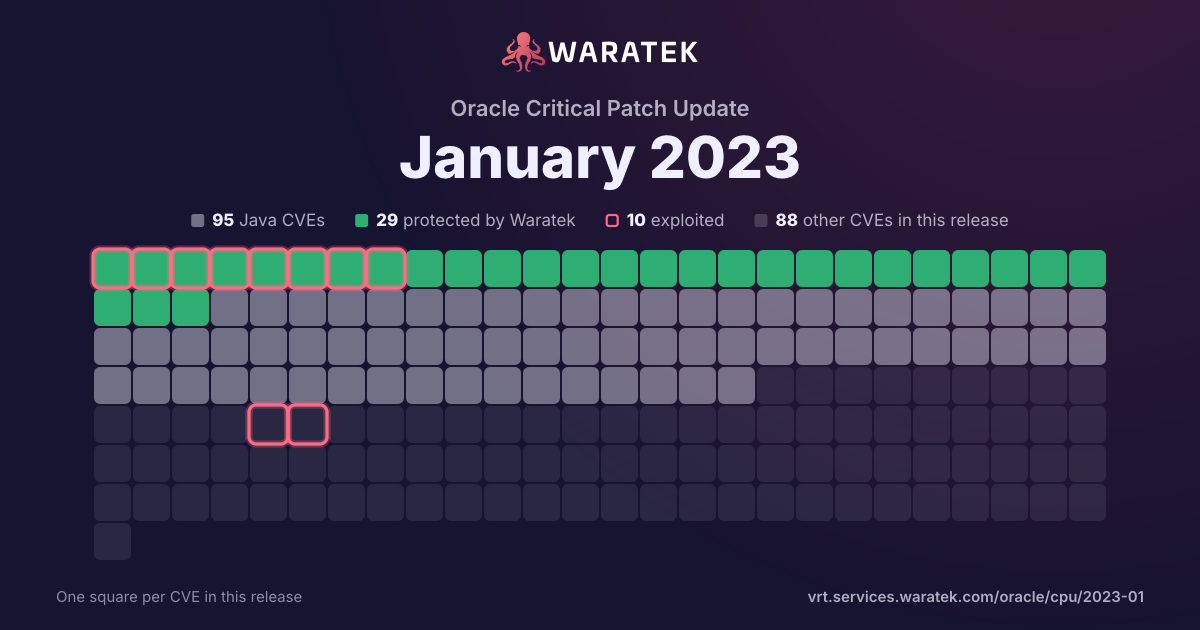
Protected by Waratek, exploitedProtected by Waratek, exploitedProtected by Waratek, exploitedProtected by Waratek, exploitedProtected by Waratek, exploitedProtected by Waratek, exploitedProtected by Waratek, exploitedProtected by WaratekProtected by WaratekProtected by WaratekProtected by WaratekProtected by WaratekProtected by WaratekProtected by WaratekProtected by WaratekProtected by WaratekProtected by WaratekProtected by WaratekProtected by WaratekProtected by WaratekProtected by WaratekProtected by WaratekProtected by WaratekProtected by WaratekProtected by WaratekProtected by WaratekProtected by WaratekMitigation candidate, exploitedMitigation candidateMitigation candidateMitigation candidateMitigation candidateMitigation candidateMitigation candidateNo exploit publishedNo exploit publishedNo exploit publishedNo exploit publishedNo exploit publishedNo exploit publishedNo exploit publishedNo exploit publishedNo exploit publishedNo exploit publishedNo exploit publishedNo exploit publishedNo exploit publishedNo exploit publishedNo exploit publishedNo exploit publishedNo exploit publishedNo exploit publishedNo exploit publishedNo exploit publishedNo exploit publishedNo exploit publishedNo exploit publishedNo exploit publishedNo exploit publishedNo exploit publishedNo exploit publishedNo exploit publishedNo exploit publishedNo exploit publishedNo exploit publishedNo exploit publishedNo exploit publishedNo exploit publishedNo exploit publishedNo exploit publishedNo exploit publishedNo exploit publishedNo exploit publishedNo exploit publishedNo exploit publishedNo exploit publishedNo exploit publishedNo exploit publishedNo exploit publishedNo exploit publishedNo exploit publishedNo exploit publishedNo exploit publishedNo exploit publishedNo exploit publishedNo exploit publishedNo exploit publishedNo exploit publishedNo exploit publishedNo exploit publishedNo exploit publishedNo exploit publishedNo exploit publishedNo exploit publishedNo exploit publishedNo exploit publishedNo exploit publishedNo exploit publishedNo exploit publishedNo exploit publishedOutside Waratek scopeOutside Waratek scopeOutside Waratek scopeNot applicable, exploitedNot applicableNot applicableNot applicableNot applicableNot applicableNot applicableNot applicableNot applicableNot applicableNot applicableNot applicableNot applicableNot applicableNot applicableNot applicableNot applicableNot applicableNot applicableNot applicableNot applicableNot applicableNot applicableNot applicableNot applicableNot applicableNot applicableNot applicableNot applicableNot applicableNot applicableNot applicableNot applicableNot applicableNot applicableNot applicableNot applicableNot applicableNot applicableNot applicableNot applicableNot applicableNot applicableNot applicableNot applicableNot applicableNot applicableNot applicableNot applicableNot applicableNot applicableNot applicableNot applicableNot applicableNot applicableNot applicableNot applicableNot applicableNot applicableNot applicableNot applicableNot applicableNot applicableNot applicableNot applicableNot applicableNot applicableNot applicableNot applicableNot applicableNot applicableNot applicableNot applicableNot applicableNot applicableNot applicableNot applicableNot applicableNot applicableWithdrawn CVE
Share this chart Oracle Critical Patch Update January 2023, one square per CVE: 100 Java CVEs, 27 protected by Waratek, 9 exploited, 83 other CVEs in this release.

Download the image

By status

No exploit published. For 35 of them, Oracle's security advisory is the source of public detail.

Protected by Waratek. Waratek RASP can block exploitation of these on systems that have not applied the patch yet.

Reset
More filters (1)
Columns
Including CVEs outside Waratek scope✕Published to 2022-10-31✕
Overview 2 matches · 0 in Waratek scope · 0 protected · 0 exploited · 0 CISA KEV · 0 public PoC · 0 EPSS ≥ 0.5
2matches 0in Waratek scope0.0% 0protected0.0% 0exploited0.0% 0CISA KEV0.0% 0public PoC0.0% 0EPSS ≥ 0.50.0%
Protected by Waratek 0 0.0% Rule in development 0 0.0% Mitigation candidate 0 0.0% No exploit published 0 0.0% Outside Waratek scope 2 100.0% Not applicable 0 0.0% Withdrawn CVE 0 0.0%
Critical 1 50.0% High 1 50.0% Medium 0 0.0% Low 0 0.0% None 0 0.0% Unknown 0 0.0%
blocked by ARMR today 0 0.0% partly blocked 0 0.0% not blocked 2 100.0% not established 0 0.0% unrecorded 0 0.0%
Exploited 0 0.0% Working exploit published 0 0.0% Proof of concept only 0 0.0% Forecast only 0 0.0% No public exploit 2 100.0%
split by peak 1 / month
May 22Jun 22Jul 22Aug 22Sep 22
2 matches Sign in to download these CVEs as CSV or JSON, or to follow them in a feed.
CVE Severity Published▾ Status Exploitation Description
CVE-2022-2526 Critical 2022-09-09 Outside Waratek scope No public exploit A use-after-free vulnerability was found in systemd. This issue occurs due to the on_stream_io() function and dns_stream_complete() function in 'resolved-dns-stream.c' not incrementing the reference counting for the DnsStream object. Therefore, other functions and callbacks called can dereference the DNSStream object, causing the use-after-free when the reference is still used later.
CVE-2022-24903 High 2022-05-06 Outside Waratek scope No public exploit Rsyslog is a rocket-fast system for log processing. Modules for TCP syslog reception have a potential heap buffer overflow when octet-counted framing is used. This can result in a segfault or some other malfunction. As of our understanding, this vulnerability can not be used for remote code execution. But there may still be a slight chance for experts to do that. The bug occurs when the octet count is read. While there is a check for the maximum number of octets, digits are written to a heap buffer even when the octet count is over the maximum, This can be used to overrun the memory buffer. However, once the sequence of digits stop, no additional characters can be added to the buffer. In our opinion, this makes remote exploits impossible or at least highly complex. Octet-counted framing is one of two potential framing modes. It is relatively uncommon, but enabled by default on receivers. Modules `imtcp`, `imptcp`, `imgssapi`, and `imhttp` are used for regular syslog message reception. It is best practice not to directly expose them to the public. When this practice is followed, the risk is considerably lower. Module `imdiag` is a diagnostics module primarily intended for testbench runs. We do not expect it to be present on any production installation. Octet-counted framing is not very common. Usually, it needs to be specifically enabled at senders. If users do not need it, they can turn it off for the most important modules. This will mitigate the vulnerability.