
Oracle Critical Patch Update January 2023
Released January 2023 · Oracle's advisory ↗ · ← Critical Patch Update, October 2022 · Critical Patch Update, April 2023 →
183 CVEs in this release, one square each
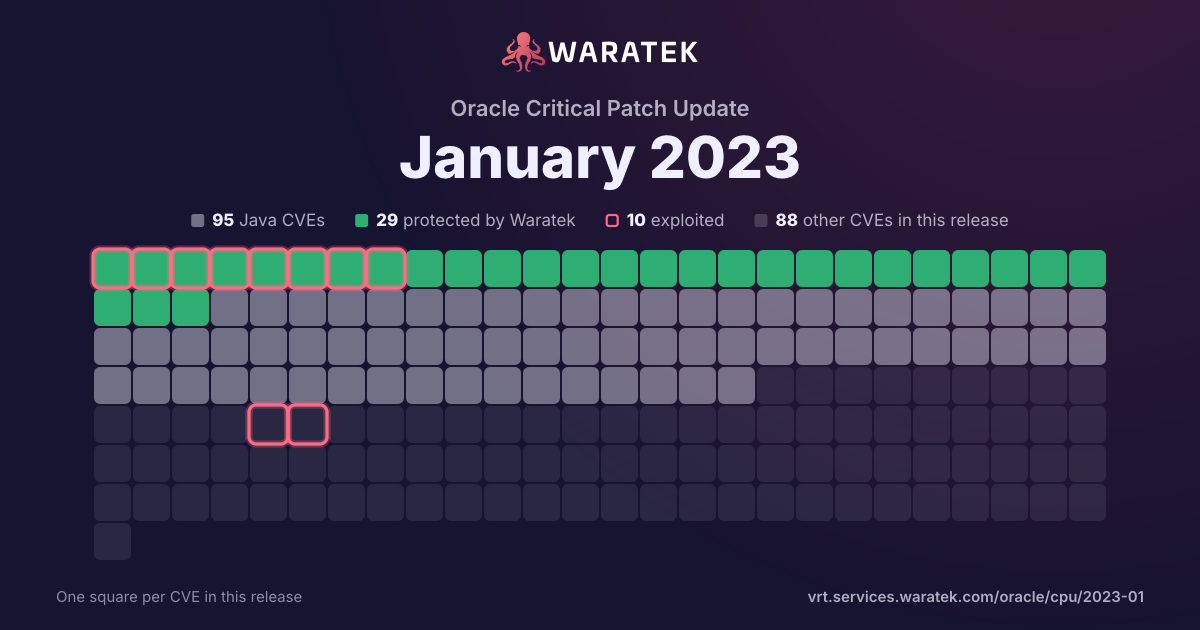
By status
29Protected by Waratek4Mitigation candidate62No exploit published13Outside Waratek scope74Not applicable1Withdrawn CVE
10Exploited, marked by the ring
No exploit published. For 39 of them, Oracle's security advisory is the source of public detail.
Protected by Waratek. Waratek RASP can block exploitation of these on systems that have not applied the patch yet.
Overview 10 matches · 8 in Waratek scope · 8 protected · 4 CISA KEV · 8 public PoC · 7 EPSS ≥ 0.5
Protected by Waratek
8
80.0%
Rule in development
0
0.0%
Mitigation candidate
0
0.0%
No exploit published
0
0.0%
Outside Waratek scope
0
0.0%
Not applicable
2
20.0%
Withdrawn CVE
0
0.0%
blocked by ARMR today
8
80.0%
partly blocked
0
0.0%
not blocked
2
20.0%
not established
0
0.0%
unrecorded
0
0.0%
Exploited
10
100.0%
Working exploit published
0
0.0%
Proof of concept only
0
0.0%
Forecast only
0
0.0%
No public exploit
0
0.0%
split by
peak 3 / quarter
Q2 181
Protected by Waratek1
Critical1
blocked by ARMR today1
Exploited1
Q3 180
Q4 180
Q1 190
Q2 190
Q3 190
Q4 190
Q1 200
Q2 200
Q3 200
Q4 200
Q1 210
Q2 210
Q3 210
Q4 212
Protected by Waratek2
Medium2
blocked by ARMR today2
Exploited2
Q1 221
Not applicable1
High1
not blocked1
Exploited1
Q2 223
Protected by Waratek3
Critical2
Medium1
blocked by ARMR today3
Exploited3
Q3 220
Q4 222
Protected by Waratek1
Not applicable1
Critical1
High1
blocked by ARMR today1
not blocked1
Exploited2
Q1 231
Protected by Waratek1
High1
blocked by ARMR today1
Exploited1
Q3 18Q1 19Q3 19Q1 20Q3 20Q1 21Q3 21Q1 22Q3 22Q1 23
| CVE | Severity | Published▾ | Status | Exploitation | Description |
|---|---|---|---|---|---|
| CVE-2023-21839 | High | 2023-01-18 | Protected by Waratek | Exploited | Vulnerability in the Oracle WebLogic Server product of Oracle Fusion Middleware (component: Core). Supported versions that are affected are 12.2.1.3.0, 12.2.1.4.0 and 14.1.1.0.0. Easily exploitable vulnerability allows unauthenticated attacker with network access via T3, IIOP to compromise Oracle WebLogic Server. Successful attacks of this vulnerability can result in unauthorized access to critical data or complete access to all Oracle WebLogic Server accessible data. CVSS 3.1 Base Score 7.5 (Confidentiality impacts). CVSS Vector: (CVSS:3.1/AV:N/AC:L/PR:N/UI:N/S:U/C:H/I:N/A:N). |
| CVE-2022-40304 | High | 2022-11-23 | Not applicable | Exploited | An issue was discovered in libxml2 before 2.10.3. Certain invalid XML entity definitions can corrupt a hash table key, potentially leading to subsequent logic errors. In one case, a double-free can be provoked. |
| CVE-2022-42889 | Critical | 2022-10-13 | Protected by Waratek | Exploited | Apache Commons Text performs variable interpolation, allowing properties to be dynamically evaluated and expanded. The standard format for interpolation is "${prefix:name}", where "prefix" is used to locate an instance of org.apache.commons.text.lookup.StringLookup that performs the interpolation. Starting with version 1.5 and continuing through 1.9, the set of default Lookup instances included interpolators that could result in arbitrary code execution or contact with remote servers. These lookups are: - "script" - execute expressions using the JVM script execution engine (javax.script) - "dns" - resolve dns records - "url" - load values from urls, including from remote servers Applications using the interpolation defaults in the affected versions may be vulnerable to remote code execution or unintentional contact with remote servers if untrusted configuration values are used. Users are recommended to upgrade to Apache Commons Text 1.10.0, which disables the problematic interpolators by default. |
| CVE-2022-34305 | Medium | 2022-06-23 | Protected by Waratek | Exploited | In Apache Tomcat 10.1.0-M1 to 10.1.0-M16, 10.0.0-M1 to 10.0.22, 9.0.30 to 9.0.64 and 8.5.50 to 8.5.81 the Form authentication example in the examples web application displayed user provided data without filtering, exposing a XSS vulnerability. |
| CVE-2021-31805 | Critical | 2022-04-12 | Protected by Waratek | Exploited | The fix issued for CVE-2020-17530 was incomplete. So from Apache Struts 2.0.0 to 2.5.29, still some of the tag’s attributes could perform a double evaluation if a developer applied forced OGNL evaluation by using the %{...} syntax. Using forced OGNL evaluation on untrusted user input can lead to a Remote Code Execution and security degradation. |
| CVE-2022-22965 | Critical | 2022-04-01 | Protected by Waratek | Exploited | A Spring MVC or Spring WebFlux application running on JDK 9+ may be vulnerable to remote code execution (RCE) via data binding. The specific exploit requires the application to run on Tomcat as a WAR deployment. If the application is deployed as a Spring Boot executable jar, i.e. the default, it is not vulnerable to the exploit. However, the nature of the vulnerability is more general, and there may be other ways to exploit it. |
| CVE-2022-0492 | High | 2022-03-03 | Not applicable | Exploited | A vulnerability was found in the Linux kernel’s cgroup_release_agent_write in the kernel/cgroup/cgroup-v1.c function. This flaw, under certain circumstances, allows the use of the cgroups v1 release_agent feature to escalate privileges and bypass the namespace isolation unexpectedly. |
| CVE-2021-44832 | Medium | 2021-12-28 | Protected by Waratek | Exploited | Apache Log4j2 versions 2.0-beta7 through 2.17.0 (excluding security fix releases 2.3.2 and 2.12.4) are vulnerable to a remote code execution (RCE) attack when a configuration uses a JDBC Appender with a JNDI LDAP data source URI when an attacker has control of the target LDAP server. This issue is fixed by limiting JNDI data source names to the java protocol in Log4j2 versions 2.17.1, 2.12.4, and 2.3.2. |
| CVE-2021-45105 | Medium | 2021-12-18 | Protected by Waratek | Exploited | Apache Log4j2 versions 2.0-alpha1 through 2.16.0 (excluding 2.12.3 and 2.3.1) did not protect from uncontrolled recursion from self-referential lookups. This allows an attacker with control over Thread Context Map data to cause a denial of service when a crafted string is interpreted. This issue was fixed in Log4j 2.17.0, 2.12.3, and 2.3.1. |
| CVE-2018-1273 | Critical | 2018-04-11 | Protected by Waratek | Exploited | Spring Data Commons, versions prior to 1.13 to 1.13.10, 2.0 to 2.0.5, and older unsupported versions, contain a property binder vulnerability caused by improper neutralization of special elements. An unauthenticated remote malicious user (or attacker) can supply specially crafted request parameters against Spring Data REST backed HTTP resources or using Spring Data's projection-based request payload binding hat can lead to a remote code execution attack. |