
Oracle Critical Patch Update January 2023
Released January 2023 · Oracle's advisory ↗ · ← Critical Patch Update, October 2022 · Critical Patch Update, April 2023 →
183 CVEs in this release, one square each
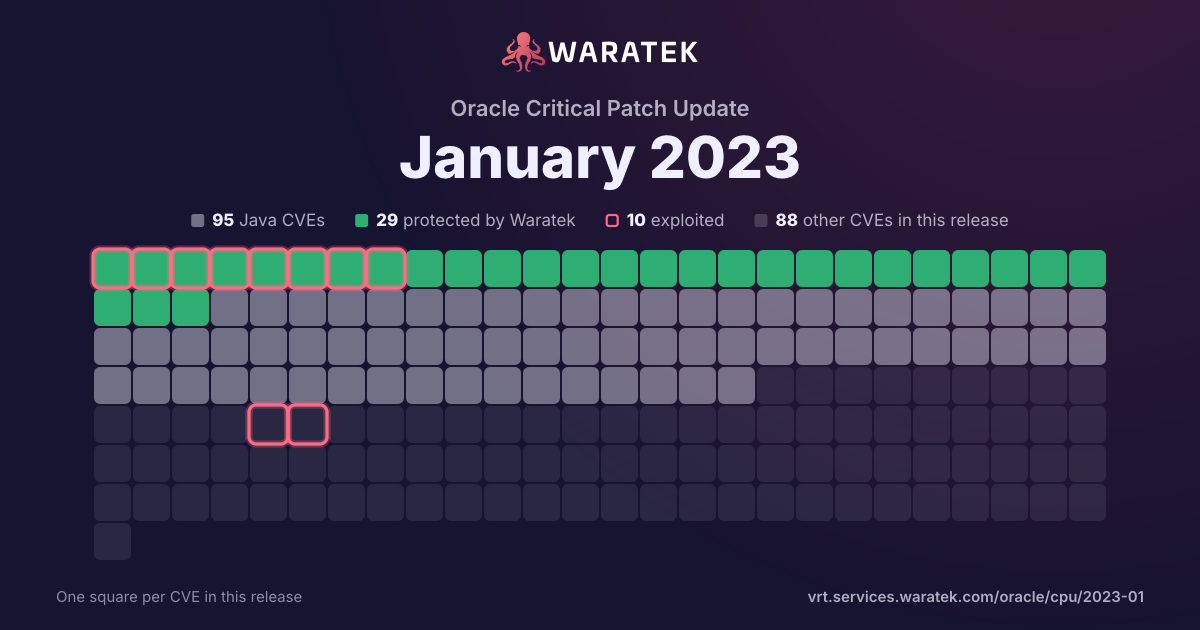
By status
29Protected by Waratek4Mitigation candidate62No exploit published13Outside Waratek scope74Not applicable1Withdrawn CVE
10Exploited, marked by the ring
No exploit published. For 39 of them, Oracle's security advisory is the source of public detail.
Protected by Waratek. Waratek RASP can block exploitation of these on systems that have not applied the patch yet.
Overview 19 matches · 7 protected · 3 exploited · 0 CISA KEV · 2 public PoC · 2 EPSS ≥ 0.5
Protected by Waratek
7
36.8%
Rule in development
0
0.0%
Mitigation candidate
0
0.0%
No exploit published
12
63.2%
blocked by ARMR today
7
36.8%
partly blocked
0
0.0%
not blocked
12
63.2%
not established
0
0.0%
unrecorded
0
0.0%
Exploited
3
15.8%
Working exploit published
0
0.0%
Proof of concept only
2
10.5%
Forecast only
0
0.0%
No public exploit
14
73.7%
split by
peak 5 / quarter
Q4 191
Protected by Waratek1
Medium1
blocked by ARMR today1
No public exploit1
Q1 200
Q2 201
No exploit published1
Medium1
not blocked1
No public exploit1
Q3 200
Q4 200
Q1 210
Q2 212
Protected by Waratek1
No exploit published1
Medium2
blocked by ARMR today1
not blocked1
No public exploit2
Q3 210
Q4 212
Protected by Waratek2
Medium2
blocked by ARMR today2
Exploited2
Q1 222
No exploit published2
Medium2
not blocked2
No public exploit2
Q2 225
Protected by Waratek2
No exploit published3
Medium5
blocked by ARMR today2
not blocked3
Exploited1
Proof of concept only1
No public exploit3
Q3 221
Protected by Waratek1
Medium1
blocked by ARMR today1
Proof of concept only1
Q4 221
No exploit published1
Medium1
not blocked1
No public exploit1
Q1 234
No exploit published4
Medium4
not blocked4
No public exploit4
Q1 20Q3 20Q1 21Q3 21Q1 22Q3 22Q1 23
| CVE | Severity | Published▾ | Status | Exploitation | Description |
|---|---|---|---|---|---|
| CVE-2023-21892 | Medium | 2023-01-18 | No exploit published | No public exploit | Vulnerability in the Oracle Business Intelligence Enterprise Edition product of Oracle Fusion Middleware (component: Visual Analyzer). Supported versions that are affected are 5.9.0.0.0 and 6.4.0.0.0. Easily exploitable vulnerability allows low privileged attacker with network access via HTTP to compromise Oracle Business Intelligence Enterprise Edition. Successful attacks require human interaction from a person other than the attacker and while the vulnerability is in Oracle Business Intelligence Enterprise Edition, attacks may significantly impact additional products (scope change). Successful attacks of this vulnerability can result in unauthorized update, insert or delete access to some of Oracle Business Intelligence Enterprise Edition accessible data as well as unauthorized read access to a subset of Oracle Business Intelligence Enterprise Edition accessible data. CVSS 3.1 Base Score 5.4 (Confidentiality and Integrity impacts). CVSS Vector: (CVSS:3.1/AV:N/AC:L/PR:L/UI:R/S:C/C:L/I:L/A:N). |
| CVE-2023-21891 | Medium | 2023-01-18 | No exploit published | No public exploit | Vulnerability in the Oracle Business Intelligence Enterprise Edition product of Oracle Fusion Middleware (component: Visual Analyzer). Supported versions that are affected are 5.9.0.0.0 and 6.4.0.0.0. Easily exploitable vulnerability allows low privileged attacker with network access via HTTP to compromise Oracle Business Intelligence Enterprise Edition. Successful attacks require human interaction from a person other than the attacker and while the vulnerability is in Oracle Business Intelligence Enterprise Edition, attacks may significantly impact additional products (scope change). Successful attacks of this vulnerability can result in unauthorized update, insert or delete access to some of Oracle Business Intelligence Enterprise Edition accessible data as well as unauthorized read access to a subset of Oracle Business Intelligence Enterprise Edition accessible data. CVSS 3.1 Base Score 5.4 (Confidentiality and Integrity impacts). CVSS Vector: (CVSS:3.1/AV:N/AC:L/PR:L/UI:R/S:C/C:L/I:L/A:N). |
| CVE-2023-21861 | Medium | 2023-01-18 | No exploit published | No public exploit | Vulnerability in the Oracle Business Intelligence Enterprise Edition product of Oracle Fusion Middleware (component: Visual Analyzer). Supported versions that are affected are 5.9.0.0.0 and 6.4.0.0.0. Easily exploitable vulnerability allows low privileged attacker with network access via HTTP to compromise Oracle Business Intelligence Enterprise Edition. Successful attacks require human interaction from a person other than the attacker and while the vulnerability is in Oracle Business Intelligence Enterprise Edition, attacks may significantly impact additional products (scope change). Successful attacks of this vulnerability can result in unauthorized update, insert or delete access to some of Oracle Business Intelligence Enterprise Edition accessible data as well as unauthorized read access to a subset of Oracle Business Intelligence Enterprise Edition accessible data. CVSS 3.1 Base Score 5.4 (Confidentiality and Integrity impacts). CVSS Vector: (CVSS:3.1/AV:N/AC:L/PR:L/UI:R/S:C/C:L/I:L/A:N). |
| CVE-2023-21859 | Medium | 2023-01-18 | No exploit published | No public exploit | Vulnerability in the Oracle Access Manager product of Oracle Fusion Middleware (component: Authentication Engine). The supported version that is affected is 12.2.1.4.0. Easily exploitable vulnerability allows high privileged attacker with logon to the infrastructure where Oracle Access Manager executes to compromise Oracle Access Manager. Successful attacks of this vulnerability can result in unauthorized access to critical data or complete access to all Oracle Access Manager accessible data. CVSS 3.1 Base Score 4.4 (Confidentiality impacts). CVSS Vector: (CVSS:3.1/AV:L/AC:L/PR:H/UI:N/S:U/C:H/I:N/A:N). |
| CVE-2021-37533 | Medium | 2022-12-03 | No exploit published | No public exploit | Prior to Apache Commons Net 3.9.0, Net's FTP client trusts the host from PASV response by default. A malicious server can redirect the Commons Net code to use a different host, but the user has to connect to the malicious server in the first place. This may lead to leakage of information about services running on the private network of the client. The default in version 3.9.0 is now false to ignore such hosts, as cURL does. See https://issues.apache.org/jira/browse/NET-711. |
| CVE-2022-36033 | Medium | 2022-08-29 | Protected by Waratek | Proof of concept only | jsoup is a Java HTML parser, built for HTML editing, cleaning, scraping, and cross-site scripting (XSS) safety. jsoup may incorrectly sanitize HTML including `javascript:` URL expressions, which could allow XSS attacks when a reader subsequently clicks that link. If the non-default `SafeList.preserveRelativeLinks` option is enabled, HTML including `javascript:` URLs that have been crafted with control characters will not be sanitized. If the site that this HTML is published on does not set a Content Security Policy, an XSS attack is then possible. This issue is patched in jsoup 1.15.3. Users should upgrade to this version. Additionally, as the unsanitized input may have been persisted, old content should be cleaned again using the updated version. To remediate this issue without immediately upgrading: - disable `SafeList.preserveRelativeLinks`, which will rewrite input URLs as absolute URLs - ensure an appropriate [Content Security Policy](https://developer.mozilla.org/en-US/docs/Web/HTTP/CSP) is defined. (This should be used regardless of upgrading, as a defence-in-depth best practice.) |
| CVE-2022-34305 | Medium | 2022-06-23 | Protected by Waratek | Exploited | In Apache Tomcat 10.1.0-M1 to 10.1.0-M16, 10.0.0-M1 to 10.0.22, 9.0.30 to 9.0.64 and 8.5.50 to 8.5.81 the Form authentication example in the examples web application displayed user provided data without filtering, exposing a XSS vulnerability. |
| CVE-2022-30126 | Medium | 2022-05-16 | No exploit published | No public exploit | In Apache Tika, a regular expression in our StandardsText class, used by the StandardsExtractingContentHandler could lead to a denial of service caused by backtracking on a specially crafted file. This only affects users who are running the StandardsExtractingContentHandler, which is a non-standard handler. This is fixed in 1.28.2 and 2.4.0 |
| CVE-2022-22971 | Medium | 2022-05-12 | Protected by Waratek | No public exploit | In spring framework versions prior to 5.3.20+ , 5.2.22+ and old unsupported versions, application with a STOMP over WebSocket endpoint is vulnerable to a denial of service attack by an authenticated user. |
| CVE-2022-22970 | Medium | 2022-05-12 | No exploit published | No public exploit | In spring framework versions prior to 5.3.20+ , 5.2.22+ and old unsupported versions, applications that handle file uploads are vulnerable to DoS attack if they rely on data binding to set a MultipartFile or javax.servlet.Part to a field in a model object. |
| CVE-2022-24823 | Medium | 2022-05-06 | No exploit published | Proof of concept only | Netty is an open-source, asynchronous event-driven network application framework. The package `io.netty:netty-codec-http` prior to version 4.1.77.Final contains an insufficient fix for CVE-2021-21290. When Netty's multipart decoders are used local information disclosure can occur via the local system temporary directory if temporary storing uploads on the disk is enabled. This only impacts applications running on Java version 6 and lower. Additionally, this vulnerability impacts code running on Unix-like systems, and very old versions of Mac OSX and Windows as they all share the system temporary directory between all users. Version 4.1.77.Final contains a patch for this vulnerability. As a workaround, specify one's own `java.io.tmpdir` when starting the JVM or use DefaultHttpDataFactory.setBaseDir(...) to set the directory to something that is only readable by the current user. |
| CVE-2022-24329 | Medium | 2022-02-25 | No exploit published | No public exploit | In JetBrains Kotlin before 1.6.0, it was not possible to lock dependencies for Multiplatform Gradle Projects. |
| CVE-2022-23437 | Medium | 2022-01-24 | No exploit published | No public exploit | There's a vulnerability within the Apache Xerces Java (XercesJ) XML parser when handling specially crafted XML document payloads. This causes, the XercesJ XML parser to wait in an infinite loop, which may sometimes consume system resources for prolonged duration. This vulnerability is present within XercesJ version 2.12.1 and the previous versions. |
| CVE-2021-44832 | Medium | 2021-12-28 | Protected by Waratek | Exploited | Apache Log4j2 versions 2.0-beta7 through 2.17.0 (excluding security fix releases 2.3.2 and 2.12.4) are vulnerable to a remote code execution (RCE) attack when a configuration uses a JDBC Appender with a JNDI LDAP data source URI when an attacker has control of the target LDAP server. This issue is fixed by limiting JNDI data source names to the java protocol in Log4j2 versions 2.17.1, 2.12.4, and 2.3.2. |
| CVE-2021-45105 | Medium | 2021-12-18 | Protected by Waratek | Exploited | Apache Log4j2 versions 2.0-alpha1 through 2.16.0 (excluding 2.12.3 and 2.3.1) did not protect from uncontrolled recursion from self-referential lookups. This allows an attacker with control over Thread Context Map data to cause a denial of service when a crafted string is interpreted. This issue was fixed in Log4j 2.17.0, 2.12.3, and 2.3.1. |
| CVE-2021-31812 | Medium | 2021-06-12 | No exploit published | No public exploit | In Apache PDFBox, a carefully crafted PDF file can trigger an infinite loop while loading the file. This issue affects Apache PDFBox version 2.0.23 and prior 2.0.x versions. |
| CVE-2021-29425 | Medium | 2021-04-13 | Protected by Waratek | No public exploit | In Apache Commons IO before 2.7, When invoking the method FileNameUtils.normalize with an improper input string, like "//../foo", or "\\..\foo", the result would be the same value, thus possibly providing access to files in the parent directory, but not further above (thus "limited" path traversal), if the calling code would use the result to construct a path value. |
| CVE-2020-10693 | Medium | 2020-05-06 | No exploit published | No public exploit | A flaw was found in Hibernate Validator version 6.1.2.Final. A bug in the message interpolation processor enables invalid EL expressions to be evaluated as if they were valid. This flaw allows attackers to bypass input sanitation (escaping, stripping) controls that developers may have put in place when handling user-controlled data in error messages. |
| CVE-2019-12415 | Medium | 2019-10-23 | Protected by Waratek | No public exploit | In Apache POI up to 4.1.0, when using the tool XSSFExportToXml to convert user-provided Microsoft Excel documents, a specially crafted document can allow an attacker to read files from the local filesystem or from internal network resources via XML External Entity (XXE) Processing. |