
Oracle Critical Patch Update January 2023
Released January 2023 · Oracle's advisory ↗ · ← Critical Patch Update, October 2022 · Critical Patch Update, April 2023 →
183 CVEs in this release, one square each
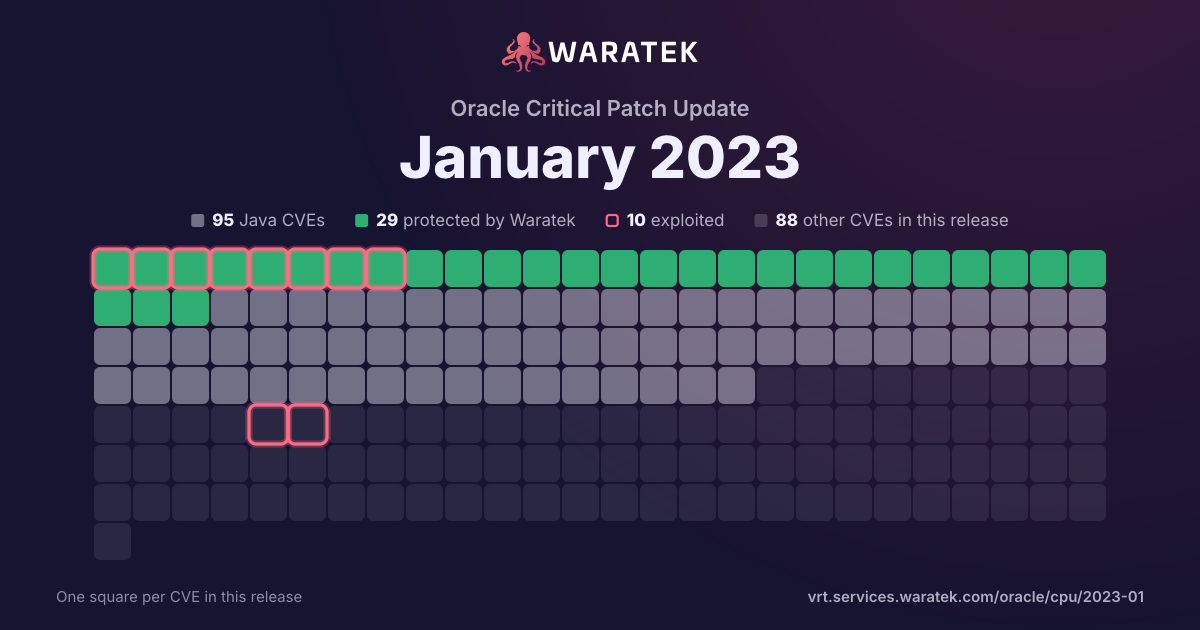
By status
28Protected by Waratek5Mitigation candidate66No exploit published3Outside Waratek scope80Not applicable1Withdrawn CVE
9Exploited, marked by the ring
No exploit published. For 35 of them, Oracle's security advisory is the source of public detail.
Protected by Waratek. Waratek RASP can block exploitation of these on systems that have not applied the patch yet.
Overview 6 matches · 3 protected · 1 exploited · 0 CISA KEV · 1 public PoC · 0 EPSS ≥ 0.5
Protected by Waratek
3
50.0%
Rule in development
0
0.0%
Mitigation candidate
0
0.0%
No exploit published
3
50.0%
blocked by ARMR today
3
50.0%
partly blocked
0
0.0%
not blocked
3
50.0%
not established
0
0.0%
unrecorded
0
0.0%
Exploited
1
16.7%
Working exploit published
0
0.0%
Proof of concept only
1
16.7%
Forecast only
0
0.0%
No public exploit
4
66.7%
split by
peak 3 / month
Jun 221
Protected by Waratek1
Medium1
blocked by ARMR today1
Exploited1
Jul 220
Aug 220
Sep 221
Protected by Waratek1
Medium1
blocked by ARMR today1
Proof of concept only1
Oct 220
Nov 220
Dec 221
No exploit published1
Medium1
not blocked1
No public exploit1
Jan 233
Protected by Waratek1
No exploit published2
Medium3
blocked by ARMR today1
not blocked2
No public exploit3
Jun 22Jul 22Aug 22Sep 22Oct 22Nov 22Dec 22Jan 23
| CVE | Severity | Published▾ | Status | Exploitation | Description |
|---|---|---|---|---|---|
| CVE-2023-21835 | Medium | 2023-01-18 | No exploit published | No public exploit | Vulnerability in the Oracle Java SE, Oracle GraalVM Enterprise Edition product of Oracle Java SE (component: JSSE). Supported versions that are affected are Oracle Java SE: 11.0.17, 17.0.5, 19.0.1; Oracle GraalVM Enterprise Edition: 20.3.8, 21.3.4 and 22.3.0. Easily exploitable vulnerability allows unauthenticated attacker with network access via DTLS to compromise Oracle Java SE, Oracle GraalVM Enterprise Edition. Successful attacks of this vulnerability can result in unauthorized ability to cause a partial denial of service (partial DOS) of Oracle Java SE, Oracle GraalVM Enterprise Edition. Note: This vulnerability applies to Java deployments, typically in clients running sandboxed Java Web Start applications or sandboxed Java applets, that load and run untrusted code (e.g., code that comes from the internet) and rely on the Java sandbox for security. This vulnerability does not apply to Java deployments, typically in servers, that load and run only trusted code (e.g., code installed by an administrator). CVSS 3.1 Base Score 5.3 (Availability impacts). CVSS Vector: (CVSS:3.1/AV:N/AC:L/PR:N/UI:N/S:U/C:N/I:N/A:L). |
| CVE-2023-21830 | Medium | 2023-01-18 | Protected by Waratek | No public exploit | Vulnerability in the Oracle Java SE, Oracle GraalVM Enterprise Edition product of Oracle Java SE (component: Serialization). Supported versions that are affected are Oracle Java SE: 8u351, 8u351-perf; Oracle GraalVM Enterprise Edition: 20.3.8 and 21.3.4. Easily exploitable vulnerability allows unauthenticated attacker with network access via multiple protocols to compromise Oracle Java SE, Oracle GraalVM Enterprise Edition. Successful attacks of this vulnerability can result in unauthorized update, insert or delete access to some of Oracle Java SE, Oracle GraalVM Enterprise Edition accessible data. Note: This vulnerability applies to Java deployments, typically in clients running sandboxed Java Web Start applications or sandboxed Java applets, that load and run untrusted code (e.g., code that comes from the internet) and rely on the Java sandbox for security. This vulnerability does not apply to Java deployments, typically in servers, that load and run only trusted code (e.g., code installed by an administrator). CVSS 3.1 Base Score 5.3 (Integrity impacts). CVSS Vector: (CVSS:3.1/AV:N/AC:L/PR:N/UI:N/S:U/C:N/I:L/A:N). |
| CVE-2023-21824 | Medium | 2023-01-18 | No exploit published | No public exploit | Vulnerability in the Oracle Communications BRM - Elastic Charging Engine product of Oracle Communications Applications (component: Customer, Config, Pricing Manager). Supported versions that are affected are 12.0.0.3.0-12.0.0.7.0. Easily exploitable vulnerability allows high privileged attacker with logon to the infrastructure where Oracle Communications BRM - Elastic Charging Engine executes to compromise Oracle Communications BRM - Elastic Charging Engine. Successful attacks of this vulnerability can result in unauthorized access to critical data or complete access to all Oracle Communications BRM - Elastic Charging Engine accessible data. CVSS 3.1 Base Score 4.4 (Confidentiality impacts). CVSS Vector: (CVSS:3.1/AV:L/AC:L/PR:H/UI:N/S:U/C:H/I:N/A:N). |
| CVE-2021-37533 | Medium | 2022-12-03 | No exploit published | No public exploit | Prior to Apache Commons Net 3.9.0, Net's FTP client trusts the host from PASV response by default. A malicious server can redirect the Commons Net code to use a different host, but the user has to connect to the malicious server in the first place. This may lead to leakage of information about services running on the private network of the client. The default in version 3.9.0 is now false to ignore such hosts, as cURL does. See https://issues.apache.org/jira/browse/NET-711. |
| CVE-2022-38752 | Medium | 2022-09-05 | Protected by Waratek | Proof of concept only | Using snakeYAML to parse untrusted YAML files may be vulnerable to Denial of Service attacks (DOS). If the parser is running on user supplied input, an attacker may supply content that causes the parser to crash by stack-overflow. |
| CVE-2022-34305 | Medium | 2022-06-23 | Protected by Waratek | Exploited | In Apache Tomcat 10.1.0-M1 to 10.1.0-M16, 10.0.0-M1 to 10.0.22, 9.0.30 to 9.0.64 and 8.5.50 to 8.5.81 the Form authentication example in the examples web application displayed user provided data without filtering, exposing a XSS vulnerability. |