
Oracle Critical Patch Update January 2023
Released January 2023 · Oracle's advisory ↗ · ← Critical Patch Update, October 2022 · Critical Patch Update, April 2023 →
183 CVEs in this release, one square each
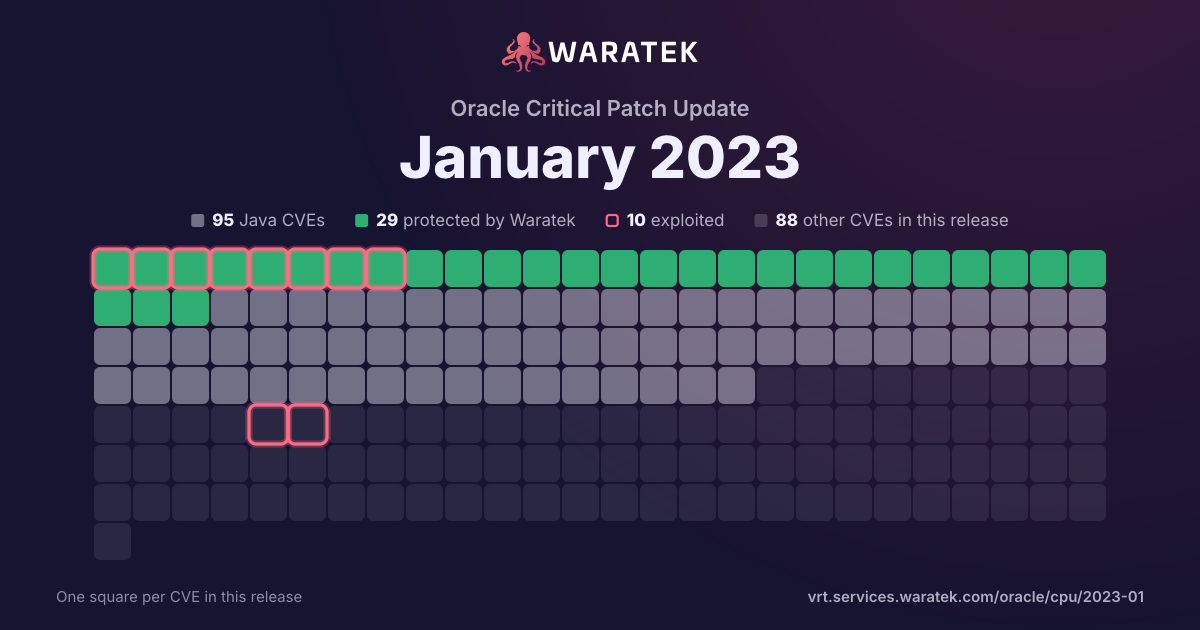
By status
28Protected by Waratek5Mitigation candidate66No exploit published3Outside Waratek scope80Not applicable1Withdrawn CVE
9Exploited, marked by the ring
No exploit published. For 35 of them, Oracle's security advisory is the source of public detail.
Protected by Waratek. Waratek RASP can block exploitation of these on systems that have not applied the patch yet.
Overview 3 matches · 2 protected · 1 exploited · 1 CISA KEV · 1 public PoC · 1 EPSS ≥ 0.5
Protected by Waratek
2
66.7%
Rule in development
0
0.0%
Mitigation candidate
0
0.0%
No exploit published
1
33.3%
blocked by ARMR today
2
66.7%
partly blocked
0
0.0%
not blocked
1
33.3%
not established
0
0.0%
unrecorded
0
0.0%
Exploited
1
33.3%
Working exploit published
0
0.0%
Proof of concept only
0
0.0%
Forecast only
0
0.0%
No public exploit
2
66.7%
split by
peak 1 / quarter
Q2 18Q3 18Q4 18Q1 19Q2 19Q3 19Q4 19Q1 20Q2 20Q3 20Q4 20Q1 21
| CVE | Severity | Published▾ | Status | Exploitation | Description |
|---|---|---|---|---|---|
| CVE-2020-36242 | Critical | 2021-02-07 | No exploit published | No public exploit | In the cryptography package before 3.3.2 for Python, certain sequences of update calls to symmetrically encrypt multi-GB values could result in an integer overflow and buffer overflow, as demonstrated by the Fernet class. |
| CVE-2020-10683 | Critical | 2020-05-01 | Protected by Waratek | No public exploit | dom4j before 2.0.3 and 2.1.x before 2.1.3 allows external DTDs and External Entities by default, which might enable XXE attacks. However, there is popular external documentation from OWASP showing how to enable the safe, non-default behavior in any application that uses dom4j. |
| CVE-2018-1273 | Critical | 2018-04-11 | Protected by Waratek | Exploited | Spring Data Commons, versions prior to 1.13 to 1.13.10, 2.0 to 2.0.5, and older unsupported versions, contain a property binder vulnerability caused by improper neutralization of special elements. An unauthenticated remote malicious user (or attacker) can supply specially crafted request parameters against Spring Data REST backed HTTP resources or using Spring Data's projection-based request payload binding hat can lead to a remote code execution attack. |