
Oracle Critical Patch Update October 2022
Released October 2022 · Oracle's advisory ↗ · ← Critical Patch Update, July 2022 · Critical Patch Update, January 2023 →
179 CVEs in this release, one square each
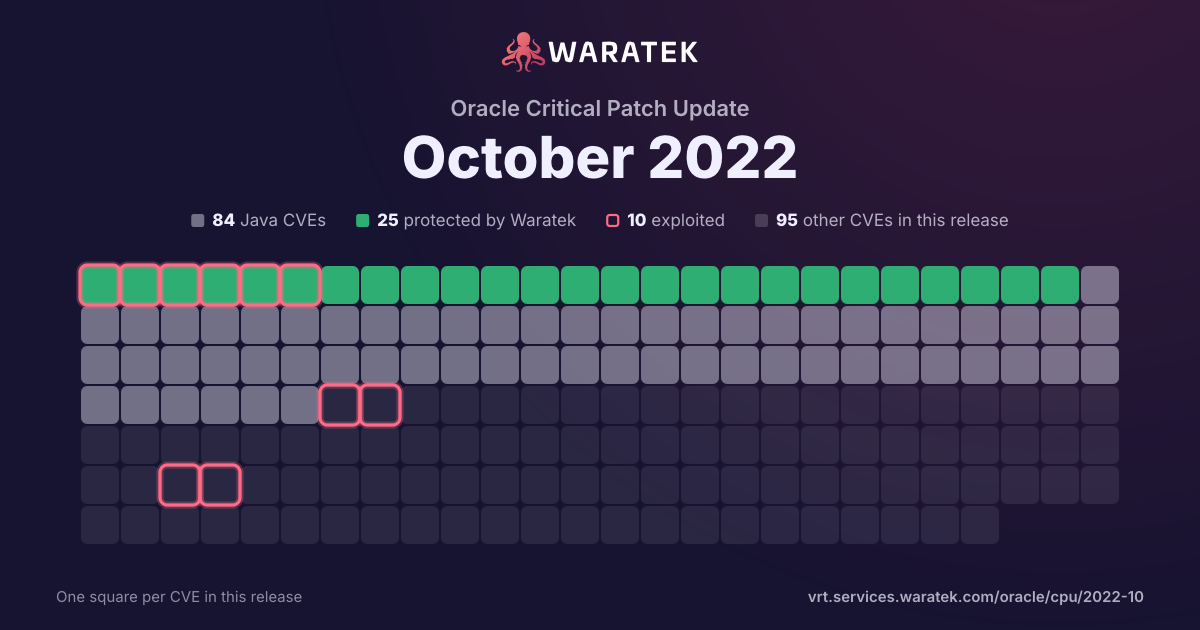
By status
25Protected by Waratek4Mitigation candidate55No exploit published48Outside Waratek scope47Not applicable
10Exploited, marked by the ring
No exploit published. For 33 of them, Oracle's security advisory is the source of public detail.
Protected by Waratek. Waratek RASP can block exploitation of these on systems that have not applied the patch yet.
Overview 30 matches · 12 in Waratek scope · 7 protected · 2 exploited · 1 CISA KEV · 9 public PoC · 7 EPSS ≥ 0.5
30matches
12in Waratek scope40.0%
7protected23.3%
2exploited6.7%
1CISA KEV3.3%
9public PoC30.0%
7EPSS ≥ 0.523.3%
Protected by Waratek
7
23.3%
Rule in development
0
0.0%
Mitigation candidate
3
10.0%
No exploit published
2
6.7%
Outside Waratek scope
12
40.0%
Not applicable
6
20.0%
Withdrawn CVE
0
0.0%
blocked by ARMR today
7
23.3%
partly blocked
0
0.0%
not blocked
23
76.7%
not established
0
0.0%
unrecorded
0
0.0%
split by
peak 9 / quarter
Q1 191
Not applicable1
Critical1
not blocked1
No public exploit1
Q2 190
Q3 190
Q4 191
Outside Waratek scope1
Critical1
not blocked1
Proof of concept only1
Q1 200
Q2 202
Protected by Waratek1
Outside Waratek scope1
Critical2
blocked by ARMR today1
not blocked1
No public exploit2
Q3 200
Q4 200
Q1 212
Protected by Waratek1
No exploit published1
Critical2
blocked by ARMR today1
not blocked1
No public exploit2
Q2 210
Q3 210
Q4 214
Outside Waratek scope3
Not applicable1
Critical4
not blocked4
Working exploit published1
No public exploit3
Q1 226
Protected by Waratek1
Outside Waratek scope2
Not applicable3
Critical6
blocked by ARMR today1
not blocked5
Proof of concept only4
Forecast only1
No public exploit1
Q2 229
Protected by Waratek2
Mitigation candidate2
Outside Waratek scope4
Not applicable1
Critical9
blocked by ARMR today2
not blocked7
Exploited1
Proof of concept only5
No public exploit3
Q3 223
Mitigation candidate1
No exploit published1
Outside Waratek scope1
Critical3
not blocked3
Proof of concept only2
No public exploit1
Q4 222
Protected by Waratek2
Critical2
blocked by ARMR today2
Exploited1
No public exploit1
Q2 19Q4 19Q2 20Q4 20Q2 21Q4 21Q2 22Q4 22
| CVE | Severity | Published▾ | Status | Exploitation | Description |
|---|---|---|---|---|---|
| CVE-2022-39428 | Critical | 2022-10-18 | Protected by Waratek | No public exploit | Vulnerability in the Oracle Web Applications Desktop Integrator product of Oracle E-Business Suite (component: Upload). Supported versions that are affected are 12.2.3-12.2.11. Easily exploitable vulnerability allows unauthenticated attacker with network access via HTTP to compromise Oracle Web Applications Desktop Integrator. Successful attacks of this vulnerability can result in takeover of Oracle Web Applications Desktop Integrator. CVSS 3.1 Base Score 9.8 (Confidentiality, Integrity and Availability impacts). CVSS Vector: (CVSS:3.1/AV:N/AC:L/PR:N/UI:N/S:U/C:H/I:H/A:H). |
| CVE-2022-21587 | Critical | 2022-10-18 | Protected by Waratek | Exploited | Vulnerability in the Oracle Web Applications Desktop Integrator product of Oracle E-Business Suite (component: Upload). Supported versions that are affected are 12.2.3-12.2.11. Easily exploitable vulnerability allows unauthenticated attacker with network access via HTTP to compromise Oracle Web Applications Desktop Integrator. Successful attacks of this vulnerability can result in takeover of Oracle Web Applications Desktop Integrator. CVSS 3.1 Base Score 9.8 (Confidentiality, Integrity and Availability impacts). CVSS Vector: (CVSS:3.1/AV:N/AC:L/PR:N/UI:N/S:U/C:H/I:H/A:H). |
| CVE-2020-35169 | Critical | 2022-07-11 | No exploit published | No public exploit | Dell BSAFE Crypto-C Micro Edition, versions before 4.1.5, and Dell BSAFE Micro Edition Suite, versions before 4.5.2, contain an Improper Input Validation Vulnerability. |
| CVE-2022-32207 | Critical | 2022-07-07 | Outside Waratek scope | Proof of concept only | When curl < 7.84.0 saves cookies, alt-svc and hsts data to local files, it makes the operation atomic by finalizing the operation with a rename from a temporary name to the final target file name.In that rename operation, it might accidentally *widen* the permissions for the target file, leaving the updated file accessible to more users than intended. |
| CVE-2022-33980 | Critical | 2022-07-06 | Mitigation candidate | Proof of concept only | Apache Commons Configuration performs variable interpolation, allowing properties to be dynamically evaluated and expanded. The standard format for interpolation is "${prefix:name}", where "prefix" is used to locate an instance of org.apache.commons.configuration2.interpol.Lookup that performs the interpolation. Starting with version 2.4 and continuing through 2.7, the set of default Lookup instances included interpolators that could result in arbitrary code execution or contact with remote servers. These lookups are: - "script" - execute expressions using the JVM script execution engine (javax.script) - "dns" - resolve dns records - "url" - load values from urls, including from remote servers Applications using the interpolation defaults in the affected versions may be vulnerable to remote code execution or unintentional contact with remote servers if untrusted configuration values are used. Users are recommended to upgrade to Apache Commons Configuration 2.8.0, which disables the problematic interpolators by default. |
| CVE-2022-32532 | Critical | 2022-06-29 | Mitigation candidate | Proof of concept only | Apache Shiro before 1.9.1, A RegexRequestMatcher can be misconfigured to be bypassed on some servlet containers. Applications using RegExPatternMatcher with `.` in the regular expression are possibly vulnerable to an authorization bypass. |
| CVE-2022-2068 | Critical | 2022-06-21 | Outside Waratek scope | Proof of concept only | In addition to the c_rehash shell command injection identified in CVE-2022-1292, further circumstances where the c_rehash script does not properly sanitise shell metacharacters to prevent command injection were found by code review. When the CVE-2022-1292 was fixed it was not discovered that there are other places in the script where the file names of certificates being hashed were possibly passed to a command executed through the shell. This script is distributed by some operating systems in a manner where it is automatically executed. On such operating systems, an attacker could execute arbitrary commands with the privileges of the script. Use of the c_rehash script is considered obsolete and should be replaced by the OpenSSL rehash command line tool. Fixed in OpenSSL 3.0.4 (Affected 3.0.0,3.0.1,3.0.2,3.0.3). Fixed in OpenSSL 1.1.1p (Affected 1.1.1-1.1.1o). Fixed in OpenSSL 1.0.2zf (Affected 1.0.2-1.0.2ze). |
| CVE-2022-31813 | Critical | 2022-06-09 | Not applicable | No public exploit | Apache HTTP Server 2.4.53 and earlier may not send the X-Forwarded-* headers to the origin server based on client side Connection header hop-by-hop mechanism. This may be used to bypass IP based authentication on the origin server/application. |
| CVE-2022-22978 | Critical | 2022-05-19 | Mitigation candidate | Proof of concept only | In spring security versions prior to 5.4.11+, 5.5.7+ , 5.6.4+ and older unsupported versions, RegexRequestMatcher can easily be misconfigured to be bypassed on some servlet containers. Applications using RegexRequestMatcher with `.` in the regular expression are possibly vulnerable to an authorization bypass. |
| CVE-2022-1587 | Critical | 2022-05-16 | Outside Waratek scope | No public exploit | An out-of-bounds read vulnerability was discovered in the PCRE2 library in the get_recurse_data_length() function of the pcre2_jit_compile.c file. This issue affects recursions in JIT-compiled regular expressions caused by duplicate data transfers. |
| CVE-2022-1586 | Critical | 2022-05-16 | Outside Waratek scope | No public exploit | An out-of-bounds read vulnerability was discovered in the PCRE2 library in the compile_xclass_matchingpath() function of the pcre2_jit_compile.c file. This involves a unicode property matching issue in JIT-compiled regular expressions. The issue occurs because the character was not fully read in case-less matching within JIT. |
| CVE-2022-1292 | Critical | 2022-05-03 | Outside Waratek scope | Proof of concept only | The c_rehash script does not properly sanitise shell metacharacters to prevent command injection. This script is distributed by some operating systems in a manner where it is automatically executed. On such operating systems, an attacker could execute arbitrary commands with the privileges of the script. Use of the c_rehash script is considered obsolete and should be replaced by the OpenSSL rehash command line tool. Fixed in OpenSSL 3.0.3 (Affected 3.0.0,3.0.1,3.0.2). Fixed in OpenSSL 1.1.1o (Affected 1.1.1-1.1.1n). Fixed in OpenSSL 1.0.2ze (Affected 1.0.2-1.0.2zd). |
| CVE-2022-23457 | Critical | 2022-04-25 | Protected by Waratek | Proof of concept only | ESAPI (The OWASP Enterprise Security API) is a free, open source, web application security control library. Prior to version 2.3.0.0, the default implementation of `Validator.getValidDirectoryPath(String, String, File, boolean)` may incorrectly treat the tested input string as a child of the specified parent directory. This potentially could allow control-flow bypass checks to be defeated if an attack can specify the entire string representing the 'input' path. This vulnerability is patched in release 2.3.0.0 of ESAPI. As a workaround, it is possible to write one's own implementation of the Validator interface. However, maintainers do not recommend this. |
| CVE-2021-31805 | Critical | 2022-04-12 | Protected by Waratek | Exploited | The fix issued for CVE-2020-17530 was incomplete. So from Apache Struts 2.0.0 to 2.5.29, still some of the tag’s attributes could perform a double evaluation if a developer applied forced OGNL evaluation by using the %{...} syntax. Using forced OGNL evaluation on untrusted user input can lead to a Remote Code Execution and security degradation. |
| CVE-2022-23943 | Critical | 2022-03-14 | Not applicable | Forecast only | Out-of-bounds Write vulnerability in mod_sed of Apache HTTP Server allows an attacker to overwrite heap memory with possibly attacker provided data. This issue affects Apache HTTP Server 2.4 version 2.4.52 and prior versions. |
| CVE-2021-21708 | Critical | 2022-02-27 | Not applicable | No public exploit | In PHP versions 7.4.x below 7.4.28, 8.0.x below 8.0.16, and 8.1.x below 8.1.3, when using filter functions with FILTER_VALIDATE_FLOAT filter and min/max limits, if the filter fails, there is a possibility to trigger use of allocated memory after free, which can result it crashes, and potentially in overwrite of other memory chunks and RCE. This issue affects: code that uses FILTER_VALIDATE_FLOAT with min/max limits. |
| CVE-2022-25315 | Critical | 2022-02-18 | Not applicable | Proof of concept only | In Expat (aka libexpat) before 2.4.5, there is an integer overflow in storeRawNames. |
| CVE-2022-23305 | Critical | 2022-01-18 | Protected by Waratek | Proof of concept only | By design, the JDBCAppender in Log4j 1.2.x accepts an SQL statement as a configuration parameter where the values to be inserted are converters from PatternLayout. The message converter, %m, is likely to always be included. This allows attackers to manipulate the SQL by entering crafted strings into input fields or headers of an application that are logged allowing unintended SQL queries to be executed. Note this issue only affects Log4j 1.x when specifically configured to use the JDBCAppender, which is not the default. Beginning in version 2.0-beta8, the JDBCAppender was re-introduced with proper support for parameterized SQL queries and further customization over the columns written to in logs. Apache Log4j 1.2 reached end of life in August 2015. Users should upgrade to Log4j 2 as it addresses numerous other issues from the previous versions. |
| CVE-2022-23219 | Critical | 2022-01-14 | Outside Waratek scope | Proof of concept only | The deprecated compatibility function clnt_create in the sunrpc module of the GNU C Library (aka glibc) through 2.34 copies its hostname argument on the stack without validating its length, which may result in a buffer overflow, potentially resulting in a denial of service or (if an application is not built with a stack protector enabled) arbitrary code execution. |
| CVE-2022-23218 | Critical | 2022-01-14 | Outside Waratek scope | Proof of concept only | The deprecated compatibility function svcunix_create in the sunrpc module of the GNU C Library (aka glibc) through 2.34 copies its path argument on the stack without validating its length, which may result in a buffer overflow, potentially resulting in a denial of service or (if an application is not built with a stack protector enabled) arbitrary code execution. |
| CVE-2021-44790 | Critical | 2021-12-20 | Outside Waratek scope | Working exploit published | A carefully crafted request body can cause a buffer overflow in the mod_lua multipart parser (r:parsebody() called from Lua scripts). The Apache httpd team is not aware of an exploit for the vulnerabilty though it might be possible to craft one. This issue affects Apache HTTP Server 2.4.51 and earlier. |
| CVE-2021-23450 | Critical | 2021-12-17 | Outside Waratek scope | No public exploit | All versions of package dojo are vulnerable to Prototype Pollution via the setObject function. |
| CVE-2021-43527 | Critical | 2021-12-08 | Outside Waratek scope | No public exploit | NSS (Network Security Services) versions prior to 3.73 or 3.68.1 ESR are vulnerable to a heap overflow when handling DER-encoded DSA or RSA-PSS signatures. Applications using NSS for handling signatures encoded within CMS, S/MIME, PKCS \#7, or PKCS \#12 are likely to be impacted. Applications using NSS for certificate validation or other TLS, X.509, OCSP or CRL functionality may be impacted, depending on how they configure NSS. *Note: This vulnerability does NOT impact Mozilla Firefox.* However, email clients and PDF viewers that use NSS for signature verification, such as Thunderbird, LibreOffice, Evolution and Evince are believed to be impacted. This vulnerability affects NSS < 3.73 and NSS < 3.68.1. |
| CVE-2021-3918 | Critical | 2021-11-13 | Not applicable | No public exploit | json-schema is vulnerable to Improperly Controlled Modification of Object Prototype Attributes ('Prototype Pollution') |
| CVE-2021-21783 | Critical | 2021-03-25 | No exploit published | No public exploit | A code execution vulnerability exists in the WS-Addressing plugin functionality of Genivia gSOAP 2.8.107. A specially crafted SOAP request can lead to remote code execution. An attacker can send an HTTP request to trigger this vulnerability. |
| CVE-2021-23926 | Critical | 2021-01-14 | Protected by Waratek | No public exploit | The XML parsers used by XMLBeans up to version 2.6.0 did not set the properties needed to protect the user from malicious XML input. Vulnerabilities include possibilities for XML Entity Expansion attacks. Affects XMLBeans up to and including v2.6.0. |
| CVE-2018-1285 | Critical | 2020-05-11 | Outside Waratek scope | No public exploit | Apache log4net versions before 2.0.10 do not disable XML external entities when parsing log4net configuration files. This allows for XXE-based attacks in applications that accept attacker-controlled log4net configuration files. |
| CVE-2020-10683 | Critical | 2020-05-01 | Protected by Waratek | No public exploit | dom4j before 2.0.3 and 2.1.x before 2.1.3 allows external DTDs and External Entities by default, which might enable XXE attacks. However, there is popular external documentation from OWASP showing how to enable the safe, non-default behavior in any application that uses dom4j. |
| CVE-2019-17195 | Critical | 2019-10-15 | Outside Waratek scope | Proof of concept only | Connect2id Nimbus JOSE+JWT before v7.9 can throw various uncaught exceptions while parsing a JWT, which could result in an application crash (potential information disclosure) or a potential authentication bypass. |
| CVE-2019-3862 | Critical | 2019-03-21 | Not applicable | No public exploit | An out of bounds read flaw was discovered in libssh2 before 1.8.1 in the way SSH_MSG_CHANNEL_REQUEST packets with an exit status message and no payload are parsed. A remote attacker who compromises a SSH server may be able to cause a Denial of Service or read data in the client memory. |