
Oracle Critical Patch Update October 2022
Released October 2022 · Oracle's advisory ↗ · ← Critical Patch Update, July 2022 · Critical Patch Update, January 2023 →
179 CVEs in this release, one square each
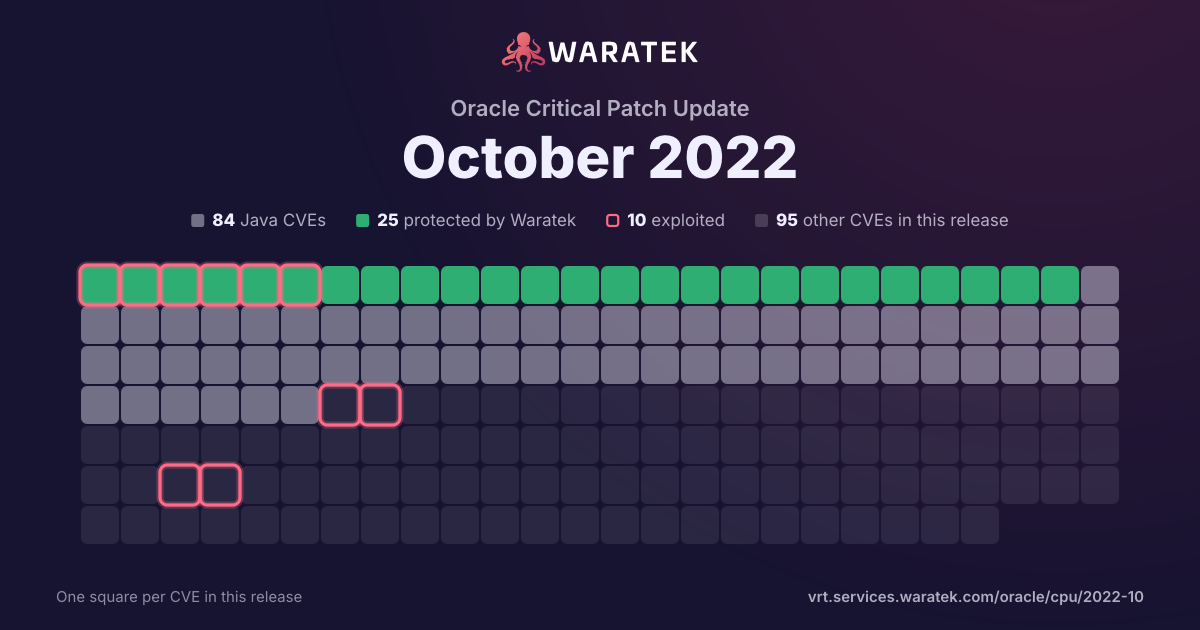
By status
26Protected by Waratek7Mitigation candidate58No exploit published3Outside Waratek scope85Not applicable
10Exploited, marked by the ring
No exploit published. For 34 of them, Oracle's security advisory is the source of public detail.
Protected by Waratek. Waratek RASP can block exploitation of these on systems that have not applied the patch yet.
Overview 10 matches · 6 in Waratek scope · 2 protected · 2 exploited · 0 CISA KEV · 3 public PoC · 3 EPSS ≥ 0.5
10matches
6in Waratek scope60.0%
2protected20.0%
2exploited20.0%
0CISA KEV0.0%
3public PoC30.0%
3EPSS ≥ 0.530.0%
Protected by Waratek
2
20.0%
Rule in development
0
0.0%
Mitigation candidate
1
10.0%
No exploit published
3
30.0%
Outside Waratek scope
0
0.0%
Not applicable
4
40.0%
Withdrawn CVE
0
0.0%
blocked by ARMR today
2
20.0%
partly blocked
0
0.0%
not blocked
8
80.0%
not established
0
0.0%
unrecorded
0
0.0%
split by
peak 6 / month
Oct 212
Mitigation candidate1
No exploit published1
Medium2
not blocked2
Proof of concept only1
No public exploit1
Nov 212
Not applicable2
Critical1
Medium1
not blocked2
No public exploit2
Dec 216
Protected by Waratek2
No exploit published2
Not applicable2
Critical3
High1
Medium2
blocked by ARMR today2
not blocked4
Exploited2
Working exploit published1
No public exploit3
Oct 21Nov 21Dec 21
| CVE | Severity | Published▾ | Status | Exploitation | Description |
|---|---|---|---|---|---|
| CVE-2021-44832 | Medium | 2021-12-28 | Protected by Waratek | Exploited | Apache Log4j2 versions 2.0-beta7 through 2.17.0 (excluding security fix releases 2.3.2 and 2.12.4) are vulnerable to a remote code execution (RCE) attack when a configuration uses a JDBC Appender with a JNDI LDAP data source URI when an attacker has control of the target LDAP server. This issue is fixed by limiting JNDI data source names to the java protocol in Log4j2 versions 2.17.1, 2.12.4, and 2.3.2. |
| CVE-2021-44790 | Critical | 2021-12-20 | Not applicable | Working exploit published | A carefully crafted request body can cause a buffer overflow in the mod_lua multipart parser (r:parsebody() called from Lua scripts). The Apache httpd team is not aware of an exploit for the vulnerabilty though it might be possible to craft one. This issue affects Apache HTTP Server 2.4.51 and earlier. |
| CVE-2021-41495 | Medium | 2021-12-17 | Not applicable | No public exploit | Null Pointer Dereference vulnerability exists in numpy.sort in NumPy < and 1.19 in the PyArray_DescrNew function due to missing return-value validation, which allows attackers to conduct DoS attacks by repetitively creating sort arrays. NOTE: While correct that validation is missing, an error can only occur due to an exhaustion of memory. If the user can exhaust memory, they are already privileged. Further, it should be practically impossible to construct an attack which can target the memory exhaustion to occur at exactly this place |
| CVE-2021-23450 | Critical | 2021-12-17 | No exploit published | No public exploit | All versions of package dojo are vulnerable to Prototype Pollution via the setObject function. |
| CVE-2021-4104 | High | 2021-12-14 | Protected by Waratek | Exploited | JMSAppender in Log4j 1.2 is vulnerable to deserialization of untrusted data when the attacker has write access to the Log4j configuration. The attacker can provide TopicBindingName and TopicConnectionFactoryBindingName configurations causing JMSAppender to perform JNDI requests that result in remote code execution in a similar fashion to CVE-2021-44228. Note this issue only affects Log4j 1.2 when specifically configured to use JMSAppender, which is not the default. Apache Log4j 1.2 reached end of life in August 2015. Users should upgrade to Log4j 2 as it addresses numerous other issues from the previous versions. |
| CVE-2021-43527 | Critical | 2021-12-08 | No exploit published | No public exploit | NSS (Network Security Services) versions prior to 3.73 or 3.68.1 ESR are vulnerable to a heap overflow when handling DER-encoded DSA or RSA-PSS signatures. Applications using NSS for handling signatures encoded within CMS, S/MIME, PKCS \#7, or PKCS \#12 are likely to be impacted. Applications using NSS for certificate validation or other TLS, X.509, OCSP or CRL functionality may be impacted, depending on how they configure NSS. *Note: This vulnerability does NOT impact Mozilla Firefox.* However, email clients and PDF viewers that use NSS for signature verification, such as Thunderbird, LibreOffice, Evolution and Evince are believed to be impacted. This vulnerability affects NSS < 3.73 and NSS < 3.68.1. |
| CVE-2021-21707 | Medium | 2021-11-29 | Not applicable | No public exploit | In PHP versions 7.3.x below 7.3.33, 7.4.x below 7.4.26 and 8.0.x below 8.0.13, certain XML parsing functions, like simplexml_load_file(), URL-decode the filename passed to them. If that filename contains URL-encoded NUL character, this may cause the function to interpret this as the end of the filename, thus interpreting the filename differently from what the user intended, which may lead it to reading a different file than intended. |
| CVE-2021-3918 | Critical | 2021-11-13 | Not applicable | No public exploit | json-schema is vulnerable to Improperly Controlled Modification of Object Prototype Attributes ('Prototype Pollution') |
| CVE-2021-41184 | Medium | 2021-10-26 | Mitigation candidate | Proof of concept only | jQuery-UI is the official jQuery user interface library. Prior to version 1.13.0, accepting the value of the `of` option of the `.position()` util from untrusted sources may execute untrusted code. The issue is fixed in jQuery UI 1.13.0. Any string value passed to the `of` option is now treated as a CSS selector. A workaround is to not accept the value of the `of` option from untrusted sources. |
| CVE-2021-41182 | Medium | 2021-10-26 | No exploit published | No public exploit | jQuery-UI is the official jQuery user interface library. Prior to version 1.13.0, accepting the value of the `altField` option of the Datepicker widget from untrusted sources may execute untrusted code. The issue is fixed in jQuery UI 1.13.0. Any string value passed to the `altField` option is now treated as a CSS selector. A workaround is to not accept the value of the `altField` option from untrusted sources. |