
Oracle Critical Patch Update October 2022
Released October 2022 · Oracle's advisory ↗ · ← Critical Patch Update, July 2022 · Critical Patch Update, January 2023 →
179 CVEs in this release, one square each
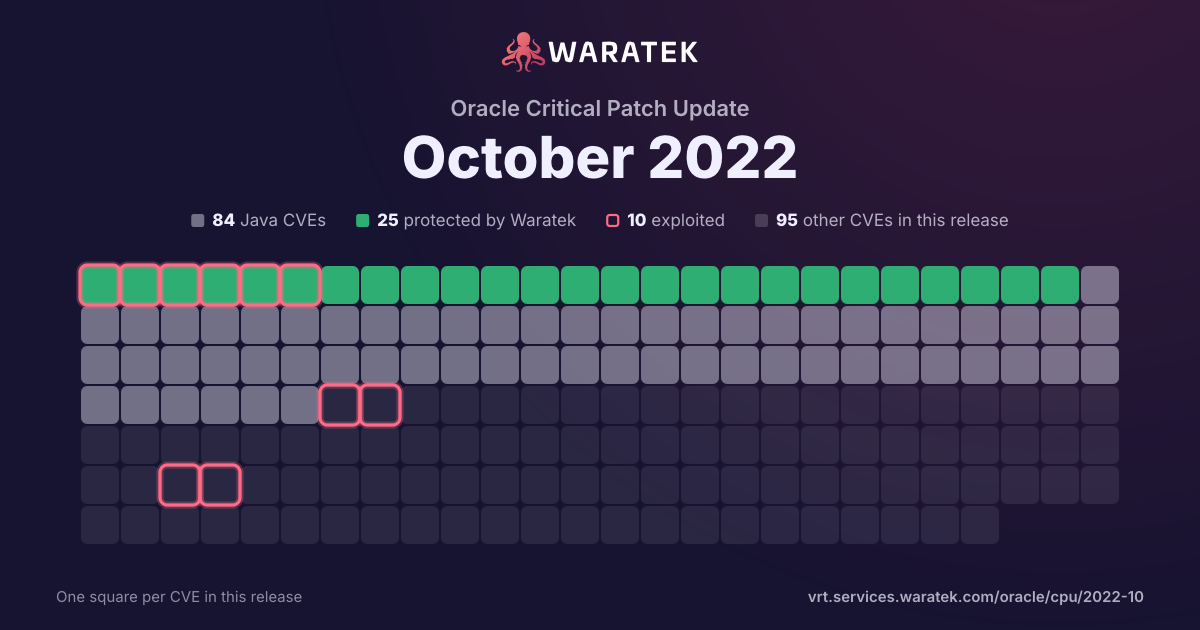
By status
24Protected by Waratek9Mitigation candidate58No exploit published3Outside Waratek scope85Not applicable
10Exploited, marked by the ring
No exploit published. For 33 of them, Oracle's security advisory is the source of public detail.
Protected by Waratek. Waratek RASP can block exploitation of these on systems that have not applied the patch yet.
Overview 8 matches · 0 protected · 1 exploited · 1 CISA KEV · 4 public PoC · 1 EPSS ≥ 0.5
Protected by Waratek
0
0.0%
Rule in development
0
0.0%
Mitigation candidate
4
50.0%
No exploit published
4
50.0%
blocked by ARMR today
0
0.0%
partly blocked
0
0.0%
not blocked
8
100.0%
not established
0
0.0%
unrecorded
0
0.0%
Exploited
1
12.5%
Working exploit published
0
0.0%
Proof of concept only
3
37.5%
Forecast only
0
0.0%
No public exploit
4
50.0%
split by
peak 2 / quarter
Q1 211
No exploit published1
Critical1
not blocked1
No public exploit1
Q2 210
Q3 210
Q4 212
No exploit published2
Critical2
not blocked2
No public exploit2
Q1 220
Q2 222
Mitigation candidate2
Critical2
not blocked2
Proof of concept only2
Q3 221
Mitigation candidate1
Critical1
not blocked1
Proof of concept only1
Q4 222
Mitigation candidate1
No exploit published1
Critical2
not blocked2
Exploited1
No public exploit1
Q1 21Q2 21Q3 21Q4 21Q1 22Q2 22Q3 22Q4 22
| CVE | Severity | Published▾ | Status | Exploitation | Description |
|---|---|---|---|---|---|
| CVE-2022-39428 | Critical | 2022-10-18 | No exploit published | No public exploit | Vulnerability in the Oracle Web Applications Desktop Integrator product of Oracle E-Business Suite (component: Upload). Supported versions that are affected are 12.2.3-12.2.11. Easily exploitable vulnerability allows unauthenticated attacker with network access via HTTP to compromise Oracle Web Applications Desktop Integrator. Successful attacks of this vulnerability can result in takeover of Oracle Web Applications Desktop Integrator. CVSS 3.1 Base Score 9.8 (Confidentiality, Integrity and Availability impacts). CVSS Vector: (CVSS:3.1/AV:N/AC:L/PR:N/UI:N/S:U/C:H/I:H/A:H). |
| CVE-2022-21587 | Critical | 2022-10-18 | Mitigation candidate | Exploited | Vulnerability in the Oracle Web Applications Desktop Integrator product of Oracle E-Business Suite (component: Upload). Supported versions that are affected are 12.2.3-12.2.11. Easily exploitable vulnerability allows unauthenticated attacker with network access via HTTP to compromise Oracle Web Applications Desktop Integrator. Successful attacks of this vulnerability can result in takeover of Oracle Web Applications Desktop Integrator. CVSS 3.1 Base Score 9.8 (Confidentiality, Integrity and Availability impacts). CVSS Vector: (CVSS:3.1/AV:N/AC:L/PR:N/UI:N/S:U/C:H/I:H/A:H). |
| CVE-2022-33980 | Critical | 2022-07-06 | Mitigation candidate | Proof of concept only | Apache Commons Configuration performs variable interpolation, allowing properties to be dynamically evaluated and expanded. The standard format for interpolation is "${prefix:name}", where "prefix" is used to locate an instance of org.apache.commons.configuration2.interpol.Lookup that performs the interpolation. Starting with version 2.4 and continuing through 2.7, the set of default Lookup instances included interpolators that could result in arbitrary code execution or contact with remote servers. These lookups are: - "script" - execute expressions using the JVM script execution engine (javax.script) - "dns" - resolve dns records - "url" - load values from urls, including from remote servers Applications using the interpolation defaults in the affected versions may be vulnerable to remote code execution or unintentional contact with remote servers if untrusted configuration values are used. Users are recommended to upgrade to Apache Commons Configuration 2.8.0, which disables the problematic interpolators by default. |
| CVE-2022-32532 | Critical | 2022-06-29 | Mitigation candidate | Proof of concept only | Apache Shiro before 1.9.1, A RegexRequestMatcher can be misconfigured to be bypassed on some servlet containers. Applications using RegExPatternMatcher with `.` in the regular expression are possibly vulnerable to an authorization bypass. |
| CVE-2022-22978 | Critical | 2022-05-19 | Mitigation candidate | Proof of concept only | In spring security versions prior to 5.4.11+, 5.5.7+ , 5.6.4+ and older unsupported versions, RegexRequestMatcher can easily be misconfigured to be bypassed on some servlet containers. Applications using RegexRequestMatcher with `.` in the regular expression are possibly vulnerable to an authorization bypass. |
| CVE-2021-23450 | Critical | 2021-12-17 | No exploit published | No public exploit | All versions of package dojo are vulnerable to Prototype Pollution via the setObject function. |
| CVE-2021-43527 | Critical | 2021-12-08 | No exploit published | No public exploit | NSS (Network Security Services) versions prior to 3.73 or 3.68.1 ESR are vulnerable to a heap overflow when handling DER-encoded DSA or RSA-PSS signatures. Applications using NSS for handling signatures encoded within CMS, S/MIME, PKCS \#7, or PKCS \#12 are likely to be impacted. Applications using NSS for certificate validation or other TLS, X.509, OCSP or CRL functionality may be impacted, depending on how they configure NSS. *Note: This vulnerability does NOT impact Mozilla Firefox.* However, email clients and PDF viewers that use NSS for signature verification, such as Thunderbird, LibreOffice, Evolution and Evince are believed to be impacted. This vulnerability affects NSS < 3.73 and NSS < 3.68.1. |
| CVE-2021-21783 | Critical | 2021-03-25 | No exploit published | No public exploit | A code execution vulnerability exists in the WS-Addressing plugin functionality of Genivia gSOAP 2.8.107. A specially crafted SOAP request can lead to remote code execution. An attacker can send an HTTP request to trigger this vulnerability. |