
Oracle Critical Patch Update October 2022
Released October 2022 · Oracle's advisory ↗ · ← Critical Patch Update, July 2022 · Critical Patch Update, January 2023 →
179 CVEs in this release, one square each
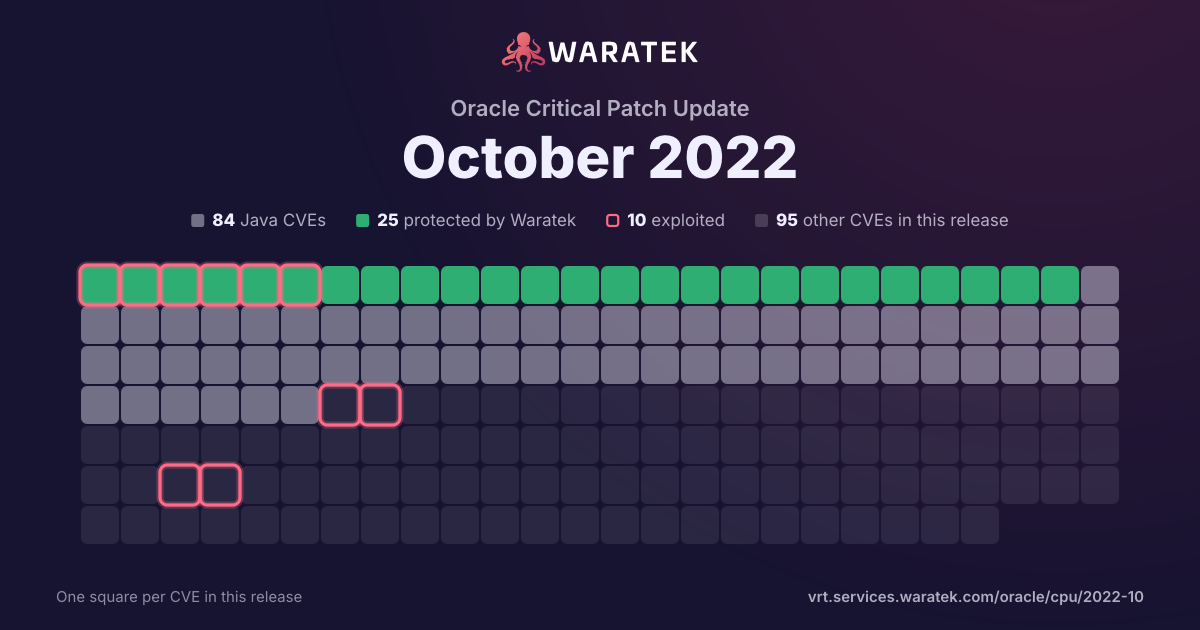
By status
25Protected by Waratek4Mitigation candidate55No exploit published48Outside Waratek scope47Not applicable
10Exploited, marked by the ring
No exploit published. For 33 of them, Oracle's security advisory is the source of public detail.
Protected by Waratek. Waratek RASP can block exploitation of these on systems that have not applied the patch yet.
Overview 5 matches · 1 exploited · 0 CISA KEV · 1 public PoC · 1 EPSS ≥ 0.5
Protected by Waratek
5
100.0%
Rule in development
0
0.0%
Mitigation candidate
0
0.0%
No exploit published
0
0.0%
blocked by ARMR today
5
100.0%
partly blocked
0
0.0%
not blocked
0
0.0%
not established
0
0.0%
unrecorded
0
0.0%
Exploited
1
20.0%
Working exploit published
0
0.0%
Proof of concept only
0
0.0%
Forecast only
0
0.0%
No public exploit
4
80.0%
split by
peak 1 / quarter
Q3 191
Protected by Waratek1
High1
blocked by ARMR today1
No public exploit1
Q4 190
Q1 200
Q2 200
Q3 200
Q4 200
Q1 210
Q2 210
Q3 210
Q4 211
Protected by Waratek1
High1
blocked by ARMR today1
Exploited1
Q1 221
Protected by Waratek1
High1
blocked by ARMR today1
No public exploit1
Q2 221
Protected by Waratek1
High1
blocked by ARMR today1
No public exploit1
Q3 221
Protected by Waratek1
High1
blocked by ARMR today1
No public exploit1
Q3 19Q1 20Q3 20Q1 21Q3 21Q1 22Q3 22
| CVE | Severity | Published▾ | Status | Exploitation | Description |
|---|---|---|---|---|---|
| CVE-2022-25857 | High | 2022-08-30 | Protected by Waratek | No public exploit | The package org.yaml:snakeyaml from 0 and before 1.31 are vulnerable to Denial of Service (DoS) due missing to nested depth limitation for collections. |
| CVE-2022-25647 | High | 2022-05-01 | Protected by Waratek | No public exploit | The package com.google.code.gson:gson before 2.8.9 are vulnerable to Deserialization of Untrusted Data via the writeReplace() method in internal classes, which may lead to DoS attacks. |
| CVE-2022-23181 | High | 2022-01-27 | Protected by Waratek | No public exploit | The fix for bug CVE-2020-9484 introduced a time of check, time of use vulnerability into Apache Tomcat 10.1.0-M1 to 10.1.0-M8, 10.0.0-M5 to 10.0.14, 9.0.35 to 9.0.56 and 8.5.55 to 8.5.73 that allowed a local attacker to perform actions with the privileges of the user that the Tomcat process is using. This issue is only exploitable when Tomcat is configured to persist sessions using the FileStore. |
| CVE-2021-4104 | High | 2021-12-14 | Protected by Waratek | Exploited | JMSAppender in Log4j 1.2 is vulnerable to deserialization of untrusted data when the attacker has write access to the Log4j configuration. The attacker can provide TopicBindingName and TopicConnectionFactoryBindingName configurations causing JMSAppender to perform JNDI requests that result in remote code execution in a similar fashion to CVE-2021-44228. Note this issue only affects Log4j 1.2 when specifically configured to use JMSAppender, which is not the default. Apache Log4j 1.2 reached end of life in August 2015. Users should upgrade to Log4j 2 as it addresses numerous other issues from the previous versions. |
| CVE-2019-10086 | High | 2019-08-20 | Protected by Waratek | No public exploit | In Apache Commons Beanutils 1.9.2, a special BeanIntrospector class was added which allows suppressing the ability for an attacker to access the classloader via the class property available on all Java objects. We, however were not using this by default characteristic of the PropertyUtilsBean. |